AI-driven personalization connects to the portal's underlying content services layer—typically the ECM platform's core APIs for metadata, search, and user management. The integration targets three key surfaces: 1) the search and discovery interface, where AI re-ranks and suggests content; 2) the dashboard or homepage widget, where it surfaces 'for you' feeds and task alerts; and 3) in-context recommendation modules within specific document libraries or project sites. This requires real-time access to user profiles (role, department), activity logs (searches, views, downloads), and the rich metadata attached to documents, folders, and sites within the ECM repository.

Integration
AI Integration for AI-Driven Content Personalization for Portals
Use AI to tailor the content displayed in ECM-powered intranet and extranet portals based on user role, projects, and past interactions. A practical guide for technical architects.
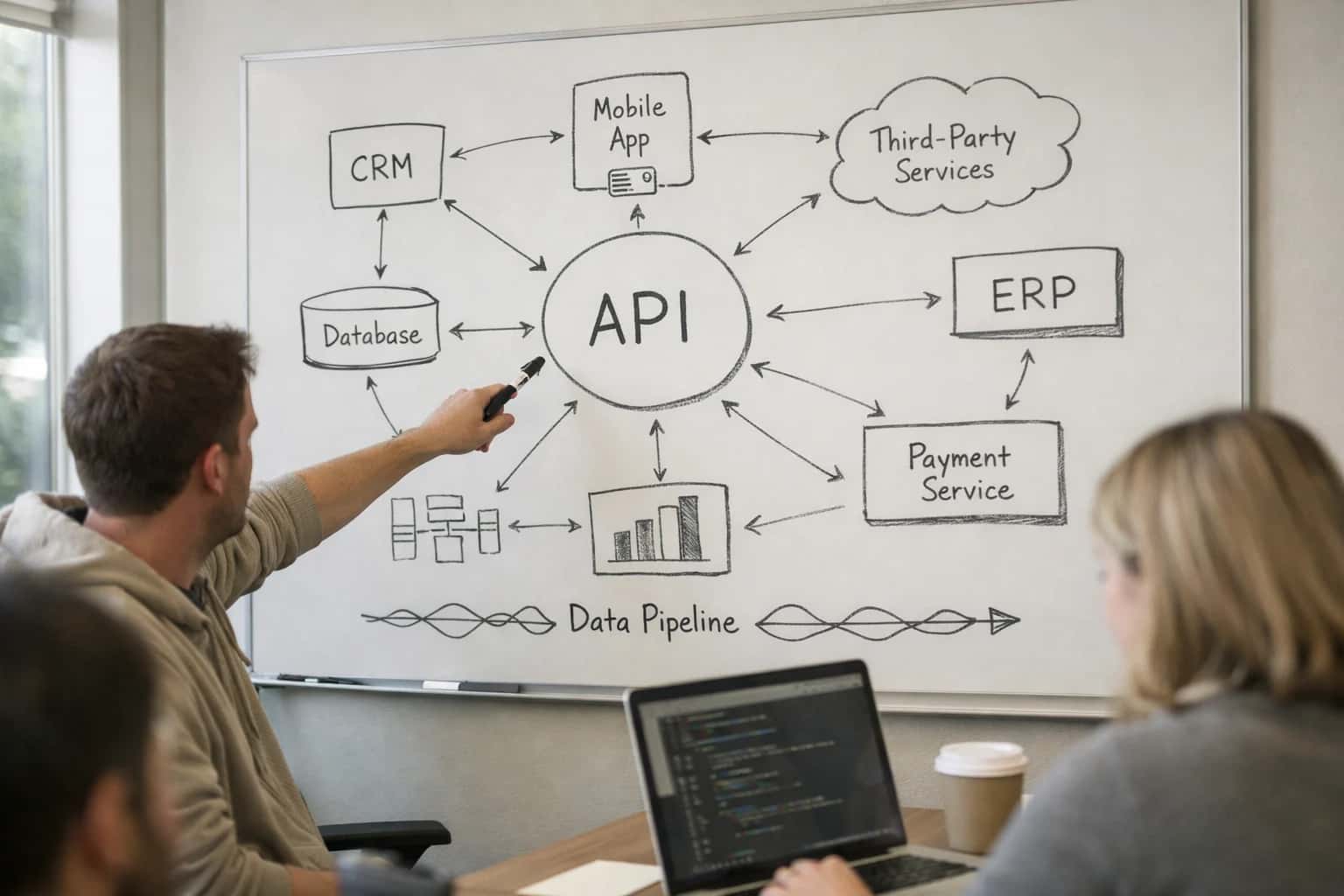
ARCHITECTURE FOR PERSONALIZED EXPERIENCES
Where AI Fits in ECM-Powered Portals
Integrate AI to dynamically tailor portal content based on user role, project context, and past interactions, transforming static repositories into intelligent, adaptive interfaces.
Implementation hinges on a lightweight middleware agent that sits between the portal and the ECM platform. This agent listens for user session events, queries the ECM's REST API or GraphQL endpoints for relevant content, and calls an LLM (like GPT-4 or a fine-tuned open model) with a structured prompt containing the user's context and available content metadata. The LLM's role is to score, filter, and reason about relevance, returning a prioritized list of document IDs, links, or summary snippets. For example, a project manager logging into an intranet portal might instantly see the latest change orders, risk assessments, and meeting minutes from their active projects, while a new hire sees onboarding guides and team directories. This logic is executed server-side via secure API calls, with results cached to maintain portal performance.
Rollout should be phased, starting with non-critical, high-traffic portals like the corporate intranet homepage. Governance is critical: establish clear audit trails for all AI-generated recommendations to explain 'why this content was shown.' Implement a human-in-the-loop review panel where portal administrators can veto or adjust AI-driven feeds, and use this feedback to fine-tune the prompting logic. A/B testing different recommendation strategies (e.g., recency vs. project relevance) is essential to measure impact on user engagement and self-service efficiency. This approach ensures the portal evolves from a passive content silo into an active, context-aware work hub, directly reducing time spent searching and increasing the relevance of organizational knowledge.
AI-DRIVEN CONTENT PERSONALIZATION FOR PORTALS
Integration Surfaces Across Major ECM Platforms
User Context & Profile
The most critical integration surface for personalization is the user context layer. AI models need real-time access to user metadata, activity logs, and entitlements to tailor portal content.
Key Integration Points:
- User Profile APIs: Pull user attributes (role, department, location, project assignments) from the ECM platform's directory service or connected HR system.
- Activity Feeds & Audit Logs: Ingest user interaction data—documents viewed, searches performed, tasks completed—to build a dynamic interest profile.
- Entitlement & Security Trimming: Respect the ECM's native permissions model. AI recommendations must only surface content the user is authorized to see, often requiring queries filtered by security descriptors or metadata.
Implementation Pattern: A lightweight service queries these APIs, constructs a rich user context object, and passes it to the personalization engine alongside content candidates.
ENTERPRISE CONTENT MANAGEMENT PLATFORMS
High-Value Use Cases for Portal Personalization
Use AI to tailor intranet, extranet, and knowledge portal experiences by analyzing user roles, project contexts, and past interactions with documents stored in platforms like OpenText, SharePoint, Laserfiche, and Hyland.
01
Role-Based Dashboard Assembly
Dynamically assemble portal homepages and dashboards by analyzing a user's role (from Active Directory/HRIS) and their recent document activity in the ECM. An AI agent queries the repository to surface relevant project files, pending approvals, and flagged updates instead of showing a generic feed.
Generic → Contextual
Dashboard relevance
02
Project-Centric Knowledge Surfacing
When a user accesses a project workspace, an AI integration analyzes all linked documents (plans, specs, meeting notes, change orders) and generates a project summary, highlights recent changes, and suggests related procedures or templates. This turns a document folder into an intelligent project hub.
Minutes → Seconds
Time to find key info
03
Personalized Search & Discovery
Replace basic keyword search with a RAG-powered assistant grounded in the ECM's secure content. The system understands natural language queries like "show me the updated safety protocol for site X" and returns precise answers with citations, prioritizing documents the user frequently interacts with.
10+ results → Precise answer
Search outcome
04
Automated Onboarding Content Bundles
For new hires or role changes, AI scans the ECM to curate a personalized bundle of essential documents—policies, team reports, training materials, and org charts—based on department, location, and job title. This bundle is presented via the portal, accelerating time-to-competence.
1 sprint
Setup time saved
05
Proactive Policy & Compliance Alerts
Integrate AI with the portal's notification engine. When a policy document relevant to a user's department is updated in the ECM, the system generates a plain-language summary of changes and pushes an alert to their portal feed, linking to the full document and any required attestations.
Broadcast → Targeted
Alert precision
06
Intelligent Content Recommendations
Embed 'Related Resources' widgets in portal article and document views. Using collaborative filtering and semantic analysis, the AI suggests related SOPs, past similar cases, or expert-authored content the user hasn't seen but is likely to need, increasing knowledge reuse and discovery.
Static links → Dynamic suggestions
Recommendation engine
IMPLEMENTATION PATTERNS
Example Personalization Workflows
These workflows demonstrate how AI integrates with ECM portal data models and APIs to deliver role-aware, context-sensitive content. Each pattern can be implemented using secure API calls, event-driven triggers, and governed LLM interactions.
Trigger: User logs into the ECM-powered intranet portal.
Context Pulled: The system queries the user's profile (from Active Directory or HRIS), recent document interactions (from ECM audit logs), and active projects (from a connected PPM system like Asana).
AI Action: An agent uses this context to call a language model with a prompt like: "Based on the user's role as a 'Senior Engineer' on 'Project Phoenix', who last reviewed 'Q4 Technical Specifications.pdf', generate a prioritized list of 5 content recommendations. Include company announcements, project documentation, and training materials."
System Update: The agent fetches the actual document links and metadata from the ECM repository (e.g., SharePoint list, Laserfiche folder) and dynamically assembles a personalized homepage widget.
Human Review Point: The logic for generating recommendations is audited. An admin dashboard flags if recommendations become stale or irrelevant, triggering a prompt tuning review.
FROM STATIC PORTALS TO PERSONALIZED EXPERIENCES
Implementation Architecture & Data Flow
A practical blueprint for integrating AI-driven personalization into ECM-powered portals, focusing on secure data flow, real-time decisioning, and scalable rollout.
The integration architecture connects three core systems: your ECM repository (OpenText Content Server, SharePoint libraries, Box folders), a real-time user context service (often from HRIS, project management, or CRM), and the AI orchestration layer. A typical flow begins when a user authenticates to the portal. The system queries the context service for the user's role, active projects, and recent document interactions. This profile, along with metadata about available portal content (titles, tags, authors, access patterns), is sent via a secure API call to the AI service, which uses a retrieval-augmented generation (RAG) model over your approved content corpus to rank and select the most relevant documents, news items, or tasks for display.
Implementation centers on two key pipelines: a batch processing pipeline that nightly generates vector embeddings for new and updated portal content, storing them in a dedicated vector database like Pinecone or Weaviate for fast similarity search, and a real-time inference pipeline that executes on each portal page load. This inference call combines the user's context vector with the content vectors to produce a personalized ranking. The results are cached per user session to balance performance with freshness. Critical governance controls are baked in: all content is security-trimmed by the ECM's native permissions before being sent to the AI, and a human-in-the-loop review dashboard allows portal admins to audit personalization decisions and adjust model weights.
Rollout is best done in phases. Start with a 'Recommended For You' widget on a high-traffic intranet homepage, using a limited set of content types. Measure engagement lift and gather feedback. Phase two expands to personalize entire project site dashboards or extranet client portals, dynamically surfacing relevant contracts, reports, and deliverables. The final phase integrates personalization into search results and automated alerting, creating a fully adaptive information environment. This phased approach de-risks the implementation and allows the AI models to be tuned based on real user interaction data, ensuring the personalization drives genuine productivity gains instead of being perceived as noise.
IMPLEMENTATION PATTERNS
Code & Payload Examples
Enriching Portal User Context
Personalization starts with a rich user profile. ECM portals typically store basic user metadata (role, department) but lack dynamic context. This pattern uses AI to analyze a user's document interaction history—accessed, edited, searched, or tagged files—to infer their active projects, interests, and expertise.
A background service queries the ECM audit logs or activity API, sends a summary to an LLM for analysis, and writes the enriched attributes (e.g., inferred_projects: ["Q4 Budget", "Acme Corp Merger"], topics_of_interest: ["Contract Law", "Data Privacy"]) back to the user's profile object or a separate metadata store. The portal's rendering engine then uses these attributes for real-time content filtering.
python# Pseudocode: Enrich user profile from document activity def enrich_user_profile(user_id, ecm_client): # Fetch recent user activity from ECM activities = ecm_client.get_user_activities(user_id, limit=100) # Prepare context for LLM activity_summary = "\n".join([f"- {act['action']} on '{act['document_title']}'" for act in activities]) prompt = f"""Analyze this user's document activity and infer: 1. Active projects or initiatives 2. Professional topics of interest 3. Primary role focus Activity Log: {activity_summary} """ # Call LLM (e.g., via Azure OpenAI) llm_response = openai_client.chat.completions.create( model="gpt-4o-mini", messages=[{"role": "user", "content": prompt}] ) # Parse and store structured attributes attributes = parse_llm_response(llm_response.choices[0].message.content) ecm_client.update_user_metadata(user_id, attributes)
AI-DRIVEN CONTENT PERSONALIZATION FOR ECM PORTALS
Realistic Time Savings & Business Impact
How AI integration transforms static intranet and extranet portals into dynamic, personalized experiences, measured by operational efficiency and user engagement.
| Metric | Before AI | After AI | Notes |
|---|---|---|---|
Content discovery for a user | Manual search across multiple sites/libraries | AI-curated feed on portal homepage | Reduces time-to-information from minutes to seconds |
Personalized news/update delivery | Broadcast emails or generic announcements | Role and project-specific digests | Increases relevance, reduces notification fatigue |
New employee onboarding content | Static checklist or overwhelming resource hub | Sequential, role-based learning path | Cuts ramp-up time by surfacing 'what you need now' |
Policy & procedure compliance | Manual navigation to find latest versions | AI surfaces relevant policies based on user's tasks | Ensures compliance by reducing reliance on user memory |
Project team collaboration | Team members manually share documents via email/chat | Portal automatically suggests related project docs & experts | Accelerates project velocity by connecting dots |
Maintaining portal content relevance | Quarterly manual audits by site owners | AI identifies stale, unused, or high-demand content | Shifts maintenance from reactive to proactive, continuous |
Generating executive/board reports | Manual compilation from multiple document sources | AI auto-assembles relevant data into draft briefing books | Reduces prep time from days to hours |
ARCHITECTING FOR CONTROL AND ADOPTION
Governance, Security, and Phased Rollout
A secure, governed rollout is critical for AI-driven personalization in enterprise portals, where content sensitivity and user trust are paramount.
Personalization logic must operate within the existing security and permission model of your ECM platform (e.g., OpenText Content Server permissions, SharePoint Online sensitivity labels, Box folder-level access). Our integrations enforce this by using the authenticated user's context for all AI operations—the system only retrieves and suggests content the user already has permission to view. All AI-generated recommendations are logged, creating an audit trail that links suggested content, the user, the underlying AI reasoning, and the source documents used for context retrieval via RAG.
A phased rollout mitigates risk and measures impact. We recommend starting with a pilot cohort (e.g., a single department portal) and a single use case, such as personalizing the 'Recent Documents' widget or the 'Recommended Resources' section on a homepage. This allows you to:
- Validate recommendation accuracy and relevance with real users.
- Fine-tune the RAG retrieval parameters and prompt templates for your specific content corpus.
- Establish baseline metrics for engagement (click-through rates, time saved) before scaling.
- Implement a human-in-the-loop review panel where a subset of AI-generated personalizations are reviewed by content owners before being visible, ensuring quality control.
Governance is maintained through a centralized prompt management and evaluation layer. This allows administrators to version-control the AI instructions that generate recommendations, test new prompts against a historical dataset, and monitor for drift in suggestion quality. For regulated industries, a content filter can be applied post-generation to redact or block recommendations based on sensitive metadata or classification tags before they reach the portal UI. Rollout expands by adding new portal sections, user groups, and content types, continuously using the audit logs and user feedback to refine the system.
Enabling Efficiency, Speed & Accuracy
Intelligent Analysis, Decision & Execution
We build AI systems for teams that need search across company data, workflow automation across tools, or AI features inside products and internal software.
Talk to Us
Search across company data
Give teams answers from docs, tickets, runbooks, and product data with sources and permissions.
Useful when people spend too long searching or get different answers from different systems.
Enterprise searchRAGPermissions
Read more
Automate internal workflows
Use AI to route work, draft outputs, trigger actions, and keep approvals and logs in place.
Useful when repetitive work moves across multiple tools and teams.
AI agentsWorkflow automationGovernance
Read more
Add AI to products and internal tools
Build assistants, guided actions, or decision support into the software your team or customers already use.
Useful when AI needs to be part of the product, not a separate tool.
AI integrationDecision supportModel routing
Read moreIMPLEMENTATION WORKFLOWS
Frequently Asked Questions
Explore common integration patterns for personalizing portal content using AI and your existing ECM platform.
This workflow dynamically assembles a personalized dashboard upon user login.
- Trigger: User authenticates into the ECM-powered portal (e.g., SharePoint intranet, OpenText Experience Suite portal).
- Context Pulled: The system queries the ECM and connected HR/Project systems for the user's:
- Role, department, and team membership.
- Active projects from a PPM system like Asana or Jira.
- Recent document interactions (views, edits, downloads) from the ECM audit trail.
- AI Agent Action: An AI agent uses this context to:
- Query a RAG index (e.g., using Pinecone or Weaviate) of portal content (policies, project docs, news articles) with a prompt like: "Find the 5 most relevant documents for a {role} working on {project_name}, prioritizing recent updates and content similar to what they recently viewed."
- Generate a brief, personalized summary of key updates from the user's project spaces.
- System Update: The portal's frontend receives the AI-generated list of recommended documents and the summary, rendering them in a "For You" widget on the user's homepage.
- Human Review Point: An admin dashboard tracks recommendation click-through rates. Low-performing suggestions can be reviewed to adjust the RAG ranking or prompt logic.

About the author
Prasad Kumkar
CEO & MD, Inference Systems
Prasad Kumkar is the CEO & MD of Inference Systems and writes about AI systems architecture, LLM infrastructure, model serving, evaluation, and production deployment. Over 5+ years, he has worked across computer vision models, L5 autonomous vehicle systems, and LLM research, with a focus on taking complex AI ideas into real-world engineering systems.
His work and writing cover AI systems, large language models, AI agents, multimodal systems, autonomous systems, inference optimization, RAG, evaluation, and production AI engineering.
LinkedIn
Limited slotsGet a Free AI Consultation
Partnered with leading AI, data, and software stack.





How We Work
Custom AI workflows for your Business
One-fit-all AI don't work for modern businesses. At Inferensys, we aim to understand your business & custom requirements; which we use to define most efficient agentic workflows, the data, and the tools for your business.
01
Review the use case
We understand the task, the users, and where AI can actually help.
Read more02
Pick the right approach
We define what needs search, automation, or product integration.
Read more03
Build the first useful version
We implement the part that proves the value first.
Read more04
Improve from there
We add the checks and visibility needed to keep it useful.
Read moreThe first call is a practical review of your use case and the right next step.
Talk to Us