AI connects at three key stages within platforms like OpenText Content Suite, Hyland OnBase, or SharePoint: 1) Drafting & Assembly, where an LLM generates initial drafts by pulling from approved clause libraries, previous versions, and regulatory text databases; 2) Review & Compliance, where an AI agent compares the draft against a vector store of current regulations (e.g., CCPA, SOX excerpts) and internal governance policies to flag inconsistencies; and 3) Update & Versioning, where AI monitors regulatory feeds and internal change requests to suggest necessary revisions to live documents, triggering a new draft workflow.

Integration
AI Integration for AI-Assisted Policy Document Creation and Update
Integrate AI with enterprise content management platforms to automate the drafting, review, and update of policy documents, ensuring consistency with regulations and previous versions.
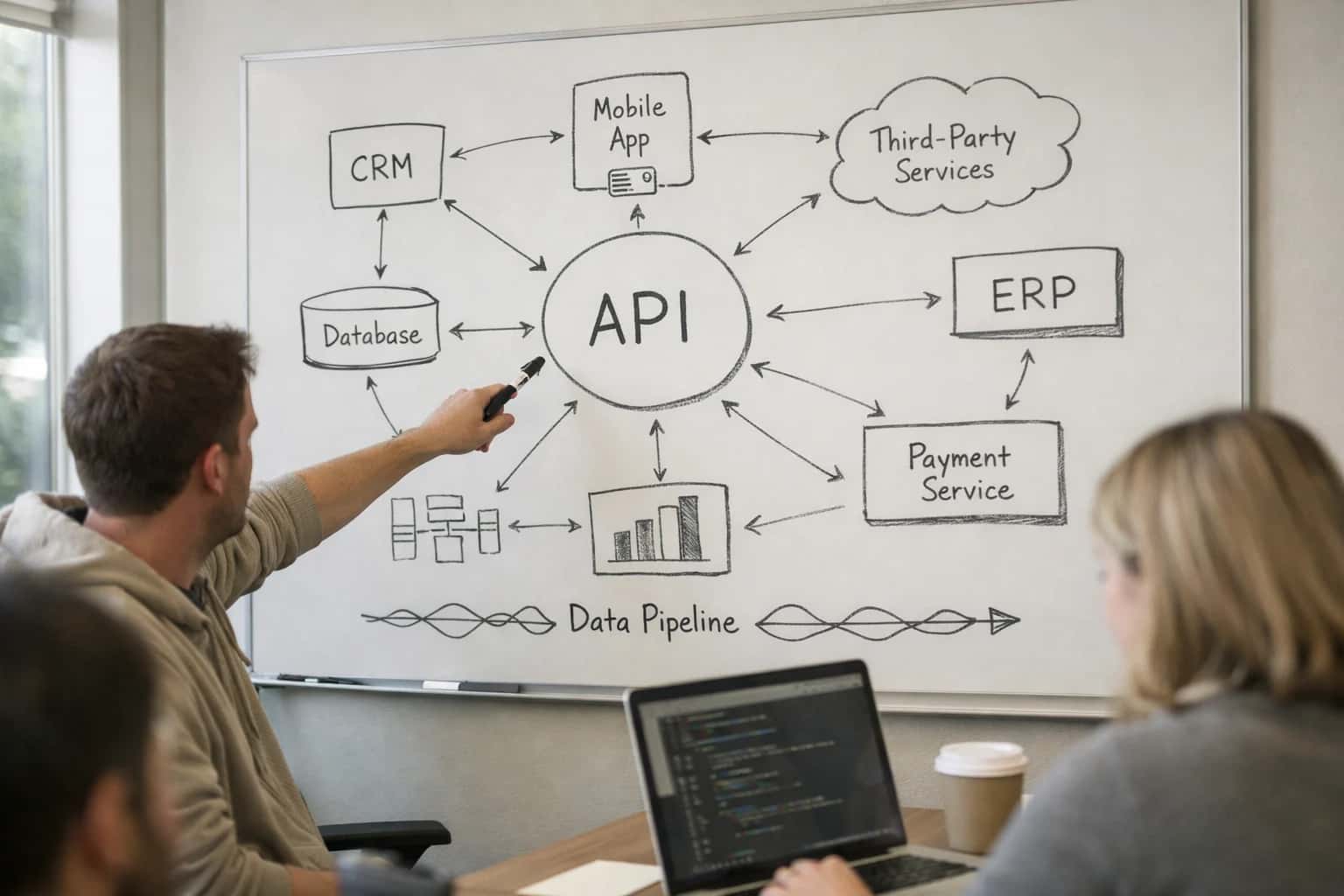
ARCHITECTURE AND IMPLEMENTATION
Where AI Fits in the Policy Document Lifecycle
Integrating AI into the policy document lifecycle automates drafting, ensures regulatory alignment, and manages version control within your ECM platform.
Implementation typically uses the ECM's REST API and event-driven webhooks. For example, creating a new policy in a SharePoint list can trigger an Azure Logic App that calls an LLM with the policy type and scope as prompts, returning a structured draft. The AI uses RAG over a connected vector database of past policies and regulatory PDFs stored in Box or Laserfiche to ground its output. The draft is then saved as a new file version, with extracted key obligations auto-populating metadata fields for tracking. This reduces the cycle from weeks of manual research and stakeholder drafting to a reviewed first draft in hours.
Rollout requires a phased approach: start with low-risk, internal policy types (e.g., IT usage) to refine prompts and approval workflows. Governance is critical: all AI-suggested text should be clearly marked, require human-in-the-loop approval via the ECM's native workflow engine (like Laserfiche Workflow), and maintain a full audit trail linking the AI model version, source documents retrieved, and approver comments. This ensures control and compliance while delivering consistent, up-to-date policies.
IMPLEMENTATION BLUEPRINT
ECM Platform Touchpoints for Policy AI
AI at the Point of Entry
Integrate AI directly into the document ingestion pipeline of your ECM platform (e.g., OpenText Capture Center, Hyland Brainware, Laserfiche Quick Fields). This is the first and most critical touchpoint for policy lifecycle management.
Key Integration Surfaces:
- Scanning/Email Ingestion Workflows: Attach AI models to classify incoming policy drafts, regulatory updates, or amendment requests as they enter the system.
- Metadata Pre-population: Use AI to read document headers and initial content to auto-fill critical metadata fields like
Policy Type,Effective Date,Regulatory Jurisdiction, andOwning Department. - Version Detection: Compare ingested documents against the existing policy library to flag if it's a new policy, a minor update, or a major revision, routing it to the appropriate review queue.
This layer ensures policy documents are correctly tagged and routed from the moment they enter the ECM, setting the stage for automated compliance checks and collaborative review.
ENTERPRISE CONTENT MANAGEMENT
High-Value Use Cases for Policy AI
Integrate AI directly into your ECM platform to transform the manual, error-prone process of policy creation and maintenance into a streamlined, consistent, and compliant workflow.
01
Automated First Draft Generation
Use AI to generate initial policy drafts based on regulatory source texts, previous versions, and a structured prompt library. The AI synthesizes requirements into a consistent format, drafting sections like scope, definitions, and procedures in hours instead of days.
Days -> Hours
Drafting time
02
Regulatory Change Impact Analysis
Connect AI to monitor regulatory updates. When a new rule is published, the system automatically cross-references your existing policy library, highlights affected sections, and suggests specific edits to maintain compliance, flagging high-risk gaps for legal review.
Proactive
Compliance posture
03
Consistency & Version Control Auditing
Deploy AI to scan new policy drafts against the entire repository. It identifies conflicting clauses, undefined terms, and deviations from standard phrasing across related documents (e.g., HR handbook vs. IT security policy), ensuring a single source of truth.
100s of docs
Cross-checked
04
Stakeholder Review & Redline Synthesis
During the review cycle, AI aggregates comments and suggested edits from multiple stakeholders (Legal, Compliance, Operations) in tools like Microsoft Word or Box Notes. It synthesizes conflicting feedback, proposes a consolidated redline, and generates a summary of changes for final approver sign-off.
1 sprint
Review cycle
05
Automated Metadata & Lifecycle Tagging
Upon policy approval, AI automatically applies governance metadata in the ECM system: assigns retention schedules based on document type, links to related regulations, sets review dates, and triggers workflow reminders for the next mandatory revision, ensuring no policy lapses.
Zero-touch
Classification
06
Employee Q&A & Policy Knowledge Agent
Deploy a secure RAG-powered agent over the approved policy library. Employees can ask natural language questions (e.g., "What's the remote work equipment policy?") and get accurate, sourced answers with direct citations to the latest policy document, reducing support tickets and misinterpretation.
Self-service
Employee support
IMPLEMENTATION PATTERNS
Example Policy AI Workflows
These workflows illustrate how AI agents can be integrated into your ECM platform to automate and assist with the creation, review, and management of policy documents. Each pattern connects to specific ECM APIs, data models, and user surfaces.
Trigger: A new regulatory document (e.g., FINRA notice, FDA guidance) is uploaded to a designated 'Source Regulations' library in the ECM.
Context/Data Pulled: The AI agent is triggered via a webhook. It retrieves the new regulatory text and uses the ECM API to search for related existing policies based on metadata (department, topic) and semantic similarity.
Model/Agent Action: An LLM compares the new regulation against the existing policy corpus. It generates a change-impact analysis and a first draft of policy updates, highlighting new requirements, modified language, and potential conflicts.
System Update/Next Step: The draft update, along with the analysis, is saved as a new version in the linked policy document's record. A workflow task is automatically created and assigned to the policy owner in the ECM's task management module.
Human Review Point: The policy owner reviews the AI-generated draft in the ECM interface, accepts/rejects changes, and initiates the formal review cycle.
A GOVERNED APPROACH FOR POLICY DOCUMENTS
Implementation Architecture: Data Flow and Guardrails
A secure, multi-stage architecture for drafting and updating policy documents within your ECM, ensuring consistency, compliance, and human oversight.
The integration is built on a secure, event-driven pipeline that connects your ECM's API layer to a governed AI orchestration service. A typical flow begins when a new policy draft is initiated or an existing document is flagged for review in platforms like OpenText Content Suite, Hyland OnBase, or SharePoint. A webhook or scheduled job triggers the process, sending the document text, relevant metadata (policy ID, version, author), and linked regulatory source documents to a secure processing queue. The system first enriches the context by retrieving the previous policy version, related procedures from the ECM, and the latest regulatory texts from a connected compliance database using RAG over a vector store.
The core drafting or redlining engine is an orchestrated series of LLM calls with strict prompts and output schemas. For a new draft, the AI synthesizes the regulatory requirements and past precedent into a structured first pass. For an update, it performs a diff-and-summarize operation, highlighting material changes and suggesting new language for impacted sections. All outputs are temporarily stored in a secure sandbox with a complete audit trail of the source context and model decisions. The revised document is then routed through the ECM's native workflow engine (e.g., Laserfiche Workflow or Power Automate for SharePoint) to a designated reviewer's queue, with the AI's change rationale and confidence scores attached as hidden metadata for transparency.
Critical guardrails are enforced at multiple layers: Role-Based Access Control (RBAC) ensures only authorized users can trigger AI drafts for sensitive policy areas. A human-in-the-loop approval is mandatory before any AI-suggested change is committed to the official record. All AI-generated content is watermarked within the document metadata. Finally, a post-implementation check can be configured to scan the updated policy in the ECM against the source regulations to verify continued alignment, closing the governance loop.
IMPLEMENTATION PATTERNS
Code and Payload Examples
Triggering AI-Assisted Drafting
When a new policy document request is created in your ECM (e.g., a SharePoint list item or a Laserfiche workflow entry), a serverless function calls an LLM API to generate a first draft. The call includes the policy type, regulatory source documents (retrieved via RAG), and previous version text for consistency analysis.
python# Example: Python function to call an LLM for policy drafting import openai import requests from typing import Dict def draft_policy_document(context: Dict) -> str: """ Generates a policy draft using an LLM. context includes: policy_type, regulatory_refs, previous_version, style_guide. """ # Retrieve grounding documents from vector store (RAG) grounding_docs = retrieve_relevant_sections( query=context['policy_type'], source_ids=context['regulatory_refs'] ) # Construct the system prompt for consistent policy authoring system_prompt = f"""You are a policy authoring assistant. Draft a new policy document. Style Guide: {context['style_guide']} Reference these source regulations: {grounding_docs} Ensure consistency with this previous version: {context['previous_version']} """ # Call the LLM response = openai.chat.completions.create( model="gpt-4-turbo", messages=[ {"role": "system", "content": system_prompt}, {"role": "user", "content": f"Draft a policy for: {context['policy_type']}"} ], temperature=0.2 ) return response.choices[0].message.content
This function returns a structured markdown draft, ready for review in the ECM workflow.
AI-ASSISTED POLICY DOCUMENTATION
Realistic Time Savings and Operational Impact
How AI integration for policy creation and updates accelerates cycles, reduces risk, and improves governance within Enterprise Content Management platforms.
| Workflow Stage | Before AI | After AI | Key Impact |
|---|---|---|---|
Initial Draft Creation | Manual drafting from scratch or copying old versions | AI generates first draft from regulatory sources & previous policies | Reduces drafting time from 4-6 hours to 30-60 minutes |
Regulatory Alignment Check | Manual review against latest regulations | AI cross-references draft with provided regulatory texts, highlighting gaps | Identifies potential compliance issues before legal review |
Version Comparison & Change Analysis | Manual side-by-side comparison of document versions | AI auto-summarizes changes, highlights substantive edits, and flags deletions | Cuts review prep time from 2 hours to 15 minutes |
Stakeholder Review & Comment Consolidation | Manually collating feedback from multiple sources (email, tracked changes) | AI aggregates all comments, groups by theme, and suggests resolution language | Reduces consolidation effort from a full day to 1-2 hours |
Consistency & Terminology Enforcement | Manual proofreading for brand voice and defined terms | AI checks against style guide and glossary, suggesting consistent replacements | Ensures uniformity and reduces post-publication corrections |
Metadata Tagging & Filing | Manual application of retention, department, and topic tags | AI analyzes content to auto-suggest accurate metadata for ECM filing | Ensures proper governance and searchability from moment of publish |
Final Approval Routing | Static workflow based on document type | Dynamic routing based on AI-identified content risk and impacted departments | Routes to correct approvers faster, reducing cycle time by 1-2 days |
ARCHITECTING CONTROLLED AI FOR POLICY MANAGEMENT
Governance, Security, and Phased Rollout
Implementing AI-assisted policy creation requires a secure, governed architecture that integrates with your ECM platform's existing compliance and review workflows.
A production integration connects to your ECM's APIs (e.g., OpenText Content Server REST API, SharePoint Graph API) to read source documents—previous policies, regulatory texts, style guides—and write draft outputs into a designated, access-controlled Draft Policies library or workspace. The AI service should operate as a headless backend, triggered via a secure webhook from an ECM workflow or a scheduled job. All prompts, source document references, and generated text are logged to an immutable audit trail linked to the policy record, satisfying records management and e-discovery requirements. Access is enforced via the ECM's native RBAC, ensuring only authorized compliance officers or legal teams can initiate generation or view draft outputs.
A phased rollout mitigates risk and builds organizational trust. Phase 1 targets low-risk, internal policy updates (e.g., IT usage guidelines) where AI drafts are used as a starting point for human editors. Phase 2 expands to regulated domains (e.g., HR policies), introducing a mandatory human-in-the-loop review step within the ECM workflow, where the AI's suggested changes are highlighted and must be accepted or rejected. Phase 3 enables AI-assisted net-new policy creation, incorporating a regulatory alignment check that compares the draft against a vector store of ingested regulatory texts (stored in a connected system like /integrations/vector-database-and-rag-platforms/) to flag potential conflicts before legal review.
Governance is managed through a centralized prompt library and version control (tools like those in /integrations/ai-governance-and-llmops-platforms/), ensuring consistency and allowing for updates to drafting guidelines. A key security control is data perimeter management: source documents are fetched from the ECM, processed in a secure, compliant AI environment (e.g., Azure OpenAI with data residency), and the results are immediately written back—no policy data persists in the AI service. Rollback plans are simple: disable the workflow trigger, and editors revert to the previous manual process within the ECM, with all AI-assisted drafts retained as part of the official version history.
Enabling Efficiency, Speed & Accuracy
Intelligent Analysis, Decision & Execution
We build AI systems for teams that need search across company data, workflow automation across tools, or AI features inside products and internal software.
Talk to Us
Search across company data
Give teams answers from docs, tickets, runbooks, and product data with sources and permissions.
Useful when people spend too long searching or get different answers from different systems.
Enterprise searchRAGPermissions
Read more
Automate internal workflows
Use AI to route work, draft outputs, trigger actions, and keep approvals and logs in place.
Useful when repetitive work moves across multiple tools and teams.
AI agentsWorkflow automationGovernance
Read more
Add AI to products and internal tools
Build assistants, guided actions, or decision support into the software your team or customers already use.
Useful when AI needs to be part of the product, not a separate tool.
AI integrationDecision supportModel routing
Read moreIMPLEMENTATION AND WORKFLOW DETAILS
Frequently Asked Questions
Practical questions about integrating AI into policy document workflows within Enterprise Content Management (ECM) platforms like OpenText, Hyland, Laserfiche, SharePoint, and Box.
AI integrates via the ECM platform's APIs and event system. A typical architecture involves:
- Trigger: A new policy draft is initiated in the ECM system (e.g., a new document is created from a template in a 'Policy Drafts' library). A webhook or scheduled job notifies your AI integration layer.
- Context Pull: The integration retrieves the draft document, its metadata (policy type, owner, effective date), and related content. This includes:
- Previous versions of the same policy from the ECM version history.
- Relevant regulatory source documents (e.g., PDFs of ISO standards, GDPR text) stored in a designated 'Regulatory Library'.
- Existing, related policies (e.g., 'Data Privacy Policy' when drafting 'BYOD Policy') using ECM search APIs.
- AI Action: A configured LLM (like GPT-4) receives this context with a structured prompt to:
- Draft new sections based on the template and regulatory texts.
- Highlight inconsistencies with previous versions or related policies.
- Suggest standardized language for compliance clauses.
- System Update: The AI's output is appended as comments or suggestions directly into the draft document's metadata or a linked 'AI Suggestions' file, keeping the master draft under human author control.
- Human Review: The policy author reviews all AI suggestions within the ECM interface, accepting, rejecting, or editing them. All AI interactions are logged in the ECM audit trail.

About the author
Prasad Kumkar
CEO & MD, Inference Systems
Prasad Kumkar is the CEO & MD of Inference Systems and writes about AI systems architecture, LLM infrastructure, model serving, evaluation, and production deployment. Over 5+ years, he has worked across computer vision models, L5 autonomous vehicle systems, and LLM research, with a focus on taking complex AI ideas into real-world engineering systems.
His work and writing cover AI systems, large language models, AI agents, multimodal systems, autonomous systems, inference optimization, RAG, evaluation, and production AI engineering.
LinkedIn
Limited slotsGet a Free AI Consultation
Partnered with leading AI, data, and software stack.





How We Work
Custom AI workflows for your Business
One-fit-all AI don't work for modern businesses. At Inferensys, we aim to understand your business & custom requirements; which we use to define most efficient agentic workflows, the data, and the tools for your business.
01
Review the use case
We understand the task, the users, and where AI can actually help.
Read more02
Pick the right approach
We define what needs search, automation, or product integration.
Read more03
Build the first useful version
We implement the part that proves the value first.
Read more04
Improve from there
We add the checks and visibility needed to keep it useful.
Read moreThe first call is a practical review of your use case and the right next step.
Talk to Us