The integration point is a middleware AI agent that subscribes to both systems. From the SIEM side (e.g., Splunk ES, Microsoft Sentinel), it ingests high-fidelity alerts and raw logs via search APIs or direct ingestion. From the CrowdStrike Falcon side, it calls the Detects API for alert details and the Spotlight API for host vulnerability context. The AI's first job is enrichment: it correlates the SIEM event (like a suspicious authentication from an unusual geography) with Falcon's endpoint telemetry to answer, 'Was the user's device compromised at that time?' This creates a unified, contextualized alert for the SOC console.

Integration
AI Integration for CrowdStrike and SIEM AI Integration
A practical blueprint for building a bidirectional AI layer between CrowdStrike Falcon and your SIEM (Splunk, Sentinel, QRadar) to automate alert enrichment, cross-platform correlation, and response orchestration.
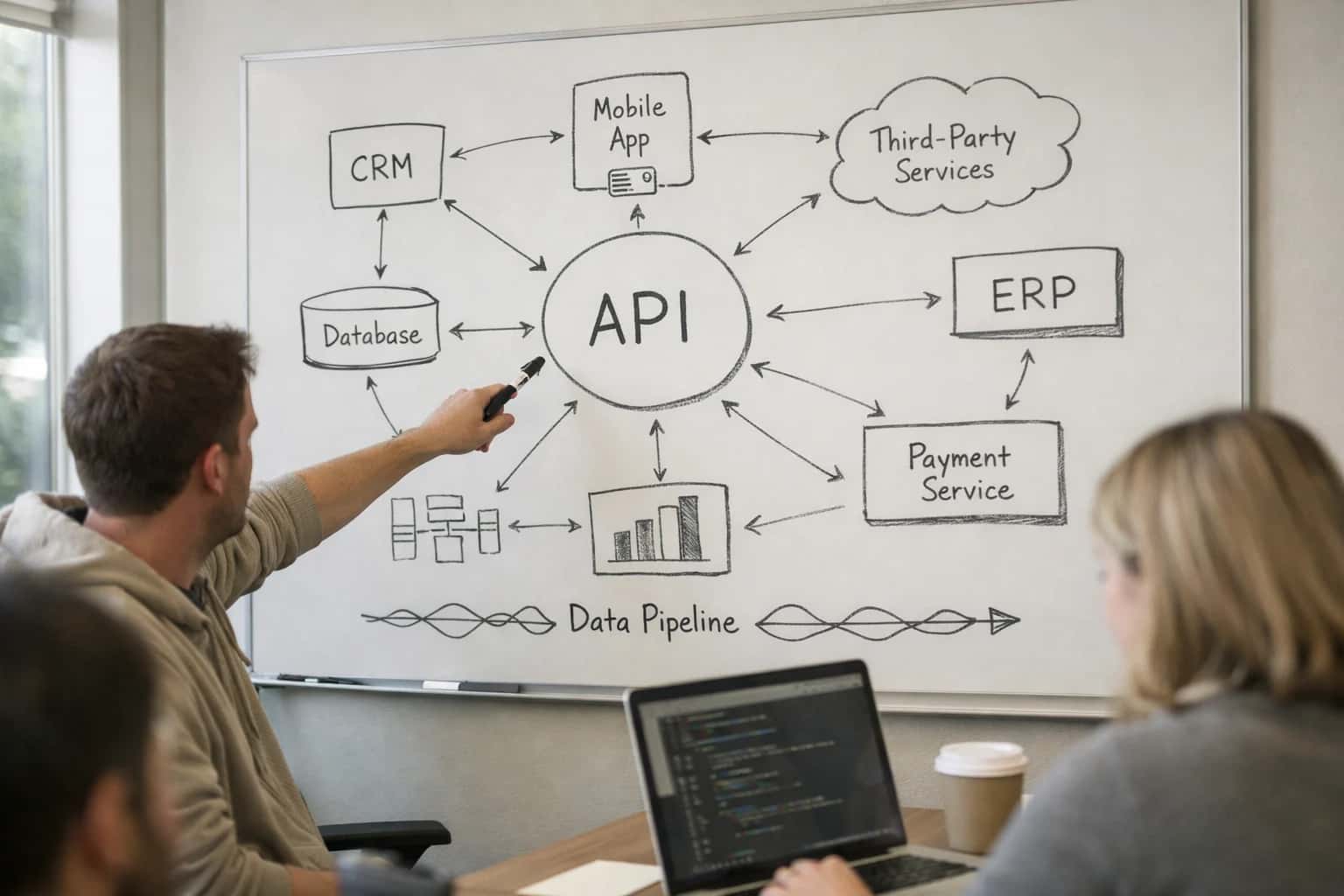
ARCHITECTURAL BLUEPRINT
Where AI Fits Between CrowdStrike and Your SIEM
A bidirectional AI layer enriches SIEM alerts with Falcon context and triggers Falcon actions from SIEM insights, creating a closed-loop threat response system.
The second function is orchestrated response. Using a decision engine, the AI can evaluate the enriched alert and, based on pre-defined confidence thresholds, execute actions via APIs. For example, upon confirming a malware detection correlated with lateral movement attempts in the SIEM, the AI can autonomously call the Falcon Real Time Response API to isolate the host and then call the SIEM's case management API to create an incident with all attached evidence. This moves containment from a manual, multi-console process to a single, automated workflow measured in seconds.
Governance is critical. All AI-initiated actions, especially host isolation or process termination, should be logged to a dedicated audit trail and can be configured to require human-in-the-loop approval for high-impact actions. The system should also feed performance data—like false-positive rates for automated containment—back into the AI model for continuous tuning. This architecture doesn't replace your SIEM or CrowdStrike; it acts as an intelligent connective tissue that makes both systems more actionable, reducing mean time to detect (MTTD) and mean time to respond (MTTR) by automating the analysis and cross-platform execution that currently slows down analysts.
ARCHITECTURAL BLUEPRINTS
Key Integration Surfaces in CrowdStrike and Common SIEMs
Ingesting and Prioritizing Alerts
The primary integration surface is the SIEM's alert ingestion pipeline. AI can be inserted here to pre-process raw CrowdStrike Falcon alerts before they hit the analyst console.
Key Workflow:
- Webhook Ingestion: Configure Falcon's Event Streams API to send real-time detection events (e.g.,
DetectionSummaryEvent) to a dedicated AI processing endpoint. - AI Enrichment: The AI layer enriches each alert with context from Falcon's APIs (host info, user identity, process tree) and external threat intelligence.
- Dynamic Scoring: Apply a risk-scoring model that considers severity, asset criticality, and threat intelligence confidence.
- SIEM Injection: The enriched, scored alert is then forwarded to the SIEM (e.g., Splunk HTTP Event Collector, Sentinel Data Connector) with custom fields for priority and AI-generated summary.
This reduces mean time to triage (MTTT) by presenting analysts with pre-summarized, context-rich incidents.
CROWDSTRIKE FALCON + SIEM INTEGRATION
High-Value Use Cases for a Bidirectional AI Layer
A bidirectional AI layer between CrowdStrike Falcon and your SIEM (like Splunk, Sentinel, or QRadar) creates a closed-loop intelligence system. AI enriches SIEM alerts with Falcon context and triggers Falcon actions from SIEM insights, moving from siloed monitoring to autonomous response.
01
SIEM Alert Enrichment & Triage
AI analyzes raw SIEM alerts, queries the Falcon platform via its APIs for endpoint context (process tree, user, hash reputation), and appends a structured summary to the SIEM case. This turns generic log alerts into actionable Falcon incidents, reducing analyst pivot time.
Hours -> Minutes
Investigation start
02
Automated IOC Hunting & Containment
When a high-confidence threat (e.g., malicious hash, C2 domain) is identified in the SIEM, the AI layer automatically executes a Falcon IOC search across the environment. If matches are found, it can initiate containment workflows (isolate host, kill process) via Falcon Real Time Response (RTR) and log the action back to the SIEM.
Batch -> Real-time
Threat containment
03
Cross-Platform Threat Correlation
AI correlates Falcon Insight detections with identity (Azure AD), network (firewall), and cloud (CSPM) logs from the SIEM. It builds a unified attack narrative, identifying whether an endpoint alert is part of a broader campaign (e.g., credential theft followed by lateral movement) and updates both Falcon Incident Graph and SIEM cases.
04
Natural Language Query & Reporting
Analysts ask questions like "Show me endpoints with suspicious PowerShell activity last week" in natural language. The AI translates this into parallel queries—Falcon Query Language (FQL) to CrowdStrike and SPL/PQL to the SIEM—synthesizes the results, and generates a consolidated report, eliminating manual query writing.
1 sprint
Report automation
05
Dynamic Playbook Orchestration
For critical incidents, AI evaluates the combined Falcon + SIEM context to dynamically select and parameterize a Falcon Fusion playbook. It can execute a sequenced response: collect forensic data via RTR, update the SIEM ticket, and trigger a ServiceNow workflow for IT engagement—all as a single automated runbook.
06
Proactive Vulnerability Context
AI links SIEM alerts for exploit attempts (e.g., Log4j) with Falcon Spotlight data. It identifies which vulnerable endpoints are actually exposed and targeted, generating a prioritized patching list in the SIEM and automatically creating a detection rule in Falcon to watch for exploitation on unpatched assets.
BIDIRECTIONAL SIEM-EDR INTEGRATION PATTERNS
Example AI-Driven Workflows: From Trigger to Action
These workflows illustrate how an AI layer can act as a real-time bridge between CrowdStrike Falcon and your SIEM (e.g., Splunk, Sentinel). The AI evaluates context from both systems to automate triage, enrich investigations, and trigger precise containment actions.
Trigger: A high-severity alert fires in the SIEM (e.g., Splunk Enterprise Security) based on a network anomaly or user behavior analytics (UBA) rule.
AI Agent Action:
- The AI agent receives the alert via webhook. It parses the alert to extract key entities:
source_ip,destination_ip,username,process_name. - It queries the CrowdStrike Falcon Device API (
/devices/queries/devices/v1) to find the endpoint(s) associated with the IP or user. - Using the returned
device_id, it calls the Falcon Detection Details API (/detects/entities/summaries/GET/v1) to check for any correlated endpoint detections in the last 24 hours. - It also queries the Falcon Spotlight API (
/spotlight/vulnerabilities/queries/vulnerabilities/v1) to pull the top 5 critical vulnerabilities for that specific host.
System Update: The AI agent generates a structured summary and posts it back to the SIEM alert as a notable event comment, enriching the context for the analyst:
json{ "enrichment_source": "CrowdStrike AI Bridge", "correlated_falcon_detections": 2, "endpoint_risk_score": 85, "top_cves": ["CVE-2024-12345", "CVE-2024-67890"], "recommended_action": "Review Falcon detection IDs: ldt:abc123, ldt:def456" }
Human Review Point: The enriched alert is prioritized in the SOC queue. The analyst reviews the combined SIEM + Falcon context before initiating response.
BUILDING A BIDIRECTIONAL AI LAYER
Implementation Architecture: Data Flow, APIs, and the AI Model Layer
A practical blueprint for integrating an AI decision engine between CrowdStrike Falcon and your SIEM to automate threat intelligence and response.
The integration architecture establishes a bidirectional data flow between systems. From the SIEM (e.g., Splunk, Microsoft Sentinel), the AI layer ingests enriched alerts, external threat feeds, and correlated event data via REST APIs or webhooks. Concurrently, it polls CrowdStrike Falcon's APIs—primarily the Detections API and Device Details API—for real-time endpoint context, process trees, and containment status. This unified data stream is processed by an orchestration service that normalizes entities (hostnames, users, hashes) and prepares a consolidated context payload for the AI model.
The core AI model layer acts as a decision engine on this enriched data. It performs two key functions: alert enrichment and action recommendation. For enrichment, it uses a Retrieval-Augmented Generation (RAG) pattern against a vector store of internal playbooks, threat intelligence briefs, and past incident reports to generate a concise summary explaining the "why" behind a Falcon detection. For action recommendation, a separate classifier evaluates the consolidated context to suggest specific Falcon Fusion playbooks or direct API actions, such as contain or lift_containment. All model inferences are logged with input context, confidence scores, and a reasoning chain for auditability.
Execution and governance are managed through a lightweight workflow engine. Approved high-confidence actions (e.g., containing a host with a known malicious hash) can be executed automatically by calling the Falcon Real Time Response API or triggering a Fusion workflow. Lower-confidence or high-risk actions are routed to a human-in-the-loop queue within the SOC's existing Slack, Teams, or SOAR platform for approval. The entire architecture is designed for incremental rollout, starting with read-only alert summarization before progressing to supervised, and eventually autonomous, response actions. This approach ensures the AI augments—rather than disrupts—existing SOC workflows and toolchains.
ARCHITECTURAL BLUEPRINT
Code and Payload Examples for Key Integration Points
Ingesting Falcon Alerts for AI Triage
This pattern involves subscribing to CrowdStrike Falcon's Real Time Response (RTR) or Streaming API to receive detection events. The AI layer enriches these raw alerts with context from the SIEM (like user risk scores or related network events) before prioritization.
Example Python Webhook Handler:
pythonfrom flask import Flask, request import requests app = Flask(__name__) @app.route('/falcon/webhook', methods=['POST']) def handle_falcon_alert(): falcon_alert = request.json # 1. Extract key entities hostname = falcon_alert.get('device', {}).get('hostname') detection_id = falcon_alert.get('detection', {}).get('detection_id') # 2. Query SIEM for related events (pseudocode) siem_context = query_siem(f"search host={hostname} last=24h") # 3. Build enriched payload for LLM enriched_payload = { "falcon_alert": falcon_alert, "siem_context": siem_context, "user_risk": get_user_risk(falcon_alert['user']), "timestamp": falcon_alert['created_timestamp'] } # 4. Send to AI triage service triage_result = call_ai_triage(enriched_payload) return {'status': 'processed', 'detection_id': detection_id}
The output is a structured JSON payload ready for an LLM to summarize, score severity, and recommend a response lane.
AI-ENHANCED SOC OPERATIONS
Realistic Time Savings and Operational Impact
This table illustrates the tangible operational improvements when integrating an AI layer between CrowdStrike Falcon and a SIEM like Splunk or Sentinel. It focuses on measurable changes to analyst workflows and system efficiency.
| Workflow / Metric | Before AI Integration | After AI Integration | Key Considerations |
|---|---|---|---|
Alert Triage & Prioritization | Manual review of raw SIEM alerts and Falcon events | AI pre-scores and enriches alerts with Falcon context | Human analyst reviews AI-ranked queue; reduces noise by 40-60% |
Initial Incident Investigation | Analyst manually queries Falcon and SIEM APIs to gather context | AI automatically correlates data, drafts a timeline summary | Analyst validates and expands AI-generated narrative; cuts initial investigation from 30+ minutes to 5-10 |
Containment Action Execution | Manual decision and step-by-step execution in Falcon console | AI recommends actions; one-click approval triggers Falcon API | Approval workflows remain; execution time drops from minutes to seconds |
Threat Intelligence Enrichment | Manual lookup in separate threat intel platforms | AI automatically fetches and summarizes relevant IOCs/TTPs from Falcon Intel | Enriches SIEM case notes automatically; saves 5-15 minutes per investigation |
Case Documentation & Handoff | Analyst manually writes summary in SIEM case notes | AI drafts structured summary with evidence links for SIEM ticket | Analyst reviews and edits; reduces documentation time by 50-70% |
Proactive Hunting Query Generation | Analyst crafts complex FQL or SPL queries from scratch | AI translates natural language hypotheses into platform-specific queries | Accelerates hypothesis testing; enables more frequent hunting cycles |
Cross-Platform Visibility Gaps | Manual correlation needed between SIEM alerts and Falcon detections | AI bi-directionally syncs high-fidelity signals, highlighting gaps | Improves detection coverage; identifies blind spots previously missed |
ARCHITECTING A CONTROLLED, BIDIRECTIONAL AI LAYER
Governance, Security, and Phased Rollout
A production-ready integration between CrowdStrike Falcon and your SIEM requires deliberate controls, secure data flows, and a phased rollout to manage risk and prove value.
The core architectural pattern involves a secure middleware layer—often a dedicated service or orchestration platform—that acts as the bidirectional conduit. This layer subscribes to high-fidelity alerts from CrowdStrike Falcon via its Event Streams API or Detections API, and from your SIEM (e.g., Splunk ES, Microsoft Sentinel) via its respective alerting webhooks or query APIs. It must enforce strict RBAC and audit logging, ensuring every AI-generated action or enrichment is traceable back to the source alert, the AI's reasoning, and the initiating user or service account. Data in transit is encrypted, and sensitive fields (like hostnames in internal domains or user PII) can be masked or tokenized before being sent to external LLM APIs for processing.
A phased rollout is critical for adoption and risk management. Phase 1 typically focuses on read-only enrichment: deploying AI agents that consume alerts from both systems to generate plain-language summaries, suggest related Falcon queries for investigation, or correlate IOCs across the two platforms, outputting these insights as comments back into the respective SIEM case or Falcon detection. Phase 2 introduces conditional, human-in-the-loop actions. For example, an AI analysis of a correlated alert could draft a containment playbook for Falcon Fusion, but require analyst approval in the SIEM console before execution via the Falcon Real Time Response API. Phase 3 evolves to supervised automation for low-risk, high-volume tasks, such as auto-closing Falcon alerts deemed benign after AI analysis and SIEM context lookup, or automatically tagging assets in Falcon based on threat intelligence parsed from the SIEM.
Governance is built around confidence scoring and feedback loops. Every AI-generated recommendation or action should include a confidence score and a brief explanation of the supporting evidence (e.g., '90% confidence; 5 similar past incidents were false positives'). Security teams must have simple mechanisms to provide feedback (thumbs up/down), which is logged and used to retrain or tune the underlying models. Furthermore, the integration should include circuit breakers—automated shutdowns of action-oriented workflows if anomaly rates spike—and regular compliance checks to ensure AI actions align with configured security policies. This controlled approach ensures the AI layer augments your SOC without introducing unmanaged risk or alert fatigue.
Enabling Efficiency, Speed & Accuracy
Intelligent Analysis, Decision & Execution
We build AI systems for teams that need search across company data, workflow automation across tools, or AI features inside products and internal software.
Talk to Us
Search across company data
Give teams answers from docs, tickets, runbooks, and product data with sources and permissions.
Useful when people spend too long searching or get different answers from different systems.
Enterprise searchRAGPermissions
Read more
Automate internal workflows
Use AI to route work, draft outputs, trigger actions, and keep approvals and logs in place.
Useful when repetitive work moves across multiple tools and teams.
AI agentsWorkflow automationGovernance
Read more
Add AI to products and internal tools
Build assistants, guided actions, or decision support into the software your team or customers already use.
Useful when AI needs to be part of the product, not a separate tool.
AI integrationDecision supportModel routing
Read moreARCHITECTURE AND IMPLEMENTATION
Frequently Asked Questions for Technical Buyers
Common questions from security architects and SOC leaders planning a bidirectional AI integration between CrowdStrike Falcon and their SIEM.
A production-ready architecture typically uses a central integration layer (often a lightweight microservice) to manage bidirectional flows.
From SIEM to Falcon (Action Triggering):
- Trigger: A high-confidence AI insight is generated within the SIEM (e.g., a user behavior anomaly correlated with a Falcon alert).
- Context Pull: The integration service queries the SIEM for the enriched alert context, including user, endpoint ID, and reasoning.
- Action Mapping: The service maps the insight to a specific Falcon API action (e.g.,
containhost,run-scriptfor investigation). - System Update: It executes the action via the Falcon API using appropriate OAuth2 scopes and logs the action back to the SIEM as a new event.
From Falcon to SIEM (Alert Enrichment):
- Trigger: A new detection alert fires in CrowdStrike Falcon.
- Context Pull: The integration service consumes the alert via Falcon's Streams API or webhook, pulling the full detection detail.
- AI Enrichment: The service sends key alert fields (process tree, file hashes, command line) to an LLM for summarization, MITRE ATT&CK mapping, and suggested investigation steps.
- System Update: The enriched narrative is posted back to the corresponding SIEM event, often using a custom field like
ai_summaryorai_investigation_steps.
Key Component: This service must handle authentication, rate limiting, idempotency, and audit logging for all cross-platform actions.

About the author
Prasad Kumkar
CEO & MD, Inference Systems
Prasad Kumkar is the CEO & MD of Inference Systems and writes about AI systems architecture, LLM infrastructure, model serving, evaluation, and production deployment. Over 5+ years, he has worked across computer vision models, L5 autonomous vehicle systems, and LLM research, with a focus on taking complex AI ideas into real-world engineering systems.
His work and writing cover AI systems, large language models, AI agents, multimodal systems, autonomous systems, inference optimization, RAG, evaluation, and production AI engineering.
LinkedIn
Limited slotsGet a Free AI Consultation
Partnered with leading AI, data, and software stack.





How We Work
Custom AI workflows for your Business
One-fit-all AI don't work for modern businesses. At Inferensys, we aim to understand your business & custom requirements; which we use to define most efficient agentic workflows, the data, and the tools for your business.
01
Review the use case
We understand the task, the users, and where AI can actually help.
Read more02
Pick the right approach
We define what needs search, automation, or product integration.
Read more03
Build the first useful version
We implement the part that proves the value first.
Read more04
Improve from there
We add the checks and visibility needed to keep it useful.
Read moreThe first call is a practical review of your use case and the right next step.
Talk to Us