The Oracle Health Developer Portal provides the foundational APIs and tooling to connect external applications to the core EHR. For AI integration, the primary surfaces are the FHIR R4 APIs for clinical data and the proprietary Millennium Platform Services (MPS) for transactional workflows. Key data objects for AI applications include Patient, Encounter, Observation, Condition, MedicationRequest, and DocumentReference. The portal's sandbox environment allows for realistic testing against synthetic patient data, which is critical for validating AI model outputs and integration logic before production deployment.

Integration
AI Integration for Oracle Health Developer Portal
A technical guide for developers using the Oracle Health Developer Portal to build, test, and deploy AI applications that connect securely to Millennium and CommunityWorks EHRs via FHIR and proprietary APIs.
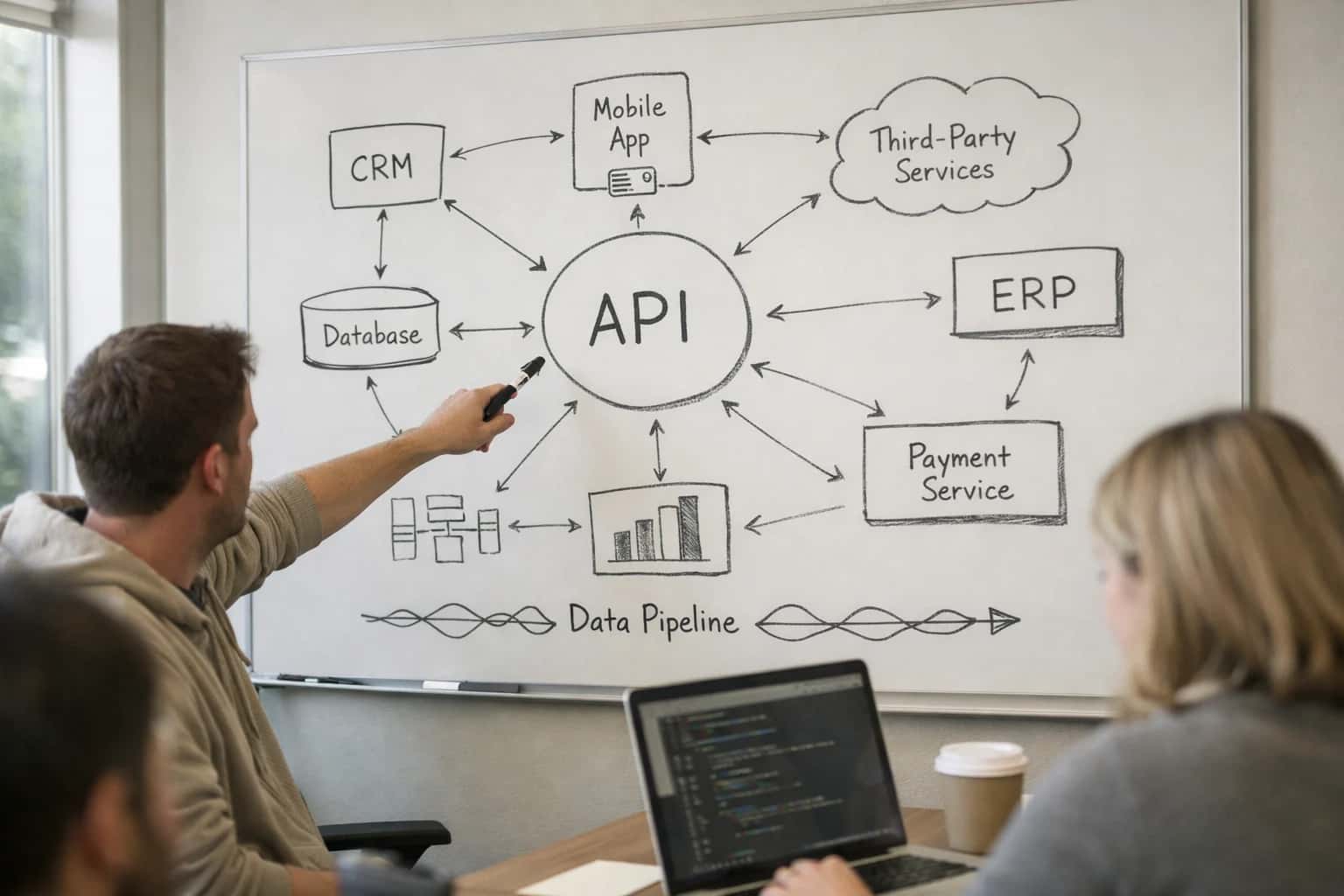
DEVELOPER PORTAL INTEGRATION
Building AI Applications on the Oracle Health Platform
A technical blueprint for developers using the Oracle Health Developer Portal to build, test, and deploy AI applications that connect to Millennium and CommunityWorks.
A production implementation typically involves a middleware layer that orchestrates between the AI service and the EHR. This layer handles OAuth 2.0 client credentials flow for authentication, manages API rate limits, and implements idempotent webhook listeners for real-time events (e.g., a new note saved, a lab result posted). For example, an AI-powered documentation assistant would: 1) Listen for a DocumentReference creation via a subscription, 2) Retrieve the associated encounter and clinical context via FHIR, 3) Call an LLM service to generate a draft SOAP note summary, 4) Post the draft back as a new DocumentReference with a draft status, flagging it for clinician review within Hyperspace. Governance is enforced through scoped API credentials and audit logging of all data accesses.
Rollout requires a phased approach, starting with a single clinic or department. Use the Developer Portal to register your application, define its SMART on FHIR scopes (e.g., user/Patient.read, user/DocumentReference.write), and undergo the required security review. Implement a human-in-the-loop pattern for all initial AI outputs, using the EHR's native tasking or in-basket system to route drafts for approval. This builds trust and creates a clear audit trail. For broader deployment, consider integrations with Oracle Health CommunityWorks modules for ambulatory settings, where workflows around chronic care management and patient messaging are prime candidates for AI automation. Explore related patterns for AI Integration for EHR Clinical Documentation and AI Integration for EHR Workflow Automation.
ORACLE HEALTH DEVELOPER PORTAL
Key Integration Surfaces in the Developer Portal
FHIR API Endpoints
The Oracle Health Developer Portal provides FHIR R4 APIs for programmatic access to clinical and administrative data. This is the primary surface for building AI applications that read from and write to the EHR.
Key Resources for AI:
Patient,Encounter,Condition,Observationfor clinical context retrieval.DocumentReferenceandBinaryfor accessing clinical notes and reports for summarization.ServiceRequestandClaimfor prior authorization and RCM workflows.CommunicationandQuestionnaireResponsefor patient engagement automation.
Implementation Pattern: AI agents typically query these endpoints to retrieve patient context, then use LLMs for tasks like note drafting or data abstraction. Writes back to the EHR (e.g., creating a DocumentReference for a generated summary) require careful audit trails and often a human-in-the-loop approval step.
INTEGRATION PATTERNS
High-Value AI Use Cases for Oracle Health Developers
For developers building on the Oracle Health Developer Portal, AI can transform Millennium and CommunityWorks workflows. These patterns show where to connect LLMs via FHIR and proprietary APIs for immediate clinical and operational impact.
01
Automated Clinical Note Drafting
Use AI to generate SOAP note drafts by synthesizing patient data from FHIR resources (Allergies, Conditions, Observations) and prior visit summaries. Integrates into the Millennium physician workspace to pre-populate note templates, reducing manual data entry and click burden.
Minutes per note
Time saved
02
Intelligent Prior Authorization Support
Build an AI agent that reviews Millennium order data and clinical documentation to auto-populate payer authorization forms. The agent can extract necessary CPT/HCPCS codes and clinical indications, then submit via integrated clearinghouse or payer portal APIs, tracking status back to the workflow.
Same day
Submission speed
03
Real-Time Clinical Decision Assistance
Create a context-aware copilot that surfaces relevant guidelines and literature by analyzing active patient data (labs, vitals, problem list) from the Millennium API. Delivers non-interruptive, evidence-based suggestions within the clinician's workflow, referencing UpToDate or institutional protocols.
Point of care
Guidance location
04
Automated Discharge Summary & Handoff
Orchestrate an AI workflow that pulls FHIR data at discharge—including medications, procedures, and lab trends—to generate a comprehensive summary. Routes the draft for attending physician review and sign-off within Millennium, then pushes the final document to the patient's CommunityWorks chart for continuity.
1 sprint
Implementation timeline
05
Intelligent Revenue Cycle Automation
Deploy AI agents to monitor the Soarian Financials or CommunityWorks RCM module. Use them to scrub claims for coding errors (CPT/ICD mismatch), predict denial likelihood, and generate appeal letters by pulling clinical notes from the associated encounter, directly impacting clean claim rates.
Batch → Real-time
Claim review
06
Patient Engagement & Inbox Triage
Integrate an LLM with the patient portal (e.g., MyHealth) to handle routine patient messages. The agent can classify intent, draft responses for nurse review, and auto-schedule follow-ups based on clinical urgency by reading/writing to the Millennium Scheduling and Communications APIs.
Reduce manual triage
Staff impact
BUILDING WITH THE ORACLE HEALTH DEVELOPER PORTAL
Example AI Agent Workflows for Millennium & CommunityWorks
These concrete workflows illustrate how AI agents, built using the Oracle Health Developer Portal's FHIR and proprietary APIs, can automate high-impact clinical and operational tasks within Millennium and CommunityWorks. Each example details the trigger, data flow, agent action, and system update.
Trigger: A provider clicks "Discharge" in Millennium's Discharge Navigator module.
Context/Data Pulled: The agent, via FHIR API and potentially custom Millennium APIs, retrieves:
- Patient demographics and encounter details (
Patient,Encounter) - Key clinical events: procedures (
Procedure), medications (MedicationAdministration), lab results (Observation) - Active problems and diagnoses (
Condition) - Nursing notes and provider progress notes (via
DocumentReferenceor proprietary API)
Model/Agent Action: A structured prompt instructs an LLM to generate a draft discharge summary following a standard format (History of Present Illness, Hospital Course, Discharge Medications, Discharge Instructions, Follow-up). The prompt grounds the output strictly in the retrieved data.
System Update/Next Step: The drafted summary is posted as a DocumentReference to the FHIR server or written to a specific Millennium application via API, flagged as a draft and linked to the encounter. It is routed to the discharging provider's In Basket for review, edit, and final sign-off.
Human Review Point: Mandatory. The provider must review, modify if necessary, and sign the note within the EHR before it becomes part of the legal record.
DEVELOPER-FIRST INTEGRATION PATTERNS
Implementation Architecture: Connecting AI to the Portal
A practical blueprint for securely connecting AI applications to the Oracle Health Developer Portal to augment Millennium and CommunityWorks workflows.
The integration architecture centers on the Oracle Health Developer Portal as the secure gateway, using its FHIR R4 and proprietary REST APIs to connect AI agents to live EHR data. Key connection points include:
- FHIR Resources:
Patient,Encounter,Observation,Condition, andMedicationRequestfor clinical context. - Proprietary APIs: For accessing Millennium-specific objects, order catalogs, and financial data not yet exposed via FHIR.
- SMART on FHIR Launch Context: To embed AI applications directly into clinician workflows with user-specific scopes and context.
- Webhook Subscriptions: For real-time triggers from events like new lab results, signed notes, or admitted patients, enabling reactive AI workflows.
This API-first approach allows developers to build AI tools that operate on a read-and-write basis, where appropriate, to suggest documentation, generate summaries, or trigger automated follow-up tasks.
A production implementation follows a layered pattern to ensure security, auditability, and clinical relevance:
- API Gateway & Auth Layer: All requests route through the Developer Portal using OAuth 2.0. AI applications request scopes (e.g.,
user/Patient.read,user/Observation.write) based on the least-privilege principle. - Orchestration & Prompt Layer: An intermediary service (often built with frameworks like LangChain or CrewAI) receives the EHR context, enriches it with internal knowledge bases, and constructs grounded prompts for the LLM. This layer manages conversation history and tool-calling for multi-step workflows.
- LLM Gateway & Guardrails: Calls to models (e.g., OpenAI, Anthropic, or hosted open-source) pass through a governance layer that enforces PHI filtering, prompt injection detection, and audit logging. All model inputs and outputs are logged with user, patient, and encounter IDs for traceability.
- Human-in-the-Loop & EHR Writeback: AI-generated content (e.g., a note draft or a care gap alert) is typically routed to a review queue within the AI application or written to a dedicated FHIR resource (like a
DocumentReferenceorFlag) for clinician approval before becoming part of the official record. Direct writes to core clinical tables are avoided.
Rollout and governance are critical. Start with a pilot focused on a single, high-value workflow—like automating draft clinical summaries for discharge—using a limited dataset (e.g., last 90 days of encounters for a specific service line). Implement a phased go-live:
- Phase 1: Read-only AI analysis (e.g., retrospective chart summarization for care coordination).
- Phase 2: Draft generation with mandatory clinician review and sign-off.
- Phase 3: Conditional, automated write-back for low-risk tasks (e.g., creating patient education materials).
Governance requires collaboration between IT, compliance, and clinical leadership to define approval workflows, establish accuracy thresholds, and integrate the AI application's audit trail with existing SIEM tools. For ongoing development, leverage the Developer Portal's sandbox environments for testing against synthetic data before promoting to production.
PRACTICAL PATTERNS FOR ORACLE HEALTH DEVELOPERS
Code Examples: FHIR API Interactions for AI Context
Retrieve Patient Data for AI Summarization
Before an AI agent can draft a discharge summary or generate a care plan, it needs a complete patient context. Use the FHIR Patient and Encounter resources to build a foundational view.
Key Steps:
- Fetch the patient's demographic and contact information.
- Retrieve the current or most recent encounter details, including type, status, and service provider.
- Use these IDs to scope subsequent queries for clinical data.
Example Python Request:
pythonimport requests # Base URL for your Oracle Health FHIR server base_url = "https://fhir.oraclehealth.com/CommunityWorks/api/FHIR/R4" headers = {"Authorization": "Bearer YOUR_ACCESS_TOKEN"} # Get Patient by ID patient_id = "example-patient-123" patient_response = requests.get(f"{base_url}/Patient/{patient_id}", headers=headers) patient_data = patient_response.json() # Get most recent Encounter for this patient encounter_params = { "patient": patient_id, "_sort": "-date", "_count": 1 } encounter_response = requests.get(f"{base_url}/Encounter", headers=headers, params=encounter_params) encounter_data = encounter_response.json()
This structured data forms the header for any AI-generated narrative and ensures the output is correctly attributed.
FOR DEVELOPERS BUILDING ON THE ORACLE HEALTH DEVELOPER PORTAL
Realistic Time Savings and Operational Impact
This table illustrates the operational impact of integrating AI into applications built via the Oracle Health Developer Portal, connecting to Millennium and CommunityWorks. Metrics are based on typical pilot implementations for clinical and administrative workflows.
| Workflow / Task | Before AI Integration | After AI Integration | Implementation Notes |
|---|---|---|---|
Clinical Note Drafting (SOAP) | Manual entry: 8-12 minutes per note | Assisted generation with structured data pull: 3-5 minutes | Uses FHIR API for patient context; clinician reviews and signs. Requires prompt engineering for specialty templates. |
Prior Authorization Document Review | Manual chart review for criteria: 15-20 minutes per case | AI-assisted extraction and criteria check: 5-7 minutes | Integrates with document storage via proprietary APIs. Human reviews AI summary before submission. |
Patient Inbox Triage (MyChart/Patient Portal) | Manual routing by staff: Next-business-day response | AI-assisted categorization & draft replies: Same-day response | Leverages FHIR Communication API. Staff approves all AI-drafted messages before sending. |
Discharge Summary Generation | Manual compilation from multiple sources: 25-40 minutes | AI-assisted draft from encounter data: 10-15 minutes | Pulls data via FHIR and proprietary APIs. Attending physician validates and finalizes. |
Medication Reconciliation on Admission | Manual patient interview and chart review: 15-25 minutes | AI-powered list comparison and discrepancy flagging: 5-10 minutes | Uses FHIR Medication resources. Pharmacist or nurse verifies flagged discrepancies. |
Chronic Care Management (CCM) Monthly Touchpoint Documentation | Manual note creation and code validation: 20-30 minutes per patient | AI-generated note draft from RPM data & call log: 8-12 minutes | Integrates with device data and scheduling APIs. Biller validates CPT codes post-review. |
New FHIR App Onboarding & Data Mapping | Manual API exploration and schema mapping: 2-3 developer days | AI-assisted endpoint discovery and sample payload generation: 4-8 developer hours | Uses Developer Portal documentation and live API specs. Developer reviews and adjusts mappings. |
ARCHITECTING FOR PRODUCTION
Governance, Security, and Phased Rollout
A practical approach to deploying AI applications built on the Oracle Health Developer Portal with enterprise-grade controls.
Integrating AI with Oracle Health Millennium or CommunityWorks via the Developer Portal requires a security-first architecture. This typically involves a dedicated middleware layer that acts as a secure bridge between the AI service and the EHR's FHIR or proprietary APIs. Key considerations include:
- Authentication & RBAC: Using OAuth 2.0 scopes tied to specific user roles (e.g.,
user/Patient.read,user/Observation.write) to enforce least-privilege access. - Data Minimization: Designing prompts and retrieval pipelines to query only the necessary patient context (e.g., last 3 encounters, active problems) rather than full chart dumps.
- Audit Trails: Logging all AI interactions—including prompts, source data references, and generated outputs—to a separate, immutable audit system linked to the user and patient ID for compliance (HIPAA, GDPR).
- Secure Tool Calling: Implementing strict validation and sanitization for any AI-generated actions (e.g., draft orders, documentation snippets) before they are submitted back to the EHR via the API.
A successful rollout follows a phased, risk-managed approach, starting with low-risk, high-impact workflows:
- Phase 1: Non-Clinical Assistance (Weeks 1-4)
- Target: Administrative and documentation support.
- Use Case: Drafting patient-friendly visit summaries for review in MyChart or generating structured data for quality reporting from free-text notes.
- Governance: All outputs are marked as
AI-DRAFTand require clinician review and sign-off before being saved to the patient record.
- Phase 2: Clinical Decision Support (Months 2-3)
- Target: Augmenting, not replacing, clinical judgment.
- Use Case: An AI agent that reviews a patient's history and active medications against new lab results (fetched via FHIR
Observation), highlighting potential interactions or trends for the care team. - Governance: Implement a mandatory human-in-the-loop step where the AI's suggestion is presented as a non-interruptive alert or inbox item, requiring explicit acceptance or modification.
- Phase 3: Integrated Workflow Automation (Months 4-6)
- Target: Multi-step operational tasks.
- Use Case: Automating prior authorization support by extracting clinical criteria from a payer portal, matching it to patient data from the EHR, and pre-filling necessary forms.
- Governance: Establish a quarterly review board to evaluate AI performance metrics (accuracy, time saved) and adjust guardrails or retire workflows as needed.
For teams using the Oracle Health Developer Portal, Inference Systems provides the architectural patterns and implementation guardrails to move from prototype to production. We help you define the approval chains, audit requirements, and fallback procedures—ensuring your AI integration enhances clinical and operational workflows without introducing new risk. Start with a controlled pilot in a single department, measure the impact on documentation time or decision latency, and scale with confidence. Explore our broader framework for EHR workflow automation or our guide to clinical decision support for related architectures.
Enabling Efficiency, Speed & Accuracy
Intelligent Analysis, Decision & Execution
We build AI systems for teams that need search across company data, workflow automation across tools, or AI features inside products and internal software.
Talk to Us
Search across company data
Give teams answers from docs, tickets, runbooks, and product data with sources and permissions.
Useful when people spend too long searching or get different answers from different systems.
Enterprise searchRAGPermissions
Read more
Automate internal workflows
Use AI to route work, draft outputs, trigger actions, and keep approvals and logs in place.
Useful when repetitive work moves across multiple tools and teams.
AI agentsWorkflow automationGovernance
Read more
Add AI to products and internal tools
Build assistants, guided actions, or decision support into the software your team or customers already use.
Useful when AI needs to be part of the product, not a separate tool.
AI integrationDecision supportModel routing
Read moreIMPLEMENTATION BLUEPRINT
FAQ for Oracle Health Developers Building AI
Practical answers for developers using the Oracle Health Developer Portal to build, secure, and deploy AI applications that connect to Millennium and CommunityWorks.
You have two main architectural paths, each with distinct trade-offs for latency, data scope, and governance.
1. FHIR APIs (Recommended for New Integrations)
- Use:
GET /fhir/Patient,POST /fhir/Communication,GET /fhir/Observation. - Best For: Patient-facing apps, cross-platform data exchange, and read-heavy operations where a standardized schema is beneficial.
- Limitation: Not all Millennium data is exposed via FHIR. Complex clinical notes or proprietary module data may require the Cerner Open Developer Experience (CODE) APIs.
2. Cerner Open Developer Experience (CODE) APIs
- Use: Direct SOAP/REST calls to Millennium's internal services for comprehensive data access.
- Best For: Deep clinical workflow integrations, writing back to specific Millennium tables, and accessing data not yet in the FHIR layer.
- Governance Note: Requires rigorous scoping and approval. Always use the minimum necessary scope for your AI agent's context.
Implementation Pattern:
- Use FHIR for patient context retrieval (demographics, conditions, medications).
- Use CODE APIs for module-specific writes (e.g., posting a draft note to a specific encounter in PowerChart).
- Implement a caching layer for frequently accessed, static data to reduce API load.

About the author
Prasad Kumkar
CEO & MD, Inference Systems
Prasad Kumkar is the CEO & MD of Inference Systems and writes about AI systems architecture, LLM infrastructure, model serving, evaluation, and production deployment. Over 5+ years, he has worked across computer vision models, L5 autonomous vehicle systems, and LLM research, with a focus on taking complex AI ideas into real-world engineering systems.
His work and writing cover AI systems, large language models, AI agents, multimodal systems, autonomous systems, inference optimization, RAG, evaluation, and production AI engineering.
LinkedIn
Limited slotsGet a Free AI Consultation
Partnered with leading AI, data, and software stack.





How We Work
Custom AI workflows for your Business
One-fit-all AI don't work for modern businesses. At Inferensys, we aim to understand your business & custom requirements; which we use to define most efficient agentic workflows, the data, and the tools for your business.
01
Review the use case
We understand the task, the users, and where AI can actually help.
Read more02
Pick the right approach
We define what needs search, automation, or product integration.
Read more03
Build the first useful version
We implement the part that proves the value first.
Read more04
Improve from there
We add the checks and visibility needed to keep it useful.
Read moreThe first call is a practical review of your use case and the right next step.
Talk to Us