The healow platform—comprising the healow patient portal, healow TeleVisits, and healow Open Access—creates a digital front door for practices. AI integration targets its key functional surfaces: the check-in API for intake forms, the messaging center for patient inquiries, the scheduling engine for appointment management, and the telehealth session context for visit support. By connecting to these points, AI agents can handle structured tasks like form pre-filling, symptom triage, and FAQ resolution, while passing complex clinical or scheduling exceptions to human staff via the same healow workflows.

Integration
AI Integration for eClinicalWorks healow Patient Engagement
A technical blueprint for embedding AI into the eClinicalWorks healow patient portal and engagement suite to automate check-in, support telehealth visits, manage chronic care outreach, and optimize scheduling.
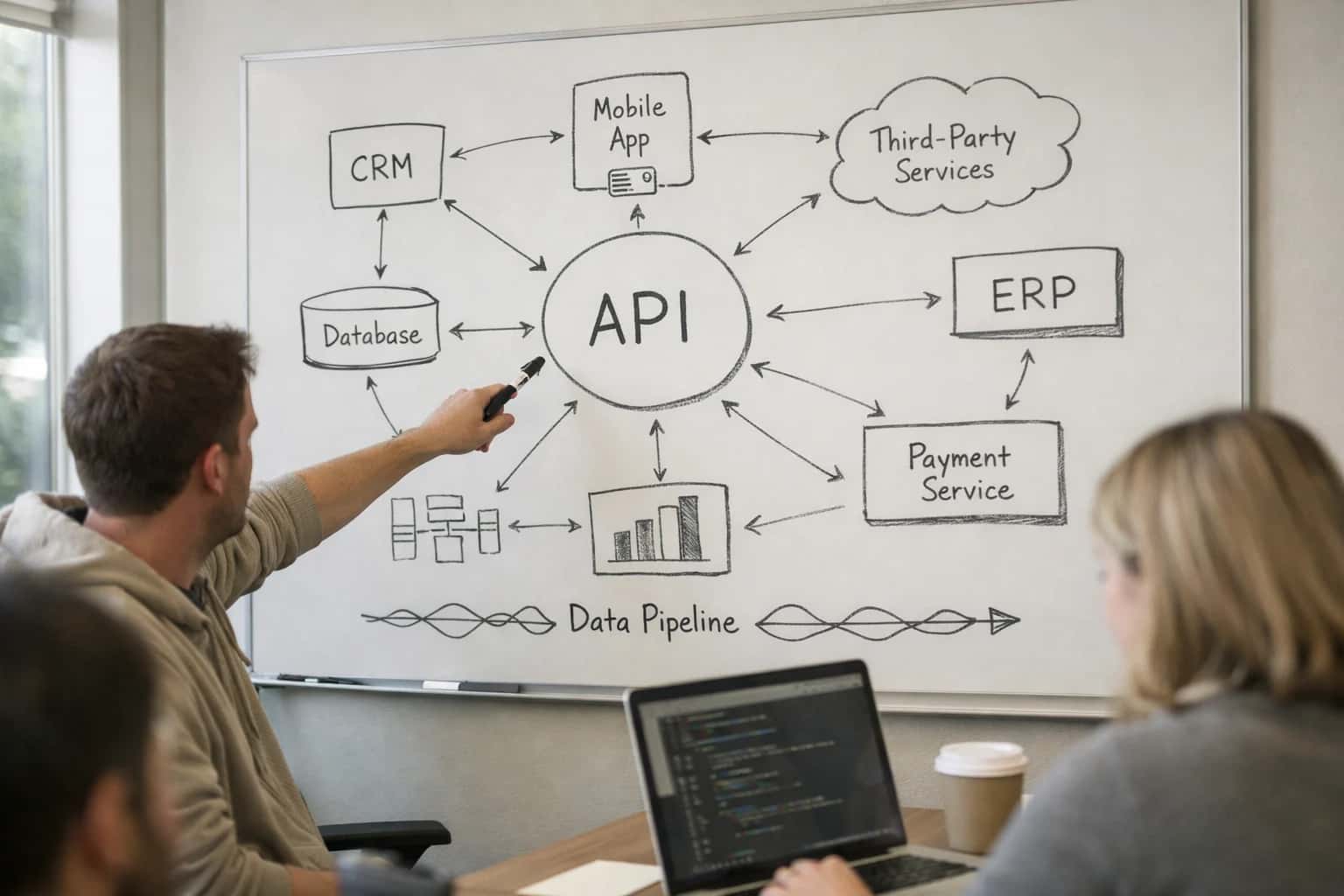
ARCHITECTURE FOR DIGITAL FRONT DOOR AUTOMATION
Where AI Fits into the healow Patient Engagement Workflow
A technical blueprint for embedding AI into the eClinicalWorks healow suite to automate patient interactions and reduce administrative burden.
Implementation typically involves a middleware layer that subscribes to healow webhooks (e.g., for new messages or check-in requests) and uses the healow API to read/write data. For example, an AI agent can be triggered by a patient message in the portal, draft a response using clinical context from the EHR via FHIR, and post a draft back to the message thread for staff review and sending. For chronic care management, AI can automate monthly outreach by pulling enrolled patient lists, generating personalized check-in messages, and logging the interaction for billing compliance. The architecture must respect healow's existing role-based access controls and audit trails, ensuring all AI-generated actions are attributable and reversible.
Rollout should prioritize high-volume, low-risk workflows first, such as automating appointment confirmation calls or post-visit satisfaction surveys, before advancing to clinical intake or medication renewal support. Governance requires a clear human-in-the-loop approval step for any AI-generated clinical communication and regular audits against message sentiment and escalation rates. This approach turns healow from a passive portal into an intelligent, proactive engagement layer, converting manual staff hours into automated patient touches while keeping the practice's existing operational model intact.
AI-PATIENT ENGAGEMENT WORKFLOWS
Key Integration Surfaces in the healow Ecosystem
Automating Pre-Visit Workflows
The healow Check-In module is a prime surface for AI to reduce front-desk burden and improve data accuracy. Integration typically involves processing patient-submitted forms and EHR data to auto-populate fields and flag discrepancies.
Key Integration Points:
- FHIR/API Endpoints: Patient
QuestionnaireResponseandQuestionnaireresources for digital forms. - Data Validation: Cross-reference submitted data (medications, allergies, history) against the eClinicalWorks chart via the
PatientandConditionresources. - Workflow Trigger: Use webhooks from healow to initiate AI processing when a check-in is submitted.
Example AI Workflow:
- Patient completes check-in via healow app.
- Webhook payload sent to AI service.
- LLM extracts and structures data, compares to last known record.
- Service returns structured data for auto-population and highlights fields requiring staff review (e.g., new medication not in chart).
- Updated data posted back via API, ready for clinician review.
PATIENT ENGAGEMENT AUTOMATION
High-Value AI Use Cases for healow
Integrate AI directly into the healow patient portal and telehealth suite to automate routine touchpoints, personalize communications, and reduce administrative burden on clinical staff.
01
Automated Digital Check-In & Intake
Use AI to process patient-submitted forms via the healow Check-In API. Extract and structure data from free-text responses, pre-fill EHR fields, and flag discrepancies or urgent concerns for staff review before the visit.
Batch -> Real-time
Data processing
02
Chronic Care Management Messaging
Deploy AI agents to conduct automated, personalized monthly check-ins for CCM-enrolled patients via healow messaging. Summarize patient-reported status, identify care gaps, and draft documentation for billing-ready time logs.
Hours -> Minutes
Monthly touchpoints
03
Telehealth Visit Support Agent
Embed an AI copilot within healow TeleVisits to provide real-time clinical documentation support. Generate visit summaries, draft after-visit summaries for the patient portal, and auto-populate structured data (e.g., vitals, assessment) from the visit transcript.
Same day
Note completion
04
Intelligent Appointment Scheduling & Reminders
Connect AI to the healow scheduling API to optimize templates and reduce no-shows. Use predictive models to identify high-risk no-show patients and trigger personalized multi-channel reminders (SMS, portal message) via healow's communication layer.
1 sprint
Pilot deployment
05
Post-Discharge & Follow-Up Orchestration
Orchestrate automated follow-up sequences after ED visits, hospital discharges, or procedures. AI agents send condition-specific instructions via healow, answer common patient questions, and escalate concerning responses to the care team.
06
Personalized Patient Education & Outreach
Leverage EHR data (diagnoses, medications, gaps in care) via healow's APIs to trigger AI-generated, plain-language educational content. Automatically push tailored articles, videos, and action items to the patient's healow feed to improve adherence and health literacy.
PATIENT ENGAGEMENT AUTOMATION
Example AI-Powered Workflows for healow
These workflows illustrate how AI agents can integrate directly with the healow patient engagement suite, automating high-volume tasks and enabling proactive, personalized patient communication at scale.
Trigger: A new appointment is scheduled in eClinicalWorks (eCW) for a telehealth or in-person visit.
Context Pulled: The AI agent queries the eCW API via the healow context to retrieve:
- Patient demographics and preferred contact method.
- Appointment type, provider, and time.
- Relevant historical intake forms or questionnaires.
Agent Action:
- Form Selection & Dispatch: The agent selects the appropriate digital intake form (e.g., Annual Wellness, New Patient, Post-Op) and sends it via the healow patient portal or SMS 24-48 hours before the appointment.
- Intelligent Follow-up: If the form is not completed within a set window, the agent sends a personalized reminder.
- Data Extraction & Structuring: Upon submission, the agent uses an LLM to extract key information from free-text patient responses (e.g., "pain level 8/10 in lower back") and maps it to structured fields in the eCW chart.
System Update: Extracted structured data is written back to the patient's chart via the eCW API, pre-populating the clinician's note in the healow TeleVisits module or the in-office workflow. The check-in status is updated automatically.
Human Review Point: The clinician reviews the pre-populated note for accuracy at the start of the visit. Any anomalies flagged by the agent (e.g., a reported symptom that conflicts with known allergies) are highlighted for immediate attention.
BUILDING A PRODUCTION-READY INTEGRATION
Implementation Architecture: Data Flow, APIs, and Guardrails
A secure, scalable AI integration for healow connects to patient data, orchestrates workflows, and maintains strict compliance.
A production integration for the healow Patient Engagement suite is built on three core layers: Data Ingestion, AI Orchestration, and Action & Feedback. The Data Ingestion layer connects to eClinicalWorks via its FHIR API and proprietary Practice Management APIs to pull patient records, upcoming appointments, and secure message threads. For real-time triggers—like a new telehealth check-in or a patient message—the system listens to healow webhooks or polls designated API endpoints. This data is normalized, with PHI tokenized or redacted as needed, before being passed to the orchestration layer.
The AI Orchestration Layer is where business logic and guardrails are applied. For a patient check-in workflow, an AI agent retrieves the patient's chart, pre-fills the intake form based on historical data, and generates clarifying questions for missing information—all via a structured prompt chain. For chronic care management, a scheduled agent reviews enrolled patient lists, drafts personalized check-in messages, and queues them in a human-in-the-loop review queue within a clinician's healow inbox before sending. All AI calls (e.g., to OpenAI, Anthropic, or a private model) are routed through a governance proxy that enforces usage policies, logs prompts/completions for audit, and strips any unintended PHI before model inference.
The Action Layer writes back to healow through its REST APIs. This could mean updating a patient's intake form status, posting a draft message to the secure messaging thread, or creating a follow-up task in the practice's workflow engine. Every AI-generated output that touches the EHR is logged with a full audit trail, linking the source data, AI model version, prompting logic, and the approving clinician (if applicable). Rollout follows a phased approach: starting with a single pilot workflow (e.g., automated appointment reminders), validating output quality and clinician satisfaction, and then expanding to more complex use cases like telehealth visit support or chronic condition messaging.
HEALOW PATIENT ENGAGEMENT
Code and Payload Examples
Automating Digital Check-In
Integrate AI to process patient-submitted forms and free-text responses during the healow check-in workflow. This reduces front-desk manual entry and flags urgent issues before the visit.
Example Workflow:
- Patient completes digital check-in via healow app, including open-ended "Reason for Visit."
- Webhook sends form payload to your AI service.
- AI extracts structured data (e.g., chief complaint, symptom onset, severity) and normalizes it for the EHR.
- AI reviews responses for potential red flags (e.g., chest pain, suicidal ideation) and triggers an immediate alert to clinical staff.
- Structured data is posted back to eClinicalWorks via API, pre-populating the encounter note.
Key API Surfaces: healow Check-In API, eClinicalWorks encounter APIs, and webhooks for real-time alerting to staff inboxes.
AI-ENHANCED PATIENT ENGAGEMENT
Realistic Time Savings and Operational Impact
This table illustrates the operational impact of integrating AI into the eClinicalWorks healow suite. It compares manual or semi-automated workflows against AI-assisted processes, focusing on measurable time savings and workflow improvements for staff and patients.
| Workflow / Task | Before AI Integration | After AI Integration | Implementation Notes |
|---|---|---|---|
Patient Check-In & Intake | Manual form review and data entry (5-10 min per patient) | AI-assisted form pre-fill and validation (1-2 min per patient) | AI extracts data from uploaded IDs/forms; staff reviews for accuracy. Reduces front-desk burden. |
Telehealth Visit Preparation | Manual chart review and prep by MA (15-20 min per visit) | AI-generated patient summary and agenda (5 min review time) | Summarizes recent notes, meds, and concerns from EHR. Clinician reviews and edits as needed. |
Chronic Care Management Outreach | Manual call list creation and scripted calls (hours per week) | AI-drafted personalized messages and automated scheduling (batch in minutes) | Generates condition-specific check-ins via healow Messaging; flags high-risk patients for staff follow-up. |
Appointment Scheduling & Reminders | Standard templated reminders and manual rescheduling calls | AI-optimized reminder timing and conversational rescheduling via SMS/portal | Reduces no-shows via predictive timing and offers self-service rescheduling, freeing up phone lines. |
Post-Visit Follow-Up & Education | Manual selection and sending of generic educational materials | AI-curated, visit-specific education packets and follow-up question drafting | Automates material selection based on diagnosis and procedures documented in the visit note. |
Patient Inbox Triage (healow Messaging) | Staff manually reads and routes all patient messages | AI performs initial triage, suggests responses, and flags urgent messages | Routes prescription refills, billing questions, and routine requests to appropriate queues; staff approves all AI-suggested replies. |
New Patient Onboarding | Manual data entry and packet assembly sent via mail/email | AI-driven digital intake workflow with smart form progression | Dynamically presents forms based on patient type; pre-populates from prior records. Cuts onboarding from days to hours. |
ARCHITECTURE FOR CONTROLLED DEPLOYMENT
Governance, Security, and Phased Rollout
A practical blueprint for implementing AI in healow with appropriate controls, security, and a low-risk rollout plan.
A production AI integration for healow must be architected to respect the platform's data model and security posture. This typically involves a middleware layer that brokers communication between the healow API (for patient data, messages, and appointments) and your chosen AI models. Key considerations include: authenticating via OAuth 2.0 with appropriate scopes; mapping AI outputs to specific healow objects like Patient, Appointment, or Message; and implementing strict data filtering to ensure only necessary, de-identified data is sent for processing where possible. All interactions should be logged with audit trails linking AI actions to specific API calls and user sessions for full traceability.
We recommend a phased rollout to manage risk and gather user feedback. Phase 1 (Pilot): Start with a single, high-impact workflow like automated responses to common patient check-in questions within the healow inbox. Implement a human-in-the-loop review step where staff approve all AI-generated messages before they are sent. Phase 2 (Expansion): After validating accuracy and user acceptance, expand to adjacent workflows like chronic care management message drafting or telehealth visit summary generation, maintaining optional review gates. Phase 3 (Automation): For proven, low-risk tasks, transition to fully automated execution, such as appointment reminder personalization or intake form data extraction, with continuous monitoring for drift or errors.
Governance is critical. Establish a cross-functional team (Clinical, IT, Compliance) to oversee the integration. Define clear guardrails: prompts must be version-controlled and tested for clinical safety; AI outputs should not make clinical decisions; and all patient-facing content must include a disclaimer if AI-generated. Use the healow platform's existing role-based access controls (RBAC) to determine which staff roles can trigger or review AI actions. Regularly audit the system's performance against key metrics like patient satisfaction, staff time saved, and error rates to ensure the integration delivers tangible, safe value. For related architectural patterns, see our guide on AI Integration for EHR Workflow Automation.
Enabling Efficiency, Speed & Accuracy
Intelligent Analysis, Decision & Execution
We build AI systems for teams that need search across company data, workflow automation across tools, or AI features inside products and internal software.
Talk to Us
Search across company data
Give teams answers from docs, tickets, runbooks, and product data with sources and permissions.
Useful when people spend too long searching or get different answers from different systems.
Enterprise searchRAGPermissions
Read more
Automate internal workflows
Use AI to route work, draft outputs, trigger actions, and keep approvals and logs in place.
Useful when repetitive work moves across multiple tools and teams.
AI agentsWorkflow automationGovernance
Read more
Add AI to products and internal tools
Build assistants, guided actions, or decision support into the software your team or customers already use.
Useful when AI needs to be part of the product, not a separate tool.
AI integrationDecision supportModel routing
Read moreIMPLEMENTATION AND WORKFLOW DETAILS
Frequently Asked Questions
Practical questions for technical and operational leaders planning AI integration with the healow patient engagement suite. These answers cover architecture, security, rollout, and specific workflow automation patterns.
AI integrations with healow are built using a secure, API-first architecture designed for HIPAA compliance and patient privacy.
Primary Access Methods:
- eCW API & healow API: Use OAuth 2.0 for authentication. The AI system acts as a registered application, requesting scoped permissions (e.g.,
patient.read,appointment.write,message.send). - Context-Bound Queries: AI agents never perform broad searches. They query for specific patient records or appointments based on a workflow trigger (e.g., a specific patient ID from a check-in kiosk, an appointment GUID from a scheduler).
- Zero Data Retention Policy: For many workflows, the AI processes data in-memory to generate a response or update, then disches the source data. Persistent data (like vector embeddings for a patient FAQ bot) requires explicit BAA coverage and encryption-at-rest.
Update Patterns:
- Write-Back via API: AI-generated content (intake summaries, message drafts) is posted back to the healow API as structured data, creating a new
ClinicalDocumentor updating aPatientMessage. - Human-in-the-Loop: For clinical actions (e.g., summarizing symptoms for a provider), the AI output is presented in a draft UI (like a note field) for clinician review and sign-off before being committed to the chart via the API.

About the author
Prasad Kumkar
CEO & MD, Inference Systems
Prasad Kumkar is the CEO & MD of Inference Systems and writes about AI systems architecture, LLM infrastructure, model serving, evaluation, and production deployment. Over 5+ years, he has worked across computer vision models, L5 autonomous vehicle systems, and LLM research, with a focus on taking complex AI ideas into real-world engineering systems.
His work and writing cover AI systems, large language models, AI agents, multimodal systems, autonomous systems, inference optimization, RAG, evaluation, and production AI engineering.
LinkedIn
Limited slotsGet a Free AI Consultation
Partnered with leading AI, data, and software stack.





How We Work
Custom AI workflows for your Business
One-fit-all AI don't work for modern businesses. At Inferensys, we aim to understand your business & custom requirements; which we use to define most efficient agentic workflows, the data, and the tools for your business.
01
Review the use case
We understand the task, the users, and where AI can actually help.
Read more02
Pick the right approach
We define what needs search, automation, or product integration.
Read more03
Build the first useful version
We implement the part that proves the value first.
Read more04
Improve from there
We add the checks and visibility needed to keep it useful.
Read moreThe first call is a practical review of your use case and the right next step.
Talk to Us