Nuix's extensible architecture is built for custom analysis, but integrating a production-grade machine learning model requires careful planning around its data flow. The primary integration surfaces are the Nuix Engine for server-side batch processing and the Nuix Workbench API for interactive, reviewer-facing insights. For batch workflows, you package your model as a custom Worker or Ingestor/Exporter that hooks into the processing queue, applying predictions to items as they are parsed—ideal for high-volume tasks like PII detection, language identification, or custom classification. For interactive review, you deploy a microservice that exposes a REST endpoint; Workbench can call this via its API to get real-time predictions on a selected document set, displaying results as custom metadata columns or visual overlays in the viewer.

Integration
Custom AI Development for Nuix's Machine Learning
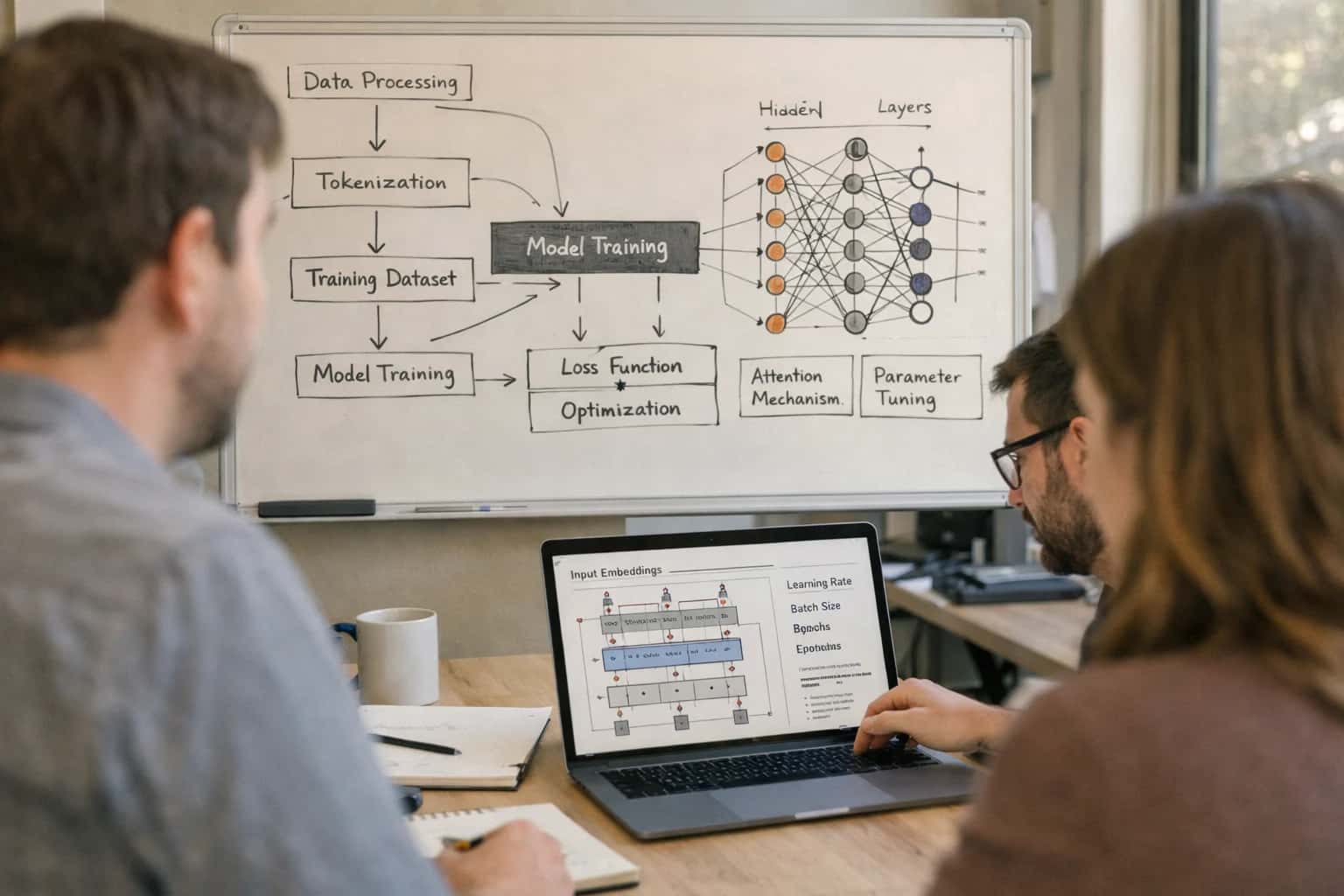
Extending Nuix with Custom Machine Learning Models
A technical guide for data scientists and legal engineers to train, package, and deploy custom ML models directly into the Nuix Workbench and processing pipeline.
The implementation detail lies in the data handoff. Your model must consume the Item objects Nuix creates—which contain extracted text, metadata, and binary representations—and return structured JSON that maps back to Nuix's schema. A common pattern is to use a Python-based inference container that loads your serialized model (e.g., a .pkl file or ONNX runtime) and listens on a queue. This container is deployed alongside the Nuix processing workers, receiving items via gRPC or REST. Results are written back as custom fields (e.g., prediction_score, detected_entity) that become searchable and reportable in Workbench. For governance, you must version your models, log all inferences with item IDs for audit trails, and implement fallback logic to handle model failures without halting the entire processing job.
Rollout follows a phased approach: first, run the model in shadow mode on a historical case, writing predictions to a log without affecting the live data. Compare its output to human-coded results to establish accuracy baselines and refine confidence thresholds. Next, enable it as a reviewer assist tool, where predictions appear as suggestions in Workbench that a human must accept or reject—this feedback loop can be used for continuous model retraining. Finally, for mature models on well-defined tasks (e.g., detecting specific regulatory clauses), automate the tagging in production mode as part of the standard processing workflow. Throughout, integrate with Nuix's RBAC to control which teams can trigger or modify models, and use its audit logging to track model usage per case for compliance and billing.
Integration Points for Custom Models in the Nuix Stack
Extending the Nuix Engine with Custom Models
The Nuix Engine is the core processing powerhouse. Integrate custom AI models directly into its ingestion and transformation pipeline via custom ingestors and exporters. This is ideal for pre-processing tasks where AI analysis should happen before data lands in Workbench.
Key Integration Points:
- Custom Ingestor: Inject a model to analyze and tag files as they are processed (e.g., for advanced language detection, PII/PHI pre-flagging, or custom entity extraction).
- Post-Processing Script: Run batch AI analysis after initial processing but before export to Workbench, enriching the item's metadata.
Example Workflow: A custom classifier ingestor scans all documents, applies a confidentiality_score based on content, and writes it to a custom metadata field for immediate filtering in Workbench.
High-Value Applications for Custom Nuix ML Models
Deploying custom machine learning models within the Nuix ecosystem transforms investigative and e-discovery workflows. These applications target specific, high-effort tasks where pre-trained models fall short, delivering precision automation directly into Workbench and processing pipelines.
Regulatory Pattern Detection
Train a model to identify complex regulatory violations (e.g., market manipulation, insider trading patterns) within communications and trading data. The model runs during Nuix processing, flagging high-risk items and populating custom metadata fields in Workbench for immediate investigator review.
Multimedia Evidence Triage
Build custom audio/video models for speaker diarization, sentiment analysis, or object detection within seized multimedia evidence. Integrate via Nuix Engine to generate searchable transcripts and highlight reels, presenting key findings as synchronized annotations within the Workbench review pane.
Proprietary Document Classification
Develop a classifier for unique, internal document types not recognized by standard ML (e.g., specific engineering schematics, custom financial forms, proprietary chat logs). The model acts as a custom ingestor, automatically applying correct document families and tags upon ingestion, structuring data for precise search and review.
Anomaly Detection in Structured Logs
Deploy models trained on application, database, or network logs to surface anomalous events indicative of fraud or security incidents. Process log exports through the Nuix Engine with the custom model, outputting a prioritized list of exceptions linked back to source files in Workbench for forensic analysis.
Dynamic Language & Dialect Identification
For global investigations, train a model to identify specific regional dialects, slang, or code words within text communications. Integrate this model into the processing pipeline to enhance language detection metadata, enabling more accurate filtering and review team assignments in Workbench based on linguistic complexity.
Custom Named Entity Recognition (NER)
Extend Nuix's entity extraction with a model trained on domain-specific entities: internal project codenames, proprietary part numbers, or non-standard person identifiers. The model enriches items during processing, populating custom object fields in Workbench to power relationship mapping and investigative timelines.
End-to-End Workflow: From Model Training to Workbench Visualization
A step-by-step technical blueprint for data scientists and legal engineers to develop, deploy, and operationalize custom machine learning models within the Nuix ecosystem, from initial training to actionable insights in Nuix Workbench.
Trigger: A legal team identifies a recurring analysis pattern not covered by Nuix's out-of-the-box analytics (e.g., identifying specific regulatory clauses in financial documents).
Process:
- Extract Training Data: Use Nuix Engine or Workbench to export a labeled dataset. This typically involves:
- Running a broad search to collect relevant documents.
- Having SMEs apply tags (e.g.,
Contains-Clause-X,No-Clause-X) via the review interface. - Exporting the document text/metadata and corresponding tags via the Nuix API or export utilities.
- Train Custom Model: Data scientists train a model (e.g., a fine-tuned transformer or a custom classifier) using the exported data.
- Common Frameworks: Scikit-learn, PyTorch, TensorFlow, or Hugging Face.
- Output: A serialized model file (e.g.,
.pkl,.pt,.joblib) and a lightweight inference script.
Key Integration Point: The training data pipeline must maintain referential integrity (Nuix document ID) to allow results to be written back to the correct records.
Architecture for Scalable Custom Model Integration
A production-ready blueprint for deploying custom machine learning models within the Nuix ecosystem, from training to runtime inference and visualization.
Integrating a custom model into Nuix begins with a clear understanding of its extensible data pipeline. The Nuix Engine serves as the core processing layer, where custom ingestors or exporters can be developed to inject model inference at key stages—such as during file processing, text extraction, or entity identification. For a scalable architecture, we recommend packaging your trained model (e.g., a PyTorch or TensorFlow model fine-tuned for specific document types like contracts or technical schematics) as a containerized microservice. This service exposes a REST or gRPC endpoint, allowing the Nuix Workbench or a custom processing script to send document text, metadata, or binary data for analysis and receive structured predictions (e.g., classification labels, extracted clauses, anomaly scores) back as custom metadata fields.
The critical integration point is Nuix Workbench's API and SDK, which enables the results of your custom model to be visualized and acted upon within the investigator's native interface. Predictions can be written back as item metadata, creating new columns in the Workbench view, or used to automatically tag items into dynamic sets. For example, a model trained to identify privileged communications can tag emails with a Privilege_Confidence score and a Privilege_Type field, allowing reviewers to sort, filter, and batch-review based on AI-generated signals. This architecture supports both batch processing of entire cases and real-time, on-demand analysis of individual items during an active investigation, all while maintaining the audit trail and chain of custody inherent to the Nuix platform.
Governance and rollout require careful planning. Start with a pilot case, using a shadow mode where model predictions are logged but not written to production items, allowing for accuracy benchmarking against human review. Implement a feedback loop where reviewer corrections in Workbench are captured to retrain and improve the model. For production, the model microservice should be deployed on GPU-accelerated infrastructure with health checks, versioning, and rollback capabilities, connected to Nuix via secure, authenticated API calls. This approach transforms Nuix from a powerful discovery tool into an AI-augmented investigation platform, where custom models built for your specific regulatory, fraud, or compliance needs become a repeatable, scalable asset.
Code Patterns for Nuix Model Integration
Packaging Custom Models for Nuix Engine
Deploying a custom ML model into the Nuix ecosystem requires packaging it as a .jar file that implements the nuix.engine.ml.Model interface. This wrapper handles data I/O between the Nuix processing engine and your model's inference logic.
Key steps include:
- Serialization: Package your trained model (e.g., TensorFlow SavedModel, PyTorch
.pt, scikit-learn.pkl) into the JAR's resources. - Input Adaptation: Map Nuix item metadata and extracted text into the tensor or feature vector your model expects. This often involves text vectorization or image preprocessing.
- Output Mapping: Transform your model's prediction (e.g., a fraud probability score) into a format Nuix can consume, typically writing results back as item metadata or custom fields.
The deployed JAR is registered with the Nuix Engine, making the model available as a processing step within workflows.
java// Example skeleton for a custom model wrapper public class CustomClassifier implements nuix.engine.ml.Model { private MyTensorFlowModel tfModel; @Override public void initialize(File modelDir) { // Load serialized model from resources tfModel = loadModel(new File(modelDir, "model.pb")); } @Override public PredictionResult predict(Item item) { // Extract features from Nuix item float[] features = extractFeatures(item.getText()); // Run inference float score = tfModel.predict(features); // Return result as metadata return new PredictionResult("fraud_score", score); } }
Operational Impact: Manual Review vs. Custom Model-Assisted Workflows
A comparison of key operational metrics before and after deploying custom machine learning models within the Nuix Workbench ecosystem, showing the shift from manual, reactive processes to AI-assisted, proactive workflows.
| Metric | Before AI | After AI | Notes |
|---|---|---|---|
Model Training & Validation Cycle | Weeks to months | Days to weeks | Iterative training with Workbench data, automated validation against case corpuses. |
Document Classification Accuracy | Rule-based or manual tagging | High-confidence AI pre-tagging | Human reviewer focuses on edge cases and model validation. |
Anomaly Detection in Data Sets | Manual sampling & spot-checks | Continuous automated scanning | AI flags outliers (e.g., encrypted files, unusual metadata) during processing. |
Time to First Insight in New Case | Days for manual corpus review | Hours for initial AI analysis | Custom models run on initial data load, surfacing key themes and custodians. |
Processing Pipeline Exception Handling | Manual triage of failures | Assisted routing & resolution | AI suggests corrective actions (e.g., different OCR engine) for failed items. |
Investigator Workflow Support | Linear search and review | Guided exploration via AI clusters | Workbench surfaces related documents and suggests investigative paths based on model findings. |
Model Performance Monitoring | Ad-hoc, manual audits | Automated drift detection & retraining triggers | Integrated tracking of model accuracy against new case data in production. |
Governance, Security, and Phased Rollout
Deploying custom ML models in Nuix requires a structured approach to ensure security, reproducibility, and operational control.
Governance starts with the model artifact itself. Each custom model must be packaged with a complete manifest detailing its training data lineage, version, performance metrics, and dependencies. This artifact is then registered in a secure, access-controlled model registry (like an internal Artifactory or Azure ML Workspace) before being deployed to the Nuix Engine runtime. Access to deploy models should be gated by RBAC, ensuring only authorized data scientists or ML engineers can push updates. All model inference calls made through the Nuix Workbench API should be logged with a unique session ID, linking predictions back to the specific model version, user, and source data batch for full auditability.
A phased rollout is critical for managing risk. Start with a shadow mode deployment, where the model processes data in parallel with existing workflows but its outputs are only logged for evaluation, not acted upon. This validates performance on real, unseen case data. Next, move to a human-in-the-loop phase within Workbench, where model suggestions (e.g., a predicted issue code or relevance score) are presented to reviewers as recommendations requiring confirmation. Finally, for mature, high-confidence models, implement guarded automation for specific, rule-gated tasks—like auto-tagging low-risk, repetitive document types. Each phase should have clear rollback procedures and performance monitoring against a golden set of labeled documents to detect model drift.
Security extends to the data pipeline. Models often require access to sensitive PII/PHI or privileged legal material. Ensure inference runs within a secured, isolated container or server group, with data encrypted in transit and at rest. Integrate with your existing data loss prevention (DLP) tools to scan model outputs if they are exported. For ultimate control, consider a private inference endpoint where the model is hosted on your infrastructure, not a public cloud service, ensuring all data never leaves your legal hold environment. This architecture, combined with phased validation, turns custom AI development from a research project into a governed, production-ready capability inside Nuix.
Enabling Efficiency, Speed & Accuracy
Intelligent Analysis, Decision & Execution
We build AI systems for teams that need search across company data, workflow automation across tools, or AI features inside products and internal software.
Talk to Us
Search across company data
Give teams answers from docs, tickets, runbooks, and product data with sources and permissions.
Useful when people spend too long searching or get different answers from different systems.

Automate internal workflows
Use AI to route work, draft outputs, trigger actions, and keep approvals and logs in place.
Useful when repetitive work moves across multiple tools and teams.

Add AI to products and internal tools
Build assistants, guided actions, or decision support into the software your team or customers already use.
Useful when AI needs to be part of the product, not a separate tool.
Frequently Asked Questions for Technical Teams
Practical questions for data scientists and engineers implementing custom machine learning models within the Nuix ecosystem, from model packaging to runtime integration and visualization in Workbench.
Nuix Engine supports custom processing through its extensible plugin architecture. The deployment workflow typically follows these steps:
- Model Packaging: Package your trained model (e.g., TensorFlow SavedModel, PyTorch
.pt, or ONNX format) and any custom inference logic into a Java or .NET assembly (JAR or DLL). This assembly acts as a wrapper that implements Nuix'sProcessororIngestorinterfaces. - Runtime Environment: Ensure the runtime dependencies (e.g., specific TensorFlow/PyTorch native libraries, Python interpreters via JNI/JNA) are available on the Nuix processing worker servers. Containerization (Docker) is recommended for consistency.
- Engine Registration: Deploy the assembly to the Nuix Engine servers and register it via configuration files. This makes your custom processor available in the processing profile dropdowns.
- Processing Profile Integration: Create or modify a Nuix processing profile to include your custom processor as a step. It can run after standard steps like text extraction and OCR.
- Output Mapping: Your processor writes results back to the Nuix case as custom metadata fields (e.g.,
custom_sentiment_score,predicted_category). These fields are then searchable and reportable in Workbench.
Example Payload Flow:
A document's extracted text is passed to your model wrapper. The wrapper calls the model, gets a prediction (e.g., {"relevance_score": 0.87, "primary_topic": "Regulatory Compliance"}), and writes these values to the document's metadata using the Nuix SDK.

About the author
Prasad Kumkar
CEO & MD, Inference Systems
Prasad Kumkar is the CEO & MD of Inference Systems and writes about AI systems architecture, LLM infrastructure, model serving, evaluation, and production deployment. Over 5+ years, he has worked across computer vision models, L5 autonomous vehicle systems, and LLM research, with a focus on taking complex AI ideas into real-world engineering systems.
His work and writing cover AI systems, large language models, AI agents, multimodal systems, autonomous systems, inference optimization, RAG, evaluation, and production AI engineering.
Partnered with leading AI, data, and software stack.





How We Work
Custom AI workflows for your Business
One-fit-all AI don't work for modern businesses. At Inferensys, we aim to understand your business & custom requirements; which we use to define most efficient agentic workflows, the data, and the tools for your business.
01
Review the use case
We understand the task, the users, and where AI can actually help.
Read more02
Pick the right approach
We define what needs search, automation, or product integration.
Read more03
Build the first useful version
We implement the part that proves the value first.
Read more04
Improve from there
We add the checks and visibility needed to keep it useful.
Read moreThe first call is a practical review of your use case and the right next step.
Talk to Us