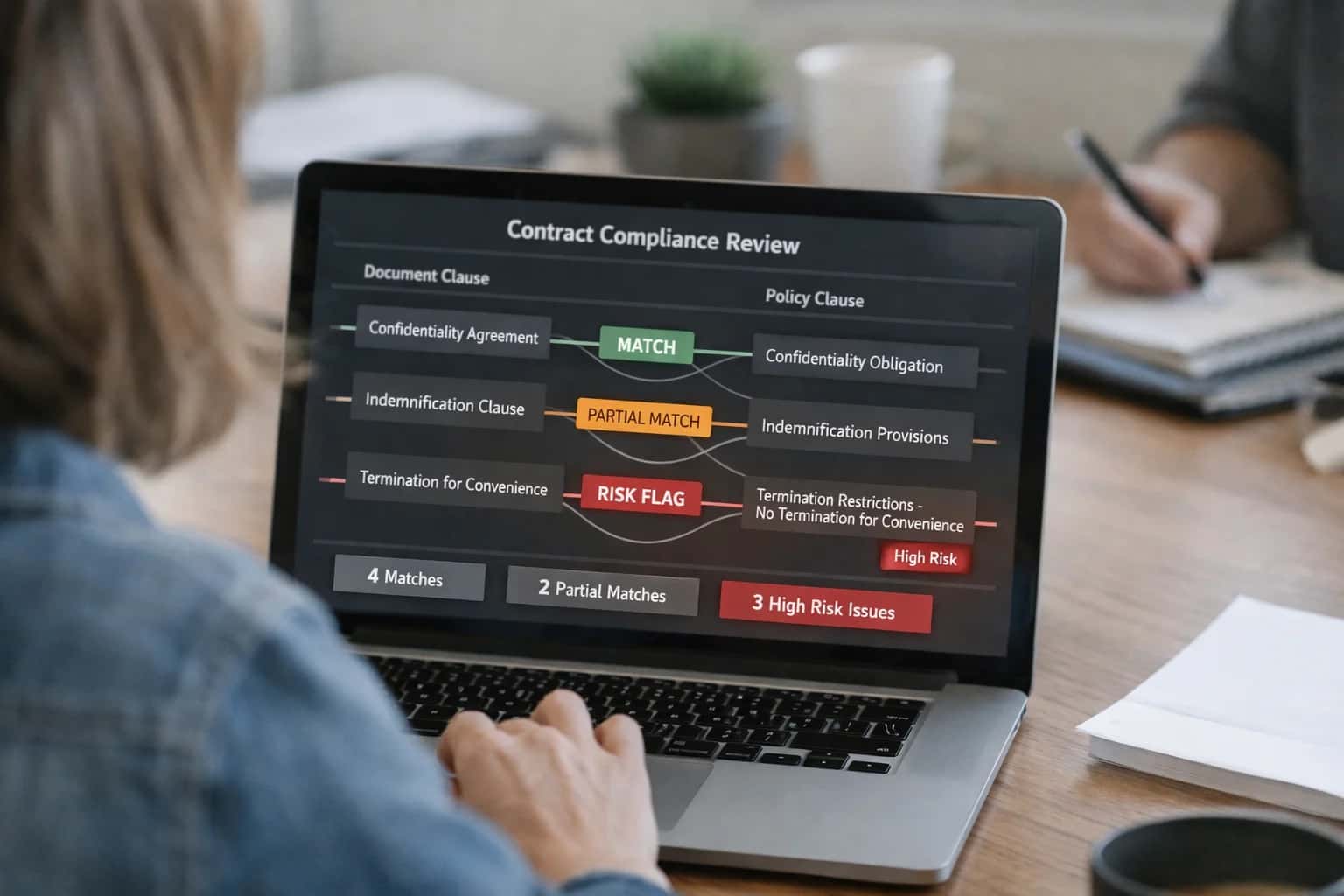
AI integration in government e-discovery connects at three critical layers: data ingestion, platform review, and export/production. During ingestion, AI agents can pre-process data from secure sources like Microsoft 365 GCC High, on-premises file shares, or mobile device collections to perform advanced OCR, language identification, and initial PII/PHI detection before documents hit the review platform (e.g., Relativity or Everlaw). Within the platform, AI operates via APIs to tag documents in legal hold workflows, populate custom objects for custodian risk scoring, and power concept search across millions of emails and files, all while logging every action to immutable audit trails.

Integration
AI for E-Discovery in Government Investigations
A specialized integration blueprint for public sector legal teams and contractors. Learn how to securely augment Relativity, Everlaw, DISCO, and Nuix with AI to handle large-volume investigations, meet strict compliance mandates, and accelerate case timelines.
SECURITY, SCALE, AND AUDITABILITY
Where AI Fits in Government E-Discovery Workflows
A practical architecture for integrating AI into government investigations, balancing automation with the strict security, chain-of-custody, and compliance requirements of the public sector.
The implementation is built for governance. AI agents are deployed in the agency's own Azure Government or AWS GovCloud environment, calling approved LLMs via private endpoints. Workflows are designed with mandatory human-in-the-loop checkpoints; for example, an AI-generated privilege log suggestion must be reviewed and approved by a senior attorney before being applied to the dataset. Integration with the e-discovery platform is event-driven, using webhooks from platforms like Relativity to trigger AI analysis when new data enters a specific workspace or when a reviewer flags a batch for predictive coding assistance. This keeps the AI tightly coupled to the existing, validated review process.
Rollout focuses on contained, high-impact use cases first, such as using AI to summarize foreign language documents or to auto-redact Social Security numbers from production sets, which directly reduces manual labor and tightens deadlines. Each integrated AI feature is accompanied by a Standard Operating Procedure (SOP) document and integrated into the agency's existing Authority to Operate (ATO) framework. The goal isn't to replace reviewers but to arm them with tools that turn weeks of sifting into days of focused analysis, all within the fortified perimeter of government IT and legal compliance. For a deeper look at platform-specific patterns, see our guides on AI Integration for Relativity and AI for Predictive Coding and TAR in E-Discovery.
AI FOR E-DISCOVERY IN GOVERNMENT INVESTIGATIONS
Platform-Specific Integration Surfaces for Government Work
AI-Enhanced Data Intake for Government Collections
Government investigations often involve massive, heterogeneous data sets from legacy systems, encrypted drives, and classified networks. AI integration at the ingestion layer focuses on improving fidelity and reducing manual prep work before documents hit the review platform.
Key integration surfaces include:
- Pre-Processing Agents: AI models that run before platform ingestion to enhance OCR, detect and classify file types (especially from custom or obsolete systems), and perform initial language identification for multi-lingual investigations.
- Metadata Enrichment: Use AI to extract and normalize entity data (names, agencies, project codes, security classifications) from document headers, footers, and properties, populating platform fields upon ingest.
- Chain-of-Custody Logging: AI agents can monitor the ingestion pipeline, automatically generating and validating audit trails required for Federal Rules of Evidence (FRE) and agency-specific protocols, logging actions directly to platform audit systems or external SIEMs.
This layer ensures data entering platforms like Relativity or Nuix is cleaner, better tagged, and forensically sound, saving weeks of manual processing in time-sensitive inquiries.
SECURITY-FOCUSED INTEGRATION PATTERNS
High-Value AI Use Cases in Government Investigations
For public sector agencies and contractors, AI integration into e-discovery platforms must prioritize security, auditability, and handling of massive, sensitive datasets. These patterns show where AI agents connect to accelerate investigations while maintaining strict chain-of-custody and compliance with frameworks like FedRAMP, CMMC, and DOJ requirements.
01
Rapid Triage for Regulatory & Congressional Subpoenas
AI agents ingest subpoena scope and immediately analyze initial data collections in Relativity or Everlaw. They perform concept clustering, custodian ranking, and privilege likelihood scoring to produce a preliminary risk and cost assessment report within hours, not weeks. Integrates with platform tagging APIs to auto-code responsive, privileged, and hot documents for first-pass review.
Weeks -> Days
Initial assessment
02
Automated PII/PHI/CUI Detection & Redaction
Deploy specialized AI models that scan for Personally Identifiable Information (PII), Protected Health Information (PHI), and Controlled Unclassified Information (CUI) patterns within document text and metadata. The agent integrates directly with the platform's native redaction tools (e.g., Relativity Redact, Everlaw Redactions) via API, applying proposed redactions in batch and logging all actions to a secure audit trail for FOIA or disclosure readiness.
Batch -> Automated
Compliance screening
03
Cross-Platform Communication Analysis
AI reconstructs communication timelines across email, encrypted messaging, and collaboration tools (Microsoft Teams, Slack archives) ingested into the platform. It identifies key participants, sentiment shifts, and policy violation indicators, mapping findings back to custodian profiles and case chronology tools within the e-discovery interface. Essential for internal misconduct or fraud investigations.
Manual -> Connected
Investigation threads
04
AI-Assisted Quality Control for Productions
Before final production to opposing counsel or regulators, an AI QC agent validates Bates numbering consistency, family relationships, and privilege log accuracy. It checks for missed redactions or metadata mismatches by comparing source files to production sets. Findings are pushed as flagged items within the platform's QC workflow, ensuring productions meet DOJ or agency standards without manual spot-checking.
High-Risk -> Governed
Production error rate
05
Foreign Language & Multimedia Analysis
For investigations involving international actors or multi-media evidence, AI agents provide real-time translation, summarization, and content analysis of non-English documents and audio/video files. Transcripts and key moment tags (e.g., 'discussion of contract terms') are synced back into the e-discovery platform as searchable documents, enabling monolingual review teams to assess relevance and privilege.
Inaccessible -> Actionable
Data coverage
06
Predictive Budgeting & Resource Forecasting
An AI model analyzes matter characteristics—data volume, custodian count, case type, and historical review rates—from the platform's database to predict total review cost and timeline. It monitors ongoing review speed and alerts project managers to bottlenecks. Integrates with matter management modules to support GAO or OMB reporting requirements and justify resource requests.
Reactive -> Forecast-Driven
Resource planning
SECURITY-FOCUSED AUTOMATION
Example AI-Augmented Workflows for Government Investigations
For government legal and investigative teams, AI integration with e-discovery platforms must prioritize security, auditability, and handling of sensitive data. These workflows illustrate how to augment core investigative processes with AI agents that operate within the strict boundaries of government systems and compliance frameworks.
Trigger: A new regulatory subpoena or FOIA request is logged in the case management system, triggering a data hold and collection in the connected e-discovery platform (e.g., Relativity).
AI Agent Action:
- The agent ingests the request scope and custodian list.
- It queries the e-discovery platform's index for an initial data set, applying date filters and custodian IDs.
- Using a secured LLM, it performs rapid concept clustering and summarization on the first 50,000 documents.
- The agent generates a confidential preliminary report identifying:
- Key themes and potential privileged topics.
- Apparent gaps in the collection.
- A high-level timeline of events.
System Update: The report is saved as a privileged document within the e-discovery platform, tagged with appropriate security markings. An alert is sent to the lead attorney via a secure, platform-integrated notification.
Human Review Point: The attorney reviews the AI-generated summary to refine the collection strategy and privilege screen before proceeding to full-scale review, saving days of manual scoping.
FEDRAMP, CMMC, AND ITAR-ALIGNED DEPLOYMENT
Secure Implementation Architecture for Government Investigations
Architectural blueprint for integrating AI into e-discovery platforms for government investigations, prioritizing air-gapped deployments, immutable audit trails, and sovereign data handling.
Government e-discovery integrations require a zero-trust architecture that treats the AI layer as a privileged, audited component within the existing security boundary. This typically involves deploying inference endpoints—whether for OpenAI, Anthropic, or open-source models like Llama 3—within the same FedRAMP High or IL5/IL6 accredited environment as the e-discovery platform (Relativity, Everlaw, DISCO). Data never leaves the accredited boundary; API calls are routed through internal service meshes, and all vector embeddings are stored in a sovereign Pinecone or Weaviate instance provisioned inside the government cloud (AWS GovCloud, Azure Government). The integration connects to the e-discovery platform's API (e.g., Relativity REST API, Everlaw API) via service accounts with role-based access control (RBAC) scoped to specific workspaces, matters, or document sets, ensuring the AI only processes data explicitly routed to it.
Workflow execution is governed by immutable audit logs that capture the full chain of AI activity: the original document ID, the prompt or instruction sent, the model used, the generated output (summary, tag, redaction coordinates), and the user or system action that triggered the call. These logs are written directly to a Splunk or Elasticsearch instance monitored by the agency's SOC and integrated with the e-discovery platform's native audit trail. For sensitive workflows like privilege log generation or early case assessment, implementations often include a human-in-the-loop (HITL) approval step within the platform's review queue before any AI-generated tag or summary is committed to the record. Batch processing for large collections uses secure, ephemeral compute queues (AWS SQS, Azure Service Bus) that auto-scale within the accredited environment and deprovision upon job completion.
Rollout follows a phased, matter-by-matter approval process. A typical pilot begins with a low-risk, high-volume use case like email threading enhancement or near-duplicate detection on a single, closed investigation. Success is measured by reduction in manual reviewer hours and validated against ground-truth human review for accuracy. Before scaling to deposition summarization or predictive coding, the system undergoes a security control assessment (SCA) to verify compliance with NIST 800-53, CMMC, or agency-specific directives. Inference Systems provides the architecture, integration code, and operational runbooks, while the government partner retains full control over model selection, data governance, and final authority for all AI-assisted decisions within the legal process.
GOVERNMENT-SPECIFIC INTEGRATION PATTERNS
Code and API Payload Examples
Ingesting Classified or CUI Data
Government investigations often involve data classified at the CUI, Secret, or Top Secret levels. AI integration must occur within accredited environments (e.g., IL5/IL6 clouds, on-prem air-gapped systems). The ingestion pipeline must validate file integrity, apply mandatory markings, and log every action to a tamper-evident audit trail before AI processing begins.
Example Python payload for secure batch ingestion:
pythonimport hashlib from gov_ediscovery_client import SecureIngestClient # Initialize client with mutual TLS and agency-specific certs client = SecureIngestClient( base_url='https://ediscovery.agency.gov/api/v1', client_cert_path='/opt/certs/client.pem', ca_bundle_path='/opt/certs/agency-ca.pem' ) # Prepare payload with required provenance metadata payload = { "case_id": "INV-2024-001-TOP-SECRET", "data_source": "SEIZED_HARD_DRIVE_ALPHA", "classification": "TOP SECRET//SI//TK", "custodian_ids": ["OFFICER_123", "CONTRACTOR_456"], "files": [ { "path": "/volumes/evidence/doc1.pdf", "original_hash": hashlib.sha256(open('/volumes/evidence/doc1.pdf', 'rb').read()).hexdigest(), "chain_of_custody_id": "COC-789012" } ], "processing_instructions": { "ocr_enabled": True, "language_detection": True, "extract_metadata": True, "ai_processing_flag": True # Explicit opt-in for AI analysis } } # Submit with non-repudiation receipt response = client.submit_ingest_job(payload) receipt_token = response['audit_receipt']
E-DISCOVERY WORKFLOW COMPARISON
Realistic Impact and Time Savings for Government Investigations
This table illustrates the operational impact of integrating AI agents into government e-discovery workflows, focusing on measurable improvements in speed, consistency, and resource allocation for investigations.
| Investigation Workflow | Traditional Manual Process | AI-Assisted Process | Key Considerations |
|---|---|---|---|
Initial Data Triage & Scope Assessment | Team of 3-5 analysts over 2-3 weeks | AI-assisted clustering & summarization in 2-4 days | Human legal team validates AI-generated scope and custodian list |
Privilege Log Generation | Paralegal team manually reviews 5-10% sample over weeks | AI flags potential privileged documents; human reviews AI output | Final privilege designations always made by attorney; AI reduces manual screening by 60-80% |
Key Custodian Identification | Manual analysis of org charts and communication patterns | AI analyzes communication volume, centrality, and content relevance | Outputs a ranked custodian list for legal team approval and hold issuance |
Deposition Prep & Transcript Analysis | Manual reading and highlighting of thousands of pages | AI provides summaries, Q&A, and key topic extraction per transcript | Enables attorneys to focus on strategy, not information gathering |
Production Set Quality Control | Manual spot-checking of Bates ranges, families, and redactions | AI runs automated checks for numbering errors, missing family members | QC focus shifts from routine checks to complex, exception-based review |
Regulatory Response Drafting | Manual compilation of data maps and responsive document lists | AI drafts initial data narrative and responsive document summaries | Attorney edits and finalizes the narrative, ensuring legal precision |
Internal Policy Violation Detection | Keyword searches and manual review of flagged communications | AI performs nuanced sentiment and policy language analysis at scale | Investigators review AI-highlighted conversations for final determination |
SECURITY, AUDIT, AND CONTROLLED DEPLOYMENT
Governance, Rollout, and Compliance Considerations
Implementing AI in government investigations requires a security-first architecture, rigorous change control, and demonstrable compliance with federal standards.
Integrations must be architected to meet FedRAMP, CJIS, or ITAR requirements where applicable. This dictates where AI models and data reside—often requiring a private cloud or on-premises deployment for the inference layer. Connections between platforms like Relativity or Everlaw and the AI service should use mutually authenticated TLS, with all API calls, document payloads, and AI-generated outputs logged to an immutable audit trail. AI agents should operate under strict role-based access control (RBAC), mirroring the platform's permissions, so a reviewer can only trigger AI analysis on matters they can already access.
Rollout follows a phased, matter-specific approval workflow. Start with a pilot on a closed, non-sensitive matter to validate accuracy and workflow integration. Use the platform's native automation (e.g., Relativity Event Handlers, Everlaw webhooks) to trigger AI processing only after manual approval by a lead attorney or case manager. Outputs—such as smart tags, summaries, or redaction suggestions—should be presented as proposed fields or tags requiring reviewer confirmation before becoming part of the official record. This human-in-the-loop gate maintains chain of custody and legal defensibility.
For compliance, AI operations must support detailed lineage reporting. This includes the source document ID, the AI model version and prompt used, the user who initiated the action, the timestamp, and the full output. This log should be exportable alongside the standard production load file. Furthermore, any AI used for Technology-Assisted Review (TAR) must comply with DOJ and case law guidance on transparency, statistical validation, and the ability to reproduce results. Governance requires regular reviews of AI performance metrics (precision/recall on test sets) and a clear rollback plan to disable AI features immediately via platform configuration if model drift or an error is detected.
Enabling Efficiency, Speed & Accuracy
Intelligent Analysis, Decision & Execution
We build AI systems for teams that need search across company data, workflow automation across tools, or AI features inside products and internal software.
Talk to Us
Search across company data
Give teams answers from docs, tickets, runbooks, and product data with sources and permissions.
Useful when people spend too long searching or get different answers from different systems.
Enterprise searchRAGPermissions
Read more
Automate internal workflows
Use AI to route work, draft outputs, trigger actions, and keep approvals and logs in place.
Useful when repetitive work moves across multiple tools and teams.
AI agentsWorkflow automationGovernance
Read more
Add AI to products and internal tools
Build assistants, guided actions, or decision support into the software your team or customers already use.
Useful when AI needs to be part of the product, not a separate tool.
AI integrationDecision supportModel routing
Read moreAI FOR E-DISCOVERY IN GOVERNMENT INVESTIGATIONS
Frequently Asked Questions for Government AI Integration
Practical answers for federal, state, and local agencies integrating AI into e-discovery workflows for investigations, audits, and FOIA responses. Focused on security, compliance, and high-volume data handling.
Integrating AI into a government e-discovery environment requires a layered security approach, not just a standard SaaS connection.
Key Implementation Patterns:
- Air-Gapped or Private Cloud Deployment: Host AI inference services (models, vector databases, orchestration) within your existing accredited cloud environment (e.g., AWS GovCloud, Azure Government). Avoid data transit to commercial AI APIs.
- API Gateway with Policy Enforcement: Route all traffic from your e-discovery platform (Relativity, Everlaw) through an internal API gateway that enforces authentication, logging, and data loss prevention (DLP) policies before reaching the AI service.
- Data Minimization & Ephemeral Processing: Design workflows where only the necessary text snippets (not entire documents) are sent for analysis. Process data in memory without persistent storage in the AI layer.
- Audit Trail Integration: Ensure every AI action (document analyzed, tag applied, summary generated) creates an immutable log entry that feeds back into the e-discovery platform's native audit system or your SIEM.
- Personnel Screening: The integration team building and maintaining the pipelines should hold appropriate clearances, with development and access controlled within your secure network.
Our architecture blueprints separate the AI runtime from the core platform, allowing you to maintain your existing ATO while adding capability.

About the author
Prasad Kumkar
CEO & MD, Inference Systems
Prasad Kumkar is the CEO & MD of Inference Systems and writes about AI systems architecture, LLM infrastructure, model serving, evaluation, and production deployment. Over 5+ years, he has worked across computer vision models, L5 autonomous vehicle systems, and LLM research, with a focus on taking complex AI ideas into real-world engineering systems.
His work and writing cover AI systems, large language models, AI agents, multimodal systems, autonomous systems, inference optimization, RAG, evaluation, and production AI engineering.
LinkedIn
Limited slotsGet a Free AI Consultation
Partnered with leading AI, data, and software stack.





How We Work
Custom AI workflows for your Business
One-fit-all AI don't work for modern businesses. At Inferensys, we aim to understand your business & custom requirements; which we use to define most efficient agentic workflows, the data, and the tools for your business.
01
Review the use case
We understand the task, the users, and where AI can actually help.
Read more02
Pick the right approach
We define what needs search, automation, or product integration.
Read more03
Build the first useful version
We implement the part that proves the value first.
Read more04
Improve from there
We add the checks and visibility needed to keep it useful.
Read moreThe first call is a practical review of your use case and the right next step.
Talk to Us