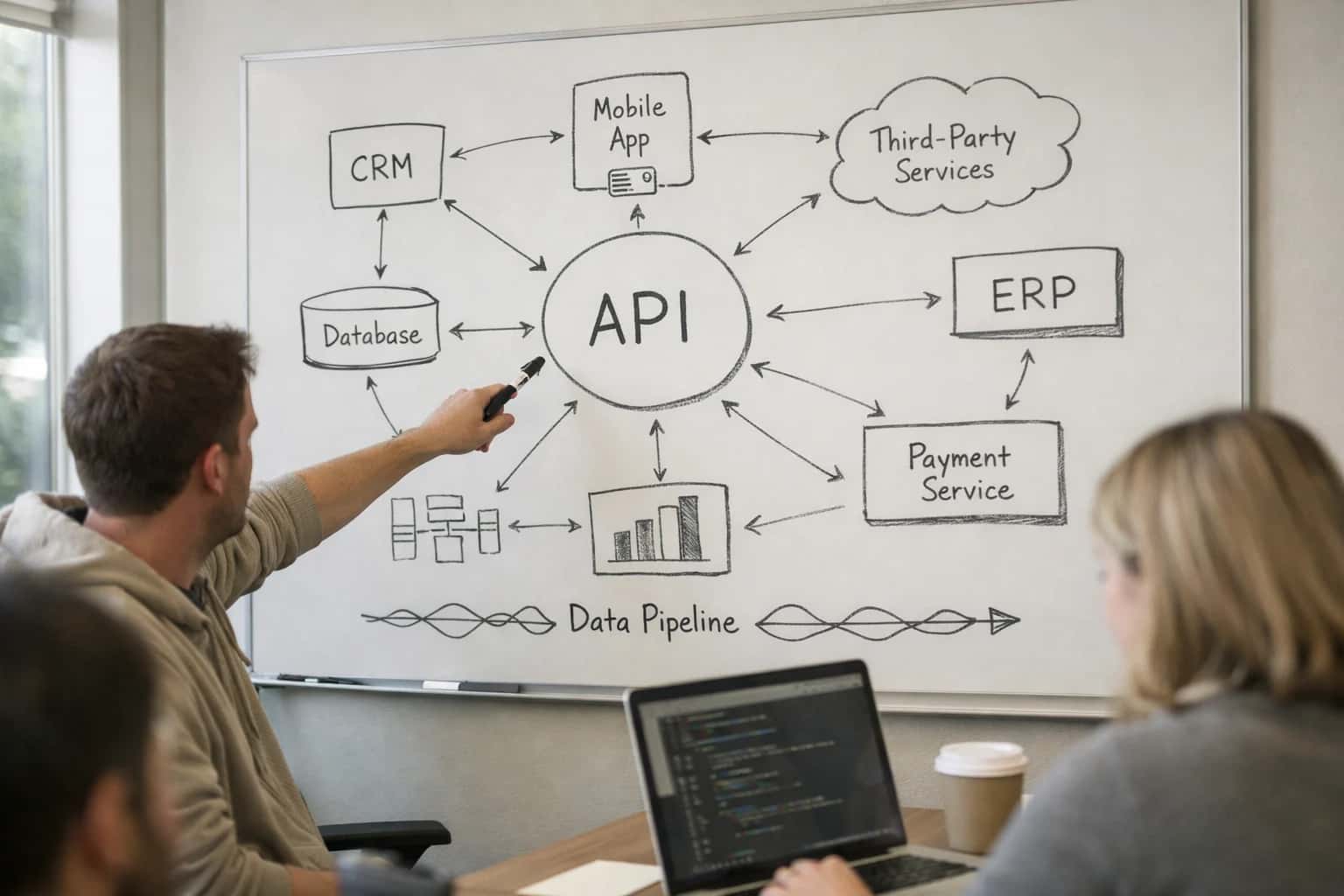
NLP acts as a pre-processing and classification layer for the text-heavy, manual workflows that surround core PMS modules. It connects primarily to three functional surfaces: the clinical documentation engine (SOAP notes, progress notes), the patient communication hub (portal messages, SMS, emails), and the revenue cycle intake (insurance correspondence, scanned forms). Instead of replacing your PMS, NLP reads from and writes back to these modules via API calls or database hooks, turning unstructured text into structured, actionable data.

Integration
AI Integration for Dental Natural Language Processing
Apply NLP to unstructured text in dental PMS—clinical notes, patient messages, insurance correspondence—to extract entities, classify intent, and automate responses.
ARCHITECTURE BLUEPRINT
Where NLP Fits in the Dental Practice Management Stack
A practical guide to injecting Natural Language Processing into the unstructured data workflows of your dental PMS.
For implementation, you typically deploy an NLP microservice that listens for events—like a new patient message in Curve Dental's API or a saved clinical note in Dentrix's database. It processes the text to extract entities (e.g., tooth numbers, symptoms, medication names from notes), classify intent (e.g., 'appointment change', 'billing question', 'pain emergency' from messages), and route or draft responses. High-impact use cases include auto-tagging clinical notes with CDT codes, triaging patient messages to the right staff role, and parsing Explanation of Benefits (EOB) documents to update claim status—reducing manual review from minutes to seconds.
Rollout requires a phased, audit-in-the-loop approach. Start with a single workflow, like automating the categorization of incoming patient portal messages. The NLP service writes its classification and confidence score back to a custom field in the PMS, where staff can review and correct misclassifications. This feedback loop continuously improves the model. Governance is critical: ensure all data processing complies with HIPAA via BAA-covered services, and implement strict access controls so AI outputs are only visible to authorized roles within the PMS's existing RBAC framework. For a deeper technical dive, see our guide on Dental Practice Management API integrations.
UNSTRUCTURED DATA SOURCES
Key Text Surfaces in Dental PMS for NLP Integration
Clinical Notes & Charting
Dental PMS clinical modules contain extensive unstructured text in SOAP notes, periodontal charting comments, treatment plan narratives, and progress notes. This is the highest-value surface for NLP, enabling automation of documentation, coding, and clinical decision support.
Key surfaces include:
- SOAP Notes: Subjective complaints, objective findings, assessment, and plan text.
- Treatment Plan Descriptions: Free-text narratives justifying procedures like crowns, implants, or periodontal therapy.
- Progress Notes: Updates on healing, symptoms, or patient-reported outcomes.
- Periodontal Charting Comments: Notes on bleeding, suppuration, or furcation involvement.
NLP can extract CDT codes, flag inconsistencies, summarize visit history, and suggest follow-up actions, directly reducing charting time and improving billing accuracy.
AUTOMATE UNSTRUCTURED TEXT WORKFLOWS
High-Value NLP Use Cases for Dental Practices
Apply Natural Language Processing to the unstructured text in your practice management system—clinical notes, patient messages, insurance correspondence—to extract entities, classify intent, and automate responses, reducing manual review and accelerating revenue cycles.
01
Clinical Note Summarization & Coding
Automatically parse SOAP notes and hygienist narratives to extract procedures, diagnoses, and medications. Generate structured summaries, suggest accurate CDT codes, and flag inconsistencies for review before claim submission.
Minutes -> Seconds
Per note review
02
Patient Message Triage & Routing
Classify intent in inbound patient portal messages and SMS. Automatically route appointment requests to scheduling, clinical questions to the provider, and billing inquiries to the front desk, with suggested responses to accelerate reply times.
Batch -> Real-time
Triage speed
03
Insurance Correspondence Analysis
Process Explanation of Benefits (EOB) documents and payer letters. Use NLP to extract denial reasons, allowed amounts, and patient responsibility, then automatically update claim status and balance in the PMS to streamline AR follow-up.
Hours -> Minutes
EOB processing
04
Automated Recall & Reactivation Campaigns
Analyze patient communication history and clinical notes to personalize recall messaging. Identify patients mentioning financial concerns or anxiety to tailor message tone and offers, improving hygiene schedule fill rates.
1 sprint
Campaign setup
05
Intelligent Document Intake & Indexing
Process uploaded documents (IDs, insurance cards, referral forms). Classify document type, extract key fields (name, ID number, group #), and pre-populate the PMS patient record, reducing manual data entry errors at check-in.
Same day
Implementation ROI
06
Compliance & Risk Monitoring
Continuously scan clinical notes and internal communications for unstructured PHI, sensitive terms, or potential HIPAA violations. Generate audit-ready reports and alert office managers to risky language or data exposure patterns.
Proactive vs. Reactive
Risk posture
AUTOMATING UNSTRUCTURED TEXT IN DENTAL PMS
Example NLP-Powered Workflows
These workflows demonstrate how NLP agents can process the unstructured text in your practice management system—clinical notes, patient messages, insurance correspondence—to extract structured data, classify intent, and trigger automated actions.
Trigger: A hygienist or dentist completes a patient visit and saves a free-text clinical note in the PMS charting module.
Context Pulled: The NLP agent receives a webhook with the patient ID and the raw note text. It fetches the patient's existing chart data (age, medical alerts, prior procedures) for context.
Agent Action: The agent uses a clinical NLP model to:
- Extract Entities: Identify tooth numbers (e.g., #3, #14), surfaces (MO, DO), procedures performed (prophy, SRP, composite), and diagnoses (gingivitis, caries).
- Summarize: Generate a concise, structured summary (e.g., "Perio maintenance on quadrants 1 & 4; existing composite on #3 intact; recommended fluoride varnish due to high caries risk.").
- Suggest Codes: Map extracted procedures to corresponding CDT codes (D1110, D4341).
System Update: The structured summary and suggested codes are posted back to the PMS via API, populating a structured summary field and pre-filling the claim form. The system flags any mismatch between the suggested code and the scheduled procedure for quick review.
Human Review Point: The dentist or billing coordinator reviews and confirms the codes before claim submission.
FROM UNSTRUCTURED TEXT TO STRUCTURED WORKFLOWS
Implementation Architecture: Connecting NLP to Dental PMS
A practical blueprint for injecting NLP intelligence into the unstructured text workflows of your dental practice management system.
The core integration surface for NLP in a dental PMS is the clinical notes module, patient messaging center, and document management system. These areas generate vast amounts of unstructured text—hygienist observations, patient portal inquiries, scanned insurance explanations of benefits (EOBs), and referral letters. The architecture connects via the PMS's API or a secure database bridge to intercept this text, route it to an NLP service for processing, and return structured data or automated actions. Key data objects include Patient.ClinicalNotes, Communication.Thread, and Document.File. The NLP pipeline typically performs: entity extraction (tooth numbers, procedure codes, dates), intent classification (appointment request, billing question, clinical concern), and sentiment analysis for patient communications.
A production implementation uses an event-driven model. For example, when a new clinical note is saved in Dentrix or Eaglesoft, a webhook triggers an NLP service to: 1) Summarize the SOAP note into a structured summary for quick review. 2) Suggest relevant CDT codes for billing. 3) Flag any missed documentation for medical history alerts. For patient messages, an AI agent can classify intent and either draft a templated response for staff approval or, for simple requests like hours or directions, send an automated reply—all while logging the interaction back to the patient's communication history. This reduces front-desk triage time from minutes to seconds and cuts down on missed billing opportunities from under-coded notes.
Rollout requires a phased, audit-first approach. Start with a read-only pilot on historical, de-identified note data to train and validate the NLP models for dental-specific terminology. Then, deploy a human-in-the-loop mode where suggestions are presented to staff within the PMS interface for acceptance or correction, creating a feedback loop to improve accuracy. Governance is critical: ensure all data processing complies with HIPAA via BAA-covered cloud services or on-premise inference, and maintain a clear audit trail of all AI-generated actions within the PMS's native audit log. This controlled integration allows practices to automate repetitive documentation and communication tasks without disrupting established clinical workflows or compliance postures. For a deeper dive on connecting to specific APIs, see our guide on Dental Practice Management API integrations.
DENTAL NLP INTEGRATION PATTERNS
Code and Payload Examples
Extracting Entities from SOAP Notes
Processing unstructured clinical notes from the PMS charting module is a primary use case. A Python service can listen for new note events via webhook, call an LLM for structured extraction, and update the patient record.
Example Payload to LLM:
json{ "text": "Patient presents for 6-month recall. BPE scores: 2,2,3,1 in quadrants 1-4. Generalized mild gingival inflammation. No caries detected. Recommended SRP in quadrant 3 and improved home care.", "instruction": "Extract the following entities: procedure_codes (CDT), periodontal_status, caries_findings, recommendations. Return as JSON." }
Expected Response:
json{ "procedure_codes": ["D0120", "D4341"], "periodontal_status": "Generalized mild gingivitis, localized periodontitis in quadrant 3", "caries_findings": "None", "recommendations": ["Scaling and root planing in quadrant 3", "Oral hygiene instruction"] }
This structured data can then be posted back to the PMS API to auto-populate billing and treatment plan fields.
APPLYING NLP TO UNSTRUCTURED DENTAL DATA
Realistic Time Savings and Operational Impact
How AI-driven natural language processing transforms manual text review in dental practice management systems, measured in time saved and workflow improvements.
| Workflow | Before AI | After AI | Implementation Notes |
|---|---|---|---|
Clinical Note Summarization | 5-10 minutes per patient chart | 30-60 seconds with auto-draft | Dentist reviews and edits AI-generated SOAP note draft from voice or typed input. |
Insurance Correspondence Triage | Manual sorting and filing of EOBs/denials | Auto-classified and routed to correct claim | NLP extracts patient, claim ID, and action code; updates PMS claim status automatically. |
Patient Message Intent Classification | Front desk reads and categorizes each message | Auto-tagged (e.g., 'Scheduling', 'Billing', 'Clinical') | Messages routed to correct staff queue in PMS; urgent clinical flags are prioritized. |
Health History Review for Alerts | Manual scan of PDF forms for red flags | Key risk factors (allergies, medications) extracted and highlighted | Extracted data populates structured fields in PMS medical history module. |
Recall Reactivation Outreach | Manual list creation and generic messaging | Segmented lists with personalized message triggers | AI analyzes last visit notes and engagement history to personalize recall reason. |
Clinical Documentation Coding Support | Manual CDT code lookup based on notes | Suggested codes with confidence scores | Integrates with charting module; final code selection requires provider approval. |
Post-Op Follow-Up Triage | Hygienist calls or reads all check-in messages | Sentiment analysis flags dissatisfied patients for immediate call | Positive check-ins receive automated confirmation in PMS; negatives are escalated. |
ARCHITECTING FOR CLINICAL DATA
Governance, Security, and Phased Rollout
Implementing NLP in a dental practice requires a security-first, phased approach that respects clinical workflows and patient privacy.
A production NLP integration for dental PMS must be architected with zero-trust principles. This means AI services never store PHI; they process text in-memory via secure APIs, with all inputs and outputs logged to an immutable audit trail. Access is controlled via role-based permissions (e.g., hygienist vs. office manager) that mirror the PMS's own security model. For platforms like Dentrix or Open Dental, this often involves using their native API tokens scoped to specific modules (e.g., ClinicalNotes.ReadWrite, Patient.Messages) and routing all data through a secure gateway that enforces encryption in transit and at rest.
A successful rollout follows a phased, value-driven path to build trust and demonstrate ROI without disrupting patient care:
- Phase 1: Non-Clinical Automation – Start with high-volume, low-risk workflows like automating patient message triage in the portal or extracting data from scanned insurance EOBs for faster posting. This proves the technology in administrative contexts.
- Phase 2: Clinical Documentation Support – Introduce AI-assisted SOAP note summarization for hygienists, with a mandatory human-in-the-loop review before finalizing the chart in Eaglesoft or Curve Dental. This reduces charting time while maintaining clinician oversight.
- Phase 3: Proactive Intelligence – Expand to predictive workflows, such as identifying patients at high risk for missed recalls or flagging inconsistent documentation for coding review, using models trained on de-identified historical practice data.
Governance is continuous. Establish a cross-functional oversight committee (clinical, administrative, IT) to review AI outputs, handle edge cases, and approve expansion to new use cases. Implement regular model performance checks for accuracy in entity extraction (e.g., tooth numbers, procedure codes) and drift detection. This controlled, iterative approach ensures the AI integration becomes a reliable, compliant component of the practice's daily operations, not a disruptive experiment. For a deeper technical dive, see our guide on Dental Practice Management API integration patterns.
Enabling Efficiency, Speed & Accuracy
Intelligent Analysis, Decision & Execution
We build AI systems for teams that need search across company data, workflow automation across tools, or AI features inside products and internal software.
Talk to Us
Search across company data
Give teams answers from docs, tickets, runbooks, and product data with sources and permissions.
Useful when people spend too long searching or get different answers from different systems.
Enterprise searchRAGPermissions
Read more
Automate internal workflows
Use AI to route work, draft outputs, trigger actions, and keep approvals and logs in place.
Useful when repetitive work moves across multiple tools and teams.
AI agentsWorkflow automationGovernance
Read more
Add AI to products and internal tools
Build assistants, guided actions, or decision support into the software your team or customers already use.
Useful when AI needs to be part of the product, not a separate tool.
AI integrationDecision supportModel routing
Read moreDENTAL NLP IMPLEMENTATION
Frequently Asked Questions
Practical questions about applying Natural Language Processing (NLP) to unstructured text within your dental practice management system (PMS).
Dental NLP can extract structured data and intent from several key text sources within platforms like Dentrix, Eaglesoft, Open Dental, and Curve Dental:
- Clinical Notes & SOAP Notes: Free-text entries from exams, procedures, and hygiene visits.
- Patient Messages: Inquiries via patient portals, SMS, or email regarding appointments, symptoms, or billing.
- Insurance Correspondence: Explanation of Benefits (EOB) comments, denial reasons, and payer notes often scanned or pasted into notes.
- Referral Letters & Medical Histories: Text from referring doctors or patient-provided health updates.
- Internal Staff Notes: Administrative notes on accounts, scheduling preferences, or follow-up tasks.
The AI parses this text to identify entities (e.g., tooth numbers, procedure codes, dates, symptoms) and classify intent (e.g., "schedule cleaning," "billing question," "pain complaint").

About the author
Prasad Kumkar
CEO & MD, Inference Systems
Prasad Kumkar is the CEO & MD of Inference Systems and writes about AI systems architecture, LLM infrastructure, model serving, evaluation, and production deployment. Over 5+ years, he has worked across computer vision models, L5 autonomous vehicle systems, and LLM research, with a focus on taking complex AI ideas into real-world engineering systems.
His work and writing cover AI systems, large language models, AI agents, multimodal systems, autonomous systems, inference optimization, RAG, evaluation, and production AI engineering.
LinkedIn
Limited slotsGet a Free AI Consultation
Partnered with leading AI, data, and software stack.





How We Work
Custom AI workflows for your Business
One-fit-all AI don't work for modern businesses. At Inferensys, we aim to understand your business & custom requirements; which we use to define most efficient agentic workflows, the data, and the tools for your business.
01
Review the use case
We understand the task, the users, and where AI can actually help.
Read more02
Pick the right approach
We define what needs search, automation, or product integration.
Read more03
Build the first useful version
We implement the part that proves the value first.
Read more04
Improve from there
We add the checks and visibility needed to keep it useful.
Read moreThe first call is a practical review of your use case and the right next step.
Talk to Us