AI diagnostic support integrates at three key points in the clinical workflow, using your PMS as the system of record: 1) Pre-Exam Data Aggregation where the AI pulls patient history, past radiographs, and health alerts from the PMS chart to provide context. 2) Intra-Exam Analysis where the AI, often via an integrated viewer or API, analyzes new radiographic images (bitewings, PAs, panoramic) in real-time, flagging potential caries, bone loss, or periapical pathologies. 3) Post-Exam Documentation where the AI generates structured findings and suggested note text, which the dentist reviews and approves before the data is written back to specific fields in the PMS clinical module, such as the periodontal chart, treatment plan, or clinical notes.

Integration
AI Integration for Dental Diagnostic Support AI
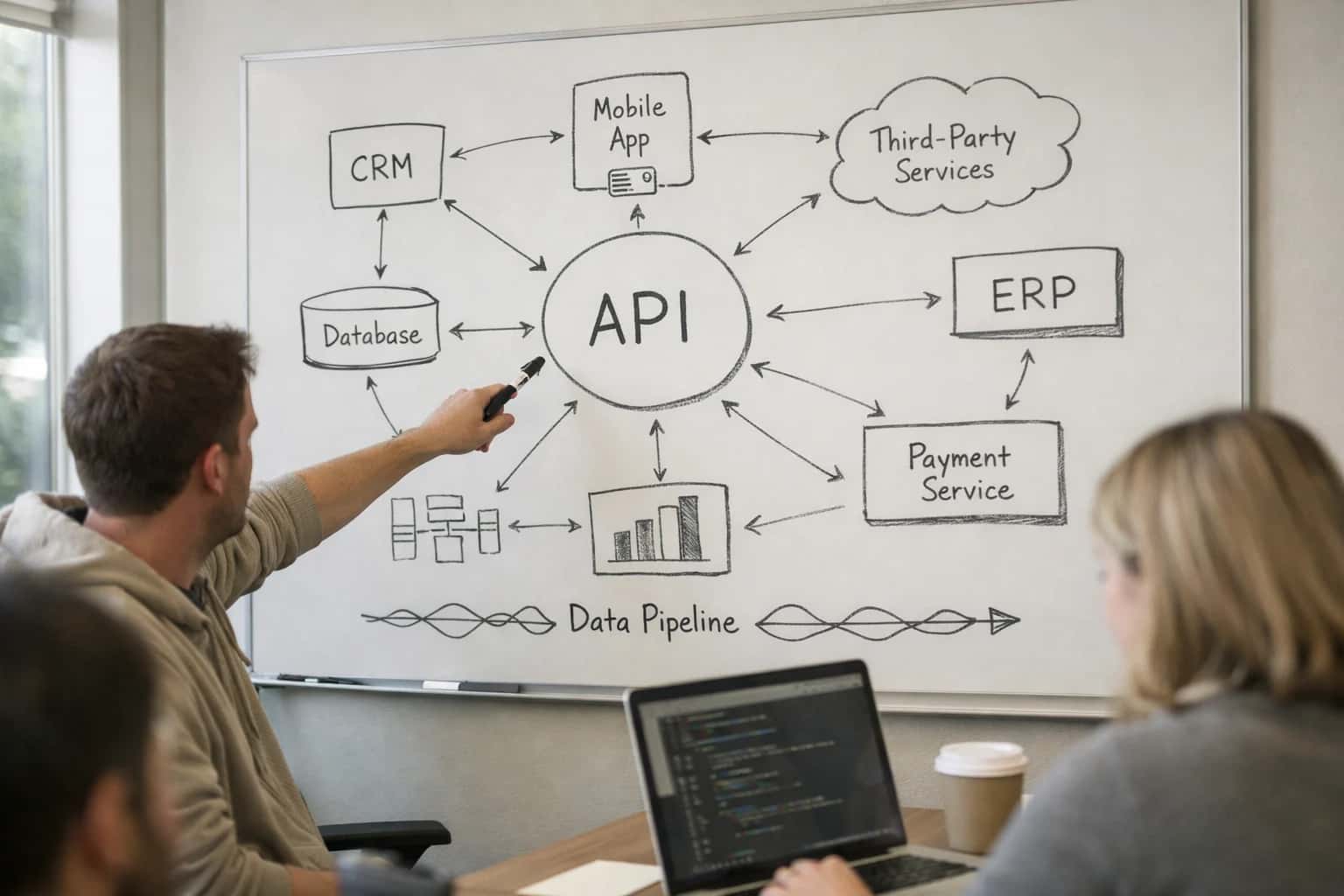
Where AI Fits into the Dental Diagnostic Workflow
A practical blueprint for integrating AI diagnostic support into the clinical surfaces of your dental practice management system (PMS).
The implementation typically uses a secure, cloud-based inference service. When a new image is saved in the PMS's integrated imaging software (e.g., Dexis, Schick), a webhook event triggers the AI service. The service fetches relevant patient context via the PMS API, processes the image, and returns a JSON payload with findings (e.g., { "potential_caries": ["tooth_3M", "tooth_14D"], "bone_loss_severity": "mild", "confidence_score": 0.92 }). A lightweight clinic-side application or embedded iFrame within the PMS UI displays these annotations for review. The dentist makes the final diagnosis, and upon approval, the system updates the patient's chart—for instance, adding a Watch note to tooth #3 and proposing a new Periodontal Maintenance procedure code to the treatment plan.
Rollout requires a phased, provider-by-provider approach, starting with hygiene exams or specific procedure types. Governance is critical: the AI is a diagnostic aid, not a replacement for clinical judgment. All AI-suggested findings must be logged in an audit trail linked to the patient record, and the system should support easy human override. The integration must be designed for minimal disruption, fitting into the existing click-path between the imaging software and the PMS chart to avoid forcing clinicians into a new, separate application. For a deeper look at clinical data workflows, see our guide on AI Integration for Dental EHR.
Integration Touchpoints Across Dental PMS & Imaging Systems
Augmenting the Clinical Record
The patient chart is the core of diagnostic support. AI integrates here to analyze structured data (periodontal charting, medical history) and unstructured clinical notes. Key touchpoints include:
- SOAP Note Fields: AI can listen to operator audio or parse typed notes to auto-populate subjective/objective findings, suggest assessment codes (ICD-10), and draft plan narratives.
- Treatment Plan Module: After analyzing radiographic findings and patient history, the AI can suggest pre-configured treatment plan lines (e.g., "D2391 - Resin-based composite - one surface, posterior") with attached AI-generated rationale.
- Health History Alerts: AI continuously screens the medical history for contraindications (e.g., bisphosphonate use for extractions) and surfaces alerts directly in the charting workflow.
Integration is typically via the PMS's clinical API to POST/PUT findings or via a companion panel that syncs in real-time.
High-Value Diagnostic Support Use Cases
Integrating diagnostic AI directly into the dental practice management workflow transforms radiographic review from a manual, time-intensive task into a structured, prioritized clinical support system. These use cases connect AI findings to the patient chart, enabling faster, more consistent diagnostic support.
Automated Caries Detection & Prioritization
AI analyzes bitewing and periapical X-rays upon upload to the imaging software, flagging potential carious lesions with confidence scores. Findings are structured into a preliminary report and attached to the patient's chart in the PMS, highlighting areas for dentist review. Workflow: Image upload → AI analysis → Findings appended to chart note → Dentist reviews/confirms.
Periodontal Bone Loss Assessment
Integrates with full-mouth series or panoramic radiographs to measure and quantify alveolar bone levels. The AI compares current bone levels to historical data in the PMS, calculating changes over time. Results populate the periodontal charting module, providing visual overlays and automated Miller classification suggestions for the hygienist or dentist.
Pathology Triage for Periapical Lesions
Scans periapical films for radiolucencies, radiopacities, and other indicators of periapical pathology (e.g., cysts, granulomas, condensing osteitis). High-probability findings are flagged in a dedicated "AI Findings" panel within the PMS chart, prioritized by urgency based on size and location, streamlining specialist referral workflows.
Implant & Restoration Planning Support
Analyzes CBCT scans to assess bone density, nerve canal proximity, and sinus location for potential implant sites. AI-generated measurements and 3D visualizations are linked to the patient's treatment plan in the PMS, providing data-driven support for case presentation and lab communication. Integrates with the PMS lab module for prescription validation.
Longitudinal Change Detection
Continuously monitors sequential radiographs for the same patient, automatically registering and comparing images to detect subtle changes in existing lesions, bone levels, or restorative margins. Anomalies are logged in the patient's clinical history within the PMS with trend lines, providing critical support for monitoring "watch" areas and justifying intervention.
Integrated Diagnostic Note Drafting
After dentist review and confirmation of AI findings, the system auto-generates a structured draft of the radiographic interpretation note using populated findings and standard clinical language. This draft is inserted into the clinical notes section of the PMS EHR, reducing dictation/typing time and ensuring coding-relevant terminology is captured for claim support.
Example AI-Augmented Diagnostic Workflows
These workflows illustrate how AI diagnostic support integrates with your dental PMS to augment clinical decision-making. Each pattern is triggered from within the practice management system, uses patient data for context, and returns structured findings to the patient chart.
Trigger: A new periapical or bitewing X-ray is uploaded and saved to the patient's document module in the PMS (e.g., Dentrix Image, Eaglesoft Digital Imaging).
Context Pulled: The PMS API provides:
- Patient ID and visit date.
- The image file itself.
- Recent clinical notes and existing caries history from the patient chart.
AI Action: A vision model analyzes the radiograph, highlighting regions of interest for potential interproximal or occlusal decay. It generates a structured JSON payload:
json{ "findings": [ { "tooth": "30", "surface": "MO", "confidence": 0.92, "note": "Moderate radiolucency consistent with caries." }, { "tooth": "31", "surface": "O", "confidence": 0.87, "note": "Early occlusal shadowing; recommend clinical exam." } ], "recommendation": "Consider restorative treatment planning for #30. Clinical confirmation advised for #31." }
System Update: The payload is posted back to the PMS via API, creating a new clinical note entry titled "AI Radiograph Review" and attaching the annotated image. The note is flagged for dentist review/sign-off.
Human Review Point: The dentist reviews the AI findings within the PMS chart during or after the exam, confirming, modifying, or dismissing them before finalizing the diagnosis and treatment plan.
Implementation Architecture: Data Flow & System Layers
A production-ready diagnostic AI integration requires a layered architecture that respects clinical workflows, secures PHI, and ensures findings are actionable within the PMS chart.
The integration connects at three primary layers within the dental PMS: the imaging module (e.g., Dexis, Schick bridge), the clinical charting interface, and the patient record database. Diagnostic AI does not replace the dentist's judgment but acts as a concurrent review system. The typical data flow is:
- Image Acquisition: A bitewing or periapical X-ray is captured and saved to the PMS's image management system.
- Event Trigger: A secure webhook or database listener detects the new image file and its associated patient ID.
- Orchestration: An integration service fetches the de-identified image (via DICOM or PNG) and relevant patient history (age, medical alerts, past caries) from the PMS API.
- AI Inference: The payload is sent to a hosted diagnostic model (e.g., a caries detection algorithm) which returns structured findings:
potential pathology,location,confidence score. - Clinical Review Layer: Findings are queued in a secure dashboard for dentist review, approval, or amendment before any permanent write-back.
- Chart Integration: Upon approval, annotations (e.g., "AI-flagged potential interproximal caries on tooth #19-DL") are written to a dedicated field in the PMS clinical note or as a structured finding linked to the radiograph.
Governance and rollout are critical. A phased implementation starts with silent mode, where AI findings are logged but not shown, to establish baseline accuracy and clinician trust. Role-based access in the PMS ensures only licensed dentists can approve AI suggestions. All data flows are encrypted in transit and at rest, with audit trails logging every image processed, user review action, and chart update. The AI service should be hosted in a HIPAA-compliant cloud, with a Business Associate Agreement (BAA) in place, and designed for zero data persistence—images and PHI are cached only for the duration of inference.
This architecture turns AI from a black box into a clinical support tool. By linking findings directly to the PMS chart, it creates a closed-loop system where diagnostic aid becomes part of the patient's permanent record, supporting longitudinal care. For practices using multiple platforms, this pattern can be adapted; see our blueprint for AI Integration for Dental Imaging Integration for deeper technical details on bridging PMS and imaging software.
Code & Payload Examples
Processing Radiographs and Updating the Chart
This workflow triggers when a new radiographic image (e.g., bitewing, periapical) is saved to the patient's document module. An AI service analyzes the image, and the findings are structured and posted back to the clinical chart.
Key Integration Points: PMS Document Storage, Clinical Charting API, Patient Record.
Example Payload to AI Service:
json{ "patient_id": "P-78910", "visit_id": "V-20240415-001", "image_urls": [ "https://pms-storage.example.com/images/bitewing_2024_left.jpg" ], "metadata": { "image_type": "bitewing", "tooth_numbers": ["2", "3", "14", "15", "18", "19", "30", "31"], "date_taken": "2024-04-15" } }
Structured Findings Payload to PMS: The AI returns a structured JSON of potential pathologies (caries, bone loss, periapical radiolucency) with confidence scores and suggested charting codes (ICD-10, SNODENT). This payload is written to a dedicated 'AI Findings' field or a clinical note, linked to the specific tooth surfaces.
Realistic Time Savings & Clinical Impact
How AI diagnostic support changes daily clinical and administrative workflows, from image review to chart documentation.
| Workflow Step | Before AI | After AI | Clinical & Operational Notes |
|---|---|---|---|
Radiograph Triage & Preliminary Review | Dentist manually scans all images | AI pre-screens, flags areas of interest | Focuses dentist's attention; reduces initial scan time by 70% |
Pathology Identification (Caries, Bone Loss) | Visual comparison, measurement tools | AI highlights potential lesions with confidence scores | Acts as a second reader; reduces oversight risk |
Chart Documentation & Note Drafting | Manual typing of findings into PMS | AI generates structured note draft from findings | Cuts charting time from 3-5 minutes to under 60 seconds per case |
Treatment Plan Data Integration | Manual entry of diagnosed codes to plan | AI suggests relevant CDT codes linked to findings | Improves coding accuracy and speeds plan creation |
Patient Communication Prep | Dentist explains findings from memory/notes | AI generates patient-friendly visual aids & explanations | Enhances case acceptance with clear, evidence-based visuals |
Follow-up & Recall Scheduling | Manual assessment of monitoring interval | AI recommends next visit timing based on risk score | Automates recall setting in PMS; personalizes preventive care |
Quality Assurance & Peer Review | Periodic manual chart audits | Continuous AI audit for documentation consistency | Provides ongoing compliance support and identifies training opportunities |
Governance, Compliance & Phased Rollout
A practical guide to deploying AI diagnostic support in dental practice management systems with appropriate controls, validation, and staged adoption.
Integrating AI for radiographic analysis into a PMS like Dentrix or Open Dental requires a governance-first architecture. The AI service must operate as a read-only analysis layer, never directly writing a diagnosis to the patient's permanent chart. Findings should be generated as a draft annotation or a flagged image within a dedicated module (e.g., a 'AI Findings Review' queue), requiring explicit dentist review and approval before being attached to the clinical record. This creates a clear audit trail within the PMS, logging which images were analyzed, which provider reviewed the AI's suggestions, and what final diagnosis was recorded, ensuring compliance with clinical documentation standards and liability frameworks.
A phased rollout is critical for clinical adoption and risk management. Phase 1 (Pilot) involves a silent mode where the AI analyzes retrospective or live radiographs but only displays findings to a single lead dentist for validation, with no impact on workflow. Phase 2 (Assistive) enables the AI to present findings as a second-read tool for specific procedures (e.g., bitewing reviews for interproximal caries), with the dentist making the final call. Phase 3 (Integrated) expands to full clinical use, with AI findings seamlessly embedded in the charting workflow, potentially triggering automated alerts for urgent pathologies. Each phase should be accompanied by provider training on the AI's capabilities and limitations, and continuous monitoring of false-positive/false-negative rates compared to gold-standard diagnoses.
Data governance is paramount. Radiographic images (DICOM/PNG) and associated patient data must be de-identified before being sent to the AI inference endpoint, with a secure token mapping results back to the correct patient record. Access to the AI module should be controlled via the PMS's existing Role-Based Access Control (RBAC), limiting it to licensed clinicians. Furthermore, the integration should support a human-in-the-loop escalation path, where ambiguous cases are automatically routed for peer review or specialist consultation, a workflow that can be managed through the PMS's existing task or referral systems. This structured approach ensures the AI augments clinical judgment without disrupting the dentist's established workflow or compromising patient safety.
Enabling Efficiency, Speed & Accuracy
Intelligent Analysis, Decision & Execution
We build AI systems for teams that need search across company data, workflow automation across tools, or AI features inside products and internal software.
Talk to Us
Search across company data
Give teams answers from docs, tickets, runbooks, and product data with sources and permissions.
Useful when people spend too long searching or get different answers from different systems.

Automate internal workflows
Use AI to route work, draft outputs, trigger actions, and keep approvals and logs in place.
Useful when repetitive work moves across multiple tools and teams.

Add AI to products and internal tools
Build assistants, guided actions, or decision support into the software your team or customers already use.
Useful when AI needs to be part of the product, not a separate tool.
Frequently Asked Questions (Technical & Clinical)
Practical questions for dental practice leaders and IT teams evaluating AI diagnostic support. These answers cover integration patterns, clinical workflows, and governance for production use.
The integration uses a secure, event-driven architecture that minimizes disruption to existing workflows.
- Trigger: A new radiographic image is saved in your imaging software (e.g., Dexis, Schick) or a completed exam is documented in the PMS (e.g., Dentrix, Eaglesoft).
- Data Pull: A secure service (via API or a monitored network folder) retrieves the anonymized image file and relevant patient context from the PMS, such as:
- Patient ID (hashed)
- Tooth numbers/quadrants
- Exam date and type
- Pertinent medical history flags (e.g., diabetes, smoking status)
- Processing: The image and context are sent to the diagnostic AI model for analysis.
- Result Delivery: Findings are returned as structured data and pushed back to the PMS via its API to create a note or populate custom fields in the patient's chart. Findings typically include:
"Potential caries detected on tooth #3, distal surface (confidence: 92%)""Moderate horizontal bone loss noted in lower anterior region""Recommend clinical correlation for radiolucency on tooth #19"
- Human Review: The AI's findings are presented as a draft note or visual overlay within the clinical module, requiring dentist review, modification if needed, and final sign-off before becoming part of the permanent record.

About the author
Prasad Kumkar
CEO & MD, Inference Systems
Prasad Kumkar is the CEO & MD of Inference Systems and writes about AI systems architecture, LLM infrastructure, model serving, evaluation, and production deployment. Over 5+ years, he has worked across computer vision models, L5 autonomous vehicle systems, and LLM research, with a focus on taking complex AI ideas into real-world engineering systems.
His work and writing cover AI systems, large language models, AI agents, multimodal systems, autonomous systems, inference optimization, RAG, evaluation, and production AI engineering.
Partnered with leading AI, data, and software stack.





How We Work
Custom AI workflows for your Business
One-fit-all AI don't work for modern businesses. At Inferensys, we aim to understand your business & custom requirements; which we use to define most efficient agentic workflows, the data, and the tools for your business.
01
Review the use case
We understand the task, the users, and where AI can actually help.
Read more02
Pick the right approach
We define what needs search, automation, or product integration.
Read more03
Build the first useful version
We implement the part that proves the value first.
Read more04
Improve from there
We add the checks and visibility needed to keep it useful.
Read moreThe first call is a practical review of your use case and the right next step.
Talk to Us