Fivetran's schema mapping process—where source tables, columns, and data types are detected and mapped to a destination warehouse—is a critical but often manual bottleneck. AI agents integrate at two key points: during the initial connector setup to infer mappings from sample data and API documentation, and within the ongoing sync monitoring to handle schema drift. Instead of manually reviewing hundreds of columns from a complex SaaS source like Salesforce or NetSuite, an LLM can analyze the extracted JSON schema, suggest appropriate Snowflake or BigQuery data types, and propose a normalized naming convention based on your organization's standards.

Integration
AI Integration with Fivetran for Schema Mapping
A technical guide for data engineers on using LLMs to automate Fivetran's schema detection and mapping, cutting connector setup time from hours to minutes and reducing manual validation for complex data sources.
AUTOMATED CONFIGURATION FOR DATA ENGINEERS
Where AI Fits into Fivetran's Schema Mapping Process
A technical blueprint for using LLMs to automate schema detection, field mapping, and validation in Fivetran, reducing manual configuration from hours to minutes.
Implementation involves deploying a lightweight service—often as a serverless function or container—that intercepts Fivetran's schema detection API calls or processes logs from the Fivetran _fivetran_schema tables. The service uses an LLM with a structured prompt containing your data warehouse's target schema rules, a glossary of business terms, and examples of past mappings. For each new or changed source column, it returns a confidence-scored mapping suggestion (e.g., source: 'Cust_Name' -> target: 'CUSTOMER_NAME' (VARCHAR(255))). High-confidence mappings can be auto-applied via Fivetran's API, while lower-confidence ones are queued for human review in a tool like Slack or Jira, creating an audit trail.
Rollout should start with a single, high-volume connector in a monitoring-only mode, where the AI suggests mappings but a data engineer approves each. Governance is critical: maintain a versioned prompt library, log all AI suggestions and human overrides, and set up alerts for unusual drift patterns. This approach turns schema mapping from a reactive, manual task into a governed, assistive workflow, ensuring data lands consistently and is immediately usable for downstream analytics and AI workloads. For teams managing dozens of connectors, this can reclaim hundreds of engineering hours per quarter.
SCHEMA MAPPING AUTOMATION
AI Touchpoints in the Fivetran Configuration Workflow
Automating Source Schema Discovery
When setting up a new Fivetran connector for a SaaS API or database, the initial schema detection can be manual and error-prone for complex, nested data structures. AI agents can analyze API documentation, sample JSON payloads, or database DDL to pre-populate the connector configuration. This includes inferring table names, column data types, and primary keys.
For example, an LLM can process a sample Salesforce REST API response to suggest object mappings and identify which fields should be marked for historical tracking. This reduces setup time from hours to minutes and minimizes configuration drift in the source's schema. The AI can also validate the proposed schema against Fivetran's best practices before the sync is activated.
FOR DATA ENGINEERS AND ARCHITECTS
High-Value AI Use Cases for Fivetran Schema Mapping
Automate the most time-consuming and error-prone aspects of Fivetran configuration using LLMs to interpret, map, and validate schemas from complex sources.
01
Automated Schema Inference for Semi-Structured APIs
Use LLMs to analyze API documentation, sample JSON responses, and OpenAPI specs to auto-generate Fivetran connector configurations. Drastically reduces manual setup for REST APIs with nested objects and dynamic fields.
Hours -> Minutes
Setup time
02
Intelligent Source-to-Target Field Mapping
Automate the mapping of source database columns or SaaS object fields to your warehouse tables. AI suggests mappings based on column names, data types, and sample values, learning from past configurations to improve accuracy.
Batch -> Guided
Mapping process
03
Dynamic Schema Drift Detection & Resolution
Continuously monitor source schema changes. When Fivetran detects a new column or altered type, an AI agent classifies the change, assesses impact, and suggests update actions—like modifying a dbt model—before the next sync.
Same day
Change response
04
Data Quality Guardrails During Ingestion
Embed validation rules at the mapping layer. As schemas are defined, AI proposes checks for PII detection, format validation, or referential integrity, generating Fivetran transformation code or downstream test assertions.
Pre-emptive
Error prevention
05
Legacy Database Modernization & Documentation
Accelerate migrations from on-premises systems. AI analyzes obscure legacy table schemas, infers business meaning from column names and sample data, and produces clean, documented mapping specifications for Fivetran replication jobs.
1 sprint
Project acceleration
06
Unified Metadata & Lineage Annotation
Automatically enrich Fivetran's technical metadata. As schemas are mapped, LLMs generate business-friendly column descriptions, tags, and data lineage notes, pushing this context to integrated catalogs like Alation or DataHub.
Auto-enriched
Metadata coverage
FIVETRAN INTEGRATION PATTERNS
Example AI-Augmented Schema Mapping Workflows
Concrete workflows showing how LLM agents can automate and validate Fivetran's schema detection and mapping processes, reducing manual configuration for complex source-to-target transformations.
Trigger: A new source connector (e.g., a niche SaaS API) is configured in Fivetran.
Workflow:
- An agent is triggered via webhook from Fivetran's connector status API or a monitoring service.
- The agent fetches the initial sync's sample payloads and the raw, inferred schema from Fivetran's metadata.
- Using an LLM with function calling, the agent analyzes the sample data against the target data warehouse's schema (e.g., Snowflake, BigQuery).
- The agent performs key actions:
- Suggests Data Types: Recommends optimal SQL data types (e.g.,
VARCHAR(255)vsTEXT,TIMESTAMP_TZvsDATE). - Infers Business Names: Generates human-readable column names (
cust_first_nameinstead off_nm). - Identifies PII: Flags columns that may contain personally identifiable information for tagging.
- Creates Mapping Document: Outputs a proposed schema mapping as a structured JSON or YAML file.
- Suggests Data Types: Recommends optimal SQL data types (e.g.,
- The proposal is sent for human review via Slack/email or can be auto-applied for low-risk connectors.
- Approved mappings are applied via Fivetran's API to configure the destination table or are used to generate initial
dbtmodels.
Impact: Reduces initial connector setup from hours of manual inspection to minutes of review.
AUTOMATED SCHEMA DETECTION AND VALIDATION
Implementation Architecture: Data Flow and Integration Points
A practical architecture for using LLMs to automate Fivetran's schema mapping, reducing manual configuration for complex source-to-target transformations.
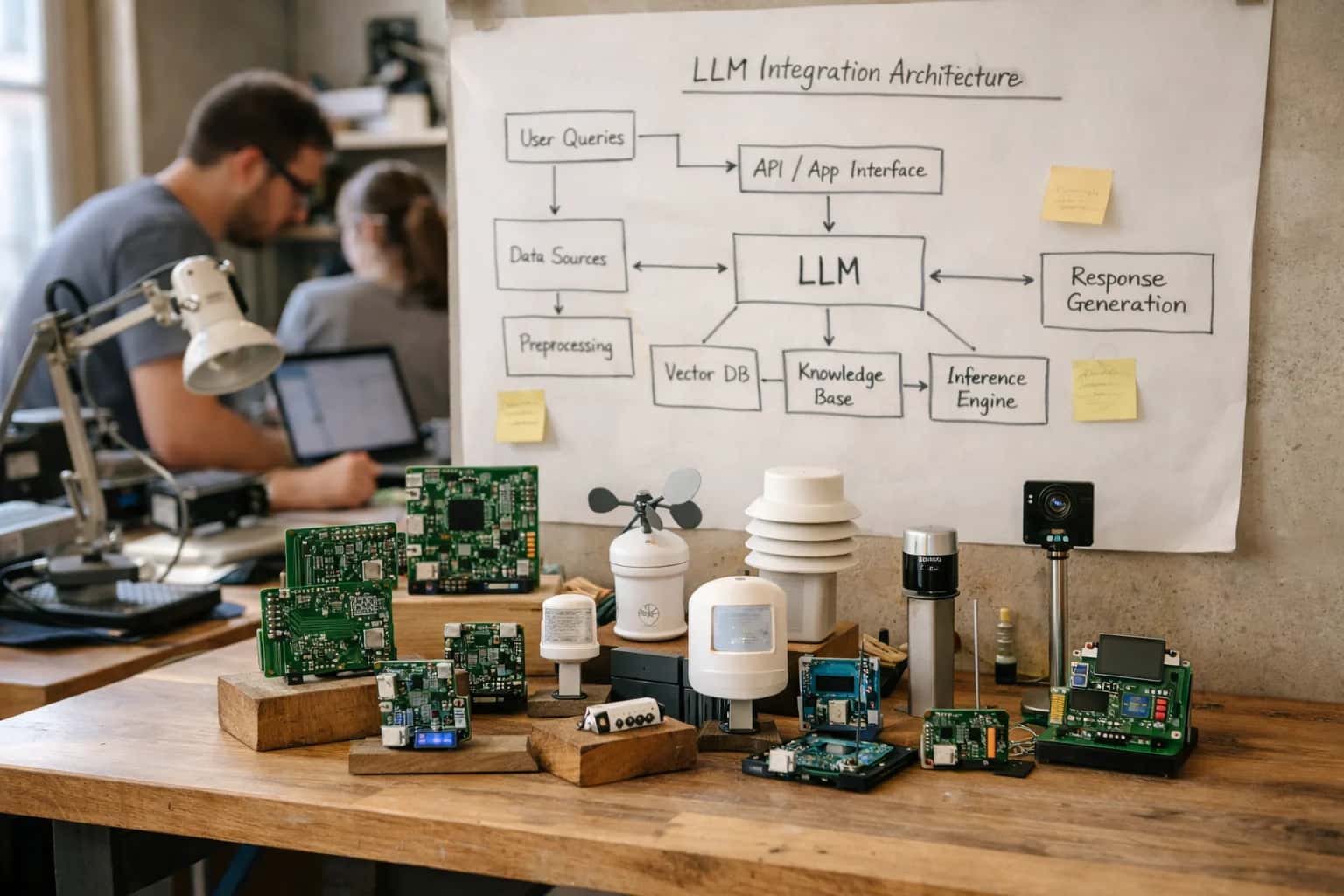
The integration injects AI logic at two key points in the Fivetran ingestion flow. First, during the connector setup and schema detection phase, an LLM agent analyzes sample data from the source (e.g., a SaaS API response, database table, or CSV file) and proposes a target schema in your data warehouse (Snowflake, BigQuery). It maps source fields to destination columns, infers data types, and suggests transformations for nested JSON or inconsistent formats. Second, in the ongoing sync monitoring phase, the same agent validates schema drift. When Fivetran detects a new or altered column, the AI compares it against the existing mapping, classifies the change (e.g., new feature rollout vs. data error), and can either auto-adapt the mapping or flag it for engineer review via a Slack alert or Jira ticket.
Implementation typically uses a serverless function (AWS Lambda, GCP Cloud Run) triggered by Fivetran's webhook alerts for schema changes or by a scheduled scan of Fivetran's log API. The function calls an LLM (like GPT-4 or Claude) with a structured prompt containing the source schema, destination context, and business rules. The output is a structured JSON payload that can be used to update Fivetran's connector configuration via its REST API or to generate a dbt model for post-load transformation. This keeps the 'brain' outside Fivetran's core, allowing for easy updates, audit logging, and human-in-the-loop approvals before any production mapping is altered.
Rollout should start with a monitoring-only mode, where the AI analyzes and suggests mappings but changes are manually applied. Governance is critical: all proposed mappings should be logged with a confidence score and rationale to a dedicated schema_audit table. For regulated data, integrate this workflow with a platform like Collibra or Alation to ensure AI-suggested mappings comply with data governance policies. This approach turns a manual, error-prone process that can take hours per connector into a consistent, auditable workflow, cutting initial configuration time significantly and reducing the risk of pipeline breaks from unexpected schema evolution.
SCHEMA MAPPING AUTOMATION
Code and Payload Examples
Automating Source-to-Target Mapping
Use an LLM to analyze source database metadata or sample JSON/CSV payloads and infer the optimal target schema in Snowflake or BigQuery. This reduces manual mapping for hundreds of tables.
Example Python pseudocode for mapping generation:
pythonimport openai from fivetran_sdk import get_connector_schema # Fetch source schema from Fivetran API source_schema = get_connector_schema(connector_id='salesforce_prod') # Prepare prompt with source details and target warehouse rules prompt = f""" Given this source schema from Salesforce: {source_schema} Generate a target schema for Snowflake with: - VARCHAR columns for text, mapped to appropriate lengths. - TIMESTAMP_NTZ for datetime fields. - BOOLEAN for checkbox fields. - Apply snake_case naming. - Identify and flag potential PII columns (email, phone). Return a JSON array of column definitions. """ # Call LLM to generate mapping response = openai.chat.completions.create( model="gpt-4o", messages=[{"role": "user", "content": prompt}] ) target_mapping = json.loads(response.choices[0].message.content) # Programmatically apply mapping via Fivetran's API
This pattern cuts schema design time from hours to minutes for new connectors.
SCHEMA MAPPING AUTOMATION
Realistic Time Savings and Operational Impact
How AI-assisted schema mapping reduces manual effort and improves data pipeline reliability for Fivetran users.
| Process Step | Before AI | After AI | Operational Notes |
|---|---|---|---|
Initial Schema Discovery | Manual review of source API docs/DB schemas | AI suggests initial field mappings with confidence scores | Engineer reviews and adjusts suggestions; focus shifts to edge cases |
Nested JSON/XML Structure Mapping | Manual traversal and flattening design | AI infers nested relationships and proposes flattened column names | Reduces cognitive load on complex APIs (e.g., Shopify, Salesforce) |
Data Type Inference & Casting | Manual specification based on sample data | AI analyzes sample payloads to recommend optimal types (timestamp, numeric, varchar) | Minimizes destination load errors due to type mismatches |
Schema Drift Detection & Alerting | Reactive: Sync failures or user reports | Proactive: AI monitors sync logs for new/removed fields, suggests updates | Prevents pipeline breaks and reduces mean time to resolution (MTTR) |
Mapping Documentation | Manual notes in Confluence or spreadsheets | AI auto-generates mapping specifications and change logs | Improves team knowledge sharing and audit readiness |
Validation Rule Generation | Basic null/format checks added post-hoc | AI proposes validation rules based on historical data patterns | Catches data quality issues earlier in the pipeline |
Connector Configuration (YAML/UI) | Trial-and-error tuning of sync frequency, page size | AI recommends optimal settings based on source API limits and data volume | Optimizes for performance and cost, avoids rate limiting |
ARCHITECTING FOR PRODUCTION
Governance, Security, and Phased Rollout
A practical framework for deploying AI-augmented schema mapping in Fivetran with control, security, and measurable impact.
Governance starts with the data model. For Fivetran schema mapping, AI agents should operate in a sandboxed environment with read-only access to source connector metadata and a dedicated staging area for proposed mappings. All AI-generated suggestions—whether for column name inference, data type casting, or transformation logic—must be logged with a full audit trail, including the source prompt, model version, and confidence score. This allows for human-in-the-loop approval workflows before any changes are promoted to active syncs, ensuring compliance with data governance policies managed in tools like Collibra or Alata.
Security is non-negotiable. The integration architecture must ensure that no raw customer data is sent to external LLM APIs during the mapping process. Instead, AI models should analyze only schema metadata (column names, inferred types, sample null rates) and synthetic patterns. All communication between Fivetran's API, your orchestration layer (e.g., a secure cloud function), and the AI service should be encrypted and adhere to your organization's data residency requirements. Implement strict RBAC so that only authorized data engineers or architects can approve AI-suggested mappings, and all actions are scoped to specific connectors and destination warehouses.
A phased rollout mitigates risk and builds trust. Start with a low-risk pilot: apply AI-assisted mapping to a net-new, non-critical data source where the impact of a mapping error is minimal. Use this phase to calibrate the AI's accuracy, refine your approval prompts, and establish baseline metrics for time saved per schema. Phase two targets high-volume, repetitive mapping tasks, such as standardizing dozens of similar SaaS source tables. The final phase introduces predictive and corrective automation, where the system proactively suggests schema evolution for existing pipelines when source APIs change, and can auto-remediate simple, high-confidence drift—always with a rollback plan and notification sent to the pipeline owner.
Enabling Efficiency, Speed & Accuracy
Intelligent Analysis, Decision & Execution
We build AI systems for teams that need search across company data, workflow automation across tools, or AI features inside products and internal software.
Talk to Us
Search across company data
Give teams answers from docs, tickets, runbooks, and product data with sources and permissions.
Useful when people spend too long searching or get different answers from different systems.
Enterprise searchRAGPermissions
Read more
Automate internal workflows
Use AI to route work, draft outputs, trigger actions, and keep approvals and logs in place.
Useful when repetitive work moves across multiple tools and teams.
AI agentsWorkflow automationGovernance
Read more
Add AI to products and internal tools
Build assistants, guided actions, or decision support into the software your team or customers already use.
Useful when AI needs to be part of the product, not a separate tool.
AI integrationDecision supportModel routing
Read moreAI INTEGRATION WITH FIVETRAN FOR SCHEMA MAPPING
Frequently Asked Questions for Data Teams
Practical answers for data engineers and architects evaluating AI to automate and validate Fivetran's schema detection and mapping processes.
AI augments, rather than replaces, Fivetran's native schema detection. The typical workflow is:
- Trigger: Fivetran detects a new source table or a schema change (new column, modified data type).
- Context Pull: The integration fetches the source schema metadata and a sample of the raw data from Fivetran's logs or staging area.
- AI Action: An LLM analyzes the source column names, sample values, and data types to:
- Propose a target column name following your data warehouse naming conventions.
- Suggest the most appropriate target data type (e.g., mapping a source
VARCHARfield containing dates to aDATEtype). - Flag potential issues, like columns that might contain PII based on name/pattern recognition.
- System Update: The proposed mapping is presented for review in a UI or via a pull request. Approved changes can be applied via Fivetran's API to update the connector configuration.
- Human Review Point: The final approval step ensures governance before any production sync is modified.

About the author
Prasad Kumkar
CEO & MD, Inference Systems
Prasad Kumkar is the CEO & MD of Inference Systems and writes about AI systems architecture, LLM infrastructure, model serving, evaluation, and production deployment. Over 5+ years, he has worked across computer vision models, L5 autonomous vehicle systems, and LLM research, with a focus on taking complex AI ideas into real-world engineering systems.
His work and writing cover AI systems, large language models, AI agents, multimodal systems, autonomous systems, inference optimization, RAG, evaluation, and production AI engineering.
LinkedIn
Limited slotsGet a Free AI Consultation
Partnered with leading AI, data, and software stack.





How We Work
Custom AI workflows for your Business
One-fit-all AI don't work for modern businesses. At Inferensys, we aim to understand your business & custom requirements; which we use to define most efficient agentic workflows, the data, and the tools for your business.
01
Review the use case
We understand the task, the users, and where AI can actually help.
Read more02
Pick the right approach
We define what needs search, automation, or product integration.
Read more03
Build the first useful version
We implement the part that proves the value first.
Read more04
Improve from there
We add the checks and visibility needed to keep it useful.
Read moreThe first call is a practical review of your use case and the right next step.
Talk to Us