AI integration for PCI DSS compliance focuses on three critical surfaces within your data security platform: sensitive data discovery scans, access audit logs, and policy violation alerts. Instead of manual quarterly reviews, AI agents can continuously monitor these feeds. For example, after a nightly discovery scan in Varonis Data Security Platform or Satori Data Access Platform, an AI workflow can analyze new file locations or database columns tagged as containing Primary Account Numbers (PAN), Cardholder Names, or Service Codes. It compares this against the known Cardholder Data Environment (CDE) scope, flags unauthorized storage outside controlled segments, and automatically generates a Jira ticket or ServiceNow incident for the security team with a contextual summary of the finding and suggested remediation steps.

Integration
AI Integration with Data Security for PCI DSS
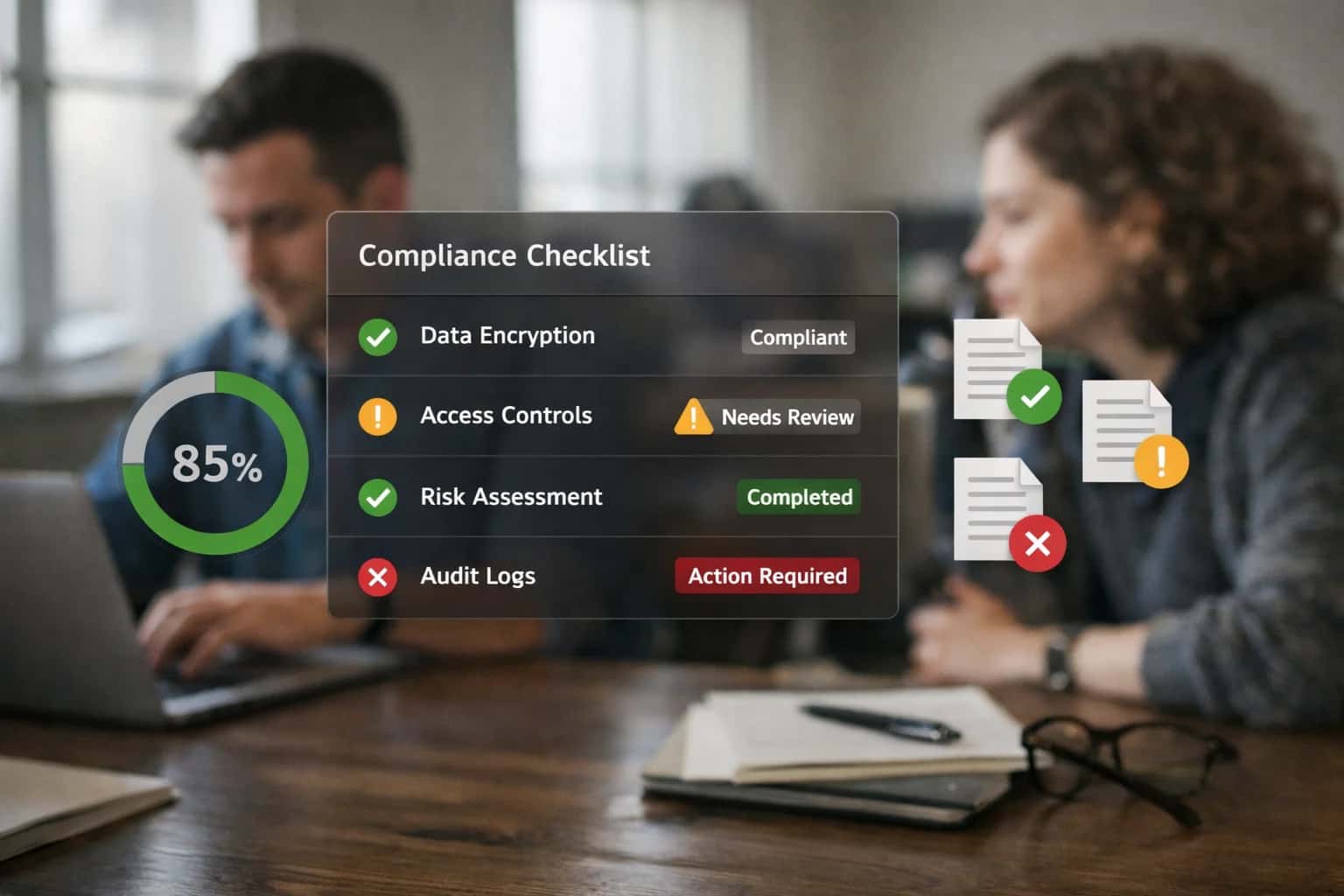
Where AI Fits into PCI DSS Data Security Workflows
Integrating AI with data security platforms like Varonis and Satori to automate PCI DSS evidence collection, monitor for cardholder data scope creep, and generate access review reports.
For the annual Self-Assessment Questionnaire (SAQ), AI can drastically reduce the manual evidence compilation burden. An integration can be configured to query the security platform's APIs for specific evidence types—such as user access reviews to systems with cardholder data, firewall rule change logs, or encryption status reports. An AI agent can then synthesize this raw log data into narrative summaries, populate evidence templates, and even draft entire sections of the SAQ (like SAQ D for Service Providers) by pulling from a pre-approved library of control descriptions and mapping them to the collected evidence. This turns a multi-week evidence hunt into a review-and-verify process completed in days.
Rollout requires careful governance. Start by connecting the AI system in a read-only capacity to a mirrored or sampled subset of audit logs and discovery results. Use a human-in-the-loop approval step for any automated tickets or report sections before they are finalized. This builds trust and creates an audit trail of AI-assisted decisions. Furthermore, the prompts and logic used by the AI to classify scope creep or generate reports must be documented and version-controlled as part of your overall PCI DSS control framework, ensuring the process itself is compliant and repeatable for auditor scrutiny.
AI Integration Points in Data Security Platforms
Automating Cardholder Data Environment (CDE) Mapping
Integrating AI with data security platforms like Varonis or Satori transforms the manual, error-prone process of defining your PCI DSS scope. AI agents can continuously analyze data access patterns, file contents, and database schemas to automatically identify systems that store, process, or transmit Primary Account Numbers (PAN).
Key integration points include:
- Scan Result Analysis: Using LLMs to interpret raw data discovery scan results, distinguishing between true PAN data and false positives (like test data or formatted numbers).
- Data Flow Mapping: Analyzing network logs and database query patterns to automatically diagram data flows in and out of the CDE, a critical requirement for PCI DSS Requirement 1.
- Scope Change Alerts: Setting up AI monitors that trigger when new databases, file shares, or applications begin interacting with PAN data, alerting the security team to potential scope creep that requires re-assessment.
This automation reduces the weeks-long manual scoping exercise to a continuous, auditable process, providing a real-time map of your compliance boundary.
High-Value AI Use Cases for PCI DSS
Integrating AI with data security platforms like Varonis and Satori transforms PCI DSS compliance from a manual, reactive audit to a continuous, intelligent control plane. These patterns focus on automating evidence collection, monitoring for scope creep, and generating audit-ready narratives.
Automated SAQ Evidence Compilation
Use AI to continuously monitor data access logs, file permissions, and network traffic. The agent correlates events against PCI DSS requirements (e.g., Requirement 8 for access control) and automatically compiles evidence packages for your Self-Assessment Questionnaire (SAQ). This turns a multi-week manual evidence hunt into a scheduled report.
Cardholder Data Scope Creep Detection
Deploy AI agents that monitor data discovery scans (e.g., from BigID or native platform tools) and user activity. They identify new databases, shares, or cloud buckets containing Primary Account Numbers (PAN) that fall under PCI scope but aren't in the official CDE inventory. Alerts security teams to unexpected expansion before the audit.
Intelligent Access Review Justification
For quarterly access reviews of cardholder data environments, AI analyzes user roles, login patterns, and data usage. It generates plain-language summaries for each user, highlighting anomalous access or lack of recent activity. This provides context for reviewers, moving beyond a simple list of names to a risk-informed decision.
Narrative Generation for Compensating Controls
When a technical constraint prevents full PCI compliance, a compensating control worksheet (CCW) with a detailed narrative is required. An AI agent, integrated with ticketing and change management systems, can draft the initial narrative by synthesizing the business justification, risk assessment, and implemented security measures, saving significant documentation time.
Real-Time Policy Violation Explanation
When a data security platform flags a potential PCI violation (e.g., PAN in an unencrypted email), AI provides an instant, contextual explanation. It pulls in user history, data classification context, and related policies to tell the analyst why it's a violation and suggests remediation steps, speeding up incident response.
QSA-Ready Audit Trail Summarization
Before an assessment, AI can process months of logs from security platforms, SIEM, and IAM systems. It generates executive summaries of control effectiveness, highlights gaps, and creates a chronological narrative of key security events. This provides your internal team and the QSA with a pre-digested, coherent story of your compliance posture.
Example AI-Augmented PCI Compliance Workflows
These workflows illustrate how AI agents and automations can integrate with data security platforms like Varonis and Satori to reduce manual effort, improve accuracy, and accelerate evidence collection for PCI DSS compliance.
Trigger: A nightly discovery scan from a data security platform (e.g., Varonis, Satori) identifies new files or database fields containing patterns matching PAN (Primary Account Number).
Context Pulled: The AI agent receives the scan alert payload, including file path, database/table name, sample content, data owner, and location (e.g., cloud storage bucket, on-prem server).
AI Agent Action:
- Contextual Analysis: The LLM reviews the sample and metadata to confirm it's likely valid PCI data (not a test number or false positive) and assesses the data's context (e.g., "appears to be a customer export CSV in a developer environment").
- Risk Scoring: The agent cross-references the data location against known network segments and access logs to assign a preliminary risk score (e.g., "High - found in a non-secured S3 bucket with public read possible").
- Ticket & Notification: The agent creates a ticket in the ITSM (e.g., ServiceNow) or a task in the security platform, tagging it with
PCI-DSS,Scope Creep, and the risk score. It also drafts and sends a notification to the data owner and security team.
System Update: The data security platform's classification label for the asset is updated to PCI - Unvalidated. The ticket includes the AI's analysis and a link to the raw alert.
Human Review Point: A security analyst reviews the ticket and AI assessment to confirm and initiate formal containment procedures.
Typical Implementation Architecture
A practical blueprint for integrating AI with data security platforms like Varonis or Satori to automate PCI DSS compliance tasks without exposing sensitive data.
The core architecture connects your data security platform's API to a secure, isolated AI processing layer. This typically involves:
- Event Ingestion: The security platform (e.g., Varonis) sends alerts or audit logs for anomalous access patterns, new data stores, or permission changes to a secure message queue (e.g., AWS SQS, Azure Service Bus).
- Contextual Enrichment: A lightweight orchestration service retrieves non-sensitive metadata—such as file paths, user roles, department codes, and timestamps—from the security platform's API to provide context for the AI, while actively filtering out or tokenizing any raw cardholder data (Primary Account Numbers, CVV, full track data).
- Secure AI Processing: The enriched, de-identified context is sent via a private API to a hosted LLM (like Azure OpenAI or a fine-tuned open model) within your VPC. The AI analyzes the patterns to generate plain-language summaries, classify risk levels, and draft compliance artifacts.
High-value workflows this architecture enables include:
- Scope Creep Monitoring: The AI continuously reviews data discovery scans from tools like Satori. It identifies new databases or cloud storage buckets containing patterns that match PCI data elements (e.g., potential PAN formats) and generates a daily summary report for the security team, flagging systems for formal classification.
- SAQ Evidence Automation: For the Self-Assessment Questionnaire, the AI ingests logs of access to cardholder data environments. It correlates user activities with approved roles and generates narrative evidence for relevant controls (e.g., "User
j.smithfromFinOpsaccessedpayment_logsdatabase 12 times in Q1, all during business hours via approved VPN"). - Access Review Reporting: Ahead of quarterly reviews, the AI analyzes permission reports for databases tagged as PCI-scoped. It groups users by department and tenure, highlights excessive privileges, and drafts a structured report for access owners, suggesting specific entitlements to review.
Governance and rollout require careful planning. The AI should never be trained on live PCI data. All prompts and completions must be logged to an immutable audit trail. A human-in-the-loop approval step is mandatory for any AI-generated artifact before it is submitted as formal compliance evidence. Start with a pilot on a single, well-defined workflow—like automating the narrative for one SAQ control—to validate the architecture, accuracy, and operational process before scaling to other PCI DSS requirements. This approach keeps cardholder data protected within your secured environment while using AI to turn security telemetry into actionable compliance intelligence.
Code and Payload Examples
Real-Time Classification & Alerting
Integrate AI with your data security platform's API to monitor data flows and classify sensitive elements in real-time. This pattern uses the platform's alerting engine to trigger when AI detects potential PCI scope creep, such as cardholder data appearing in non-sanctioned tables or logs.
python# Example: AI classification service call from a data security platform webhook handler import requests def classify_data_for_pci(payload): """ Payload from platform (e.g., Varonis, Satori) containing query/access event. """ ai_service_url = "https://api.your-ai-service.com/v1/classify" headers = {"Authorization": f"Bearer {API_KEY}"} # Enrich event with AI classification ai_payload = { "text": payload.get('query_text', ''), "metadata": { "user": payload['user'], "data_store": payload['data_store'] } } response = requests.post(ai_service_url, json=ai_payload, headers=headers) classification = response.json() # Logic to trigger platform alert if PCI data is found in unexpected context if classification.get('contains_pci_data') and not payload['is_sanctioned_location']: trigger_alert(payload, classification)
This enables security teams to move from periodic scans to continuous compliance monitoring, catching misconfigurations or policy violations as they happen.
Realistic Time Savings and Operational Impact
How AI integration with data security platforms (e.g., Varonis, Satori) changes the effort and timeline for key PCI DSS compliance activities.
| Compliance Activity | Traditional Process | AI-Assisted Process | Key Impact |
|---|---|---|---|
Scope Definition & Maintenance | Quarterly manual review of network/data flows | Continuous monitoring with automated scope drift alerts | Reduces risk of audit findings from scope creep |
Evidence Collection for SAQ | Days of manual log and policy document gathering | Automated query and report generation for evidence packages | Cuts preparation time from days to hours |
Access Review for Cardholder Data | Manual user-by-user entitlement review every 90 days | AI-prioritized review lists with anomalous access explanations | Focuses analyst effort on highest-risk entitlements |
Security Alert Triage | Manual investigation of all alerts on sensitive data stores | AI-prioritized alert queue with narrative summaries | Reduces mean time to triage by 60-70% |
Policy Exception Request Review | Manual analysis of request against static policies | AI-assisted impact analysis with historical context | Speeds approvals while improving risk assessment |
Incident Report Drafting for Breach | Manual compilation of logs and timelines post-incident | Automated timeline generation and initial report drafting | Accelerates mandatory notification timelines |
Quarterly Compliance Reporting | Manual data aggregation and narrative writing | Automated report generation with executive summaries | Shifts effort from data wrangling to strategic review |
Governance, Security, and Phased Rollout
Integrating AI with data security platforms like Varonis or Satori requires a governance-first architecture that preserves compliance and control.
A production integration for PCI DSS scope monitoring and evidence automation is built on a policy-enforced data pipeline. Sensitive data discovery scans from platforms like Varonis Data Security Platform or Satori are streamed via API to a secure processing layer. Here, AI models—hosted in your compliant cloud—analyze findings to detect scope creep (e.g., new databases storing PANs) and classify data against PCI requirements. All prompts, model calls, and outputs are logged with full audit trails, linking back to the source security platform's incident or finding ID for traceability. Access to the AI layer itself is gated by the same RBAC and just-in-time access controls used for the security platform, ensuring only authorized analysts and automated workflows can trigger processing.
Rollout follows a phased, risk-based approach. Phase 1 focuses on read-only analysis: AI reviews existing classification results and access logs to generate initial SAQ evidence drafts and highlight high-risk anomalies for manual review. Phase 2 introduces controlled automation, such as AI-driven ticket creation in the security platform's workflow engine for confirmed scope violations or automated generation of access review packages for cardholder data environments. Each phase includes parallel runs where AI outputs are compared against manual baselines, with results reviewed by the compliance team. This crawl-walk-run method builds trust, validates accuracy, and refines prompts before broader deployment.
Governance is continuous. A human-in-the-loop approval gate is mandated for any AI-generated action that modifies data classification tags, triggers access revocation, or submits compliance evidence. The integration architecture includes a dedicated model governance layer to monitor for prompt drift, ensure outputs remain within PCI-defined guidelines, and perform regular bias/accuracy checks on the training data used for context. By designing the integration as a policy-aware extension of your existing data security platform, you maintain the security posture and audit readiness required for PCI DSS, while incrementally gaining the efficiency of AI for monitoring, reporting, and response workflows.
Enabling Efficiency, Speed & Accuracy
Intelligent Analysis, Decision & Execution
We build AI systems for teams that need search across company data, workflow automation across tools, or AI features inside products and internal software.
Talk to Us
Search across company data
Give teams answers from docs, tickets, runbooks, and product data with sources and permissions.
Useful when people spend too long searching or get different answers from different systems.

Automate internal workflows
Use AI to route work, draft outputs, trigger actions, and keep approvals and logs in place.
Useful when repetitive work moves across multiple tools and teams.

Add AI to products and internal tools
Build assistants, guided actions, or decision support into the software your team or customers already use.
Useful when AI needs to be part of the product, not a separate tool.
FAQ: AI for PCI DSS Data Security
Practical answers for security and compliance teams evaluating AI integration with data security platforms to automate PCI DSS compliance tasks, from scope monitoring to audit evidence generation.
AI agents can integrate with your data security platform's API (e.g., Varonis, Satori) to continuously analyze data access and discovery logs.
Typical workflow:
- Trigger: Scheduled daily scan or real-time alert from the data security platform on new sensitive data findings.
- Context Pulled: The agent retrieves the file path, database location, data classification tags (e.g., "Credit Card Number"), and the user/service account that created or modified the data.
- AI Action: An LLM reviews the context against your defined Cardholder Data Environment (CDE) boundaries and historical baselines. It determines if this represents legitimate scope expansion (e.g., a new payment microservice) or unauthorized creep (e.g., a developer storing test data in a non-secured S3 bucket).
- System Update: The agent creates a high-priority ticket in your ITSM (e.g., ServiceNow) or security orchestration platform with a plain-language summary: "Potential PCI scope creep detected: 124 files containing PAN found in
/data/dev/test_env. Files created by svc_account_dev01. Recommend review and remediation." - Human Review Point: The ticket is routed to the PCI compliance lead for validation before any automated quarantine action is taken.

About the author
Prasad Kumkar
CEO & MD, Inference Systems
Prasad Kumkar is the CEO & MD of Inference Systems and writes about AI systems architecture, LLM infrastructure, model serving, evaluation, and production deployment. Over 5+ years, he has worked across computer vision models, L5 autonomous vehicle systems, and LLM research, with a focus on taking complex AI ideas into real-world engineering systems.
His work and writing cover AI systems, large language models, AI agents, multimodal systems, autonomous systems, inference optimization, RAG, evaluation, and production AI engineering.
Partnered with leading AI, data, and software stack.





How We Work
Custom AI workflows for your Business
One-fit-all AI don't work for modern businesses. At Inferensys, we aim to understand your business & custom requirements; which we use to define most efficient agentic workflows, the data, and the tools for your business.
01
Review the use case
We understand the task, the users, and where AI can actually help.
Read more02
Pick the right approach
We define what needs search, automation, or product integration.
Read more03
Build the first useful version
We implement the part that proves the value first.
Read more04
Improve from there
We add the checks and visibility needed to keep it useful.
Read moreThe first call is a practical review of your use case and the right next step.
Talk to Us