For teams managing AI/ML projects, metadata management platforms like Alation and Collibra are the system of record for data assets. The integration surface for AI is their REST APIs, workflow engines, and catalog interfaces. AI agents connect here to automate high-volume, manual stewardship tasks: classifying training datasets based on content and provenance, generating plain-language summaries for features in a feature store, and tracing model lineage from source data through transformation jobs to the final deployed artifact. This turns the catalog from a passive inventory into an active, AI-augmented governance layer.

Integration
AI Integration for Metadata Management for AI/ML Projects
Automate dataset tagging, model lineage tracking, and AI governance documentation by integrating generative AI with metadata management platforms like Alation and Collibra.
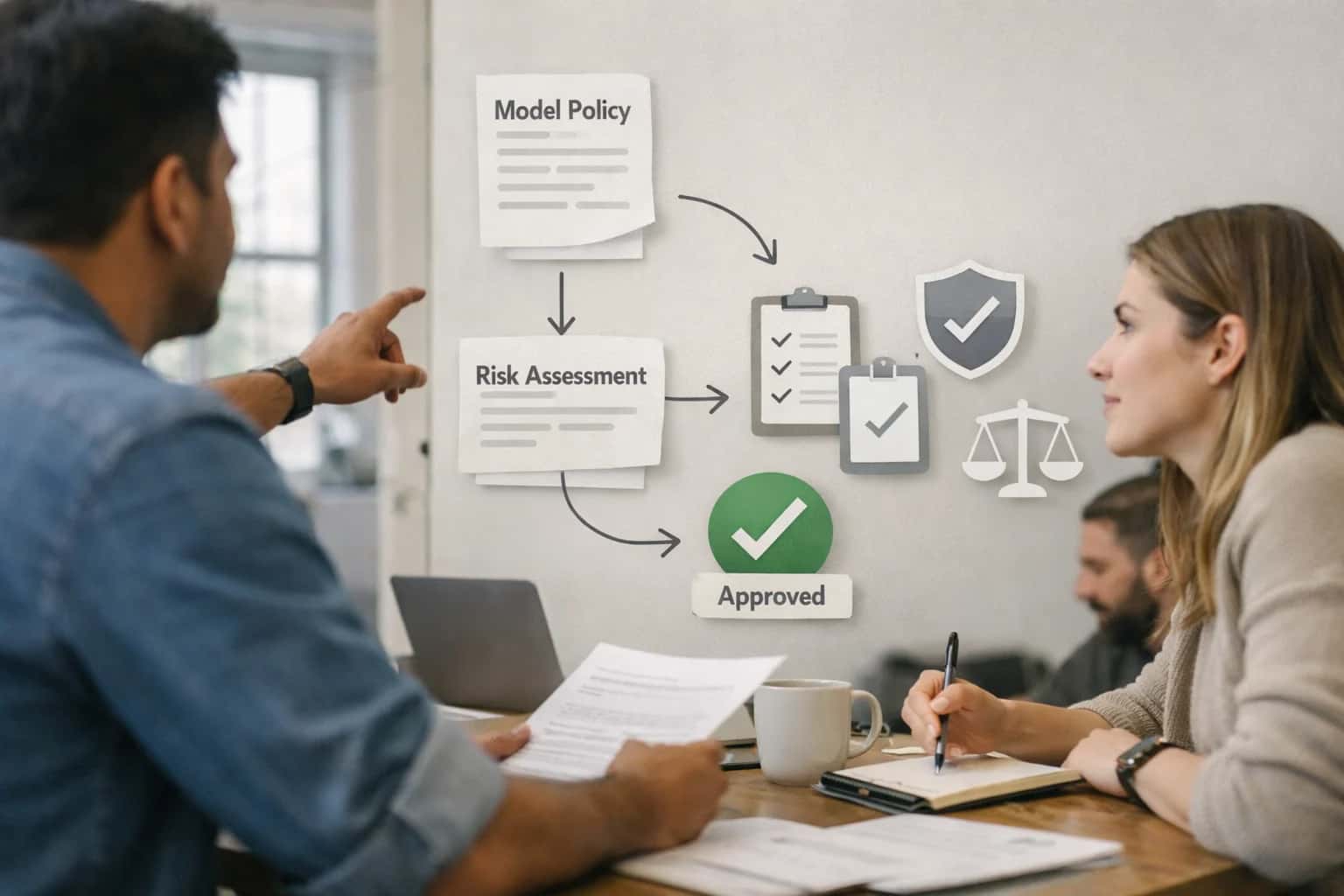
AUTOMATING GOVERNANCE FOR THE AI PIPELINE
Where AI Fits into AI/ML Metadata Management
Integrating AI with platforms like Alation and Collibra to automate the tagging, lineage, and documentation of datasets, features, and models.
The implementation typically involves an orchestration layer that listens for events—like a new dataset registration in a data lake or a model promotion in MLflow—and triggers AI workflows. For example, an agent can analyze a new dataset's schema and sample rows via the platform's API, then automatically suggest and apply business glossary terms, PII sensitivity tags, and data quality expectations. For model governance, AI can parse experiment logs and training code to auto-generate model cards and AI governance documentation, populating custom objects in Collibra or articles in Alation. This reduces the time from model development to compliant deployment from weeks to days.
Rollout requires mapping the AI/ML pipeline's key stages to the governance platform's data model. Start with a high-value, bounded use case like automating dataset tagging for a specific project or generating lineage for models in a single environment. Governance is critical: all AI-generated metadata should be flagged for human-in-the-loop review before broad publication, and prompts must be engineered to avoid hallucination of terms or lineage. This integration ensures your metadata platform scales with your AI ambitions, providing the auditable traceability that risk and compliance teams require. For related patterns on governing the data used by AI, see our guide on AI Integration for Data Governance for LLM Training.
AI FOR AI/ML PROJECTS
Key Integration Surfaces in Metadata Platforms
Automating Data Asset Documentation
AI can integrate directly with the core cataloging engine of platforms like Alation and Collibra to automate the enrichment of training datasets. By analyzing data schemas, sample records, and pipeline metadata, an AI agent can generate and suggest:
- Business-friendly column descriptions and usage notes.
- PII/sensitivity tags based on content patterns, supporting compliance for model inputs.
- Provenance and lineage links to source systems, creating a searchable inventory of AI-ready data.
This automation surfaces in the platform's UI via suggested tags and descriptions for steward approval, and is executed via REST API calls to create or update data asset objects. It turns manual, post-hoc documentation into a continuous, integrated workflow.
AUTOMATING GOVERNANCE FOR MACHINE LEARNING
High-Value AI Use Cases for AI/ML Metadata
Integrate AI with metadata platforms like Alation and Collibra to automate the governance of machine learning projects—from dataset tagging to model compliance—ensuring AI initiatives are scalable, auditable, and trustworthy.
01
Automated Dataset Classification & Tagging
Use AI to scan training datasets (e.g., in Snowflake, Databricks, or S3) and automatically apply business, sensitivity, and PII tags within the data catalog. This reduces manual stewardship work and ensures consistent policy application for AI-ready data.
Batch -> Real-time
Classification speed
02
AI-Generated Model Cards & Documentation
Automatically draft model cards and governance documentation by extracting metadata from ML platforms (MLflow, Weights & Biases). AI synthesizes training parameters, data lineage, and performance metrics into audit-ready reports stored in Collibra or Alation.
1 sprint
Documentation time saved
03
Intelligent Model Lineage & Impact Analysis
Enhance lineage graphs in platforms like MANTA or Collibra with AI to trace model predictions back to source features and training data. AI explains data drift root causes and generates impact reports for retraining decisions when source schemas change.
Hours -> Minutes
Impact analysis
04
Automated Bias & Fairness Monitoring
Connect AI governance tools (Arize AI, Credo AI) to the metadata catalog. AI analyzes model outputs and training data distributions to flag potential bias risks, automatically creating stewardship tickets in Collibra for review and documentation.
Proactive detection
Compliance risk
05
Natural Language Catalog Search for ML Teams
Augment Alation or data.world with a conversational AI layer. Data scientists can ask, "Find all customer datasets tagged for churn modeling approved for EU use," and get trusted, policy-aware results with direct links to governed assets.
Same day
Dataset discovery
06
Regulatory Report Drafting for AI Audits
For compliance with EU AI Act or internal policies, AI aggregates metadata on models, datasets, and access logs from the governance platform to auto-generate sections of conformity assessments and audit evidence packages, reviewed by stewards.
Days -> Hours
Report preparation
FOR AI/ML PROJECTS
Example AI-Augmented Metadata Workflows
These workflows demonstrate how AI agents can automate critical, yet manual, metadata management tasks for AI/ML projects within platforms like Alation and Collibra, connecting governance to the model lifecycle.
Trigger: A new dataset is registered in the data lake (e.g., an S3 path is added to Alation) or a data pipeline job completes.
Context Pulled: The agent retrieves the dataset's schema, a sample of records, and any existing project metadata from the catalog.
AI Agent Action:
- Uses a classification model to analyze column names, data types, and sample values.
- Cross-references findings with the business glossary to suggest relevant PII categories, domain tags (e.g.,
finance,customer), and sensitivity labels. - Generates a plain-language description of the dataset's contents and potential use cases for ML.
System Update: The agent proposes tags and description via the catalog's API (e.g., Alation's REST API). A data steward receives a notification for one-click approval, or tags are auto-applied based on confidence scores.
Human Review Point: Stewards review low-confidence classifications or tags applied to highly sensitive data domains before finalization.
FOR AI/ML PROJECTS
Implementation Architecture: Connecting AI to Metadata Platforms
A technical blueprint for integrating AI with platforms like Alation and Collibra to automate governance for machine learning data and models.
The integration connects to the metadata platform's REST API and workflow engine, targeting key objects: Data Assets (tables, files), Business Glossary terms, Lineage edges, and Stewardship Tasks. AI agents are triggered by events like a new dataset registration in the catalog or a model promotion in an ML platform like MLflow. The core workflow involves an AI service consuming these events, analyzing the associated data profiles or model artifacts, and writing enriched metadata back via API calls—for example, auto-generating a Column Description based on sample values or proposing Sensitive Data Tags by inspecting schema and content patterns.
For model governance, the architecture extends lineage tracking. When a training pipeline executes, an agent captures the snapshot of feature tables and the resulting model ID, then calls the metadata platform to create a Lineage Record linking the source dataset to the new model artifact. This enables critical use cases: impact analysis for data drift (e.g., 'Which models use this deprecated feature?') and automated generation of Model Cards by synthesizing lineage, performance metrics from the experiment tracker, and business context from the glossary. The AI layer acts as a bridge between the operational ML stack and the governance system of record, turning manual documentation into a byproduct of the pipeline.
Rollout is phased, starting with read-only metadata analysis to build trust in AI-generated tags before enabling automated writes. Governance is maintained through a human-in-the-loop approval queue for sensitive classifications and an audit log of all AI-suggested metadata changes linked to the prompting context. This ensures the system enhances—not bypasses—existing stewardship workflows, providing scale while keeping experts in control. For teams using Databricks Unity Catalog or Snowflake, the pattern often involves a middleware layer that synchronizes tags and policies bidirectionally, creating a unified governance plane across the data and AI estates.
AI-ENHANCED METADATA OPERATIONS
Code and Payload Examples
Automating Training Data Annotation
Integrating AI with metadata platforms like Alation or Collibra allows for the automated tagging of training datasets based on content, schema, and usage patterns. This is critical for building governed AI/ML feature stores.
A common pattern involves using the platform's REST API to fetch new or updated dataset metadata, passing column names, sample values, and existing business glossary terms to an LLM for context-aware classification, and then writing the enriched tags back via API. This automates the mapping of raw data to governed business concepts like PII_Status, Data_Domain, or Allowed_Use_Case.
Example Payload for Tagging API Call:
jsonPOST /api/v1/catalog/assets/{datasetId}/tags { "tags": [ { "tagName": "Training_Data_Approved", "source": "AI_Classifier", "confidence": 0.92, "derivedFrom": [ "Column 'transaction_amount' matches financial domain patterns.", "No PII columns detected per policy FIN-2023-01." ] } ] }
This creates an auditable, machine-readable record of why a dataset was classified as suitable for model training.
AI-ENHANCED METADATA MANAGEMENT FOR AI/ML PROJECTS
Realistic Time Savings and Operational Impact
This table compares manual metadata management processes against an AI-augmented approach integrated with platforms like Alation or Collibra, showing realistic efficiency gains for MLOps and data science teams.
| Process | Manual / Baseline | AI-Augmented | Implementation Notes |
|---|---|---|---|
Dataset Tagging & Classification | Hours per dataset for manual review and tagging | Minutes for automated suggestion and steward review | AI suggests tags based on schema, sample data, and lineage; human approval required for governance. |
Model Card & Documentation Generation | Days to weeks for manual drafting and review | Hours to generate first draft from training metadata | AI pulls from experiment logs, feature definitions, and governance policies; technical lead reviews and finalizes. |
Lineage Mapping for Model Features | Manual tracing across notebooks, ETL jobs, and source tables | Automated discovery and visualization of key data flows | AI parses code repositories, SQL logs, and pipeline metadata to infer and suggest lineage connections. |
Bias & Fairness Assessment Prep | Manual data profiling and slice identification for testing | Automated sensitive attribute detection and slice suggestion | AI scans training data and model outputs to flag potential cohorts for fairness evaluation. |
Compliance & Audit Evidence Collection | Weeks to manually gather artifacts for internal/external audit | Days to auto-assemble evidence packages from catalog metadata | AI queries the metadata graph for relevant datasets, models, and approvals, generating structured reports. |
Stewardship Task Prioritization | Ad-hoc based on emails or spreadsheets | Ranked backlog based on data usage, quality scores, and project criticality | AI analyzes catalog activity, data quality incidents, and project timelines to suggest daily priorities for data stewards. |
Onboarding to New ML Project | Days to understand relevant datasets, owners, and policies | Hours with AI-generated project briefing and interactive Q&A | AI creates a tailored summary of project data assets, lineage, and governance rules from the catalog, accelerating ramp-up. |
ARCHITECTING CONTROLLED AI FOR METADATA WORKFLOWS
Governance, Security, and Phased Rollout
Integrating AI into metadata management for AI/ML projects requires a security-first, policy-aware architecture that embeds governance directly into the automation layer.
A production integration connects your AI orchestration layer (e.g., using tools like CrewAI or n8n) to your metadata platform's REST API (e.g., Alation or Collibra). The AI agent acts as a privileged, automated steward. It requires service accounts with scoped permissions—typically to create/update Glossary Terms, Data Assets, Lineage Objects, and Model Cards—but never to delete core records or modify user permissions. All AI-generated metadata proposals should be logged as draft suggestions, often requiring a human-in-the-loop approval step within the platform's native workflow engine before promotion to production status. This creates a full audit trail linking the AI agent, the source data, and the approving steward.
Security is multi-layered. First, the AI service itself must be deployed in a secure VPC with access limited to the metadata platform's API and the approved data sources for analysis (e.g., feature stores, model registries, data catalogs). Second, a policy engine—often a lightweight rules service or integration with your existing Immuta or Privacera platform—should evaluate every AI action. For example, before an AI agent tags a dataset as containing PII for a model card, the policy engine checks if the agent is authorized for that data domain and if the tag complies with internal classification standards. Third, all prompts and API calls should be logged for compliance, enabling traceability from a generated model card back to the exact LLM call and source data snapshot.
A phased rollout mitigates risk and builds trust. Phase 1 (Assistive Drafting): Deploy AI as a co-pilot for data stewards and ML engineers, focusing on automating the generation of draft dataset descriptions, model card sections, and preliminary lineage links within a single sandbox business unit. Output requires explicit review and approval. Phase 2 (Controlled Automation): Expand to automated tagging of training datasets based on schema and sample data, and triggering lineage updates upon model deployment events in MLflow or SageMaker. Implement automated quality checks (e.g., for required fields in a model card) and escalation workflows for low-confidence AI suggestions. Phase 3 (Policy-Driven Orchestration): Scale to enterprise-wide coverage, where AI agents proactively monitor the AI/ML pipeline, governed by centralized policies. They can automatically update data quality scores in the catalog based on model performance drift or generate compliance summaries for audit-ready packages, all while operating within the guardrails of your integrated data governance and privacy platforms.
Enabling Efficiency, Speed & Accuracy
Intelligent Analysis, Decision & Execution
We build AI systems for teams that need search across company data, workflow automation across tools, or AI features inside products and internal software.
Talk to Us
Search across company data
Give teams answers from docs, tickets, runbooks, and product data with sources and permissions.
Useful when people spend too long searching or get different answers from different systems.
Enterprise searchRAGPermissions
Read more
Automate internal workflows
Use AI to route work, draft outputs, trigger actions, and keep approvals and logs in place.
Useful when repetitive work moves across multiple tools and teams.
AI agentsWorkflow automationGovernance
Read more
Add AI to products and internal tools
Build assistants, guided actions, or decision support into the software your team or customers already use.
Useful when AI needs to be part of the product, not a separate tool.
AI integrationDecision supportModel routing
Read moreAI INTEGRATION FOR METADATA MANAGEMENT
FAQ: Technical and Commercial Questions
Practical answers for teams integrating AI with platforms like Alation and Collibra to automate governance for AI/ML projects, covering implementation, security, and rollout.
The connection is typically made via the catalog's REST API, using a secure middleware layer (often a purpose-built service) to manage the interaction. Here’s the common pattern:
- Trigger & Context Pull: A new dataset is registered in Alation or Collibra, or a scheduled scan identifies untagged assets. The integration service extracts sample data, column names, existing business glossary terms, and usage metadata via API.
- Secure Payload Assembly: The service redacts any actual sensitive data values (PII, secrets) from the sample before sending context to the LLM. It sends only schema, metadata, and a curated list of your organization's approved business terms.
- Model Action: The LLM (e.g., GPT-4, Claude, or a fine-tuned internal model) analyzes the context and suggests relevant tags, classifications, and potential glossary associations. It can also draft a plain-language dataset description.
- Governed System Update: Suggestions are returned to the middleware, where a rules engine or a human steward can approve, modify, or reject them. Approved tags are then written back to the catalog via API, with a full audit trail of who or what system made the change.
Key Security Note: The LLM should never have direct, persistent access to your production data catalog or raw data. All interactions are brokered through the integration service, which enforces RBAC, masks sensitive data, and logs all prompts and completions.

About the author
Prasad Kumkar
CEO & MD, Inference Systems
Prasad Kumkar is the CEO & MD of Inference Systems and writes about AI systems architecture, LLM infrastructure, model serving, evaluation, and production deployment. Over 5+ years, he has worked across computer vision models, L5 autonomous vehicle systems, and LLM research, with a focus on taking complex AI ideas into real-world engineering systems.
His work and writing cover AI systems, large language models, AI agents, multimodal systems, autonomous systems, inference optimization, RAG, evaluation, and production AI engineering.
LinkedIn
Limited slotsGet a Free AI Consultation
Partnered with leading AI, data, and software stack.





How We Work
Custom AI workflows for your Business
One-fit-all AI don't work for modern businesses. At Inferensys, we aim to understand your business & custom requirements; which we use to define most efficient agentic workflows, the data, and the tools for your business.
01
Review the use case
We understand the task, the users, and where AI can actually help.
Read more02
Pick the right approach
We define what needs search, automation, or product integration.
Read more03
Build the first useful version
We implement the part that proves the value first.
Read more04
Improve from there
We add the checks and visibility needed to keep it useful.
Read moreThe first call is a practical review of your use case and the right next step.
Talk to Us