AI integration for platforms like Docebo, Cornerstone, Absorb LMS, and TalentLMS typically follows an API-first, event-driven pattern. The core surfaces for AI are the learner profile (goals, job role, past activity), the content catalog (courses, videos, documents), and the administrative layer (reporting, user management, communications). AI models connect via REST APIs or webhooks to ingest user events (completions, searches, time-on-content), analyze unstructured content (SCORM packages, video transcripts, PDFs), and trigger automated workflows (assignments, notifications, skill tagging). The goal is to augment, not replace, the existing LMS data model and business logic.

Integration
AI Integration for Corporate LMS Platforms
A technical blueprint for embedding AI into enterprise learning platforms (Docebo, Cornerstone, Absorb, TalentLMS) to automate content tagging, personalize learning paths, analyze skills gaps, and streamline training operations.
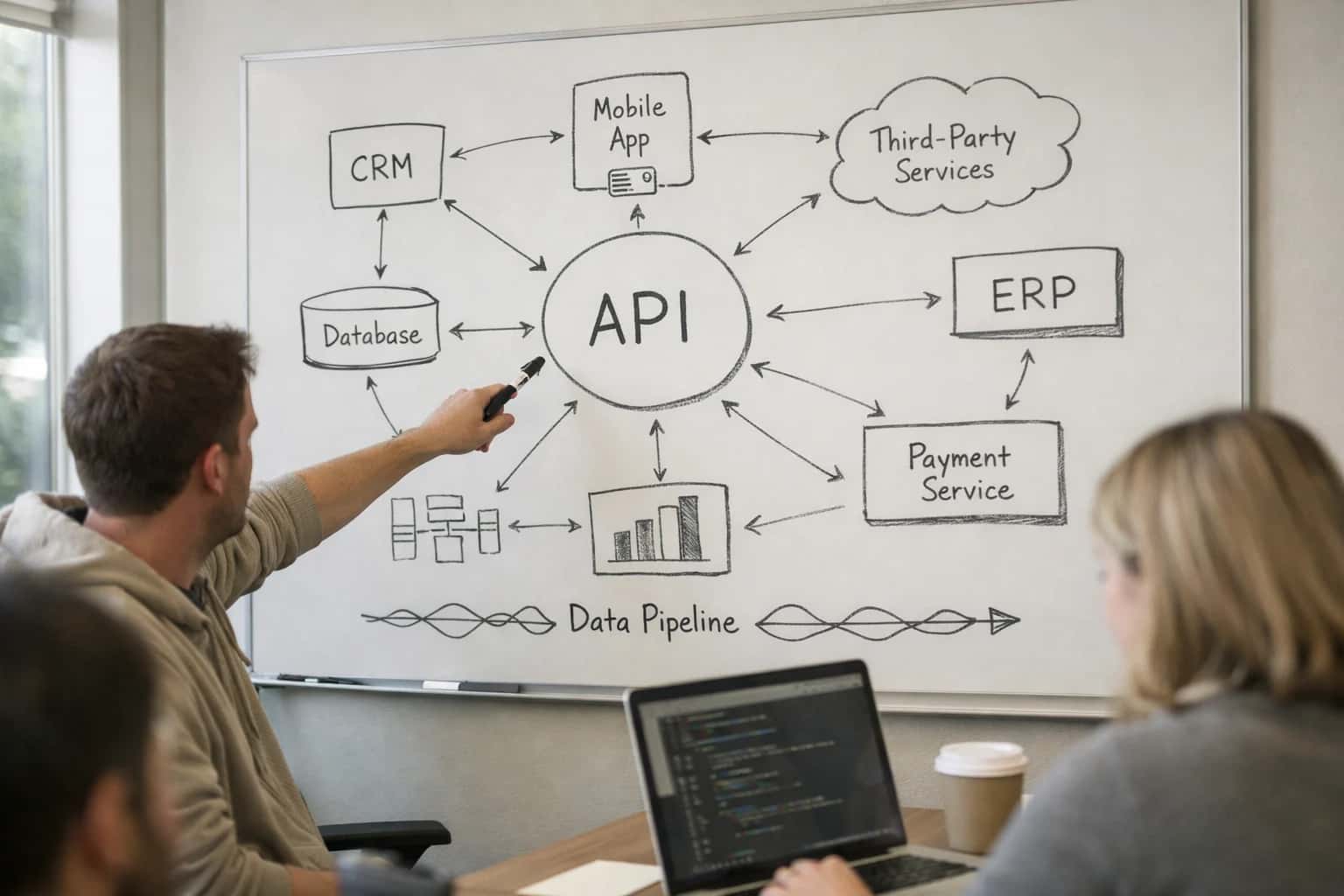
ARCHITECTURE & ROLLOUT
Where AI Fits into Your Corporate LMS Stack
A practical guide for CTOs and learning architects on integrating AI into enterprise learning platforms without a full rip-and-replace.
Implementation starts by identifying high-friction, high-volume workflows. For example, an AI-powered skills inference agent can run nightly, consuming data from the User, CourseCompletion, and ExternalActivity APIs. It maps activity to a skills framework (like ESCO or your internal taxonomy) and writes inferred skill levels back to a custom object or user field via the LMS API. Another common pattern is a RAG-based learner support copilot. This system uses a vector store indexed on course content, FAQs, and policy docs. When a learner asks a question in a chat widget, the system queries the vector store via the LMS's SSO and context API to ground the response in authorized content, ensuring accuracy and compliance.
Rollout requires a phased, governance-first approach. Start with a pilot group and a single use case, such as automated content tagging for new uploads. Implement an approval loop where AI-suggested tags (e.g., compliance, beginner-level, software-training) are reviewed by an L&D admin before being committed via the ContentMetadata API. For personalized learning path generation, use A/B testing to compare AI-recommended paths against static curricula, measuring completion rates and skill acquisition. Critical governance controls include audit logs for all AI-generated actions (who triggered it, what was changed), RBAC integration to ensure AI agents only act within their permissions, and a human-in-the-loop step for high-stakes operations like compliance course assignments.
The business impact is operational efficiency and adaptive learning. AI integration turns the LMS from a static content repository into a dynamic skills intelligence engine. It reduces the manual overhead of tagging thousands of assets, enables just-in-time learning recommendations based on project assignments pulled from an HRIS, and provides L&D leaders with natural-language insights like, 'Which sales regions have the lowest completion rates for the new product training, and what common themes are in their feedback?' This is not about replacing instructional designers but empowering them with tools to scale personalized learning across the enterprise.
WHERE AI CONNECTS TO THE DATA MODEL
Primary Integration Surfaces in Leading LMS Platforms
The Learner Record System
AI models require rich, contextual user data to personalize experiences. The primary integration surface is the User Object/API, which contains:
- Demographic and role data: Job title, department, location, tenure.
- Learning history: Course enrollments, completions, assessment scores, time spent.
- Skills and goals: Manually entered skills, competency frameworks, career aspirations.
Integration Pattern: A scheduled job or real-time webhook syncs user profiles from the LMS to a vector store or data lake. AI models then analyze this data to infer latent skills, predict knowledge gaps, and generate personalized learning recommendations. This powers use cases like dynamic learning path generation and skills inference engines.
Key API Endpoints: GET /users, GET /users/{id}/enrollments, POST /users/{id}/skills.
OPERATIONAL BLUEPRINTS
High-Value AI Use Cases for Corporate LMS
For CTOs and learning architects, here are proven AI integration patterns that connect to the core data models and APIs of platforms like Docebo, Cornerstone, Absorb, and TalentLMS to automate workflows and personalize learning at scale.
01
Personalized Learning Path Generation
Use AI to analyze a learner's role, past course completions, and skills profile (often from an integrated HRIS) to dynamically assemble and recommend a unique learning journey. This moves beyond static curricula to adaptive paths that update as goals or business needs change.
Static -> Adaptive
Curriculum model
02
Automated Skills Inference & Gap Analysis
Connect AI models to LMS activity data, performance review text, and job architecture to continuously infer an employee's current skills and identify gaps against target roles. This creates a real-time, AI-powered skills inventory synced with the LMS user profile.
Quarterly -> Real-time
Skills visibility
03
Intelligent Content Tagging & Curation
Integrate AI to automatically tag, summarize, and enrich metadata for uploaded learning assets (videos, PDFs, SCORM packages). This powers accurate search, improves content discoverability, and enables AI-driven recommendations based on semantic understanding, not just keywords.
Hours -> Minutes
Metadata creation
04
Conversational Learner Support Agent
Build a RAG-based chatbot or copilot embedded in the LMS interface. It uses Retrieval-Augmented Generation on course content, FAQs, and policy docs to answer learner questions instantly, reducing help desk tickets and providing 24/7 support.
Tier 1 Deflection
Support impact
05
AI-Enhanced Training Operations
Automate routine L&D admin work. Use AI agents to trigger cohort communications, generate compliance reports, manage deadline reminders, and handle user provisioning/de-provisioning via LMS APIs and webhooks, freeing admins for strategic work.
Batch -> Real-time
Admin workflow
06
Dynamic Assessment & Feedback
Integrate AI into the LMS testing module to create adaptive assessments that adjust question difficulty based on performance and generate personalized, natural-language feedback. This identifies precise knowledge gaps and recommends remedial content.
Generic -> Personalized
Learner feedback
IMPLEMENTATION PATTERNS
Example AI-Enhanced LMS Workflows
These concrete workflows illustrate how AI integrates with core LMS APIs and data models to automate high-value tasks. Each pattern is designed to be triggered by platform events, leverage user and content context, and update system records or initiate next steps.
Trigger: A user's job role is updated in the connected HRIS, syncing to their LMS profile via SCIM or a scheduled sync job.
Context Pulled:
- User's current role and target role from the LMS
Userobject. - Required competency framework (e.g.,
Skillslibrary) mapped to the target role. - User's historical training completions and assessment scores from the
EnrollmentandGradebookAPIs.
AI Agent Action:
- An AI model compares the user's demonstrated competencies (inferred from completed courses) against the target role's required skills.
- It generates a natural language summary of the primary gaps (e.g., "Gap in Advanced Data Analysis and Project Leadership").
- Using RAG over the LMS course catalog, it retrieves and ranks 3-5 relevant courses or learning assets to address each gap.
System Update:
- A new, tagged
Learning Planis created via the LMS API, with the AI-generated title and description. - The recommended courses are added as plan items.
- An automated notification is queued to the user and their manager via the LMS's messaging system or a webhook to Slack/Teams.
Human Review Point: The manager receives the proposed plan for approval/modification before it is formally assigned, ensuring alignment with business priorities.
CONNECTING AI TO THE LMS DATA MODEL
Typical Implementation Architecture & Data Flow
A scalable AI integration for corporate LMS platforms connects to user, content, and activity APIs to power personalized learning and operational automation.
The integration architecture typically uses the LMS as the system of record, with AI services acting as an intelligent middleware layer. Core data flows include:
- User & Profile Sync: Pulling user records, role data, and (if available) skills profiles from the LMS (e.g., Docebo's
/manage/v1/userAPI, Cornerstone'susersendpoint) to build a learner persona. - Content Catalog Ingestion: Indexing course metadata, descriptions, modules, and associated assets (SCORM, video, PDF) to enable semantic search and content-based recommendations.
- Activity Stream Consumption: Subscribing to LMS webhooks or polling completion, assessment, and engagement APIs to feed real-time behavior into the AI model for adaptive learning paths.
For a production implementation, we deploy a containerized service layer that handles authentication (OAuth 2.0), rate-limited API calls, and data transformation. This service orchestrates calls to AI models (e.g., OpenAI for content summarization, custom classifiers for skills inference) and writes results back to the LMS via:
- Custom Object/Field Updates: Writing inferred skill tags, next-best-course recommendations, or content metadata back to user or course records.
- Automation Triggers: Using the LMS's native workflow engine (like Absorb's Automations or Cornerstone's Event Framework) to trigger actions—such as assigning a new micro-learning module when a skills gap is detected.
- External Agent Interfaces: Exposing a secure API for AI-powered chatbots or copilots embedded in the learner portal, which use RAG on the indexed content to answer questions.
Governance and rollout focus on phased impact. A first phase often automates content tagging and basic recommendations, which requires no learner UI changes. A second phase introduces a skills inference engine, which needs alignment with HR on the skills taxonomy. The final phase rolls out adaptive learning paths and conversational agents, requiring change management for learners and facilitators. All data flows are logged for audit, and human review loops are maintained for high-stakes recommendations like promotion-ready skill assessments.
AI INTEGRATION PATTERNS
Code & Payload Examples
Automating Skills Gap Analysis
A core AI integration pattern is inferring skills from unstructured data (job descriptions, performance reviews, project notes) and mapping them to the LMS's user profile or skills framework. This typically involves a batch job that calls an LLM API, processes the results, and updates the LMS via its User or Skills API.
Example Python Payload for Cornerstone:
pythonimport requests # 1. Call LLM for skills extraction llm_response = openai_client.chat.completions.create( model="gpt-4", messages=[ {"role": "system", "content": "Extract technical and soft skills from the following job description. Return a JSON list."}, {"role": "user", "content": job_description_text} ] ) extracted_skills = json.loads(llm_response.choices[0].message.content) # 2. Map to internal taxonomy & prepare LMS payload skills_payload = { "userId": user_cornerstone_id, "skills": [ { "skillId": mapped_skill_id, # Matched to internal framework "proficiencyLevel": "INTERMEDIATE", "source": "AI_Inferred_JobDesc", "lastUpdated": datetime.now().isoformat() } for skill in extracted_skills ] } # 3. Update user profile in Cornerstone response = requests.put( f"{csod_api_base}/users/{user_cornerstone_id}/skills", json=skills_payload, headers={"Authorization": f"Bearer {api_token}"} )
This pattern enables real-time skills inventory updates, powering personalized learning recommendations and talent mobility insights.
AI-ENHANCED LMS OPERATIONS
Realistic Operational Impact & Time Savings
A practical comparison of manual vs. AI-assisted workflows for common corporate learning platform tasks, based on implementation patterns for Docebo, Cornerstone, Absorb LMS, and TalentLMS.
| Task / Workflow | Manual / Pre-AI Process | AI-Assisted Process | Operational Impact |
|---|---|---|---|
Personalized Learning Path Creation | Instructional designer manually maps skills to courses over 2-3 days per role | AI generates draft paths in minutes based on job architecture and learner history | Designer reviews & refines, reducing path creation time by 70% |
Content Tagging & Metadata Enrichment | Admin manually tags 100+ assets per course, taking 4-6 hours | AI auto-tags assets on upload with topics, skills, and difficulty | Ensures consistent discoverability, freeing ~15 admin hours/week |
Skills Gap Analysis at Scale | Quarterly manual analysis of completion data vs. competency models for 1000+ employees | Continuous AI inference of skills from activity, generating real-time gap dashboards | Shifts from reactive quarterly reports to proactive, weekly talent insights |
Learner Support & FAQ Resolution | Help desk manually answers 50+ daily queries on course access, deadlines, and tech issues | RAG-powered chatbot answers common queries instantly using LMS knowledge base | Reduces Tier 1 support tickets by 40%, allowing focus on complex issues |
Compliance Training Assignment & Tracking | Admin manually assigns mandatory courses based on HRIS role data; tracks completions via spreadsheets | AI syncs with HRIS, auto-assigns based on rules, and generates audit-ready exception reports | Eliminates manual assignment errors and cuts audit prep from days to hours |
Training Impact & ROI Reporting | Monthly manual compilation of completion rates and survey scores into static PowerPoint decks | AI correlates LMS activity with performance data (e.g., CRM, productivity tools), generating narrative insights | Transforms reporting from a 3-day manual task to an on-demand analytics function |
Dynamic Content Curation for Learning Portals | Content manager weekly scouts and manually adds 5-10 external articles/videos to the portal | AI continuously scans trusted sources, suggests relevant content, and drafts summaries for review | Scales external resource library 5x with same curation effort |
ARCHITECTING FOR SCALE AND CONTROL
Governance, Security, and Phased Rollout
A production-ready AI integration for an enterprise LMS requires a deliberate approach to data security, user privacy, and controlled adoption.
Start by mapping the data model and API permissions. An AI integration will need read access to user profiles, course catalogs, completion records, and skills frameworks. It will require write access for actions like tagging content, updating user skill profiles, or posting automated recommendations. Use the LMS's native role-based access control (RBAC) to create a dedicated service account with the principle of least privilege. For platforms like Cornerstone or Docebo, this means scoping API tokens to specific modules (e.g., reports/read, content/write, users/read) and implementing webhooks for event-driven triggers, such as user.completed.course or content.uploaded.
A phased rollout is critical for managing risk and proving value. Phase 1 (Pilot): Deploy a single, high-impact use case like AI-powered content tagging in a sandbox environment. Use it to automatically classify 100 legacy courses, validate accuracy against a human-in-the-loop review, and measure time saved for administrators. Phase 2 (Expansion): Roll out a personalized learning path generator to a controlled user group (e.g., new hires in a specific department). Monitor engagement metrics and gather feedback. Phase 3 (Scale): Activate organization-wide features like the skills inference engine, ensuring all AI-generated skill attributions are presented as suggestions within the LMS UI, requiring manager or user confirmation before being written to the official talent profile.
Governance is non-negotiable, especially for regulated industries. Establish clear audit trails for all AI-generated actions—every content tag, skill suggestion, or learning recommendation written back to the LMS should be logged with a source identifier (e.g., AI_Engine_v1.2). Implement a human review queue for sensitive outputs, such as performance-related skill gap analyses. For healthcare or financial services clients, data residency and processing agreements must explicitly cover AI services. Use a prompt management layer to ensure all LLM interactions are grounded in approved organizational knowledge and avoid generating hallucinations in learner-facing content. Finally, integrate with your existing AI governance platform (e.g., Credo AI, LangSmith) to monitor for model drift in skills inference accuracy and track the business impact of AI-driven recommendations over time.
Enabling Efficiency, Speed & Accuracy
Intelligent Analysis, Decision & Execution
We build AI systems for teams that need search across company data, workflow automation across tools, or AI features inside products and internal software.
Talk to Us
Search across company data
Give teams answers from docs, tickets, runbooks, and product data with sources and permissions.
Useful when people spend too long searching or get different answers from different systems.
Enterprise searchRAGPermissions
Read more
Automate internal workflows
Use AI to route work, draft outputs, trigger actions, and keep approvals and logs in place.
Useful when repetitive work moves across multiple tools and teams.
AI agentsWorkflow automationGovernance
Read more
Add AI to products and internal tools
Build assistants, guided actions, or decision support into the software your team or customers already use.
Useful when AI needs to be part of the product, not a separate tool.
AI integrationDecision supportModel routing
Read moreAI INTEGRATION FOR CORPORATE LMS PLATFORMS
Frequently Asked Questions for Technical Buyers
Practical answers to common technical and architectural questions about embedding AI into Docebo, Cornerstone, Absorb LMS, and TalentLMS.
Secure integration typically follows a server-side, API-first pattern to avoid exposing sensitive learner data to third-party AI services.
Primary Architecture:
- API Gateway & Webhooks: Use the LMS's native REST APIs (e.g., Docebo's API, Cornerstone's REST API) and event webhooks as the primary integration point. All calls should be authenticated via OAuth 2.0 or API keys with strict, role-based scopes.
- Orchestration Layer: Implement a middleware service (often in your cloud environment) that acts as a broker. This service:
- Listens for LMS webhooks (e.g.,
user.completed.course,content.uploaded). - Calls the LMS API to fetch necessary context (user profile, course metadata, completion history).
- Formats and sends requests to your chosen AI service (OpenAI, Anthropic, Azure OpenAI, or a fine-tuned open model).
- Processes the AI response and uses the LMS API to write back results (e.g., update a user's skills tag, post a generated summary to a activity feed).
- Listens for LMS webhooks (e.g.,
- Data Minimization: The orchestration layer should filter and pseudonymize data before sending it externally. For instance, send a user's job title and course history, but not their employee ID or name, to the AI model.
- VPC / Private Endpoints: For cloud-hosted AI services, use private endpoints to keep traffic within your trusted network. For platforms like TalentLMS or Absorb LMS (often SaaS), ensure your middleware service uses static IPs that you can whitelist in their admin console.
Key Consideration: Audit your AI vendor's data processing agreements (DPA). For highly sensitive data, consider running open-source models (like Llama 3) within your own infrastructure, though this increases operational complexity.

About the author
Prasad Kumkar
CEO & MD, Inference Systems
Prasad Kumkar is the CEO & MD of Inference Systems and writes about AI systems architecture, LLM infrastructure, model serving, evaluation, and production deployment. Over 5+ years, he has worked across computer vision models, L5 autonomous vehicle systems, and LLM research, with a focus on taking complex AI ideas into real-world engineering systems.
His work and writing cover AI systems, large language models, AI agents, multimodal systems, autonomous systems, inference optimization, RAG, evaluation, and production AI engineering.
LinkedIn
Limited slotsGet a Free AI Consultation
Partnered with leading AI, data, and software stack.





How We Work
Custom AI workflows for your Business
One-fit-all AI don't work for modern businesses. At Inferensys, we aim to understand your business & custom requirements; which we use to define most efficient agentic workflows, the data, and the tools for your business.
01
Review the use case
We understand the task, the users, and where AI can actually help.
Read more02
Pick the right approach
We define what needs search, automation, or product integration.
Read more03
Build the first useful version
We implement the part that proves the value first.
Read more04
Improve from there
We add the checks and visibility needed to keep it useful.
Read moreThe first call is a practical review of your use case and the right next step.
Talk to Us