AI integration transforms static e-learning modules into adaptive, conversation-driven simulations. The primary connection points are the LMS's assessment engine, user activity logs, and content delivery APIs. For platforms like Docebo or Cornerstone, this means using webhooks to trigger an AI orchestration layer when a learner launches a simulation module. The AI system then manages the branching logic, generating scenario variations, processing trainee inputs (text or multiple-choice), and determining narrative outcomes based on predefined learning objectives and a knowledge base of correct procedures.

Integration
AI-Enhanced Simulation and Scenario-Based Learning
A technical blueprint for integrating AI to create dynamic, branching training simulations within enterprise LMS platforms like Docebo, Cornerstone, Absorb, and TalentLMS. Learn where AI plugs in, high-value use cases, and implementation patterns.
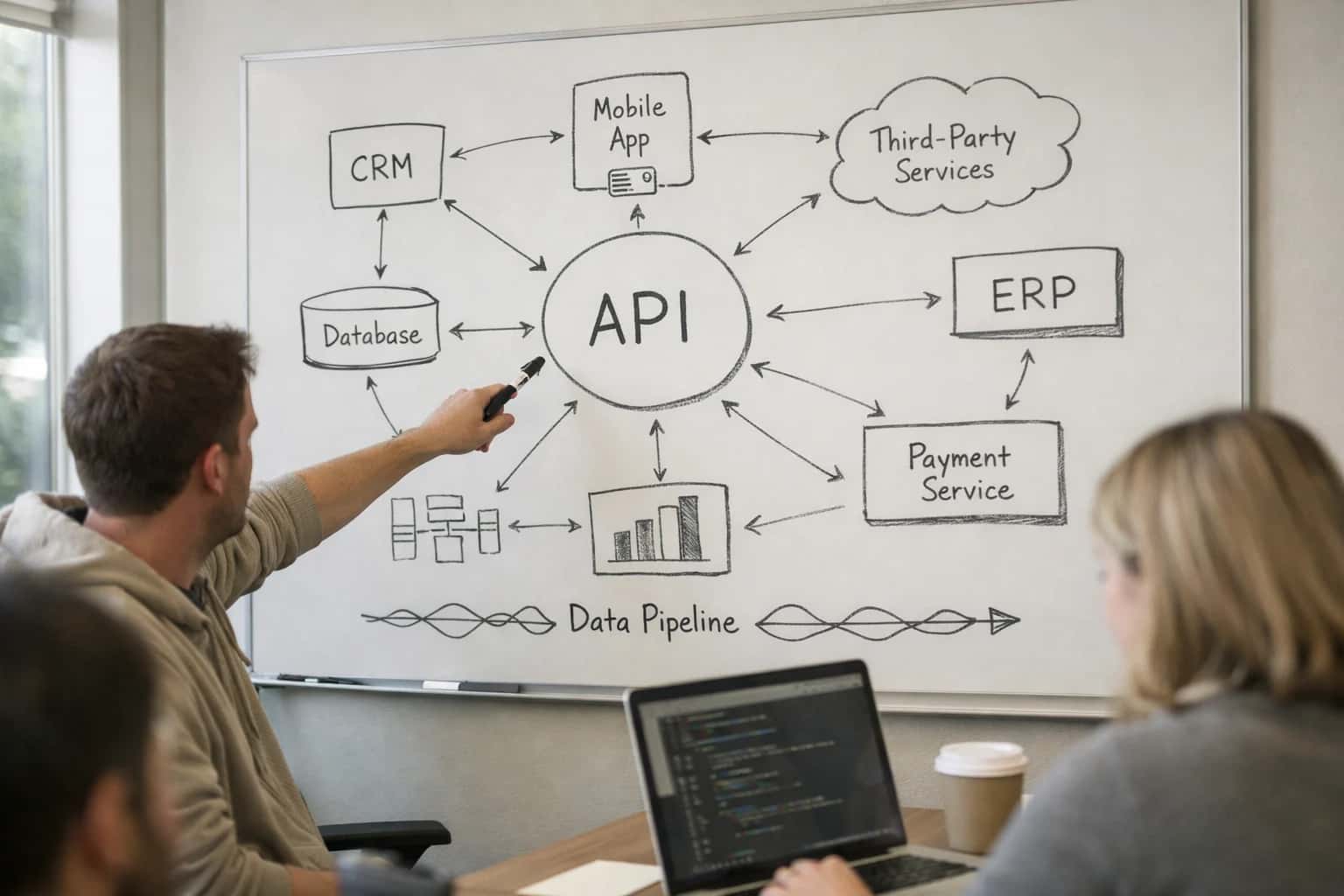
ARCHITECTURE AND INTEGRATION POINTS
Where AI Fits into Simulation-Based Learning
A technical blueprint for connecting AI models to LMS-hosted training simulations, enabling dynamic, branching scenarios and personalized feedback.
Implementation requires a separate simulation runtime environment that calls the LMS via API for user context (role, past performance) and posts results back as a custom xAPI or SCORM statement. For example, a customer service simulation in TalentLMS can use a GPT-based agent to role-play as an irate customer. The AI evaluates the learner's response for empathy, policy knowledge, and resolution effectiveness, then dynamically adjusts the customer's tone and presents a new challenge. The resulting performance data—decision path, time to resolve, key phrases used—is sent back to the LMS as a detailed completion record, enriching the learner's profile for future personalization.
Governance is critical. A human-in-the-loop review step should be built into the simulation design workflow, where L&D managers approve AI-generated scenario branches and feedback templates before they go live. Furthermore, all AI-driven interactions must be logged in an audit trail linked to the LMS activity, ensuring debriefs are explainable and outcomes are traceable for compliance-sensitive training (e.g., healthcare protocols, financial conduct). Rollout typically starts with a pilot cohort, using A/B testing to compare engagement and knowledge retention against traditional linear scenarios, proving value before enterprise-wide deployment.
AI-ENHANCED SIMULATION AND SCENARIO-BASED LEARNING
Integration Surfaces in Major Corporate LMS Platforms
AI-Enhanced Branching Logic for Assessments
Integrate AI directly into the LMS's native assessment engine (e.g., Docebo's Test & Survey app, Cornerstone's Assessment module) to transform static quizzes into dynamic simulations. Use the platform's API to inject AI-generated, context-aware branching questions based on a learner's previous answers.
Implementation Pattern:
- Capture the learner's response via a webhook from the assessment module.
- Process the response with an LLM to evaluate decision quality and narrative context.
- Call the LMS API to dynamically serve the next scenario branch, personalized feedback, or a new set of multiple-choice options.
This turns compliance or procedural training into a decision-making drill, where outcomes change based on trainee actions, stored as granular completion data within the LMS.
CORPORATE LEARNING MANAGEMENT PLATFORMS
High-Value Use Cases for AI-Powered Simulations
Integrating AI into LMS-hosted simulations moves beyond static branching to create dynamic, adaptive training experiences. These use cases detail where to connect AI models to simulation engines, trainee data, and content libraries to generate personalized scenarios and actionable debriefs.
01
Dynamic Branching Scenario Generation
Use generative AI and the LMS's course authoring API to create multi-path simulation narratives on-demand. Instead of manually scripting every decision tree, define a learning objective (e.g., 'difficult customer conversation') and let the AI generate contextually appropriate scenarios, character responses, and consequence branches, which are then published as a new learning object.
1 sprint
Development time
02
Real-Time Coaching & Feedback Agent
Embed a conversational AI agent within the simulation interface using LMS LTI or iframe integration. As the trainee navigates the scenario, the agent analyzes their text or voice inputs against best-practice rubrics stored in the LMS, providing in-the-moment nudges, probing questions, and immediate feedback on communication style or decision rationale.
03
Personalized Post-Simulation Debriefs
After a simulation concludes, trigger an AI workflow via LMS webhook (e.g., simulation.completed). The AI analyzes the trainee's complete interaction log, compares it to model answers or competency frameworks linked from the HRIS integration, and generates a tailored PDF or video debrief highlighting strengths, specific gaps, and recommended follow-up learning from the LMS catalog.
Same day
Feedback delivery
04
Role-Specific Scenario Customization
Connect AI to the LMS user profile API and HRIS job architecture data. At simulation launch, the AI dynamically customizes case details, metrics, and stakes based on the learner's actual role (e.g., a sales manager vs. an account executive), region, and tenure. This ensures relevance without maintaining dozens of static variants.
05
Simulation Analytics & Risk Flagging
Use AI to analyze aggregated simulation attempt data across the LMS, moving beyond completion scores. Detect patterns where large cohorts struggle with specific decision points, flag potential biases in scenario design, and correlate simulation performance with post-training assessment results to identify which scenarios best predict real-world competency.
Batch -> Real-time
Insight generation
06
Compliance & Certification Scenario Refresh
For regulated industries, integrate AI with the LMS's compliance tracking module. When a new policy or regulation is published, the AI scans the document, identifies key procedural changes, and automatically updates the branching logic and scoring rubrics of linked compliance simulations (e.g., safety protocols, financial conduct), ensuring training remains current.
IMPLEMENTATION PATTERNS
Example AI Simulation Workflows
These workflows detail how to connect AI models to your LMS's simulation engine and data layer, enabling dynamic, branching scenarios that adapt to trainee decisions and generate personalized feedback.
Trigger: A learner launches a simulation module from the LMS course player.
Workflow:
- The LMS passes the learner's role, current skill profile, and simulation ID to the AI orchestration layer via a secure API call.
- The AI system retrieves the simulation's base scenario and ruleset from a connected content repository.
- Using a reasoning model (e.g., GPT-4, Claude 3), the system generates the initial scenario prompt, dynamically adjusting complexity based on the learner's profile.
- For each learner decision, the model evaluates the choice against learning objectives and business rules, then generates the next branch of the scenario, including potential consequences and new data (e.g., a simulated customer email, a system alert).
- All decision points, paths taken, and timestamps are logged back to the LMS via the SCORM or xAPI interface for granular reporting.
System Update: The LMS records the completed simulation path, final outcome, and all interaction data to the learner's transcript and the reporting database.
BUILDING DYNAMIC, BRANCHING SIMULATIONS
Implementation Architecture: Data Flow and System Components
A technical blueprint for integrating AI to power adaptive training simulations that connect to your LMS data and generate personalized feedback.
The core architecture connects three systems: your LMS (Docebo, Cornerstone, Absorb, TalentLMS), an AI simulation engine, and a feedback generation service. The LMS serves as the system of record, providing via its API the learner profile (role, past completions, skills), simulation metadata (learning objectives, compliance tags), and launch context. The AI engine—often a combination of a rules-based branching logic layer and a large language model (LLM)—processes this context to generate the simulation's initial scenario and subsequent decision points. Trainee inputs (choices, text responses, timing) are sent via secure API calls back to the engine, which evaluates the response against predefined success criteria and narrative logic to determine the next branch.
Key data flows and components include:
- LMS Launch Connector: A lightweight iframe or LTI 1.3 integration embedded in a course module, passing
user_id,course_id, andobjectivesto the simulation engine. - Simulation State Manager: A backend service that maintains the session state (branch path, decisions, scores) in a temporary data store, keyed by a unique
session_id. - Decision Evaluation Module: This component compares trainee actions against an ideal path model. It can use deterministic rules ("if choice A, then branch to scenario X") or probabilistic LLM scoring ("assess the quality of this text response on a 1-5 scale").
- Debrief Generator: At session end, this service aggregates the session state, references the original learning objectives from the LMS, and uses a configured LLM (e.g., GPT-4, Claude) to produce a personalized narrative debrief. The debrief highlights strengths, identifies missed concepts, and suggests specific follow-up learning assets from the LMS catalog.
For rollout, start with a pilot cohort and a single high-impact use case (e.g., new manager conflict resolution). Implement audit logging for all AI-generated content and decision paths to ensure reviewability. Governance requires clear ownership: L&D owns the simulation learning objectives and success criteria, while the platform/IT team manages the API integrations, data privacy (ensuring no PII is sent to external AI services unnecessarily), and performance SLAs for simulation load times. The final step is closing the loop: the simulation's outcome data (completion status, score, key decision metrics) and a link to the generated debrief are posted back to the LMS via its API, creating a permanent record in the learner's transcript and updating their skill profile.
IMPLEMENTATION PATTERNS
Code and Payload Examples
Generating Dynamic Branching Scenarios
Use the LMS's API to fetch learner profile data (role, department, past performance) and pass it to a generative AI model to create a personalized, branching scenario. The AI generates the narrative, decision points, and potential outcomes as structured JSON, which your integration posts back to the LMS to create a new simulation activity.
python# Example: Call LMS API, then generate scenario with OpenAI import requests import openai # 1. Fetch learner context from LMS (e.g., Docebo API) lms_api_url = "https://your-lms.docebosaas.com/api/v1/users/{user_id}/progress" headers = {"Authorization": "Bearer YOUR_LMS_TOKEN"} learner_data = requests.get(lms_api_url, headers=headers).json() # 2. Construct prompt with learner context prompt = f""" Generate a customer service escalation scenario for a {learner_data['job_role']}. The learner's recent compliance score is {learner_data['compliance_score']}. Output a JSON with: 'scenario_title', 'initial_situation', 'decision_points' (list of objects with 'prompt', 'options', 'consequences'). """ # 3. Call AI model client = openai.OpenAI(api_key=YOUR_OPENAI_KEY) response = client.chat.completions.create( model="gpt-4-turbo", messages=[{"role": "user", "content": prompt}], response_format={ "type": "json_object" } ) # 4. Parse and post scenario JSON back to LMS simulation module scenario_json = json.loads(response.choices[0].message.content) create_scenario_url = "https://your-lms.docebosaas.com/api/v1/simulations" requests.post(create_scenario_url, json=scenario_json, headers=headers)
This pattern allows for on-the-fly, data-driven scenario creation, moving beyond static, pre-built simulations.
AI-ENHANCED SIMULATION AND SCENARIO-BASED LEARNING
Realistic Time Savings and Business Impact
This table illustrates the operational impact of integrating AI to power dynamic, branching training simulations within a corporate LMS like Docebo, Cornerstone, Absorb, or TalentLMS.
| Workflow / Task | Traditional Process | AI-Enhanced Process | Implementation & Impact Notes |
|---|---|---|---|
Scenario Authoring & Updates | Weeks of instructional design for each branching path | Days to generate core narrative, branches, and debriefs | AI drafts scenarios from learning objectives; human SME reviews and refines. |
Learner Debrief & Feedback Generation | Manual review by facilitator; generic written feedback | Automated, personalized debrief report in minutes | AI analyzes learner's decision path, references course materials, and generates specific improvement insights. |
Scenario Difficulty & Path Adjustment | Static paths; one-size-fits-all challenge level | Dynamic adjustment based on learner role and performance | AI engine tailors subsequent scenario complexity and branches in real-time to optimize skill development. |
Compliance & Policy Alignment Check | Manual legal/Compliance review of all scenario content | Automated initial scan against policy documents | AI flags potential misalignment in scenario outcomes for human review, reducing risk and review cycles. |
Performance Analytics & Gap Identification | Post-course survey and basic completion metrics | Real-time analysis of decision patterns against competency models | AI maps simulation choices to skill gaps, enabling proactive, targeted follow-up training assignments. |
Facilitator Preparation & Support | Hours spent reviewing learner paths pre-session | AI-generated facilitator guide highlighting common pitfalls | Provides instructors with data-driven talking points and intervention opportunities for live debrief sessions. |
Multi-Language & Localization Drafting | Costly, time-consuming professional translation | AI-generated first-draft translations of scenario dialogue | Accelerates global rollout; human translator focuses on cultural nuance and final polish. |
Integration with Live Performance Data | Manual correlation of training to on-the-job metrics | Automated linkage of simulation outcomes to CRM/ERP events | AI connects simulated decisions to real business workflows in systems like Salesforce or SAP, closing the learning-to-impact loop. |
ENSURING SAFE, CONTROLLED DEPLOYMENT OF AI SIMULATIONS
Governance, Security, and Phased Rollout
Implementing AI-driven simulations requires a deliberate approach to data privacy, content integrity, and user readiness.
Data and Privacy Governance is foundational. AI simulations often process sensitive learner data—performance, decisions, and feedback. Your integration must enforce strict access controls, ensuring AI models only receive anonymized or pseudonymized data via secure API calls from the LMS (e.g., Docebo's REST API or Cornerstone's event webhooks). All generated debriefs and scenario data should be written back to secure, audit-logged fields within the learner's record, never stored in an ungoverned external cache. For highly regulated industries (e.g., healthcare, finance), consider an on-premise or VPC-deployed LLM to maintain full data sovereignty.
Content Integrity and Bias Mitigation are critical for credible training. AI-generated branching scenarios and feedback must be grounded in validated organizational knowledge. Implement a RAG (Retrieval-Augmented Generation) layer that retrieves context from approved policy documents, SOPs, and compliance manuals stored in your LMS or connected systems like SharePoint. This grounds the AI in truth. Establish a human-in-the-loop review workflow where L&D subject matter experts approve or tune new scenario branches before they are deployed to learners, preventing the propagation of incorrect or biased content.
A phased rollout minimizes risk and builds confidence. Start with a pilot group in a low-stakes, non-compliance training module (e.g., soft skills or onboarding simulations). Monitor key metrics: completion rates, learner satisfaction, and the accuracy of AI-generated feedback. Use this phase to refine prompts and integration logic. Then, expand to role-specific simulations (e.g., sales negotiation for reps, patient interaction for clinicians), ensuring the AI is tuned to the specific workflows and data objects of those roles. Finally, scale to high-stakes compliance and safety simulations, where the governance and review processes are fully proven and automated.
Technical Rollout Checklist: 1) API Rate Limits & Fallbacks: Configure your AI service client to respect LMS API limits and have fallback content for simulator availability. 2) Performance Monitoring: Instrument the integration to log latency, token usage, and error rates, tying them back to learner experience. 3) User Support & Transparency: Prepare help desk resources and ensure the UI clearly indicates when a learner is interacting with an AI simulation, not a human evaluator. This controlled, phased approach ensures AI enhances training impact without introducing operational or compliance risk.
Enabling Efficiency, Speed & Accuracy
Intelligent Analysis, Decision & Execution
We build AI systems for teams that need search across company data, workflow automation across tools, or AI features inside products and internal software.
Talk to Us
Search across company data
Give teams answers from docs, tickets, runbooks, and product data with sources and permissions.
Useful when people spend too long searching or get different answers from different systems.
Enterprise searchRAGPermissions
Read more
Automate internal workflows
Use AI to route work, draft outputs, trigger actions, and keep approvals and logs in place.
Useful when repetitive work moves across multiple tools and teams.
AI agentsWorkflow automationGovernance
Read more
Add AI to products and internal tools
Build assistants, guided actions, or decision support into the software your team or customers already use.
Useful when AI needs to be part of the product, not a separate tool.
AI integrationDecision supportModel routing
Read moreIMPLEMENTATION DETAILS
Frequently Asked Questions
Technical questions about integrating AI to power dynamic, branching simulations within your corporate LMS, covering architecture, data flows, and rollout.
The integration typically uses a headless architecture where the simulation engine is a separate service. It connects to your LMS (Docebo, Cornerstone, etc.) via REST APIs and webhooks in three key ways:
- User & Context Sync: The engine calls the LMS API to pull user profiles, role data, and completed prerequisite training when a simulation is launched. This personalizes the starting scenario.
- Event Triggers: The LMS uses webhooks to notify the simulation service when a user is enrolled in a simulation-based course or module.
- Completion & Data Write-Back: After the simulation concludes, the engine posts results back to the LMS via API. This includes:
- A completion status for the learning record.
- A detailed JSON payload of decisions, outcomes, and competency scores, stored in a custom LMS object or via xAPI to the LRS.
- The generated personalized debrief, often stored as a PDF or HTML attachment to the user's record.
This keeps the simulation logic and heavy AI processing outside the LMS while maintaining a seamless learner experience.

About the author
Prasad Kumkar
CEO & MD, Inference Systems
Prasad Kumkar is the CEO & MD of Inference Systems and writes about AI systems architecture, LLM infrastructure, model serving, evaluation, and production deployment. Over 5+ years, he has worked across computer vision models, L5 autonomous vehicle systems, and LLM research, with a focus on taking complex AI ideas into real-world engineering systems.
His work and writing cover AI systems, large language models, AI agents, multimodal systems, autonomous systems, inference optimization, RAG, evaluation, and production AI engineering.
LinkedIn
Limited slotsGet a Free AI Consultation
Partnered with leading AI, data, and software stack.





How We Work
Custom AI workflows for your Business
One-fit-all AI don't work for modern businesses. At Inferensys, we aim to understand your business & custom requirements; which we use to define most efficient agentic workflows, the data, and the tools for your business.
01
Review the use case
We understand the task, the users, and where AI can actually help.
Read more02
Pick the right approach
We define what needs search, automation, or product integration.
Read more03
Build the first useful version
We implement the part that proves the value first.
Read more04
Improve from there
We add the checks and visibility needed to keep it useful.
Read moreThe first call is a practical review of your use case and the right next step.
Talk to Us