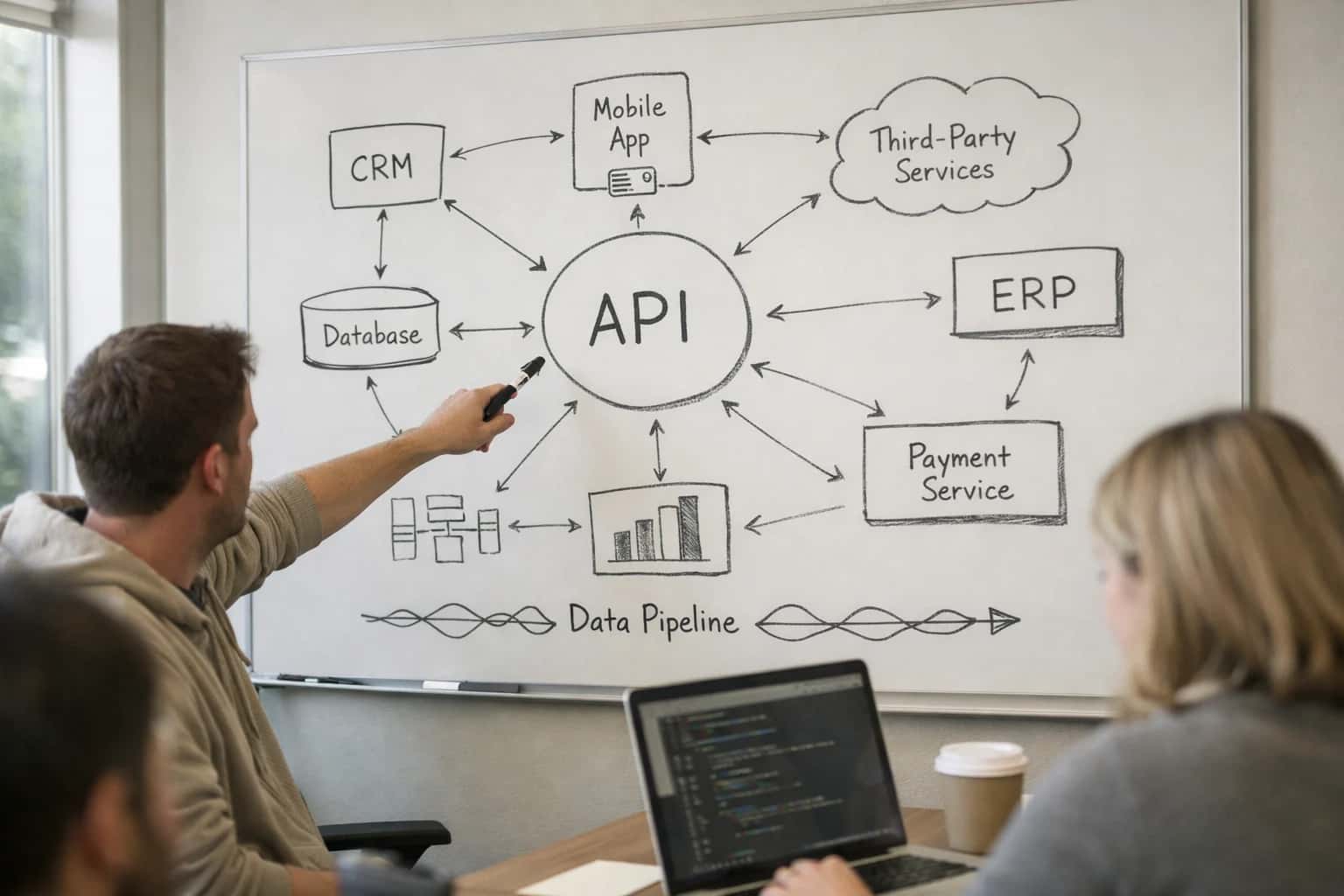
Traditional LMS platforms like Docebo, Cornerstone, and Absorb LMS manage static skill lists tied to job roles or manually entered profiles. This creates a brittle, outdated view of organizational capability. A production AI integration connects three primary data streams via APIs and webhooks: 1) LMS activity data (course completions, assessment scores, content interactions), 2) HRIS job architecture and performance review data (from Workday, UKG, etc.), and 3) unstructured work artifacts (project documents, peer feedback, internal wiki contributions). An inference pipeline processes this data to generate probabilistic skill assertions—for example, Jane_Doe → Python → 0.85 confidence—which are written back to a dedicated skills object or custom field within the LMS.

Integration
AI-Driven Skills Analysis in Enterprise LMS
From Static Skill Lists to Dynamic, AI-Inferred Inventories
A technical blueprint for building a living skills inventory by connecting your LMS, HRIS, and performance data to AI inference models.
The implementation centers on a skills inference service that sits between your systems. It subscribes to LMS webhooks for events like course.completed or assessment.submitted, ingests periodic HRIS data dumps, and uses orchestration frameworks like CrewAI or n8n to sequence analysis jobs. For each user, the service calls LLM APIs (OpenAI, Anthropic, or open-source models) with carefully engineered prompts to analyze aggregated data and output structured JSON skill profiles. These profiles are then compared against target role architectures stored in the LMS to generate personalized gap analyses. The resulting dynamic inventory powers automated learning path recommendations in the LMS and provides a real-time skills API for other systems like internal mobility platforms or project staffing tools.
Rollout requires a phased governance approach. Start with a pilot cohort and a limited, high-value skill domain (e.g., 'Cloud Security' or 'Agile Coaching'). Implement a human-in-the-loop review step where managers can validate or adjust AI-inferred skills before they become system-of-record. Audit logs must track the source data and prompt used for each inference. Crucially, this integration shifts L&D and HR operations from reactive, manual skills management to a proactive, data-driven model, enabling same-day visibility into emerging capabilities and closing critical skill gaps weeks or months faster than manual processes allow.
Where AI Connects: LMS Data Surfaces for Skills Inference
Core Learner Interaction Data
This is the primary fuel for skills inference, capturing what users do within the platform. AI models analyze these granular records to infer knowledge acquisition and proficiency trends.
Key API objects and webhook events include:
- User Profiles & Job Roles:
GET /usersandGET /job-rolesendpoints provide demographic and organizational context. - Course Enrollment & Completion Records:
POST /enrollmentsandGET /completionsevents signal commitment and follow-through. - Assessment Scores & Attempts: Detailed results from quizzes, tests, and surveys (
GET /assessments/{id}/results) offer direct proficiency signals. - Content Engagement Metrics: Time-on-page, video watch percentages, and document downloads (often via xAPI or SCORM statements) indicate depth of learning.
A skills inference pipeline typically consumes this data hourly or daily, joining user activity with external job architectures to build a probabilistic skills profile.
High-Value Use Cases for AI Skills Analysis
These are the most common and impactful workflows where AI-driven skills inference connects to your LMS data, automates manual analysis, and creates a dynamic skills inventory.
Automated Skills Inference from Learning Artifacts
Use AI to analyze course completion data, assessment results, and project submissions within the LMS to infer and tag user profiles with demonstrated skills. This automates the manual mapping of learning activities to a centralized skills framework, keeping talent profiles current.
Dynamic Skills Gap Analysis for Roles
Continuously compare inferred user skill profiles against target role architectures or project requirements. The AI identifies critical gaps and automatically surfaces relevant learning content, external resources, or mentorship opportunities from the LMS catalog to close them.
Talent Marketplace and Mobility Matching
Power internal talent marketplaces by using AI to match employees' inferred skills and learning interests with open projects, gigs, or mentorship opportunities. This integration typically sits between the LMS and an internal mobility platform, using the LMS as the skills data source.
Personalized Learning Path Generation
Move beyond static curricula. AI uses the skills gap analysis to generate adaptive, multi-modal learning paths. It sequences courses, micro-learning, and external content from the LMS library to build a personalized upskilling journey for each employee, adjusting as they progress.
Succession Planning and Readiness Scoring
For HR and talent leaders, AI analyzes the skills delta between high-potential employees and future leadership roles. It generates a readiness score and a prioritized development plan, pulling required training directly from the LMS and tracking progress toward succession milestones.
Skills-Based Content Curation & Tagging
Automatically tag the entire LMS content library with relevant skills from your framework. AI analyzes course descriptions, transcripts, and completion data to maintain accurate metadata. This powers precise, skills-based search and recommendation engines within the platform.
Example AI Skills Analysis Workflows
These workflows illustrate how AI can be integrated into an enterprise LMS to automate skills inference, gap analysis, and development planning. Each pattern connects LMS data with external systems and uses AI models to generate actionable insights.
Trigger: A learner completes a course, module, or external certification tracked in the LMS.
Context/Data Pulled:
- LMS API call to fetch the completed activity's metadata (title, description, learning objectives, tags).
- Optional: Pull the learner's historical transcript and current role/job profile from the connected HRIS.
Model or Agent Action:
- A pre-configured LLM (e.g., GPT-4, Claude 3) analyzes the activity description and objectives.
- The model maps the content to a structured skills taxonomy (e.g., ESCO, O*NET, custom framework) and infers relevant skills and proficiency deltas.
- The agent generates a confidence score for each inferred skill.
System Update or Next Step:
- The inferred skills, with confidence scores, are posted via the LMS's Skills API or a custom object API to update the learner's skills profile.
- If confidence is low, the update can be flagged for HR/admin review in a separate queue.
- An event webhook can notify the learner's manager or trigger a "skills updated" notification.
Human Review Point: Optional review queue for low-confidence inferences before updating the master skills record.
Implementation Architecture: Data Flow, APIs, and Guardrails
A technical blueprint for connecting your LMS to AI models to infer, analyze, and act on workforce skills data.
A production implementation connects three core data streams via your LMS's API and webhook ecosystem: learner activity (course completions, assessment scores, time spent), HRIS data (job titles, performance reviews, career aspirations), and external frameworks (ESCo, O*NET, custom competency models). The AI layer processes this data to create a unified skills profile for each employee, identifying inferred proficiencies, confidence scores, and critical gaps against target roles. In platforms like Cornerstone or Docebo, this typically involves a middleware service that polls the User, LearningRecord, and JobProfile APIs, transforms the data into a structured format for the LLM, and writes the enriched skills inventory back to a custom object or external vector database for real-time querying.
The critical workflow is the skills gap analysis engine. Once skills profiles are established, the system compares them to defined role architectures or project requirements. For a role like "Enterprise Account Executive," the AI evaluates an employee's profile against a target skill set (e.g., "MEDDIC qualification," "financial modeling," "competitive intelligence"). It then generates a prioritized development plan, automatically curating relevant learning assets from the LMS catalog, recommending external resources, and even suggesting mentorship matches. This entire loop—from data ingestion to personalized recommendation—should be orchestrated as an asynchronous, idempotent process to handle scale, using message queues to manage updates triggered by new learning completions or performance review cycles.
Governance and rollout require careful planning. Start with a pilot cohort (e.g., a specific business unit or job family) to validate the accuracy of skill inferences and the relevance of recommendations. Implement human-in-the-loop approval for any automatic learning assignments, especially for compliance-mandated training. Crucially, build an audit trail that logs every AI-generated insight, its source data, and the prompting logic used, which is essential for HR compliance and model refinement. For platforms like Workday or UKG integrated with your LMS, ensure bidirectional sync is handled with appropriate data privacy controls, anonymizing personal data before AI processing where required. The final architecture should treat the AI not as a black box, but as a governed decision-support layer that augments L&D and talent management workflows without replacing human judgment.
Code and Payload Examples
Triggering Skills Analysis from LMS Activity
When a learner completes a course or assessment, you can call an inference service to analyze the activity and infer newly demonstrated skills. This example uses a Python client to send a payload containing the learner's ID, activity metadata, and content (like a submitted essay or project description) to an AI model endpoint.
pythonimport requests import json # Example: Send a completed project description for skills inference lms_webhook_payload = { "learner_id": "usr_5f8d2a1b", "activity_type": "project_submission", "activity_id": "proj_7c3e9a", "content": "Led a cross-functional workshop on Agile methodologies, resulting in a 15% reduction in sprint cycle time. Created new Jira workflows and documented the process for the team.", "metadata": { "course_id": "crs_leadership_101", "completion_date": "2024-04-15T14:30:00Z", "score": 95 } } # Call your inference service response = requests.post( "https://api.your-inference-service.com/v1/skills/infer", headers={"Authorization": "Bearer YOUR_API_KEY", "Content-Type": "application/json"}, data=json.dumps(lms_webhook_payload) ) # Response contains inferred skills with confidence scores inferred_skills = response.json() # Example output: {"skills": [{"id": "SKL_AGILE_COACH", "name": "Agile Coaching", "confidence": 0.87}, {"id": "SKL_PROCESS_DESIGN", "name": "Process Design", "confidence": 0.92}]}
The response can be written back to the LMS user profile via its API or to a centralized skills inventory.
Realistic Operational Impact and Time Savings
How AI-powered skills inference transforms manual, reactive HR processes into a proactive, data-driven talent intelligence system.
| Operational Process | Manual / Legacy Approach | AI-Augmented Approach | Implementation & Governance Notes |
|---|---|---|---|
Skills Inventory Creation | Quarterly surveys & manager assessments (2-3 weeks) | Continuous inference from LMS activity, reviews, projects (real-time) | Initial model tuning required; human validation loop for critical roles |
Gap Analysis for a Role | Manual comparison of job description to static profiles (4-8 hours) | Automated matching against live skills inventory with heat maps (minutes) | Integrates with job architecture API; outputs prioritized development needs |
Personalized Learning Path Curation | L&D specialist manually maps courses (1-2 days per path) | AI generates dynamic path from catalog based on inferred gaps (same day) | Paths require SME review; system learns from completion and feedback data |
Compliance & Readiness Reporting | Spreadsheet consolidation from LMS, HRIS, surveys (next-day) | Automated dashboard with natural language summaries (real-time) | Audit trail for all inferred skills; RBAC controls report access |
Talent Mobility & Succession Identification | Annual review cycle, manual cross-referencing (weeks) | Continuous identification of internal candidates for open roles (daily) | Model bias checks are mandatory; final decisions remain with HRBP |
Skills Taxonomy Maintenance | Annual committee review, manual updates to master list | AI suggests new emerging skills from internal documents & industry data | Governance workflow for term approval/rejection before system adoption |
Onboarding Plan Personalization | Generic 30-60-90 day plan assigned by job family | Role-specific plan generated from hiring manager input & team skills data | Plan syncs to LMS as a trackable learning plan; manager can edit |
Governance, Security, and Phased Rollout
A production-ready AI skills analysis system requires careful planning around data access, model governance, and incremental deployment to mitigate risk and demonstrate value.
The integration architecture must respect the LMS as the system of record. AI models should operate as a read-only analytics layer, consuming data via secure APIs (e.g., Docebo's REST API, Cornerstone's ODATA feeds) and writing inferred skills back to designated custom objects or extended profile fields. All data flows should be logged for audit, and access must adhere to the LMS's existing RBAC—ensuring a manager can only see skills inferences for their direct reports, for example. For highly sensitive data, such as performance review text, consider a dual-consent model where AI processing is opt-in at the individual or organizational level.
Start with a pilot focused on a single, high-value data source and a closed user group. A common first phase is automated skills extraction from learning completion records. In this model, the AI parses course titles, descriptions, and completion certificates from the LMS to infer and tag skills to user profiles. This provides immediate value by making implicit skills explicit, with low risk. Subsequent phases can introduce more complex inputs: Phase 2 might integrate anonymized performance review summaries from your HRIS, and Phase 3 could incorporate project data from a PPM tool like Asana. Each phase should include a human-in-the-loop review step (e.g., a manager approves AI-suggested skills) before full automation.
Governance is critical for maintaining trust in the skills inventory. Establish a cross-functional steering committee (HR, IT, Legal, Business Leaders) to oversee the initiative. Key governance artifacts include a Skills Taxonomy Governance Charter (who approves new skills), a Model Bias and Fairness Review Process (regularly audit inferences across demographic groups), and a Data Retention and Purging Policy for AI-generated metadata. Use your LMS's native reporting and audit trails as the primary source of truth, and ensure any AI-driven recommendations for learning paths or career moves are presented as suggestions, not directives. For a deeper dive on connecting these insights to development actions, see our guide on AI-Powered Learning Paths in Corporate LMS.
Enabling Efficiency, Speed & Accuracy
Intelligent Analysis, Decision & Execution
We build AI systems for teams that need search across company data, workflow automation across tools, or AI features inside products and internal software.
Talk to Us
Search across company data
Give teams answers from docs, tickets, runbooks, and product data with sources and permissions.
Useful when people spend too long searching or get different answers from different systems.

Automate internal workflows
Use AI to route work, draft outputs, trigger actions, and keep approvals and logs in place.
Useful when repetitive work moves across multiple tools and teams.

Add AI to products and internal tools
Build assistants, guided actions, or decision support into the software your team or customers already use.
Useful when AI needs to be part of the product, not a separate tool.
Frequently Asked Questions for Technical Buyers
Technical questions from HR tech, IT, and learning architecture teams planning an AI-driven skills analysis integration with platforms like Docebo, Cornerstone, Absorb LMS, or TalentLMS.
A robust skills inference engine requires multiple data streams. The core integration involves:
-
Primary LMS Data via API:
- User profiles, job titles, departments.
- Course enrollments, completions, and assessment scores.
- Content metadata (tags, descriptions, learning objectives).
-
External System Feeds:
- HRIS (Workday, UKG): For official job architecture, performance review summaries, and career history.
- Project/Task Tools (Jira, Asana): To infer applied skills from project descriptions and contributions.
- Collaboration Platforms (Microsoft 365, Slack): For analyzing communication patterns and topic expertise (with proper privacy controls).
Connection Pattern: We typically implement a central skills orchestration layer. This service:
- Polls or receives webhooks from source systems.
- Normalizes data into a unified skills ontology (e.g., using ESCO or your internal framework).
- Stores processed outputs in a dedicated vector database (like Pinecone or Weaviate) for real-time querying by the LMS and other systems.
- Key API calls involve batch user syncs and real-time skill profile updates.

About the author
Prasad Kumkar
CEO & MD, Inference Systems
Prasad Kumkar is the CEO & MD of Inference Systems and writes about AI systems architecture, LLM infrastructure, model serving, evaluation, and production deployment. Over 5+ years, he has worked across computer vision models, L5 autonomous vehicle systems, and LLM research, with a focus on taking complex AI ideas into real-world engineering systems.
His work and writing cover AI systems, large language models, AI agents, multimodal systems, autonomous systems, inference optimization, RAG, evaluation, and production AI engineering.
Partnered with leading AI, data, and software stack.





How We Work
Custom AI workflows for your Business
One-fit-all AI don't work for modern businesses. At Inferensys, we aim to understand your business & custom requirements; which we use to define most efficient agentic workflows, the data, and the tools for your business.
01
Review the use case
We understand the task, the users, and where AI can actually help.
Read more02
Pick the right approach
We define what needs search, automation, or product integration.
Read more03
Build the first useful version
We implement the part that proves the value first.
Read more04
Improve from there
We add the checks and visibility needed to keep it useful.
Read moreThe first call is a practical review of your use case and the right next step.
Talk to Us