An effective compliance monitoring system connects to the Icertis Contract Intelligence Platform via its REST API and webhook infrastructure. The core architecture involves a scheduled agent that queries the Icertis data model for contracts with upcoming or active obligation dates, milestone deliverables, and regulatory attestation requirements. Key objects like Contract, Obligation, Party, and custom metadata fields for compliance status become the primary data sources. The AI layer is triggered by lifecycle events—such as a contract moving to an 'Active' state or a milestone being marked complete—to initiate a new compliance review cycle.

Integration
AI Integration with Icertis Contract Compliance
Implement AI to automatically monitor active contracts in Icertis against regulatory frameworks and internal policies, generating compliance reports and flagging potential violations.
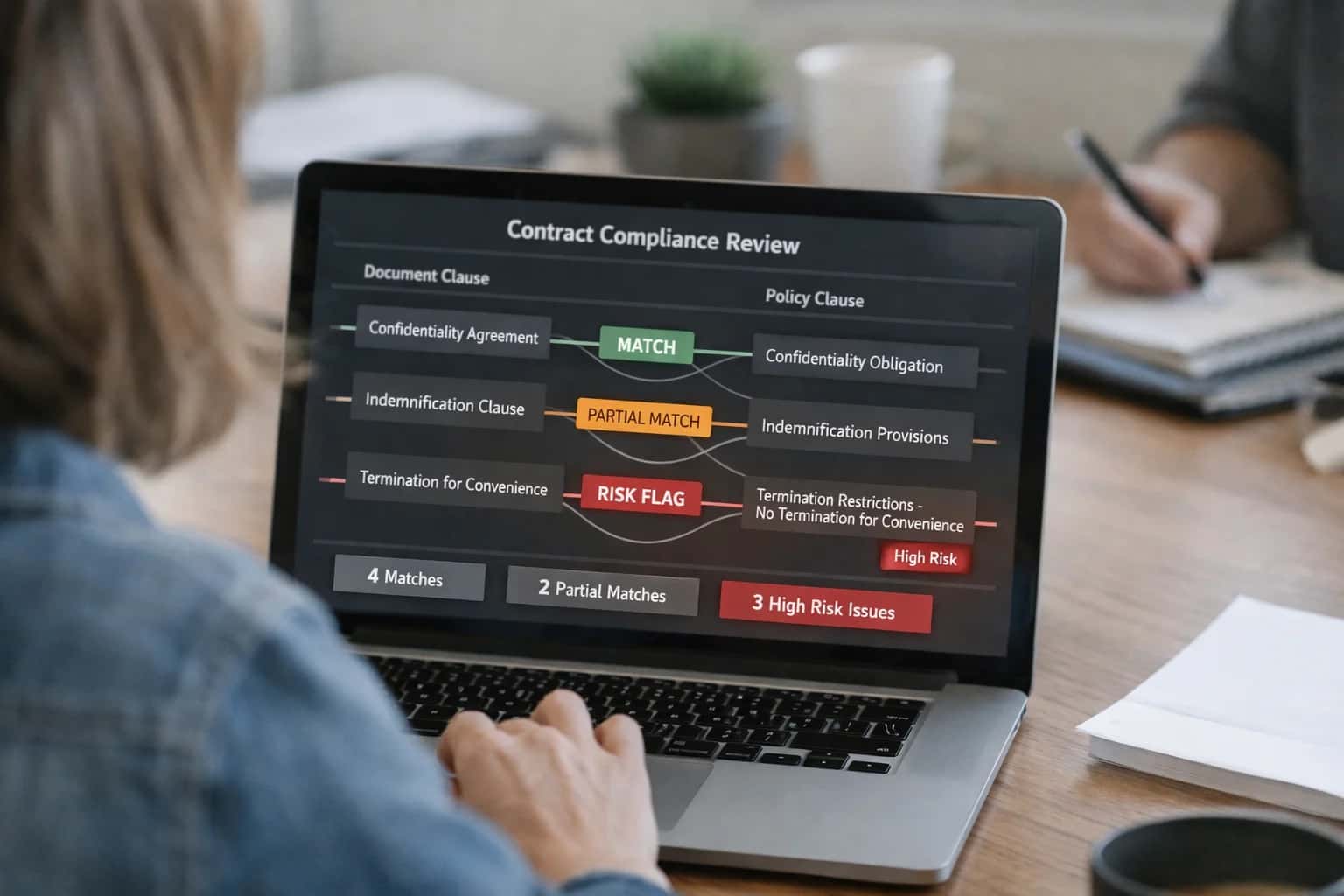
ARCHITECTURE FOR CONTINUOUS OBLIGATION SURVEILLANCE
Automating Contract Compliance Monitoring in Icertis
Implement a production-grade AI system that continuously monitors active contracts in Icertis for compliance with regulatory frameworks and internal policies.
For each contract, the system employs a RAG (Retrieval-Augmented Generation) pipeline grounded in your internal policy library and relevant regulatory texts (e.g., GDPR, SOX, industry-specific codes). It extracts the specific obligations and terms from the contract document stored in Icertis, compares them against the ruleset, and generates a structured compliance report. High-risk findings—like a missing insurance certificate, a late deliverable, or a non-standard data processing clause—are automatically logged as Issues or Tasks within Icertis, assigned to the responsible business owner, and can trigger email alerts or create cases in connected systems like ServiceNow for remediation tracking.
Rollout requires a phased, risk-based approach. Start with a pilot on a single contract type (e.g., Data Processing Agreements) and a focused regulation. Governance is critical: all AI-generated flags should route through a human-in-the-loop review step initially, with clear audit trails logging the AI's reasoning, the evidence retrieved, and the human adjudicator's decision. This builds trust and creates a feedback loop for model fine-tuning. Over time, the system can be configured to auto-approve low-risk, high-confidence compliance validations, freeing legal and operations teams to focus on material exceptions. For a deeper dive on grounding AI in enterprise contract data, see our guide on AI Integration with RAG.
PLATFORM SURFACES
Where AI Connects to Icertis for Compliance
The Foundation: Your Contract Corpus
The Icertis repository is the primary data source for compliance AI. This is where all executed contracts—MSAs, SOWs, NDAs, and amendments—are stored with their metadata. AI connects here to perform bulk analysis across the entire portfolio.
Key Integration Points:
- Icertis AI Studio APIs: Use these to submit documents for pre-built or custom AI model processing (e.g., clause extraction, obligation identification).
- Document & Metadata APIs: Programmatically retrieve contract files (PDF, DOCX) and their structured fields (parties, effective dates, governing law) to feed your compliance analysis pipeline.
- Data Lake Sync: For large-scale historical analysis, orchestrate secure exports of contract text and metadata to a dedicated vector database or data lake, enabling complex cross-contract RAG queries that go beyond Icertis's native search.
CONTRACT COMPLIANCE AUTOMATION
High-Value AI Compliance Use Cases for Icertis
Transform Icertis from a contract repository into an active compliance engine. These AI integration patterns automate the monitoring, analysis, and reporting required to manage regulatory and policy obligations across your active portfolio.
01
Regulatory Clause Monitoring
Continuously scan active contracts against a dynamic library of regulatory frameworks (e.g., GDPR, CCPA, SOX). AI flags clauses that are non-compliant, sunsetting, or require updates due to new legislation, creating remediation tasks directly in Icertis workflows.
Batch -> Real-time
Monitoring cadence
02
Policy Deviation Detection
Encode internal procurement, legal, and risk policies into AI rules. During contract intake or renewal, the system automatically reviews terms against playbooks, highlighting deviations (e.g., non-standard liability caps, payment terms) for expedited review and approval routing.
1 sprint
Policy rollout
03
Automated Obligation Fulfillment Tracking
AI parses executed contracts to extract specific obligations (e.g., deliver reports, maintain insurance, achieve SLAs). It creates tracked tasks in Icertis, assigns owners, monitors deadlines via system integrations, and triggers alerts for potential breaches before they occur.
Hours -> Minutes
Obligation extraction
04
Vendor Performance & Risk Dashboards
Build AI-powered dashboards that correlate Icertis contract terms (SLAs, KPIs, liability) with operational data from ERP, CRM, and ITSM systems. Generate executive reports on vendor risk scores, compliance health, and performance trends for quarterly business reviews.
Same day
Report generation
05
Audit Evidence Package Assembly
For internal or external audits, use AI to automatically assemble evidence packages from Icertis. It retrieves specific contract versions, approval chains, compliance reports, and obligation fulfillment records, compiling them into a structured, auditor-ready dossier.
Days -> Hours
Evidence collection
06
Renewal & Expiration Risk Forecasting
AI analyzes contract terms, relationship history, and usage data to predict renewal likelihood, optimal negotiation windows, and financial exposure from expirations. It surfaces high-risk contracts requiring early intervention and populates Icertis renewal workflows with AI-generated negotiation briefs.
AUTOMATED MONITORING AND REPORTING
Example AI Compliance Workflows in Icertis
These workflows illustrate how AI agents can be integrated into Icertis to transform static contract repositories into proactive compliance engines. Each pattern connects to specific Icertis objects and APIs to monitor terms, flag risks, and automate reporting.
Trigger: A new regulation (e.g., GDPR update, new state privacy law) is published to the company's internal policy repository.
Workflow:
- An AI monitoring agent, subscribed to the policy feed, receives the update.
- The agent queries the Icertis API for all active contracts containing related clauses (e.g., data processing, indemnification, governing law).
- Using a fine-tuned model or RAG over the new regulation text, the agent analyzes each identified contract clause for potential conflicts or gaps.
- For each contract with a high-risk mismatch, the agent:
- Creates a Compliance Task in the associated Icertis contract record.
- Assigns it to the designated Business Owner and Legal Contact.
- Generates a summary report detailing the specific clause, the regulatory conflict, and recommended remediation language.
- Updates the contract's Risk Score metadata field.
- A consolidated report is generated for the compliance team, listing all affected contracts by vendor/counterparty and risk severity.
ARCHITECTURE FOR PRODUCTION
Implementation Architecture: Building the AI Compliance Layer
A technical blueprint for deploying an AI-powered compliance monitoring system on top of Icertis contract data.
The core architecture connects Icertis's Contract Intelligence Platform and its AI Studio APIs to a dedicated AI compliance engine. This engine typically runs as a separate microservice, ingesting executed contracts via Icertis webhooks or scheduled batch jobs. For each contract, the AI layer performs a multi-step analysis: first, a RAG (Retrieval-Augmented Generation) pipeline grounds the LLM in your specific regulatory frameworks (e.g., GDPR, SOX, industry-specific codes) and internal policy documents. The system then extracts obligations, rights, and conditional clauses, mapping them against compliance rules to identify potential violations, reporting deadlines, and required attestations.
Production implementation focuses on governed workflows and auditability. The AI service writes its findings—flagged clauses, risk scores, and recommended actions—back to custom objects within Icertis, triggering automated tasks for legal or compliance teams. A human-in-the-loop approval step is essential before any external report is generated. All AI inferences, the source data used, and human overrides are logged to a secure audit trail, which is critical for regulated industries. This architecture ensures the AI acts as a continuous monitoring layer, not a black-box replacement, keeping the contract owner in control while scaling oversight from quarterly manual reviews to real-time surveillance.
Rollout follows a phased, risk-based approach. Start with a pilot on a single contract type (e.g., Data Processing Agreements) and a defined regulation. Use Icertis's workflow engine to route AI-generated compliance reports for validation, feeding corrections back to fine-tune the models. Successful pilots can then scale to broader portfolios, with the system configured to prioritize high-risk vendors or business units. The final state is an operationalized compliance dashboard within Icertis, powered by AI, that provides a real-time view of contract adherence and automates the generation of evidence for internal and external audits.
ICERTIS CONTRACT COMPLIANCE
Code and Payload Examples
Defining and Executing Compliance Rules
Use Icertis APIs to fetch contract metadata and full text, then apply AI to evaluate against a library of compliance rules. The rule engine checks for specific clauses, dates, and obligations, flagging potential violations.
Example Payload for a Regulatory Check:
json{ "contract_id": "IC-2024-78910", "rule_set": "GDPR_Data_Processing", "checks": [ { "clause_type": "data_transfer", "required_language": ["standard_clauses", "binding_corporate_rules"], "prohibited_language": ["unrestricted_transfer", "waiver_of_rights"] }, { "clause_type": "data_security", "required_obligation": "notification_period <= 72_hours" } ], "ai_context": "Analyze sections 5.2 (Data Handling) and 7.1 (Liability)." }
The AI service processes this payload, extracts the relevant sections, and returns a compliance score with specific citations.
AI-ENHANCED COMPLIANCE MONITORING
Realistic Time Savings and Operational Impact
How AI integration transforms manual compliance reviews into a continuous, automated monitoring system within Icertis, reducing workload and surfacing risks proactively.
| Workflow | Before AI | After AI | Notes |
|---|---|---|---|
New Regulation Impact Assessment | Manual review of 1000+ contracts (2-3 weeks) | AI-scoped report in 2-4 hours | Identifies affected contracts and flags high-risk clauses for legal review |
Quarterly Compliance Reporting | Manual sampling and data entry (40-60 hours) | Automated report generation (2-4 hours) | AI pulls from live Icertis data, human validates findings |
Contract Obligation Monitoring | Periodic manual checks (missed deadlines common) | Continuous AI tracking with 30-day alerts | Tasks created in Icertis or connected project tools |
Policy Deviation Detection | Ad-hoc review during renewals | AI flags non-standard terms at ingestion | Routes exceptions to compliance officers; standard terms auto-approved |
Vendor Compliance Audits | Manual document request and review cycle (4-6 weeks) | AI pre-audit dossier in 1 week | Surfaces potential violations from contract language and attached certs |
Regulatory Change Communication | Broad email blasts to all contract owners | Targeted alerts to affected business units | AI maps regulation changes to specific contract portfolios in Icertis |
Remediation Workflow Initiation | Manual ticket creation after issue discovery | AI-triggered tasks in Icertis or ServiceNow | Includes suggested corrective action based on clause history |
ARCHITECTING FOR ENTERPRISE CONTROL
Governance, Security, and Phased Rollout
A practical framework for implementing AI-powered contract compliance in Icertis with robust oversight and minimal risk.
A production AI integration with Icertis must be architected for policy enforcement and auditability. This means implementing a human-in-the-loop review layer where the AI's compliance findings—such as flagged regulatory deviations or missing clauses—are presented as actionable alerts within Icertis workflows, not automatic changes. All AI-generated reports and flags should be logged as activities against the relevant Contract, Party, or Obligation records in Icertis, creating a clear lineage from AI suggestion to human action. Access to AI tools and sensitive compliance data should be controlled via Icertis's native role-based permissions (RBAC), ensuring only authorized legal, compliance, or procurement team members can view or act on high-risk findings.
Security is paramount when processing sensitive contract data. The integration should be designed to keep Personally Identifiable Information (PII), Protected Health Information (PHI), and proprietary commercial terms within your secure cloud environment. We recommend a pattern where documents are redacted or masked before being sent to external LLM APIs for analysis, or where a private, fine-tuned model is deployed within your own infrastructure. All data flows between Icertis, your AI service, and any vector database (e.g., Pinecone, Weaviate) must be encrypted in transit and at rest, with API calls authenticated via Icertis's OAuth 2.0 or service accounts.
A successful rollout follows a phased, value-driven approach. Phase 1 (Pilot) targets a single, high-volume contract type (e.g., NDAs or standard vendor MSAs) and a specific compliance framework. The AI is configured to monitor for 3-5 key clauses, with outputs reviewed by a dedicated pilot team. Phase 2 (Expansion) integrates the validated AI workflows into broader Icertis Compliance Management modules and automates report generation for a wider contract portfolio. Phase 3 (Scale) connects the AI compliance engine to external systems like SAP Ariba or ServiceNow for closed-loop remediation, turning alerts into tracked tasks. Each phase includes defined accuracy benchmarks, user feedback loops, and updates to the underlying RAG index in your vector database to improve result relevance.
Enabling Efficiency, Speed & Accuracy
Intelligent Analysis, Decision & Execution
We build AI systems for teams that need search across company data, workflow automation across tools, or AI features inside products and internal software.
Talk to Us
Search across company data
Give teams answers from docs, tickets, runbooks, and product data with sources and permissions.
Useful when people spend too long searching or get different answers from different systems.
Enterprise searchRAGPermissions
Read more
Automate internal workflows
Use AI to route work, draft outputs, trigger actions, and keep approvals and logs in place.
Useful when repetitive work moves across multiple tools and teams.
AI agentsWorkflow automationGovernance
Read more
Add AI to products and internal tools
Build assistants, guided actions, or decision support into the software your team or customers already use.
Useful when AI needs to be part of the product, not a separate tool.
AI integrationDecision supportModel routing
Read moreIMPLEMENTATION AND WORKFLOW DETAILS
Frequently Asked Questions
Practical questions about integrating AI with Icertis to automate contract compliance monitoring, risk detection, and reporting workflows.
The integration connects via Icertis's REST APIs and leverages its AI Studio framework. A typical pipeline involves:
- Trigger: A new contract is executed and stored in Icertis, or a scheduled job runs for the active contract portfolio.
- Data Pull: The integration uses the Icertis API to fetch contract documents (PDF, DOCX) and structured metadata (parties, dates, categories).
- AI Processing: Documents are sent to a secure AI service (e.g., hosted LLM with RAG) that has been grounded on your specific compliance frameworks (e.g., GDPR, SOX, internal policies) and approved clause libraries.
- System Update: Results (compliance scores, flagged clauses, violation risks) are written back to Icertis as custom object fields or linked compliance records via API.
- Alerting: Based on risk thresholds, workflows in Icertis or connected systems (like ServiceNow or email) are triggered to notify legal, compliance, or business owners.
This creates a closed-loop system where Icertis remains the system of record, augmented by AI-driven intelligence.

About the author
Prasad Kumkar
CEO & MD, Inference Systems
Prasad Kumkar is the CEO & MD of Inference Systems and writes about AI systems architecture, LLM infrastructure, model serving, evaluation, and production deployment. Over 5+ years, he has worked across computer vision models, L5 autonomous vehicle systems, and LLM research, with a focus on taking complex AI ideas into real-world engineering systems.
His work and writing cover AI systems, large language models, AI agents, multimodal systems, autonomous systems, inference optimization, RAG, evaluation, and production AI engineering.
LinkedIn
Limited slotsGet a Free AI Consultation
Partnered with leading AI, data, and software stack.





How We Work
Custom AI workflows for your Business
One-fit-all AI don't work for modern businesses. At Inferensys, we aim to understand your business & custom requirements; which we use to define most efficient agentic workflows, the data, and the tools for your business.
01
Review the use case
We understand the task, the users, and where AI can actually help.
Read more02
Pick the right approach
We define what needs search, automation, or product integration.
Read more03
Build the first useful version
We implement the part that proves the value first.
Read more04
Improve from there
We add the checks and visibility needed to keep it useful.
Read moreThe first call is a practical review of your use case and the right next step.
Talk to Us