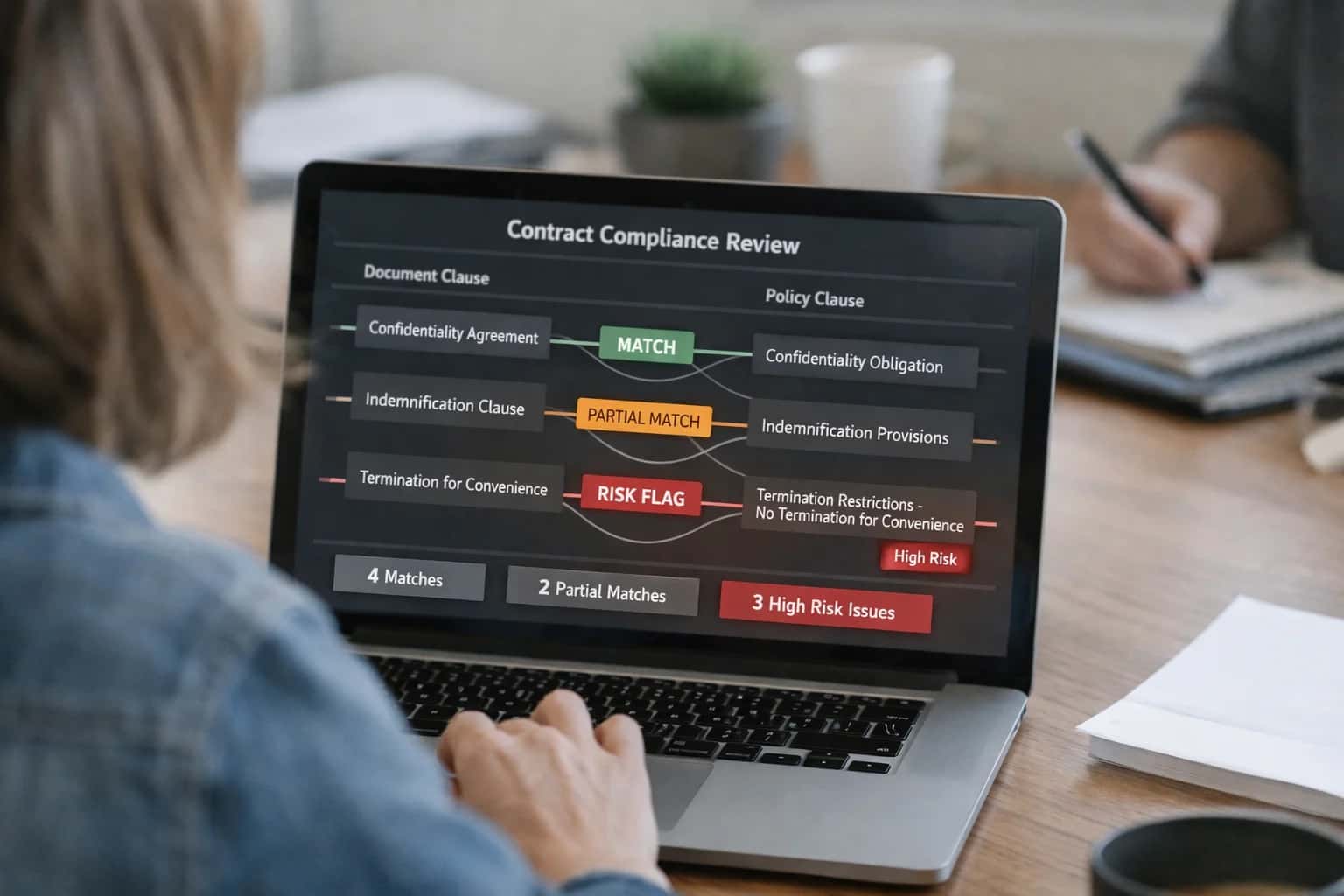
Traditional playbooks are often locked in PDFs or SharePoint sites, requiring manual look-up and interpretation. AI integration codifies these rules directly into your CLM's workflow engine. For platforms like Ironclad Workflow Engine, Icertis AI Studio, or Agiloft's configurable business rules, this means embedding logic that automatically evaluates contract drafts against approved fallback language, pricing terms, liability caps, and jurisdiction-specific clauses. The AI acts as a first-line reviewer, scanning uploaded drafts and comparing extracted clauses against the playbook's rule set stored in a vector database for semantic matching.

Integration
AI Integration for Contract Playbook Automation
Codify your legal and business playbooks into executable AI rules within your CLM platform. Automate fallback language suggestions, intelligent approval routing, and real-time deviation alerts to accelerate contract creation and enforce compliance.
ARCHITECTING PLAYBOOK AUTOMATION
From Static PDFs to Dynamic AI Rules
Transform your legal and business playbooks from static PDFs into executable AI rules that automate contract review, drafting, and approval within your CLM platform.
Implementation connects the CLM's API layer to an AI orchestration service. When a contract is uploaded or a draft is initiated, the system triggers an AI agent to: 1) Extract key clauses via NLP, 2) Query the vectorized playbook for relevant rules and precedent, and 3) Generate specific suggestions or deviation alerts. These outputs are injected back into the CLM as inline suggestions in the redlining interface, pre-populated fields in a clause library, or priority-ranked tasks in an approval queue. For example, a sales contract in DocuSign CLM can trigger an AI rule that flags any indemnity clause exceeding the standard cap and suggests the approved alternative language with a link to the relevant playbook section.
Rollout requires a phased, use-case-led approach. Start by automating high-volume, low-risk agreements like NDAs or order form renewals, where playbooks are well-defined. Governance is critical: all AI-suggested edits should be logged in the CLM's audit trail with a human-in-the-loop approval step for material deviations. Over time, the system learns from user overrides, continuously refining the rule base. This shifts legal and procurement teams from manual policing to managing exceptions and evolving the playbook itself, turning a compliance burden into a scalable competitive advantage.
ARCHITECTURE BLUEPRINT
Where AI Integrates into Your CLM Playbook Workflow
Codifying Business Rules into AI Logic
This is the foundation. AI integrates by ingesting your existing legal playbooks—the approved fallback positions, standard clauses, and approval matrices—and converting them into structured rules and embeddings. This powers the core automation.
Key Integration Points:
- Clause Library API: Connect AI to your CLM's clause repository (e.g., Ironclad's Clause Library, Icertis AI Studio) to analyze and tag clauses by risk, jurisdiction, and recommended usage.
- Playbook Configuration: Use the CLM's workflow engine API to inject AI-scored routing logic. For example, a contract with a liability cap below $X and governing law of Delaware might be auto-routed to a specific approver group, bypassing legal review.
- Metadata Mapping: AI populates custom object fields (like
Risk_Score__c,Deviation_Flag__c) based on its analysis, triggering downstream workflow conditions.
This layer turns static documents into an executable, queryable rulebook for the AI agent.
CONTRACT LIFECYCLE MANAGEMENT
High-Value AI Playbook Automation Use Cases
Transform static legal and business playbooks into active, intelligent agents within your CLM platform. These AI-driven workflows automate review, enforce policy, and accelerate contract cycles by codifying rules directly into the negotiation and approval process.
01
Automated Fallback Language Suggestions
When a counterparty proposes non-standard language, the AI analyzes the clause against the approved playbook and instantly suggests compliant fallback language. It explains the rationale (e.g., 'Our standard liability cap is $X based on deal size') directly in the redlining interface of Ironclad or DocuSign CLM.
Batch -> Real-time
Suggestion speed
02
Intelligent Approval Routing & Escalation
AI pre-screens contracts upon upload to Agiloft or Icertis, scoring risk based on playbook rules (e.g., unusual termination terms, high value). It then dynamically routes the contract: low-risk deals auto-approve, medium-risk route to business owner, high-risk escalate to legal with a flagged summary. This eliminates manual triage.
Hours -> Minutes
Triage time
03
Deviation Detection & Alerting
Continuously monitors all new contract drafts against the master playbook. When a clause deviates beyond a configurable threshold (e.g., indemnity scope, payment terms), the AI triggers an immediate alert in the CLM workflow, Slack, or email with a side-by-side comparison and risk assessment for the negotiator.
Proactive
Risk mitigation
04
Playbook-Aware Clause Selection
During contract creation in Salesforce CPQ or a CLM template, the AI acts as a copilot. Based on deal attributes (product, region, customer tier), it recommends the optimal clause from the library, ensuring the draft is pre-aligned with business rules before legal ever sees it. This reduces back-and-forth on first drafts.
1 sprint
Drafting cycle reduction
05
Obligation Extraction & Task Creation
Once a contract is executed in Icertis or Ironclad, AI parses the final document to identify all obligations, milestones, and reporting requirements. It then automatically creates tracked tasks in the CLM or syncs them to a connected project tool like Asana or Jira, with owners and deadlines assigned.
Manual -> Automated
Obligation tracking
06
Negotiation Concession Tracking
An AI agent tracks all proposed changes and accepted redlines throughout a negotiation in the CLM's version history. It builds a real-time concession log, showing what was traded, and can warn if the deal is drifting from the playbook's acceptable fallback positions. This provides leverage and auditability for the negotiator.
Complete Visibility
Negotiation intelligence
IMPLEMENTATION PATTERNS
Example AI Playbook Automation Workflows
Concrete examples of how AI can be embedded into CLM workflows to automate playbook enforcement, from initial draft to final obligation tracking.
Trigger: A vendor or partner submits an NDA via a webform connected to the CLM (e.g., Ironclad Clickwrap).
Context Pulled: The AI system retrieves the submitting party's details from the CRM (if available) and fetches the organization's standard NDA playbook rules from the CLM clause library.
AI Action:
- An LLM with RAG over the playbook extracts key clauses from the submitted PDF.
- It compares them against the standard position, scoring deviations on mutual vs. one-way confidentiality, term length, governing law, and liability caps.
- The model generates a risk summary and a recommendation: "Auto-approve," "Route to Legal with suggested redlines," or "Flag for High-Risk Review."
System Update: The CLM workflow is automatically updated:
- Low-risk, compliant NDAs are auto-approved, e-signature is triggered, and the executed copy is filed.
- Medium-risk NDAs are routed to a legal operations queue with the AI's redline suggestions pre-populated in the redlining interface.
- High-risk NDAs are assigned to a specific attorney with the flagged clauses highlighted.
Human Review Point: All medium and high-risk recommendations require human review and final approval within the CLM before proceeding.
FROM STATIC RULES TO INTELLIGENT, CONTEXT-AWARE AUTOMATION
Implementation Architecture: The AI Playbook Engine
A technical blueprint for embedding AI into your CLM to codify legal and business playbooks, automating review, redlining, and approval workflows.
The core of this integration is a RAG (Retrieval-Augmented Generation) pipeline that grounds an LLM in your specific clause library, approved templates, and historical negotiation data. This pipeline connects to your CLM platform (Ironclad, Icertis, Agiloft, or DocuSign CLM) via its API to read contract drafts and write back suggestions. Key integration surfaces include the clause library for fallback language, the redlining interface for inline suggestions, the workflow engine for conditional routing, and the metadata model for tagging deviations and risks. The AI acts as a copilot, analyzing each new contract against your codified playbooks to suggest compliant edits, explain deviations, and recommend approval paths.
A production deployment typically involves a secure middleware layer that orchestrates the flow: 1) A webhook from the CLM triggers on a new contract draft, 2) The document is chunked and vectorized, 3) A semantic search retrieves relevant playbook clauses and past similar agreements, 4) A prompted LLM generates a risk summary, redline suggestions, and routing recommendation, 5) These outputs are formatted and posted back to the CLM as a draft comment, a metadata update, or a workflow variable. This architecture ensures human-in-the-loop control, with all AI suggestions logged to the contract's audit trail for governance. The system can be tuned to auto-approve low-risk NDAs while flagging complex MSAs for legal review, turning a multi-day process into a same-day activity.
Rollout focuses on iterative playbook codification. Start with high-volume, standardized agreements (e.g., NDAs, Order Forms) where the rules are clear. Use the initial AI outputs to refine your playbook logic in tools like Ironclad's Workflow Designer or Icertis's AI Studio. Governance is critical; establish a review board (Legal, Procurement, Sales Ops) to validate AI suggestions and update playbooks quarterly. For a deeper dive on grounding AI in your specific contract data, see our guide on RAG for CLM Platforms.
IMPLEMENTATION PATTERNS
Code & Payload Examples
Defining & Enforcing Playbook Logic
Playbook automation requires codifying business rules into executable logic. This typically involves a rules engine that evaluates contract text against a library of approved clauses and fallback positions.
Example JSON Payload for a Playbook Rule:
json{ "rule_id": "liability_cap_software", "clause_type": "limitation_of_liability", "desired_position": "mutual_cap", "fallback_language": [ "Liability is capped at the fees paid in the 12 months preceding the claim.", "Liability is capped at $[AMOUNT] where amount is 1.5x Annual Contract Value." ], "approval_route": "legal_review", "deviation_threshold": 0.85, "metadata_fields": ["liability_cap_type", "cap_amount", "cap_calculation"] }
This rule defines the target clause, provides AI-suggested fallback language if the counterparty's clause deviates, and specifies the routing and metadata extraction required when a contract is analyzed.
CONTRACT PLAYBOOK AUTOMATION
Realistic Time Savings & Operational Impact
How AI integration transforms manual, rule-based contract review into an assisted, scalable workflow within your CLM platform.
| Workflow Stage | Before AI | After AI | Implementation Notes |
|---|---|---|---|
Initial Draft Review | Manual clause-by-clause check against playbook (2-4 hours) | AI highlights deviations and suggests fallback language (15-30 minutes) | AI flags issues; legal retains final approval on material terms. |
Redlining & Negotiation Support | Negotiator manually compares drafts to standard positions | AI suggests specific redlines and explains rationale per playbook | Reduces back-and-forth cycles; human negotiator drives strategy. |
Approval Routing | Manual triage based on contract value, risk keywords, or department | AI scores risk/complexity and auto-routes to correct approver queue | Ensures compliance; approvers focus on high-value exceptions. |
Obligation Extraction | Manual reading to identify and log deliverables, dates, and milestones | AI extracts key obligations and auto-creates tracked tasks in CLM | Tasks sync to project tools; owners get automated reminders. |
Contract Summarization | Legal or sales ops creates a summary for stakeholders (1-2 hours) | AI generates an executive summary and key term sheet upon execution | Accelerates onboarding for sales, finance, and business owners. |
Deviation & Risk Flagging | Relies on reviewer experience to spot non-standard or risky clauses | AI continuously scans against approved libraries and flags anomalies | Creates audit trail of exceptions for compliance and playbook refinement. |
Metadata Population | Manual data entry into CLM fields post-signature | AI auto-populates 80-90% of structured fields (parties, dates, values) | Improves search, reporting, and integration with CRM/ERP systems. |
Renewal Forecasting | Manual calendar tracking and spreadsheet analysis | AI analyzes terms and usage to predict renewal windows and likelihood | Enables proactive outreach by sales and customer success teams. |
ARCHITECTING FOR CONTROLLED ADOPTION
Governance, Security, and Phased Rollout
A practical framework for deploying AI-powered playbook automation with the necessary controls, security, and change management.
A production-grade AI integration for contract playbooks must be built on a secure, auditable architecture. This typically involves a middleware layer (like an AI orchestration service) that sits between your CLM platform (e.g., Ironclad, Icertis) and the LLM APIs. This layer handles secure API calls, manages authentication via service accounts with scoped permissions, and logs all AI interactions—including the prompt sent, the contract text analyzed, and the suggestions returned—to a dedicated audit trail. Sensitive data, such as PII in employment contracts or financial terms in deals, should be redacted or tokenized before being sent to external models, with processing aligned to your data residency requirements.
Governance is enforced through a human-in-the-loop (HITL) review gate for initial phases and high-risk clauses. For example, an AI suggestion to replace a liability clause with fallback language from the playbook can be presented to the negotiator as a "recommended edit" within the CLM's redlining interface, requiring explicit approval before application. Approval routing workflows in the CLM can be configured so contracts exceeding a certain value or containing specific flagged terms (identified by the AI) are automatically escalated to senior legal counsel, ensuring the AI augments—not replaces—critical oversight.
A phased rollout mitigates risk and builds trust. Start with a controlled pilot on a single, high-volume contract type like NDAs or simple order forms. Focus the AI on a narrow task, such as identifying the governing law clause and suggesting the standard playbook language. Measure accuracy (e.g., % of correct suggestions accepted), time saved in initial review, and user feedback. Success in this pilot allows you to expand scope: first to more contract types (e.g., MSAs, SOWs), then to more complex playbook automation like obligation extraction and milestone creation. This iterative approach, coupled with continuous model fine-tuning on your accepted/rejected suggestions, ensures the system becomes more accurate and valuable over time, leading to broader adoption across legal, sales, and procurement teams.
Enabling Efficiency, Speed & Accuracy
Intelligent Analysis, Decision & Execution
We build AI systems for teams that need search across company data, workflow automation across tools, or AI features inside products and internal software.
Talk to Us
Search across company data
Give teams answers from docs, tickets, runbooks, and product data with sources and permissions.
Useful when people spend too long searching or get different answers from different systems.
Enterprise searchRAGPermissions
Read more
Automate internal workflows
Use AI to route work, draft outputs, trigger actions, and keep approvals and logs in place.
Useful when repetitive work moves across multiple tools and teams.
AI agentsWorkflow automationGovernance
Read more
Add AI to products and internal tools
Build assistants, guided actions, or decision support into the software your team or customers already use.
Useful when AI needs to be part of the product, not a separate tool.
AI integrationDecision supportModel routing
Read moreCONTRACT LIFECYCLE MANAGEMENT
Frequently Asked Questions on AI Playbook Integration
Practical answers for legal, procurement, and operations leaders implementing AI-driven contract playbook automation within platforms like Ironclad, Icertis, Agiloft, and DocuSign CLM.
AI integrates via the platform's API layer, typically listening for workflow triggers (e.g., contract.created, draft.submitted_for_review).
- Trigger: A new contract draft enters a review stage in the CLM.
- Context Pull: The AI service fetches the document text and metadata via API.
- AI Action: A Retrieval-Augmented Generation (RAG) pipeline queries your approved playbook clause library and runs the document against risk detection models.
- System Update: The AI returns structured data (e.g., risk score, suggested redlines, missing clauses) which is written back to the CLM as custom metadata or comments.
- Workflow Routing: Based on the AI's output, the CLM workflow can automatically route the contract—sending low-risk, compliant drafts for auto-approval and flagging high-deviation contracts for legal review.
This keeps the CLM as the system of record while injecting intelligence at key decision points.

About the author
Prasad Kumkar
CEO & MD, Inference Systems
Prasad Kumkar is the CEO & MD of Inference Systems and writes about AI systems architecture, LLM infrastructure, model serving, evaluation, and production deployment. Over 5+ years, he has worked across computer vision models, L5 autonomous vehicle systems, and LLM research, with a focus on taking complex AI ideas into real-world engineering systems.
His work and writing cover AI systems, large language models, AI agents, multimodal systems, autonomous systems, inference optimization, RAG, evaluation, and production AI engineering.
LinkedIn
Limited slotsGet a Free AI Consultation
Partnered with leading AI, data, and software stack.





How We Work
Custom AI workflows for your Business
One-fit-all AI don't work for modern businesses. At Inferensys, we aim to understand your business & custom requirements; which we use to define most efficient agentic workflows, the data, and the tools for your business.
01
Review the use case
We understand the task, the users, and where AI can actually help.
Read more02
Pick the right approach
We define what needs search, automation, or product integration.
Read more03
Build the first useful version
We implement the part that proves the value first.
Read more04
Improve from there
We add the checks and visibility needed to keep it useful.
Read moreThe first call is a practical review of your use case and the right next step.
Talk to Us