Before writing a single line of integration code, you need a clear model for quantifying value. A robust ROI analysis for a CLM AI project should map directly to the platform's core objects and workflows: the time saved in contract review queues, the risk reduction from automated clause extraction against playbooks, the accelerated revenue from faster obligation tracking in Icertis or Ironclad, and the improved compliance from AI-powered metadata enrichment across your repository. This moves the conversation from speculative 'AI potential' to concrete impact on legal ops KPIs.

Integration
AI Integration for Contract AI ROI Analysis
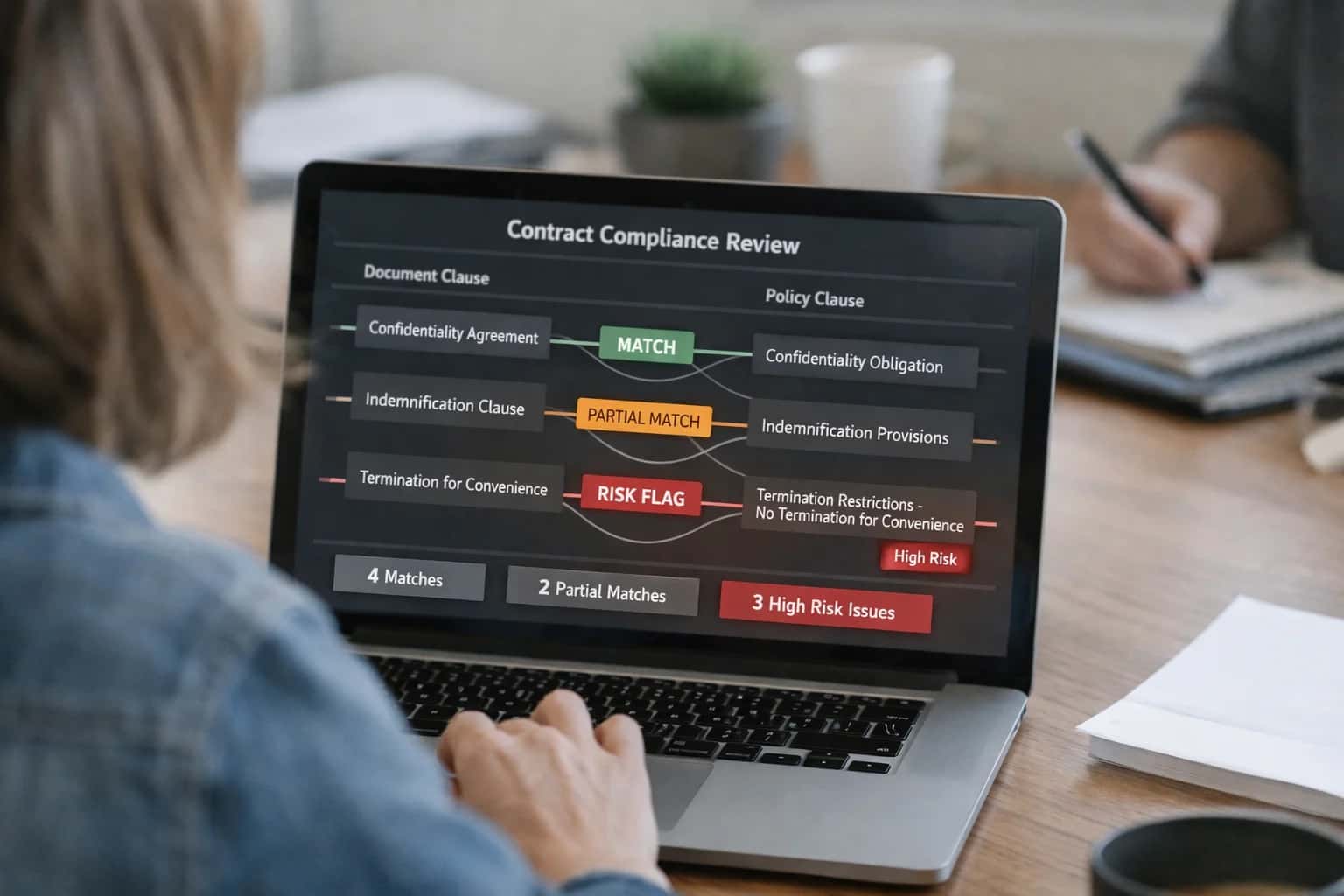
A practical framework for quantifying the return on investment of AI integrations in Contract Lifecycle Management platforms. Calculate time savings, risk reduction, compliance gains, and revenue acceleration for Ironclad, Icertis, Agiloft, and DocuSign CLM.
ARCHITECTURE & GOVERNANCE
Why ROI Analysis is Critical for CLM AI Integration
A disciplined ROI framework is the foundation for a successful, scalable AI integration in your Contract Lifecycle Management platform.
From an implementation perspective, your ROI model dictates the integration architecture. A use case focused on reducing manual data entry will prioritize a high-volume document ingestion pipeline and fine-tuned extraction models that populate custom object fields. A use case aimed at accelerating sales cycles will require a generative drafting agent tightly coupled to your CRM-CLM sync, with a human-in-the-loop approval step. Each path has different technical requirements, cost profiles, and rollout complexities that your ROI analysis must surface early.
Finally, a formal ROI process establishes the governance needed for long-term success. It forces clarity on audit trails for AI-suggested redlines, defines the accuracy thresholds for automated clause classification before moving to production, and sets the review cycles for model drift detection. This disciplined approach, grounded in the specific capabilities of platforms like Agiloft or DocuSign CLM, ensures your AI integration delivers measurable business value and not just technical novelty. For a deeper dive on implementation patterns, see our guide on AI Integration for Contract Lifecycle Management Platforms.
FRAMEWORK FOR QUANTIFYING IMPACT
Where AI ROI is Measured in Your CLM Platform
Accelerating Negotiation Velocity
AI ROI is most tangible in the review cycle. By integrating AI for clause extraction and redlining support, you compress the time legal and sales teams spend on manual analysis. AI agents can instantly compare a new draft against your approved playbooks in Ironclad or Icertis, flagging deviations and suggesting compliant fallback language.
Measurable Impact:
- Reduce initial review time from hours to minutes for standard agreements like NDAs and MSAs.
- Cut redlining cycles by 30-50% through AI-powered edit suggestions and rationale.
- Enable junior staff or business users to handle low-risk contracts, freeing senior counsel for complex deals.
This directly translates to faster deal closure and lower legal department burn rate.
CONTRACT AI ROI ANALYSIS
High-Value Use Cases with Quantifiable ROI
Calculating the return on investment for AI in your CLM requires focusing on specific, high-impact workflows. These use cases demonstrate where AI integration delivers measurable time savings, risk reduction, and revenue acceleration.
01
Automated NDA & Low-Risk Contract Intake
AI agents triage incoming contract requests via webform or email, classify document type, and extract key metadata (parties, dates, value). For standard NDAs and low-risk amendments, the system can auto-approve against playbooks, routing only exceptions for legal review. This reduces intake-to-execution time from days to hours and frees legal ops for higher-value work.
Days -> Hours
Intake cycle time
70-80%
Auto-routed volume
02
Obligation Extraction & Proactive Tracking
AI parses executed contracts to identify obligations, milestones, reporting requirements, and renewal options. It then creates tracked tasks in the CLM or connected project tools (e.g., Asana, Jira) with automated reminders for business owners. This transforms passive documents into active management systems, reducing compliance risk and missed deadlines.
Manual -> Automated
Obligation tracking
>90%
Reduction in missed milestones
03
AI-Powered Redlining & Playbook Enforcement
An AI copilot integrated into the CLM's redlining interface compares draft language against approved clause libraries and playbooks. It suggests specific edits, flags deviations, and explains the rationale based on negotiated positions. This accelerates negotiation cycles by providing real-time guidance to sales and procurement, ensuring consistency and reducing legal back-and-forth.
Hours -> Minutes
Initial review time
1-2 Rounds
Fewer negotiation cycles
04
Contract Data Extraction for Portfolio Analytics
AI models batch-process legacy contracts and incoming agreements to extract structured data (termination dates, liability caps, governing law, pricing terms) into CLM metadata fields. This creates a searchable, reportable contract database without manual entry, enabling instant portfolio analysis for spend, risk concentration, and renewal forecasting.
Weeks -> Days
Portfolio analysis setup
100%
Metadata coverage
05
RAG-Powered Contract Intelligence Assistant
A retrieval-augmented generation (RAG) system grounds a chatbot in your specific contract repository and playbooks. Users ask natural language questions ("Show all auto-renewal clauses for Vendor X") and get accurate, sourced answers. This eliminates hours of manual searching for legal, sales, and procurement teams, turning the CLM into an active knowledge base.
Hours -> Seconds
Information retrieval
Single Source
For contract queries
06
Renewal Prediction & Revenue Recognition
AI analyzes contract terms, usage data from connected systems, and relationship signals to predict renewal likelihood, timing, and optimal negotiation windows. It triggers proactive workflows in the CLM and CRM for account teams. For SaaS companies, this directly accelerates revenue recognition by reducing renewal cycle delays and identifying at-risk contracts earlier.
Reactive -> Proactive
Renewal management
Same Quarter
Faster revenue recognition
ROI ANALYSIS FRAMEWORK
Example Workflows: From Manual Process to AI-Automated
These workflows illustrate how AI integrations convert manual, time-intensive CLM tasks into automated processes, directly impacting the core ROI drivers of time savings, risk reduction, improved compliance, and accelerated revenue.
Manual Process: A sales rep emails a third-party NDA to legal. An ops coordinator manually logs it, a paralegal reviews it line-by-line against a 5-page playbook, and emails redlines back and forth.
AI-Automated Flow:
- Trigger: NDA uploaded via web portal or emailed to a dedicated inbox.
- AI Action: An AI agent instantly extracts key fields (parties, effective date, term, governing law) and performs a clause-level analysis against the approved playbook.
- System Update: The CLM (e.g., Ironclad) record is auto-populated. The AI scores the NDA as "Standard," "Non-Standard," or "High-Risk" based on deviations.
- Next Step:
- Standard: Auto-approved and routed for e-signature.
- Non-Standard: Auto-redlined with playbook language and routed to a paralegal for a 2-minute review instead of a 30-minute draft.
- High-Risk: Flagged and routed directly to a specific attorney.
ROI Impact: Reduces average review time from 45 minutes to under 5 minutes, freeing legal capacity for strategic work and accelerating deal velocity.
CONTRACT AI ROI ANALYSIS
Implementation Architecture for Measurable AI
A technical blueprint for instrumenting your CLM integration to quantify time savings, risk reduction, and revenue acceleration.
To measure ROI, your AI integration must be built with instrumentation from day one. This starts by defining key performance indicators (KPIs) tied to specific CLM platform surfaces: the review queue in Ironclad, the obligation tracker in Icertis, the workflow engine in Agiloft, or the analytics module in DocuSign CLM. For each KPI—such as 'average review time per contract' or 'percentage of obligations auto-identified'—you need to capture baseline metrics from the platform's audit logs or reporting APIs before AI is introduced. The integration architecture should then log AI-assisted events (e.g., a clause extracted, a risk flag raised, a draft auto-generated) back to a dedicated analytics layer or data warehouse, enabling a clear before-and-after comparison.
A measurable implementation typically follows this pattern: 1) Data Extraction Pipeline: AI models process incoming contracts, outputting structured data (parties, dates, clauses) and confidence scores. Each extraction event is logged with a timestamp and source document ID. 2) Workflow Triggers: Based on AI output (e.g., a high-risk score), the CLM platform's API automates routing, task creation, or alert generation. The system logs the trigger condition and the resulting automation. 3) Human-in-the-Loop Actions: When a legal reviewer accepts or overrides an AI suggestion within the CLM UI, that feedback is captured to calculate AI accuracy and human time saved. This closed-loop data flow allows you to attribute specific outcomes—like a 65% reduction in manual data entry hours or a 40% faster negotiation cycle—directly to the AI integration.
Governance is critical for credible ROI. Implement a versioned prompt registry and model performance dashboard that tracks accuracy drift over time against a golden set of contracts. Use the CLM platform's native RBAC and audit trails to control who can modify AI rules and access sensitive analysis. For rollout, start with a controlled pilot on a single contract type (e.g., NDAs) within one business unit. Measure the pilot's impact on the defined KPIs, then use that data to build the business case for scaling to more complex agreements like MSAs or procurement contracts across the enterprise. This staged, data-driven approach de-risks investment and provides the concrete metrics needed for expansion.
AI INTEGRATION FOR CONTRACT AI ROI ANALYSIS
Code Patterns for Instrumentation and ROI Tracking
Capturing Granular Workflow Events
Instrumenting your CLM platform is the first step to measuring AI ROI. This involves capturing events at key workflow stages before and after AI integration. Use webhooks or API listeners to log events like contract_uploaded, ai_review_triggered, ai_summary_generated, human_review_started, and contract_executed.
Each event payload should include a unique session ID, user role, contract type, and timestamps. This data feeds your analytics pipeline, allowing you to compare cycle times, human touchpoints, and error rates. For example, capture the timestamp when a contract enters the AI redlining queue and when it's returned to a legal reviewer to calculate AI processing latency and reviewer wait time.
python# Example: Logging an AI processing event in Ironclad import requests import json from datetime import datetime def log_ai_event(session_id, contract_id, event_type, metadata): payload = { "session_id": session_id, "contract_id": contract_id, "event_type": event_type, # e.g., "clause_extraction_started" "timestamp": datetime.utcnow().isoformat(), "user_role": metadata.get('user_role'), "contract_type": metadata.get('contract_type'), "ai_model_version": "gpt-4-turbo-2024-04-09", "processing_time_ms": metadata.get('processing_time') } # Send to your analytics service requests.post("https://analytics.yourcompany.com/clm-events", json=payload, headers={"Authorization": "Bearer YOUR_API_KEY"})
CONTRACT AI ROI FRAMEWORK
Realistic Time Savings and Business Impact Model
A conservative model for quantifying the operational and financial impact of AI integration into Contract Lifecycle Management (CLM) platforms like Ironclad, Icertis, Agiloft, and DocuSign CLM.
| Metric | Before AI | After AI | Notes |
|---|---|---|---|
Standard NDA Review | 30-60 minutes manual reading | 5-minute AI summary with risk flags | AI pre-screens for non-standard terms; legal reviews exceptions only. |
Key Data Extraction (Parties, Dates, Value) | Manual entry: 15-20 minutes per contract | Automated population: <1 minute | AI parses executed PDFs/Word docs into structured CLM metadata fields. |
Obligation Identification & Tracking Setup | Ad-hoc, often missed; manual task creation | Automated extraction and task creation in CLM/PM tool | Reduces compliance risk and operational oversights. |
Contract Portfolio Risk Assessment | Quarterly manual sampling; limited visibility | Continuous AI monitoring with real-time dashboards | Proactive identification of risky clauses (e.g., auto-renewal, liability) across all active contracts. |
Response to "Find all contracts with X clause" | Manual search: Hours to days | Semantic/RAG search: Seconds | Enables rapid due diligence for M&A, litigation, or regulatory requests. |
Initial Draft Generation from Playbook | Manual template assembly: 1-2 hours | AI-assisted assembly with context: 15-20 minutes | AI suggests clauses based on deal type, jurisdiction, and counterparty, reducing early-stage errors. |
Renewal Forecast & Preparation | Reactive, spreadsheet-driven | AI-predicted timing + automated packet generation | Shifts renewal management from reactive to strategic, protecting revenue. |
Pilot Implementation Timeline | N/A (Baseline) | Proof of Concept: 4-6 weeks | Targets a high-volume, low-risk use case (e.g., NDA intake) to demonstrate value and build internal buy-in. |
MEASURING AI IMPACT IN CLM
Governance and Phased Rollout for ROI Validation
A structured approach to deploying AI in your CLM platform that validates ROI at each step while maintaining control.
A successful AI integration for contract ROI analysis requires a phased rollout tied to specific, measurable outcomes. Start with a pilot focused on a single, high-volume contract type like NDAs or simple MSAs. Use AI to automate metadata extraction (parties, dates, key terms) and initial risk scoring against a defined playbook. The success metric is the reduction in manual review time per contract, moving from hours to minutes. This controlled pilot provides the initial ROI data point—quantifying the labor savings from automating repetitive data entry and first-pass review—while limiting scope and risk.
For the second phase, expand to obligation extraction and tracking for a broader set of sales or procurement contracts. Here, the AI pipeline ingests executed contracts from your CLM (Ironclad, Icertis, etc.), identifies obligations (reporting, deliverables, insurance requirements), and creates tracked tasks in connected systems like your project management tool or CRM. The ROI expands to include risk reduction (fewer missed milestones) and revenue acceleration (faster identification of renewal triggers or fee adjustments). Implement a human-in-the-loop review for the first 100 extracted obligations to validate accuracy and build trust in the system before full automation.
The final governance layer ensures ROI is sustainable. This includes audit trails logging all AI actions (extractions, scores, suggestions) within the CLM's activity history, regular model performance reviews against a golden set of contracts to monitor drift, and RBAC controls to ensure only authorized users can modify AI playbooks or approve AI-suggested redlines. By tying each rollout phase to a clear operational metric—time saved, risk items flagged, obligations tracked—you build a defensible, incremental business case for scaling AI across your entire contract portfolio.
Enabling Efficiency, Speed & Accuracy
Intelligent Analysis, Decision & Execution
We build AI systems for teams that need search across company data, workflow automation across tools, or AI features inside products and internal software.
Talk to Us
Search across company data
Give teams answers from docs, tickets, runbooks, and product data with sources and permissions.
Useful when people spend too long searching or get different answers from different systems.
Enterprise searchRAGPermissions
Read more
Automate internal workflows
Use AI to route work, draft outputs, trigger actions, and keep approvals and logs in place.
Useful when repetitive work moves across multiple tools and teams.
AI agentsWorkflow automationGovernance
Read more
Add AI to products and internal tools
Build assistants, guided actions, or decision support into the software your team or customers already use.
Useful when AI needs to be part of the product, not a separate tool.
AI integrationDecision supportModel routing
Read morePRACTICAL FRAMEWORK
FAQ: ROI Calculation for CLM AI Integrations
A practical guide to quantifying the return on investment for AI integrations in Contract Lifecycle Management platforms like Ironclad, Icertis, Agiloft, and DocuSign CLM. Focuses on measurable time savings, risk reduction, and process acceleration.
The largest ROI component is the reduction in manual legal and business review time. Calculate this by:
- Establish a Baseline: Measure the current average time spent by role (e.g., attorney, procurement specialist, sales ops) reviewing a contract type (NDA, MSA, SOW).
- Apply the AI Efficiency Factor: AI integration for clause extraction and risk detection can reduce initial review time by 40-70%. Use a conservative estimate (e.g., 50%) for your model.
- Annualize the Savings:
Example: 500 NDAs/year, taking 0.5 hours to review at $120/hour, with 50% AI time reduction.codeAnnual Savings = (Avg. Manual Review Hours × Avg. Hourly Fully-Loaded Cost) × (Annual Contract Volume) × (AI Efficiency Factor)Savings = (0.5 × $120) × 500 × 0.5 = $15,000/year.
This does not include the value of redeploying high-cost resources to more strategic work.

About the author
Prasad Kumkar
CEO & MD, Inference Systems
Prasad Kumkar is the CEO & MD of Inference Systems and writes about AI systems architecture, LLM infrastructure, model serving, evaluation, and production deployment. Over 5+ years, he has worked across computer vision models, L5 autonomous vehicle systems, and LLM research, with a focus on taking complex AI ideas into real-world engineering systems.
His work and writing cover AI systems, large language models, AI agents, multimodal systems, autonomous systems, inference optimization, RAG, evaluation, and production AI engineering.
LinkedIn
Limited slotsGet a Free AI Consultation
Partnered with leading AI, data, and software stack.





How We Work
Custom AI workflows for your Business
One-fit-all AI don't work for modern businesses. At Inferensys, we aim to understand your business & custom requirements; which we use to define most efficient agentic workflows, the data, and the tools for your business.
01
Review the use case
We understand the task, the users, and where AI can actually help.
Read more02
Pick the right approach
We define what needs search, automation, or product integration.
Read more03
Build the first useful version
We implement the part that proves the value first.
Read more04
Improve from there
We add the checks and visibility needed to keep it useful.
Read moreThe first call is a practical review of your use case and the right next step.
Talk to Us