AI drafting integrates at three key points in the CLM workflow: the template initiation stage, the clause assembly and population phase, and the consistency and compliance check before routing. For platforms like Ironclad or DocuSign CLM, this means connecting to the template library API to trigger AI-assisted document generation based on deal attributes from your CRM. The AI agent uses a RAG pipeline over your approved clause library and historical contracts to suggest the most relevant, pre-negotiated language, auto-populating fields like parties, effective dates, and payment terms extracted from the source system of record.

Integration
AI Integration for AI-Enhanced Contract Drafting
Build an AI drafting assistant within your CLM platform to suggest language, auto-populate templates from playbooks, and check for internal consistency and missing clauses.
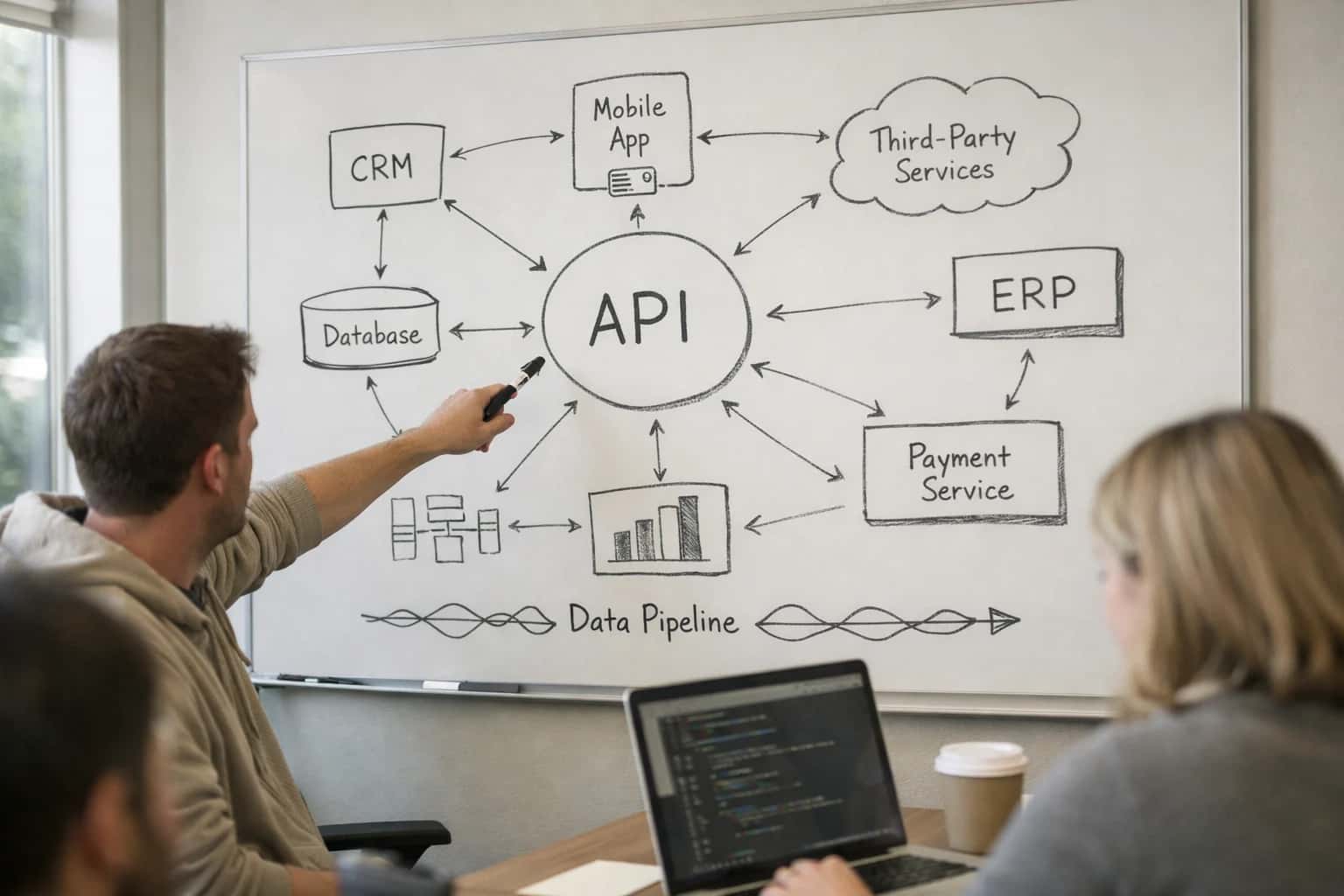
ARCHITECTURE BLUEPRINT
Where AI Fits into the CLM Drafting Workflow
A practical guide to embedding AI drafting assistants into the core surfaces of your Contract Lifecycle Management platform.
During the active drafting session, the AI functions as an in-line copilot. It monitors the document object in real-time via webhook or streaming API connection to the CLM's editing interface. For each new section or when a user highlights text, it can: suggest alternative clauses from the playbook, flag missing mandatory sections (e.g., indemnification, termination), and explain the business impact of specific language deviations. This is not a black-box generator; it's a governed assistant where suggestions are tied to your internal legal positioning, and all outputs are logged to the contract's audit trail for model oversight and continuous improvement.
Before the contract moves to the review queue, an AI pre-flight check runs automatically. This system scans the nearly complete draft against a rules engine codifying your legal, security, and procurement policies. It checks for internal consistency (e.g., ensuring termination notice periods align across clauses), validates that all extracted data points map correctly to CLM metadata fields, and generates a one-page risk summary for the assigned reviewer. This final automated quality gate reduces back-and-forth and ensures only vetted, playbook-compliant drafts enter human review cycles, compressing drafting time from days to hours.
AI-ENHANCED CONTRACT DRAFTING
CLM Platform Drafting Surfaces for AI Integration
The Foundation for AI-Assisted Drafting
The template and clause library is the primary surface for AI to accelerate initial contract creation. AI integration here focuses on dynamic assembly and intelligent suggestion.
Key Integration Points:
- Dynamic Template Generation: AI analyzes deal attributes (e.g., product, region, counterparty type) from a connected CRM or intake form to select the correct master template and pre-populate variable fields (parties, effective date, jurisdiction).
- Clause Recommendation Engine: Based on the contract context and negotiated terms, the AI suggests optimal clauses from the approved library, explaining why a certain indemnity cap or termination clause is recommended.
- Playbook Enforcement: The AI acts as a guardrail, checking drafted language against internal legal playbooks. It flags deviations from standard positions (e.g., an unlimited liability clause) and suggests fallback language before the draft is shared.
This layer transforms static templates into intelligent, context-aware drafting assistants, reducing manual lookups and ensuring consistency from the first draft.
PRACTICAL INTEGRATION PATTERNS
High-Value AI Drafting Use Cases for CLM
Integrating AI directly into your Contract Lifecycle Management platform automates drafting's most time-consuming tasks. These patterns show where to connect AI to Ironclad, Icertis, Agiloft, or DocuSign CLM for measurable speed and consistency gains.
01
Playbook-Driven Template Assembly
AI analyzes deal attributes (product, region, counterparty type) from a CRM or intake form and dynamically assembles a first-draft contract from the approved clause library. It selects the correct jurisdiction, liability caps, and termination terms, ensuring compliance from the first version.
1 sprint
Typical implementation
02
Context-Aware Clause Suggestion
Within the CLM's redlining interface, an AI copilot suggests fallback language in real-time. Grounded in the company's playbook and past negotiated outcomes, it explains why a clause is preferred, accelerating reviews for sales and procurement teams.
Hours -> Minutes
Review cycle change
03
Automated Metadata & Obligation Extraction
Upon contract upload or execution, AI parses the document to populate key CLM fields: parties, effective/expiration dates, auto-renewal terms, notice periods, and payment obligations. This eliminates manual data entry and creates trackable tasks for business owners.
Batch -> Real-time
Data capture mode
04
Deviation Detection & Risk Flagging
AI continuously compares new drafts against approved templates and playbooks. It flags non-standard or high-risk clauses (e.g., unlimited liability, unusual indemnity) for legal review and can route the contract to a specialized approval queue based on risk score.
05
Intelligent Counterparty Analysis
For vendor or customer contracts, AI cross-references the counterparty against internal vendor master data, past agreements, and performance records. It surfaces historical negotiation points, standard terms they've accepted, and potential red flags before drafting begins.
06
Multi-Language Drafting Support
For global operations, AI assists in generating and reviewing contracts in multiple languages. It ensures translated clauses retain their legal intent, checks for consistency across language versions, and helps local teams understand deviations from the standard global playbook.
IMPLEMENTATION PATTERNS
Example AI-Enhanced Drafting Workflows
These workflows illustrate how AI agents can be embedded into the drafting lifecycle of a CLM platform like Ironclad, Icertis, Agiloft, or DocuSign CLM. Each pattern connects to specific platform APIs and data models to automate manual steps while keeping legal and business teams in the loop.
Trigger: A sales rep initiates a new contract request in the CLM, selecting a template (e.g., MSA, NDA, SOW) and filling a webform with deal attributes (parties, product, region, value).
AI Agent Action:
- The agent retrieves the approved clause library and playbook rules associated with the selected template and deal attributes (e.g., jurisdiction=California, product=Enterprise Tier).
- Using a configured LLM, it assembles a complete first draft by:
- Populating the base template with form data.
- Selecting the correct fallback clauses from the library (e.g., California-specific limitation of liability).
- Flagging any missing required fields or incompatible terms for the user.
- The draft is saved back to the CLM as a new contract version, with AI-generated metadata tags (e.g.,
draft_source: ai_playbook,risk_tier: standard).
Human Review Point: The draft is automatically routed to the assigned legal reviewer within the CLM's workflow. The AI provides a summary of key selections made and any flags for reviewer attention.
BUILDING A GROUNDED DRAFTING ASSISTANT
Implementation Architecture: Data Flow & AI Layer
A production-ready AI drafting assistant for CLM platforms requires a secure, multi-stage pipeline that grounds generative AI in your specific playbooks and historical data.
The core architecture connects your CLM platform (Ironclad, Icertis, Agiloft, or DocuSign CLM) to a private AI layer via secure APIs. When a user initiates a new contract, the system first extracts key deal attributes—like parties, jurisdiction, product type, and value—from the CRM or intake form. This context is used to query a vector database containing your approved clause library, past negotiated contracts, and playbook rules. The retrieved, relevant clauses and guidelines are then passed as grounded context to a large language model (LLM) via a secure gateway, instructing it to assemble a first draft within the CLM's native template editor.
For high-accuracy drafting, the pipeline employs a multi-agent pattern. A Clause Selection Agent uses semantic search to pull the most appropriate pre-approved language. A Consistency Check Agent reviews the assembled draft against playbook logic to flag missing exhibits, conflicting terms, or non-standard liability caps. All suggestions and generated text are presented to the user as tracked changes or comments within the CLM's redlining interface, maintaining a clear human-in-the-loop approval step. Every AI action—from clause retrieval to draft generation—is logged with a full audit trail back to the source playbook rule or precedent contract.
Rollout is typically phased, starting with low-risk, high-volume agreements like NDAs or simple order forms. Governance is critical: a feedback loop captures user acceptances, rejections, and manual edits of AI suggestions to continuously fine-tune the underlying retrieval and generation models. This architecture ensures the AI acts as a compliant copilot, accelerating drafting from hours to minutes while keeping legal and business teams firmly in control of the final contract language.
AI-ENHANCED CONTRACT DRAFTING
Code & Payload Examples for Key Integration Points
Retrieving Approved Language via RAG
When a user initiates a new contract, the drafting assistant must first retrieve relevant, approved clauses from the enterprise's playbook. This is a classic RAG (Retrieval-Augmented Generation) pattern. The system queries a vector database containing embedded clause text and metadata (e.g., jurisdiction, contract type, risk tier). The returned context is then used to ground the LLM's drafting suggestions.
Example Python RAG Query:
python# Pseudocode for retrieving playbook clauses from inference_client import InferenceClient client = InferenceClient(api_key='your_key') query = "indemnification clause for SaaS MSA in California" clause_context = client.retrieve( collection="clause_library", query=query, filter={"jurisdiction": "CA", "doc_type": "MSA"}, top_k=3 ) # clause_context now contains the top 3 matching clause texts and metadata
The LLM prompt is then constructed with this context to generate a draft clause that aligns with internal standards.
AI-ENHANCED CONTRACT DRAFTING
Realistic Time Savings & Operational Impact
Expected efficiency gains and workflow changes when integrating an AI drafting assistant into your CLM platform (Ironclad, Icertis, Agiloft, DocuSign CLM).
| Workflow Stage | Before AI | After AI | Implementation Notes |
|---|---|---|---|
Initial Draft Creation | Manual template selection and data entry (1-2 hours) | AI auto-populates template from playbook based on deal attributes (15-20 minutes) | Requires mapping deal metadata from CRM (e.g., Salesforce) to CLM fields. |
Clause Selection & Insertion | Manual search of clause library; risk of outdated or non-standard language | AI suggests compliant, pre-approved clauses based on jurisdiction and deal type | AI references a governed, version-controlled clause library integrated with the CLM. |
Internal Consistency Check | Manual review by legal or paralegal for conflicting terms | AI scans draft for contradictory dates, terms, and missing exhibits | AI flags inconsistencies for human review; reduces downstream negotiation rework. |
Playbook Adherence Review | Senior legal or procurement review against lengthy internal playbooks | AI scores draft against playbook rules and highlights deviations | Human reviewer focuses on high-risk deviations flagged by AI, not entire document. |
First Draft to Counterparty | Multiple internal review cycles (2-5 business days) | Accelerated internal review with AI-assisted summaries (1-2 business days) | AI generates a negotiation brief for the business lead, summarizing key terms and risks. |
Redlining & Negotiation Support | Manual comparison of versions and tracking of concessions | AI compares redlines to standard positions, suggests trade-offs, and tracks concession history | AI acts as a copilot during negotiation, grounded in historical deal data and playbooks. |
Final Document Assembly | Manual compilation of final version, exhibits, and signature packets | AI auto-generates clean final version and required ancillary documents | Ensures version control and triggers automated signature workflow in the CLM. |
ARCHITECTING CONTROLLED ADOPTION
Governance, Security, and Phased Rollout
A practical framework for deploying AI drafting assistants within your CLM platform with appropriate controls and measurable impact.
A production-ready AI integration for contract drafting must be built on a secure, governed architecture. This typically involves a middleware layer that sits between your CLM platform (like Ironclad or Icertis) and the AI models. This layer handles secure API calls, manages authentication via your CLM's OAuth or API keys, and enforces strict data policies—such as redacting sensitive PII or financial terms before sending text to an external LLM like GPT-4 or Claude. All AI suggestions should be logged with a full audit trail, linking the generated clause, the source playbook rule, the user who accepted or modified it, and the model version used. This traceability is critical for legal review, compliance audits, and continuous model improvement.
Rollout should follow a phased, risk-based approach. Start with a controlled pilot on a low-risk, high-volume contract type like NDAs or simple order forms. Configure the AI assistant to operate in a "co-pilot" mode within the CLM's drafting interface, where all suggestions are clearly highlighted and require explicit user approval. Use this phase to gather feedback, measure time savings (e.g., reduction in manual clause lookup), and tune prompts for your specific playbook language. The next phase expands to more complex agreements (e.g., MSAs) and introduces automated playbook checks, where the AI flags deviations from standard positions for legal review before routing for signature. The final phase enables conditional automation, where fully compliant, low-risk amendments can be auto-generated and routed based on AI-scored criteria, significantly accelerating the drafting cycle.
Governance is an ongoing operation, not a one-time setup. Establish a cross-functional committee (Legal, IT, Security, Procurement) to review the AI's performance metrics, approve updates to the underlying playbook rules encoded in the system, and adjudicate edge cases. Implement a human-in-the-loop (HITL) review queue for all AI-drafted clauses that fall outside a high-confidence threshold. This layered approach—combining secure infrastructure, phased adoption, and active oversight—ensures the AI enhances productivity without introducing uncontrolled risk into your contracting process. For a deeper technical dive on implementing these governance patterns, see our guide on AI Integration for Contract AI Governance.
Enabling Efficiency, Speed & Accuracy
Intelligent Analysis, Decision & Execution
We build AI systems for teams that need search across company data, workflow automation across tools, or AI features inside products and internal software.
Talk to Us
Search across company data
Give teams answers from docs, tickets, runbooks, and product data with sources and permissions.
Useful when people spend too long searching or get different answers from different systems.
Enterprise searchRAGPermissions
Read more
Automate internal workflows
Use AI to route work, draft outputs, trigger actions, and keep approvals and logs in place.
Useful when repetitive work moves across multiple tools and teams.
AI agentsWorkflow automationGovernance
Read more
Add AI to products and internal tools
Build assistants, guided actions, or decision support into the software your team or customers already use.
Useful when AI needs to be part of the product, not a separate tool.
AI integrationDecision supportModel routing
Read moreCONTRACT LIFECYCLE MANAGEMENT
AI Drafting Integration: Technical & Commercial FAQ
Practical answers to the most common technical and business questions about integrating an AI drafting assistant into your CLM platform (Ironclad, Icertis, Agiloft, DocuSign CLM).
The integration is API-first and event-driven, designed to augment your existing CLM workflows without requiring a rip-and-replace.
Typical Architecture:
- Trigger: A user initiates a new contract from a template or a playbook within the CLM UI, or an automated workflow (e.g., a new Salesforce Opportunity reaches a certain stage) calls the CLM's API.
- Context Enrichment: Our integration service pulls the deal context (parties, product, jurisdiction, value) from the CLM record and any linked systems (CRM, CPQ).
- AI Orchestration: The enriched context is sent to a secure orchestration layer, which:
- Queries a RAG-based vector database (e.g., Pinecone) containing your approved clause library and historical contracts.
- Calls a configured LLM (e.g., GPT-4, Claude 3) with a structured prompt and retrieved clauses.
- CLM Update: The AI-generated draft, along with metadata (suggested clauses used, confidence scores), is posted back to the CLM platform via its API, creating a new contract draft or populating a template.
- Human Review: The draft is routed into the standard CLM review workflow. The AI's suggestions and rationale are displayed inline for the negotiator to accept, modify, or reject.
Key Interfaces: CLM REST APIs (for contract objects), a secure middleware layer (for orchestration and logging), and your chosen LLM provider's API.

About the author
Prasad Kumkar
CEO & MD, Inference Systems
Prasad Kumkar is the CEO & MD of Inference Systems and writes about AI systems architecture, LLM infrastructure, model serving, evaluation, and production deployment. Over 5+ years, he has worked across computer vision models, L5 autonomous vehicle systems, and LLM research, with a focus on taking complex AI ideas into real-world engineering systems.
His work and writing cover AI systems, large language models, AI agents, multimodal systems, autonomous systems, inference optimization, RAG, evaluation, and production AI engineering.
LinkedIn
Limited slotsGet a Free AI Consultation
Partnered with leading AI, data, and software stack.





How We Work
Custom AI workflows for your Business
One-fit-all AI don't work for modern businesses. At Inferensys, we aim to understand your business & custom requirements; which we use to define most efficient agentic workflows, the data, and the tools for your business.
01
Review the use case
We understand the task, the users, and where AI can actually help.
Read more02
Pick the right approach
We define what needs search, automation, or product integration.
Read more03
Build the first useful version
We implement the part that proves the value first.
Read more04
Improve from there
We add the checks and visibility needed to keep it useful.
Read moreThe first call is a practical review of your use case and the right next step.
Talk to Us