In a production environment, AI connects to IoT data through a multi-layer architecture. Sensor gateways (from vendors like Triax, Pillar, or Sensera) stream data—concrete maturity, ambient temperature, humidity, vibration, or personnel counts—to a cloud ingestion layer. An AI processing service subscribes to these streams, applying rules and machine learning models to detect anomalies, predict outcomes (like cure times), and generate actionable events. These events are then pushed into Autodesk Build via its REST API, creating or updating records in key modules: Issues for immediate alerts, Daily Logs for environmental conditions, Checklists for inspection criteria, and Project Photos with annotated sensor data overlays.

Integration
AI Integration with Autodesk Build and IoT Sensors
Architect AI systems that process IoT sensor data (concrete maturity, environmental) within Autodesk Build to automate alerts, predict risks, and inform critical construction decisions.
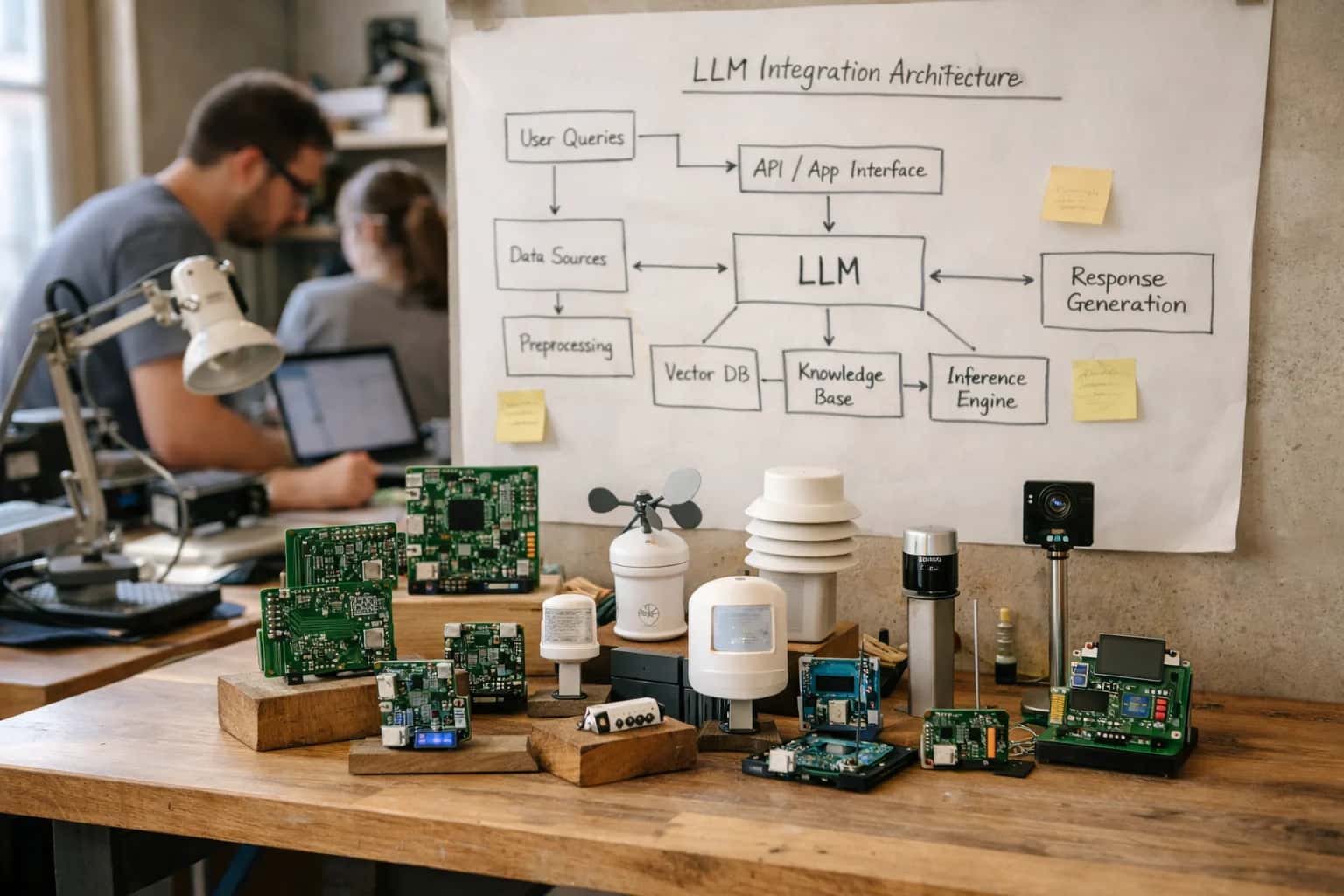
ARCHITECTURE FOR AUTOMATED FIELD INTELLIGENCE
Where AI Connects IoT Sensor Data to Autodesk Build Workflows
A technical blueprint for integrating live IoT sensor streams into Autodesk Build to automate alerts, inform decisions, and close the loop between physical conditions and project management.
High-value workflows emerge when this integration is contextual. For example, an AI agent can monitor maturity sensors in a concrete pour, compare readings against the spec and forecasted weather in the Schedule, and automatically create a Protected Work issue in Autodesk Build if stripping is attempted too early. For safety, geofenced personnel sensors can trigger a review if crew density in a trench exceeds thresholds, auto-generating a Safety observation. The impact is operational: moving from periodic manual checks to continuous, condition-based monitoring reduces rework risk, prevents safety incidents, and provides auditable, time-stamped evidence linked directly to the project record.
Rollout requires careful governance. Start with a single, high-impact sensor type and a corresponding Autodesk Build module. Implement a dead-letter queue for failed API calls to ensure data integrity. Use Autodesk Build's Roles and Permissions to control who receives automated alerts—superintendents for immediate issues, project managers for trend reports. Crucially, the AI should act as a copilot, not an autopilot; initial workflows should flag items for human review within the platform before escalating to fully automated actions. This builds trust and allows for model calibration. For teams managing this complexity, Inference Systems provides the integration architecture and LLM orchestration needed to make sensor data a proactive part of the construction workflow, not just a passive log. Explore our related guide on AI Integration with Autodesk Build for Inspections for complementary quality control patterns.
ARCHITECTING DATA-DRIVEN CONSTRUCTION WORKFLOWS
Key Autodesk Build Surfaces for IoT & AI Integration
Automating Field Condition Logging
The Issues module is the primary surface for logging field conditions, defects, and non-conformances. AI can transform this from a manual reporting task into an automated alerting system.
Integration Pattern: IoT sensors (e.g., concrete maturity, vibration, tilt) send data to a cloud queue. An AI agent monitors this stream, applies predefined logic or a trained model, and automatically creates an Issue in Autodesk Build via API when a threshold is breached. The Issue is pre-populated with:
- Sensor location (linked to BIM model coordinates)
- Timestamp and duration of the event
- Recommended priority and assigned trade
- Reference to the relevant specification clause
This creates a closed-loop system where the physical environment directly updates the digital project record, enabling superintendents to act on data-driven alerts instead of relying solely on periodic walks.
AUTODESK BUILD INTEGRATION PATTERNS
High-Value AI + IoT Use Cases for Construction
Integrating AI with Autodesk Build and IoT sensor streams automates critical site decisions, turning raw environmental and structural data into actionable alerts and predictive insights for project teams.
01
Predictive Concrete Maturity & Pour Scheduling
AI processes real-time temperature and strength data from embedded IoT sensors, predicting optimal cure times and strip dates. Workflows automatically update the Autodesk Build schedule, notify the superintendent via Issues, and adjust crew assignments to prevent delays.
Batch -> Real-time
Cure monitoring
02
Automated Environmental Compliance Alerts
IoT sensors for dust, noise, and vibration feed data into an AI model that compares readings against permit limits. When thresholds are breached, the system auto-creates a Non-Conformance Report in Autodesk Build, tags the responsible subcontractor, and logs evidence for regulatory reporting.
Same day
Violation documentation
03
Enclosure & Dew Point Analysis for Interior Work
AI correlates humidity, temperature, and HVAC operational data from site sensors to predict condensation risk within building envelopes. It generates preventative Actions in Autodesk Build, recommending dry-in verification or HVAC activation to protect finishes and avoid mold-related rework.
Proactive → Reactive
Risk mitigation
04
IoT-Driven Equipment Utilization & Fuel Forecasting
AI analyzes telematics from generators, cranes, and heavy equipment (runtime, fuel burn, GPS) to predict maintenance needs and optimize deployment. Insights are written to Custom Data fields in Autodesk Build, enabling the project engineer to schedule servicing and accurately forecast fuel deliveries.
Hours -> Minutes
Utilization reporting
05
Structural Health Monitoring for Temporary Works
Load and tilt sensors on shoring, scaffolding, and excavation supports stream data to an AI model that detects anomalous patterns. The system creates a high-priority Safety Issue in Autodesk Build with recommended corrective actions, ensuring engineer review before a shift begins.
Real-time
Hazard detection
06
Progress Verification via Environmental Signatures
AI cross-references scheduled activities (e.g., concrete pour, drywall installation) with expected environmental signatures from IoT data (power draw, humidity spike). Discrepancies trigger a Daily Log note in Autodesk Build for the superintendent to verify progress, reducing self-reported lag.
1 sprint
Schedule confidence
AUTOMATING CONSTRUCTION INTELLIGENCE
Example AI-Driven Workflows from Sensor to Action
These workflows illustrate how AI can process real-time IoT data within Autodesk Build to create closed-loop automations, moving from passive monitoring to proactive decision-making.
Trigger: Hourly temperature readings from embedded sensors in a concrete pour.
Context Pulled: AI agent retrieves the pour's concrete mix design, ambient weather data from a connected service, and the target strength profile from the project's specifications in Autodesk Build.
Model/Action: A predictive model calculates the current maturity and estimated compressive strength. It compares this against the critical path schedule (pulled from the Autodesk Build Schedule module) for the next trade (e.g., formwork stripping).
System Update: If strength targets are met ahead of schedule, the agent:
- Creates a task in Autodesk Build for the field crew to perform a field test.
- Sends an automated notification via Autodesk Build to the superintendent and project engineer with the analysis.
- Logs the predicted strength and time savings in a custom Autodesk Build dashboard.
Human Review Point: The superintendent must review the field test results in the Autodesk Build mobile app and officially approve the next step, creating an audit trail.
FROM SENSOR TO ACTIONABLE INSIGHT
Implementation Architecture: Data Flow, APIs, and Guardrails
A production-ready blueprint for connecting IoT sensor data to AI-driven alerts and decisions within Autodesk Build.
The core integration pattern establishes a real-time data pipeline from IoT hardware (e.g., concrete maturity sensors, environmental monitors) into Autodesk Build's Issues, Checklists, and custom data objects. This typically involves an IoT gateway (like Samsara or a custom edge device) streaming telemetry to a secure cloud queue (AWS IoT Core, Azure IoT Hub). An orchestration service then processes this raw data, using pre-trained AI models to detect anomalies—like a concrete pour curing too fast or ambient humidity exceeding spec—before writing structured findings back to the Autodesk Construction Cloud API. The result is an automated Issue or Checklist item created in the relevant project folder, tagged with the sensor location, timestamp, and AI-generated severity assessment, ready for the superintendent's review.
Key technical surfaces within Autodesk Build include the Issues API for creating and updating alerts, the Checklists API for populating inspection items, and the Custom Attributes feature for storing sensor metadata against project assets. The AI layer often runs as a containerized service, evaluating streaming data against project-specific thresholds and historical patterns. For example, a model can predict the optimal stripping time for formwork by analyzing real-time maturity data against the project's concrete mix design, then automatically post a recommendation to the project's daily log. Guardrails are implemented at the API layer with strict RBAC, ensuring only authorized systems can write data, and all AI-generated actions are logged in Autodesk Build's audit trail for full traceability.
Rollout follows a phased approach: first, connecting a single sensor type (e.g., temperature) to a non-critical checklist for validation. Governance is critical; we recommend a human-in-the-loop approval step for all AI-generated critical issues during the initial pilot. Over time, as confidence grows, rules can be adjusted to allow auto-closing of low-severity items. This architecture not only automates manual monitoring but creates a searchable, auditable record of environmental conditions directly tied to the project's digital twin, supporting future claims or warranty analysis. For teams managing this integration, see our guide on AI Governance and LLMOps Platforms to establish model monitoring and prompt management practices.
ARCHITECTING AI + IOT DATA FLOWS
Code and Payload Examples
Ingesting Sensor Telemetry
IoT sensors (e.g., concrete maturity, ambient temperature/humidity) stream data via MQTT or REST to a cloud ingestion layer. An AI agent enriches this raw telemetry with contextual metadata from Autodesk Build—linking sensor IDs to specific project locations, pour IDs, and specification requirements.
Example Python enrichment payload:
python# Payload sent to AI enrichment service enrichment_request = { "sensor_id": "concrete_sensor_alpha_12", "raw_readings": { "temperature_c": 28.5, "maturity_mp_hours": 150, "timestamp": "2024-05-15T14:30:00Z" }, "build_context": { "project_id": "proj_789", "location_code": "B2-SLAB", "pour_id": "pour_20240514_01", "spec_min_maturity": 175, "spec_target_strength_psi": 3000 } } # AI service returns enriched alert logic enriched_output = { "predicted_strength_psi": 2850, "hours_to_spec": "~12", "alert_severity": "warning", # derived from trend vs. spec "recommended_action": "Schedule stripping crew for tomorrow AM." }
This enriched data is then posted back to Autodesk Build's Issues or Observations module, creating a traceable record.
AI-PROCESSED IOT DATA IN AUTODESK BUILD
Realistic Time Savings and Operational Impact
This table illustrates the operational impact of integrating AI systems that analyze IoT sensor data (e.g., concrete maturity, temperature, humidity) directly within Autodesk Build workflows, automating alerts and decision support.
| Workflow / Metric | Before AI Integration | After AI Integration | Implementation Notes |
|---|---|---|---|
Concrete Maturity Monitoring | Manual data collection and spreadsheet analysis; review every 4-6 hours | Automated sensor ingestion with AI-driven strength prediction; alerts for target maturity | AI model ingests sensor telemetry, predicts strength curve, posts alert to Autodesk Build Issues |
Environmental Condition Alerts | Foreman visually checks sensors or weather reports; reactive response to thresholds | Proactive AI alerts for freeze risk or excessive heat posted to relevant project teams | Triggers Autodesk Build Tasks for protective measures; logs condition in Daily Logs |
Inspection Report Generation | Manual compilation of sensor logs, photos, and notes into PDF reports (1-2 hours) | AI auto-generates draft report with data summaries and annotated trends (15-20 minutes) | Human review and sign-off required; report attached to Autodesk Build Inspections module |
Specification Compliance Tracking | Weekly manual audit to check sensor data against spec requirements (e.g., ASTM C31) | Continuous AI monitoring with deviation alerts linked to spec clauses in Autodesk Build Docs | Links non-compliance directly to the project's specification document for traceability |
Subcontractor Performance Insights | Monthly review of sensor data to assess curing or protection practices | AI provides weekly performance dashboards scoring adherence to planned conditions | Data feeds into Autodesk Build Analytics; used for weekly coordination meetings |
Predictive Delay Identification | Schedule impact recognized after concrete fails test or rework is needed | AI flags potential delays 24-48 hours in advance based on maturity forecasts | Creates a Risk item in Autodesk Build; suggests schedule adjustments in the Schedules tool |
Data Consolidation for Handover | Manual extraction and formatting of sensor data for O&M manuals at project closeout | Automated export of certified sensor logs and analysis summaries to Autodesk Docs | AI tags data by location and phase; ready for commissioning and asset management |
ARCHITECTING FOR PRODUCTION
Governance, Security, and Phased Rollout
A practical approach to deploying AI for IoT sensor data within Autodesk Build, ensuring control, security, and measurable impact.
A production AI integration for IoT sensors and Autodesk Build requires a clear data governance model. Define which sensor data streams (e.g., concrete maturity sensors, environmental monitors) are ingested, where raw and processed data is stored, and who has access. Use Autodesk Build's Issues, Forms, and Checklists as the primary action surfaces for AI-generated alerts, ensuring all automated actions create an auditable trail within the platform's native activity log. This keeps human oversight central while automating the detection and routing of critical events.
Security is enforced at multiple layers. Sensor data ingestion occurs via secure APIs or IoT middleware, never writing directly to Autodesk Build's core tables. AI models process data in a dedicated environment, and their outputs—like "Concrete pour #405 ready for stripping" or "Ambient temperature exceeds spec in Zone B"—are posted as structured comments or new issues via Autodesk Build's API using service accounts with scoped permissions. This prevents the AI system from having broad edit rights, aligning with the principle of least privilege.
A phased rollout is critical for adoption and trust. Start with a monitoring-only phase, where AI analyses sensor data and generates reports in a separate dashboard, allowing superintendents and project engineers to validate predictions against real-world outcomes. Next, move to assisted workflows, where the AI creates draft issues in Autodesk Build but requires a human to review and publish them. Finally, enable closed-loop automation for low-risk, high-frequency alerts, like notifying a field team when a concrete maturity threshold is met, automatically populating the relevant checklist with sensor timestamps and recommended actions. Each phase includes clear rollback procedures and defined key personnel for oversight.
Enabling Efficiency, Speed & Accuracy
Intelligent Analysis, Decision & Execution
We build AI systems for teams that need search across company data, workflow automation across tools, or AI features inside products and internal software.
Talk to Us
Search across company data
Give teams answers from docs, tickets, runbooks, and product data with sources and permissions.
Useful when people spend too long searching or get different answers from different systems.
Enterprise searchRAGPermissions
Read more
Automate internal workflows
Use AI to route work, draft outputs, trigger actions, and keep approvals and logs in place.
Useful when repetitive work moves across multiple tools and teams.
AI agentsWorkflow automationGovernance
Read more
Add AI to products and internal tools
Build assistants, guided actions, or decision support into the software your team or customers already use.
Useful when AI needs to be part of the product, not a separate tool.
AI integrationDecision supportModel routing
Read moreIMPLEMENTATION BLUEPRINTS
Frequently Asked Questions
Practical questions for architects and project engineers planning AI integrations between IoT sensor streams and Autodesk Build's data model and workflows.
The typical architecture involves a dedicated, secure ingestion layer before data reaches Autodesk Build or the AI model.
- Trigger & Ingestion: IoT sensors (e.g., concrete maturity, temperature/humidity, vibration) stream data via protocols like MQTT or HTTP to a cloud message queue (e.g., AWS IoT Core, Azure IoT Hub).
- Context Enrichment: A lightweight processing service enriches raw sensor readings with project metadata (e.g.,
project_id,location_id,pour_id,specified_mix_design). This links the telemetry to the correct Autodesk Build records. - AI Processing: The enriched payload is sent to an inference endpoint. For concrete maturity, a model calculates strength gain; for environmental data, it assesses risk against thresholds.
- System Update: Results are written back via the Autodesk Construction Cloud API. This typically updates:
- A custom dataset or extension property on the relevant
Issue,Checklist, orDaily Log. - A dedicated dashboard via embedded analytics.
- A custom dataset or extension property on the relevant
- Alerting: If a threshold is breached, the system can automatically create an
Issuein Autodesk Build with the AI-generated findings pre-populated in the description, assigned to the relevant superintendent or project engineer.
Security Note: The ingestion layer should never expose Autodesk Build credentials to the sensor network. Use service principals with scoped API permissions.

About the author
Prasad Kumkar
CEO & MD, Inference Systems
Prasad Kumkar is the CEO & MD of Inference Systems and writes about AI systems architecture, LLM infrastructure, model serving, evaluation, and production deployment. Over 5+ years, he has worked across computer vision models, L5 autonomous vehicle systems, and LLM research, with a focus on taking complex AI ideas into real-world engineering systems.
His work and writing cover AI systems, large language models, AI agents, multimodal systems, autonomous systems, inference optimization, RAG, evaluation, and production AI engineering.
LinkedIn
Limited slotsGet a Free AI Consultation
Partnered with leading AI, data, and software stack.





How We Work
Custom AI workflows for your Business
One-fit-all AI don't work for modern businesses. At Inferensys, we aim to understand your business & custom requirements; which we use to define most efficient agentic workflows, the data, and the tools for your business.
01
Review the use case
We understand the task, the users, and where AI can actually help.
Read more02
Pick the right approach
We define what needs search, automation, or product integration.
Read more03
Build the first useful version
We implement the part that proves the value first.
Read more04
Improve from there
We add the checks and visibility needed to keep it useful.
Read moreThe first call is a practical review of your use case and the right next step.
Talk to Us