The most impactful AI integration connects directly to the quote object in your CPQ platform—whether it's Salesforce CPQ's SBQQ__Quote__c, Oracle CPQ's Transaction object, or Conga's deal record. An AI agent, triggered via a platform webhook or a scheduled job, pulls the finalized line items, pricing, customer data, and configured product attributes. This structured data forms the core payload. The agent then retrieves relevant, approved content from your clause library, past winning proposals, and product marketing materials—often stored in a connected CMS like SharePoint or a dedicated sales enablement platform like Seismic. This is where a RAG (Retrieval-Augmented Generation) pipeline becomes critical, grounding the AI in your approved language and avoiding hallucinations.

Integration
AI for CPQ Proposal and Contract Drafting
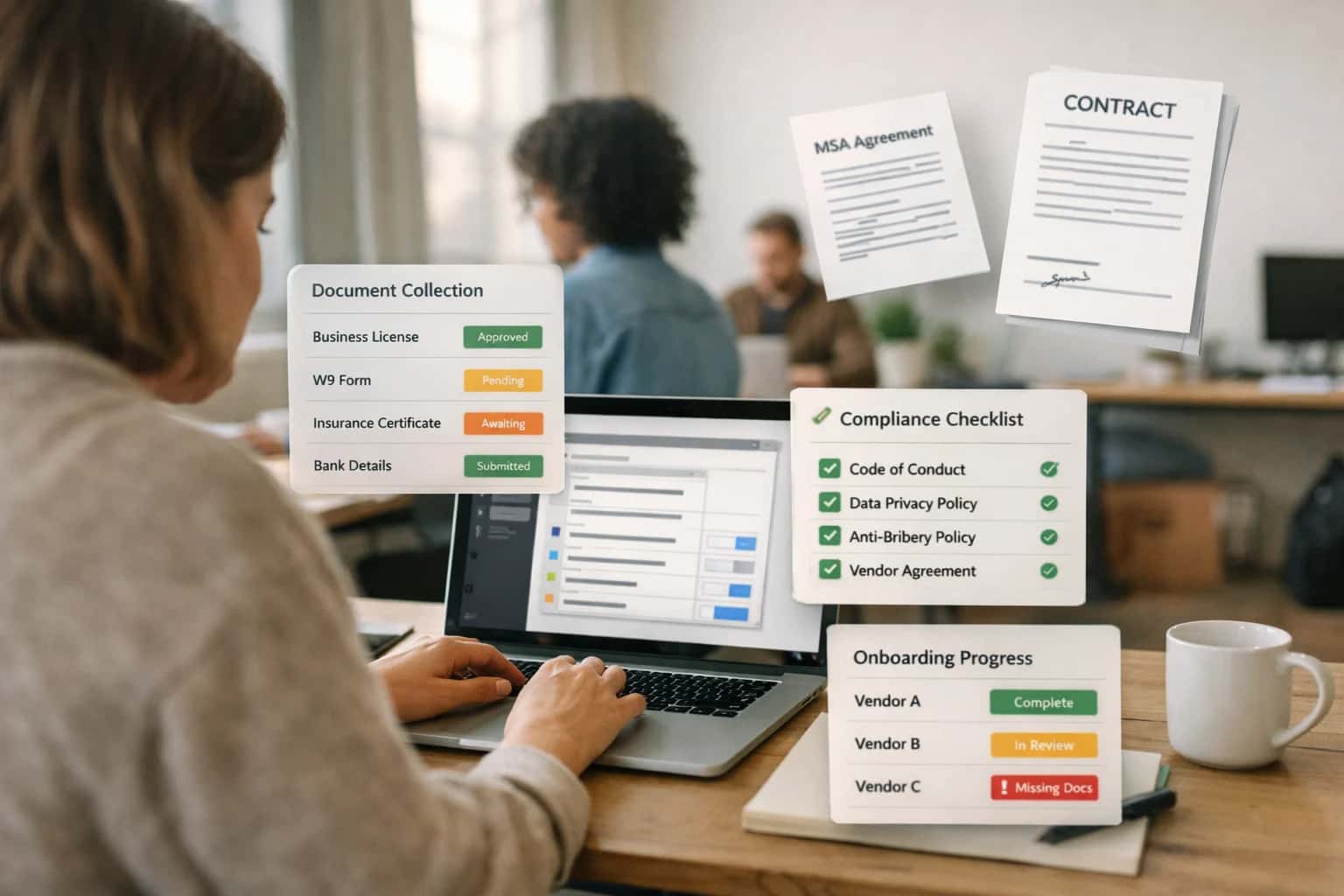
Where AI Fits in the CPQ-to-Document Workflow
A practical guide to inserting generative AI agents between your CPQ platform and your document generation layer to automate proposal and contract drafting.
The AI's role is to assemble a first draft by mapping CPQ data to document templates. For a proposal, it populates the scope of work, pricing tables, and solution overview. For a contract or SOW, it selects the correct master agreement, inserts commercial terms, and attaches the appropriate schedules and exhibits based on the products sold. The output isn't a final document; it's a review-ready draft in your CLM or document system (e.g., Ironclad, DocuSign CLM, or even Conga Documents) that triggers a predefined approval workflow. This shifts the sales or legal team's work from drafting from scratch to reviewing and refining, cutting cycle time from days to hours.
Governance is built into the workflow. Every AI-generated draft is logged as a new version in the document system with an audit trail linking back to the source quote ID. The system should enforce a human-in-the-loop checkpoint before customer sharing, allowing for legal, security, or deal desk review. Prompts and data access are scoped by role and geography using the CPQ platform's existing RBAC, ensuring reps only generate drafts for their own opportunities. This controlled, phased rollout—starting with low-risk, high-volume documents like non-disclosure agreements or simple proposals—de-risks the implementation while delivering immediate productivity gains. For a deeper look at connecting these AI workflows to your contract systems, see our guide on AI Integration for CPQ and CLM Platforms.
AI Integration Touchpoints by CPQ Platform
The Foundation for AI-Generated Content
AI proposal drafting starts with structured data from the CPQ quote object. This includes finalized line items, configured products, pricing, discounts, and customer-specific terms. An integration extracts this data via the platform's REST API (e.g., Salesforce CPQ's Quote, QuoteLineItem objects) or from a middleware layer.
Key Data Points for AI:
- Product Descriptions & SKUs: For accurate feature inclusion in the proposal.
- Pricing & Discount Logic: To explain value and justify the quoted price.
- Customer & Opportunity Context: Company name, industry, deal size from the linked CRM record.
This structured payload is sent to an LLM endpoint, instructing it to generate customer-facing narrative around the configured solution.
High-Value AI Drafting Use Cases for CPQ
Generative AI transforms the most manual, error-prone, and time-consuming steps in the CPQ process. These are the specific drafting workflows where AI delivers immediate operational lift by pulling structured data from CPQ objects and unstructured context from clause libraries.
Automated Customer Proposal Drafting
AI agents ingest the finalized CPQ quote, including line items, pricing tables, and configured options, to generate a first-draft customer-facing proposal. The workflow pulls approved boilerplate, inserts deal-specific terms, and formats it for brand compliance, turning a multi-hour manual assembly task into a review-ready document in minutes.
Dynamic Statement of Work (SOW) Generation
For service-based quotes, AI constructs a detailed SOW from CPQ data. It maps configured service SKUs to deliverable descriptions, pulls in pre-defined scope language, and auto-populates timelines, milestones, and acceptance criteria based on the quote's service level and duration. Eliminates copy-paste errors and ensures scope/quote alignment.
Intelligent Clause Selection & Assembly
AI reviews the CPQ opportunity context (e.g., customer tier, product mix, region, deal value) to recommend and insert the correct legal and commercial clauses from a centralized library into draft contracts. It flags non-standard terms that require legal review, reducing manual clause hunting and compliance risk.
Personalized Executive Summary & Cover Letters
Generates a tailored narrative for the deal by synthesizing CPQ data with CRM context (e.g., relationship history, strategic initiatives). AI drafts a cover letter or executive summary that highlights key value drivers, pricing rationale, and next steps, elevating the proposal from a transactional quote to a strategic business document.
Renewal & Amendment Drafting Automation
Triggers AI drafting workflows for renewal quotes by analyzing expiring contract terms, historical usage data (if integrated), and current CPQ price books. Automatically generates amendment documents that reflect price adjustments, product swaps, or term changes, accelerating the renewal process from days to same-day.
CPQ-to-CLM Handoff & Data Enrichment
Orchestrates a seamless handoff from CPQ (e.g., Salesforce CPQ, Oracle CPQ) to Contract Lifecycle Management (CLM) platforms like Ironclad or Icertis. AI structures the finalized quote data into a CLM intake form, pre-populates contract metadata, and attaches the AI-drafted document, creating a fully auditable, automated quote-to-contract pipeline.
Example AI Drafting Workflows from Quote to Document
These concrete workflows illustrate how generative AI agents can be embedded into CPQ processes to auto-draft customer-facing documents, pulling structured data from quotes and unstructured context from CRM and clause libraries.
Trigger: A quote reaches an Approved status in Salesforce CPQ.
Context Pulled:
- The complete quote object, line items, pricing summary, and configured products.
- The related Opportunity record (deal size, stage, close date).
- Account data (company name, industry, key contacts).
- A pre-approved proposal template library, tagged by product line and deal size.
AI Agent Action:
- The agent retrieves the relevant template and populates all structured fields (e.g.,
{{Account.Name}},{{Quote.Total}}). - Using the quote's line items, it generates a tailored "Solution Overview" section, describing the configured products in customer-friendly language.
- It drafts a customized "Business Value" paragraph by cross-referencing the account's industry with a value-prop library.
- The agent assembles the final draft, including terms & conditions from a governed clause library, and attaches it to the Quote record.
System Update & Next Step:
- The draft proposal is saved as a PDF and Files-related list item on the Quote.
- A Chatter post or Slack alert notifies the sales rep: "Draft proposal ready for your review in Salesforce."
- The rep reviews, makes edits if needed, and sends to the customer via Conga Composer or native Salesforce sending.
Implementation Architecture: Data Flow and Guardrails
A production-ready AI integration for CPQ proposal drafting connects your quote data, clause library, and approval workflows into a secure, governed document engine.
The integration is triggered from within your CPQ platform (e.g., Salesforce CPQ, Oracle CPQ) when a sales rep finalizes a quote and clicks "Generate Proposal." An event payload containing the quote ID, line items, pricing, customer record, and deal context is sent via a secure webhook to an orchestration layer. This layer retrieves the full quote object and any related data (e.g., product descriptions from a PIM, historical discounts) via the CPQ API, assembles a structured context, and calls a governed LLM endpoint. The system uses a pre-configured prompt template that merges this data with approved legal clauses from your centralized library (often in a system like Ironclad or SharePoint) to generate a first-draft document in the required format (DOCX, PDF).
Critical guardrails are enforced at multiple stages. A validation agent reviews the AI-generated draft against a rules engine, checking for missing required clauses, pricing mismatches, or non-standard terms. All document generations are logged with a full audit trail, linking the output to the source quote, user, prompt version, and model used. For high-value or complex deals, the workflow can be configured to route the draft to a human-in-the-loop review step within the CPQ or CLM system before the final version is attached to the opportunity record and sent to the customer. This ensures legal and commercial oversight while still automating 80-90% of the drafting effort.
Rollout follows a phased approach. Start with low-risk, high-volume document types like standard commercial proposals or renewal quotes, where templates are well-defined. Use this phase to tune prompts, establish confidence thresholds for auto-approval, and train sales teams. Subsequent phases can introduce more complex documents like Statements of Work (SOWs) or Master Service Agreements (MSAs), integrating with your legal team's redlining workflows in your CLM. The architecture is designed to be platform-agnostic, allowing the same core AI service to support multiple CPQ systems across your organization, while maintaining centralized governance, cost controls, and performance monitoring.
Code and Payload Patterns for AI Drafting Agents
Webhook Handler for Quote Finalization
When a quote is approved in Salesforce CPQ or Oracle CPQ, a webhook triggers the AI drafting pipeline. This handler extracts the quote ID, line items, customer context, and selected template to initiate document generation.
Key Payload Fields:
quote_id: The system identifier for the approved quote.template_key: References a pre-approved document template (e.g.,"enterprise_master_services_agreement").customer_context: JSON object containing company name, industry, and deal-specific terms.line_items: Array of configured products, quantities, and negotiated pricing.
This payload is queued for processing, ensuring the drafting workflow is decoupled from the CPQ platform's transaction.
Realistic Time Savings and Operational Impact
How generative AI integration transforms manual, error-prone document creation into an assisted, data-driven workflow, measured by time savings and process improvements.
| Workflow Stage | Before AI | After AI | Key Notes |
|---|---|---|---|
Initial Proposal Drafting | 2-4 hours manual assembly | 15-30 minutes for AI-generated first draft | AI pulls from CPQ line items, approved clause libraries, and historical templates. |
Contract Clause Selection & Insertion | Manual search across repositories | Context-aware clause recommendations | AI suggests pre-approved clauses based on deal type, region, and product. |
Pricing Table & Term Sheet Generation | Manual copy/paste from CPQ to Word/PDF | Automated table generation from CPQ data | Ensures 100% data fidelity between quote and customer-facing documents. |
Internal Legal/Deal Desk Review | Full document review for all non-standard terms | Focused review on AI-highlighted exceptions | AI pre-flags clauses that deviate from standard playbooks. |
Customer Redlining & Negotiation | Manual comparison of document versions | AI-assisted change summarization | Generates a concise summary of customer edits for faster negotiation. |
Final Document Assembly & Routing | Manual compilation and email routing for signatures | Automated assembly and integration with e-signature | Triggers DocuSign or Adobe Sign workflows directly from the CPQ platform. |
Post-Signature Obligation Extraction | Manual review to populate CLM or CRM | Automated extraction of key dates, terms, and values | AI parses executed docs to update systems like Ironclad or Salesforce. |
Governance, Security, and Phased Rollout
Implementing AI for CPQ drafting requires a secure, governed approach that aligns with sales operations and legal review cycles.
A production architecture typically inserts an AI orchestration layer between the CPQ platform (like Salesforce CPQ or Oracle CPQ) and the document generation system. This layer pulls structured data—Product lines, pricing tables, customer account details, and approved clause libraries—via secure APIs. It uses this context to generate drafts, which are then routed as new document records or attachments back into the CPQ opportunity or quote object. All prompts, model calls, and generated text are logged against the deal record for a full audit trail, ensuring every AI-suggested clause can be traced to its source data and model parameters.
Rollout follows a phased, human-in-the-loop model. Phase 1 focuses on internal drafting assistance, where AI generates first-pass proposals for rep review within the CPQ UI, reducing initial drafting from hours to minutes. Phase 2 introduces conditional automation for low-risk, repeatable deals (e.g., renewals with minimal changes), where drafts can be auto-generated and sent for a single-click rep approval. Phase 3 expands to more complex scenarios, integrating with CLM systems like Ironclad for redlining support, but always maintaining defined approval gates and fallback to manual drafting for exceptions.
Governance is built around content guardrails and role-based access. Legal teams define and maintain the master clause library in a system like Salesforce Content or a dedicated CMS, which the AI pulls from exclusively. Sales ops configures which deal attributes (e.g., deal size, product mix, region) trigger specific clause recommendations or require mandatory legal review. Access to configure AI drafting rules is restricted to admin roles, and all generated documents are watermarked as 'AI-Draft' until final approval. This controlled approach ensures AI accelerates the process without bypassing necessary commercial and compliance checks.
Enabling Efficiency, Speed & Accuracy
Intelligent Analysis, Decision & Execution
We build AI systems for teams that need search across company data, workflow automation across tools, or AI features inside products and internal software.
Talk to Us
Search across company data
Give teams answers from docs, tickets, runbooks, and product data with sources and permissions.
Useful when people spend too long searching or get different answers from different systems.

Automate internal workflows
Use AI to route work, draft outputs, trigger actions, and keep approvals and logs in place.
Useful when repetitive work moves across multiple tools and teams.

Add AI to products and internal tools
Build assistants, guided actions, or decision support into the software your team or customers already use.
Useful when AI needs to be part of the product, not a separate tool.
FAQ: AI Drafting for CPQ Proposals and Contracts
Practical questions for teams evaluating AI to automate the creation of customer-facing documents from CPQ data.
The integration connects via the CPQ platform's native REST APIs or a middleware layer. The agent is triggered (e.g., on quote finalization) and executes a data retrieval sequence:
- Quote Context: Fetches the quote object, line items, configured products, pricing, discounts, and customer metadata.
- Clause Library: Pulls approved legal clauses, terms and conditions, and service descriptions from a connected repository (e.g., a CMS, SharePoint, or a dedicated clause database).
- Historical Data: Optionally retrieves similar past proposals or contracts for the same customer or product family to ensure consistency.
This data is structured into a prompt context for the LLM. For example, an API call to Salesforce CPQ might fetch:
json{ "quoteId": "0Q01a000001A1b2C", "accountName": "Acme Corp", "lineItems": [ { "productName": "Enterprise SaaS Platform", "quantity": 50, "listPrice": 100, "netPrice": 85 }, { "productName": "Premium Support", "quantity": 1, "listPrice": 20000, "netPrice": 18000 } ], "totalAmount": 242500, "selectedTerms": "Standard Enterprise Agreement" }

About the author
Prasad Kumkar
CEO & MD, Inference Systems
Prasad Kumkar is the CEO & MD of Inference Systems and writes about AI systems architecture, LLM infrastructure, model serving, evaluation, and production deployment. Over 5+ years, he has worked across computer vision models, L5 autonomous vehicle systems, and LLM research, with a focus on taking complex AI ideas into real-world engineering systems.
His work and writing cover AI systems, large language models, AI agents, multimodal systems, autonomous systems, inference optimization, RAG, evaluation, and production AI engineering.
Partnered with leading AI, data, and software stack.





How We Work
Custom AI workflows for your Business
One-fit-all AI don't work for modern businesses. At Inferensys, we aim to understand your business & custom requirements; which we use to define most efficient agentic workflows, the data, and the tools for your business.
01
Review the use case
We understand the task, the users, and where AI can actually help.
Read more02
Pick the right approach
We define what needs search, automation, or product integration.
Read more03
Build the first useful version
We implement the part that proves the value first.
Read more04
Improve from there
We add the checks and visibility needed to keep it useful.
Read moreThe first call is a practical review of your use case and the right next step.
Talk to Us