The critical integration surface sits at the quote validation and submission stage. When a sales rep finalizes a configuration in Oracle CPQ, Salesforce CPQ, or Conga CPQ, an AI agent can be triggered via webhook or platform automation to call the ERP's APIs—such as SAP S/4HANA, NetSuite, or Oracle Cloud ERP—for real-time data. The agent retrieves and analyzes current standard costs, available-to-promise (ATP) inventory, manufacturing lead times, and vendor pricing for configured BOM items.

Integration
AI for CPQ and ERP Integration
A technical guide to implementing AI agents that automate data synchronization, validation, and enrichment between Configure Price Quote (CPQ) and Enterprise Resource Planning (ERP) systems to ensure quote accuracy and operational efficiency.
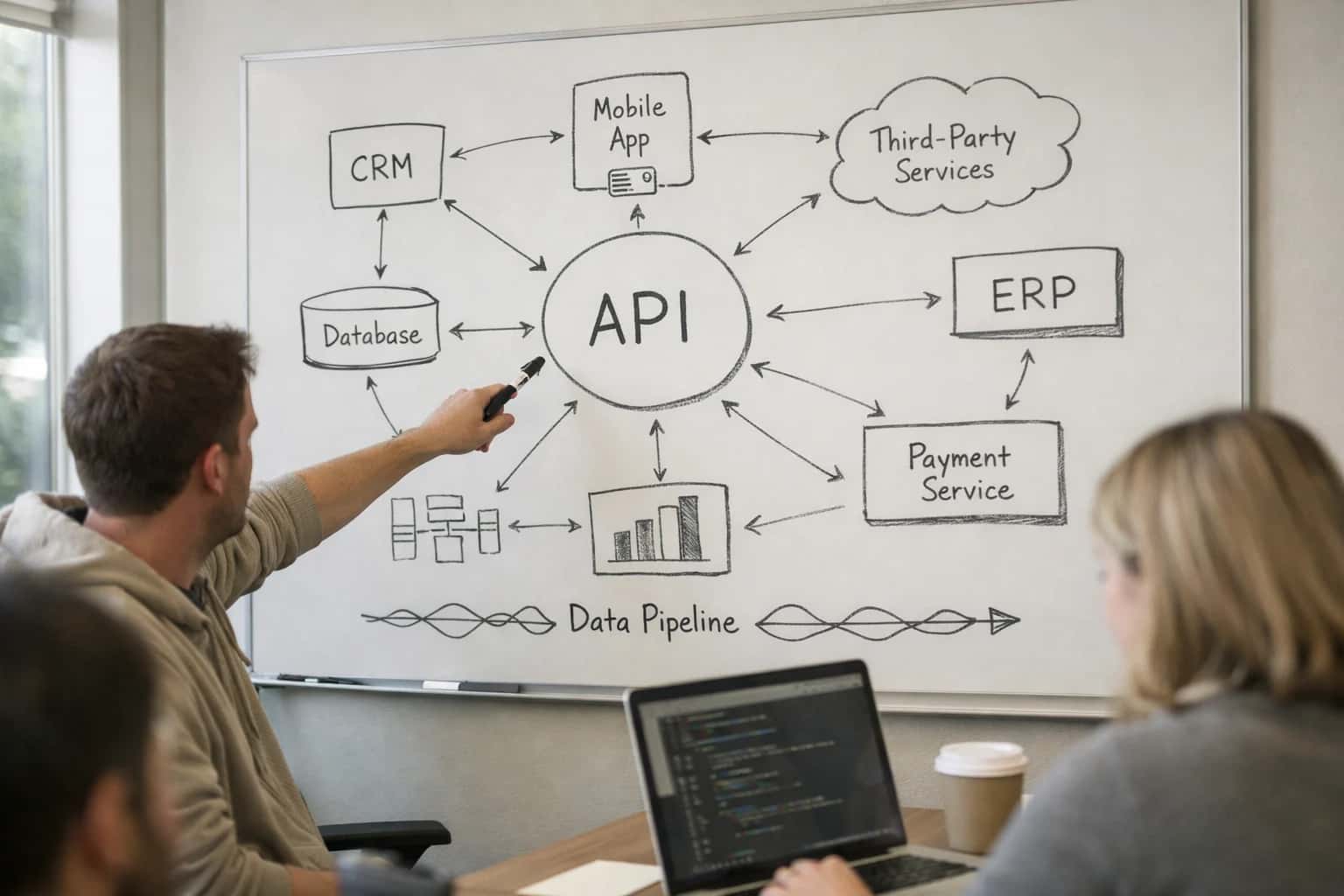
ARCHITECTURE FOR ACCURATE COSTING AND INVENTORY
Where AI Fits Between CPQ and ERP
AI agents bridge the operational gap between Configure Price Quote (CPQ) platforms and Enterprise Resource Planning (ERP) systems to validate quotes against real-time cost and availability data.
The AI's role is to synthesize this ERP data with the CPQ quote context. It can flag line items where the proposed price falls below a dynamic cost threshold, identify components with long lead times that risk the delivery date, or suggest alternative in-stock items. This validation happens before the quote is sent for approval or to the customer, preventing downstream order management errors. The agent can also write back a validation summary or cost-hold flag to a custom object in the CPQ platform, creating an audit trail.
For rollout, start with a pilot on your most complex or high-value product lines. Implement the AI agent as a middleware service (e.g., using n8n or CrewAI) that handles the API orchestration, prompt engineering for data interpretation, and secure logging. Governance is key: define clear rules for when a quote requires human review versus an automated override, and ensure all AI-suggested changes are visible in the CPQ approval workflow. This pattern turns the CPQ-ERP sync from a nightly batch job into a real-time, intelligent gatekeeper for quote accuracy.
ARCHITECTURE PATTERNS
Key Integration Touchpoints in CPQ and ERP
Synchronizing Master Data for Accurate Quotes
The most critical integration surface is the product master and pricing engine. AI agents can monitor and validate the sync between CPQ product catalogs and ERP item masters (e.g., SAP MARAs, NetSuite Items).
Typical Workflow:
- An AI agent detects a new product launch or price change in the ERP.
- It validates the data against CPQ configuration rules and pricing matrices.
- It either auto-propagates the update with a change log or flags discrepancies for human review.
This prevents quoting with outdated costs or invalid SKUs, directly impacting margin. Implementation uses scheduled jobs or event listeners on ERP change tables, with the AI performing context-aware mapping and validation.
INTELLIGENT DATA ORCHESTRATION
High-Value AI Use Cases for CPQ-ERP Sync
Manual data sync between CPQ and ERP creates errors and delays. These AI-driven patterns automate validation, enrich costing, and accelerate quote-to-order handoffs by making the data flow intelligent.
01
Automated Cost and Margin Validation
AI agents intercept CPQ quotes before submission, call ERP APIs (SAP, NetSuite) to fetch real-time standard costs, landed costs, and current inventory levels. The system validates configured margins against policy, flags unprofitable lines, and suggests alternative components—all within the CPQ UI.
Batch -> Real-time
Cost validation
02
Intelligent Lead Time and Availability Promising
Instead of static lead times, an AI model analyzes ERP production schedules, supplier PO data, and warehouse transfers. It provides dynamic available-to-promise (ATP) dates within the CPQ configuration, enabling sales to commit to accurate delivery dates and automatically update the ERP work order queue.
Same day
Schedule visibility
03
AI-Enriched BOM and Routing Synchronization
For engineer-to-order or configure-to-order, AI parses CPQ output to map line items to the correct ERP Bill of Materials (BOM) and routing templates. It identifies missing components, suggests substitutions from approved vendor lists, and pre-populates the work order in the ERP to reduce manual engineering review.
1 sprint
Implementation cycle
04
Proactive Quote-to-Order Exception Handling
An AI workflow monitors the CPQ-to-ERP integration queue. It detects failed records (e.g., invalid customer ID, discontinued SKU), classifies the root cause, and either auto-corrects using master data rules or routes the exception to the correct RevOps or IT team with a suggested fix.
Hours -> Minutes
Exception resolution
05
Predictive Pricing and Discount Governance
AI models analyze historical ERP data—win/loss rates, deal profitability, customer payment terms—to provide context-aware pricing guidance within CPQ. It recommends discounts or premiums based on actual cost-to-serve and strategic value, enforcing governance before the quote is approved.
06
Unified Customer and Item Master Sync
AI-driven stewardship for master data. When a new customer or product is created in CPQ, the AI agent validates, enriches, and formats the record to match ERP schema requirements before initiating the sync. It prevents creation of duplicate or non-compliant records in the system of record.
CPQ-ERP DATA SYNCHRONIZATION
Example AI-Powered Workflows
These workflows demonstrate how AI agents and automations bridge the critical gap between Configure Price Quote (CPQ) platforms like Oracle CPQ and Enterprise Resource Planning (ERP) systems like SAP S/4HANA or NetSuite. The goal is to ensure quotes reflect real-time costing, inventory, and compliance data.
Trigger: A sales rep initiates a new quote in Oracle CPQ, adding configured products and quantities.
AI Agent Action:
- The agent extracts the Bill of Materials (BOM) and raw material IDs from the CPQ configuration.
- It calls the ERP's costing APIs (e.g., SAP's standard cost or moving average price) and procurement APIs to fetch the latest per-unit material costs, including any recent purchase order variances.
- Concurrently, it checks the ERP for current inventory levels of finished goods or critical components.
- An LLM reviews the cost data against the proposed sales price, calculating a real-time gross margin.
System Update:
- The CPQ quote is automatically annotated with flags:
⚠️ Margin Below Threshold: 18%✅ Component Inventory: Sufficient
- The rep receives an in-app notification: "Current ERP cost data suggests a 22% margin. For a 25% target, consider increasing price by 3.8% or reviewing configuration X."
Human Review Point: The rep can adjust the quote before submission. All cost pulls are logged with timestamps for audit.
SYNCHRONIZING COSTING AND INVENTORY DATA
Implementation Architecture and Data Flow
A practical blueprint for using AI to validate and synchronize data between your CPQ and ERP systems, ensuring quotes reflect real-time costing and availability.
The core integration pattern involves a bidirectional data flow between your CPQ platform (e.g., Oracle CPQ) and your ERP system (e.g., SAP S/4HANA, NetSuite). AI agents act as intelligent validators and orchestrators within this flow. When a quote is being configured, the CPQ system typically calls the ERP via standard APIs for item costs, inventory levels (ATP), and lead times. An AI layer intercepts these calls to perform real-time validation, checking for data anomalies, flagging stale cost data, or suggesting alternative components based on real-time supplier or inventory constraints.
For high-value or complex quotes, an AI workflow can be triggered to perform a multi-system reconciliation. This agent pulls the proposed Bill of Materials (BOM) from the CPQ, fetches the latest standard costs, current on-hand/committed inventory, and open purchase orders from the ERP, and runs a discrepancy analysis. It can then generate a summary for the sales engineer or deal desk, highlighting items where the quoted cost deviates from the latest standard cost by a configurable threshold, or where lead times are at risk. This is often implemented as an asynchronous job, with results posted back to the CPQ quote record or a dedicated deal room.
Rollout typically starts with a read-only validation phase, where AI insights are presented as recommendations without blocking quote submission. Governance is critical: all AI-suggested overrides or validations should be logged with the user's rationale, creating an audit trail for finance and operations reviews. The final architecture often includes a queue (like RabbitMQ or AWS SQS) to manage these validation jobs, ensuring the CPQ user experience remains fast while complex, multi-step data checks happen in the background.
AI-DRIVEN DATA SYNCHRONIZATION PATTERNS
Code and Payload Examples
Real-Time Cost Validation via API
Before finalizing a quote, an AI agent can call your ERP's APIs to validate cost and availability, preventing margin erosion and stockouts. This pattern uses the CPQ system as the trigger and the ERP as the source of truth.
Example Python function for an AI agent to call SAP S/4HANA:
pythonimport requests def validate_erp_data(cpq_line_item): # Extract material ID and quantity from CPQ payload material_id = cpq_line_item['productCode'] quantity = cpq_line_item['quantity'] # Call SAP OData API for current standard cost and ATP headers = {'Authorization': f'Bearer {ERP_TOKEN}'} cost_url = f'{SAP_BASE_URL}/MaterialCosts?$filter=Material eq '{material_id}'' atp_url = f'{SAP_BASE_URL}/MaterialAvailability?$filter=Material eq '{material_id}'' cost_resp = requests.get(cost_url, headers=headers).json() atp_resp = requests.get(atp_url, headers=headers).json() current_cost = cost_resp['value'][0]['StandardCost'] available_qty = atp_resp['value'][0]['AvailableQuantity'] # AI logic: compare CPQ cost vs. ERP cost, check availability validation_result = { 'costVariance': cpq_line_item['unitCost'] - current_cost, 'isAvailable': available_qty >= quantity, 'erpStandardCost': current_cost, 'erpAvailableQty': available_qty } return validation_result
The agent can flag discrepancies for review or automatically update the CPQ record, ensuring the quote reflects real-time operational data.
AI FOR CPQ AND ERP INTEGRATION
Realistic Operational Impact and Time Savings
How AI-driven synchronization and validation between CPQ and ERP systems reduces manual effort, improves accuracy, and accelerates key sales and finance workflows.
| Workflow / Metric | Before AI (Manual) | After AI (Assisted) | Implementation Notes |
|---|---|---|---|
Cost and Margin Validation | Manual export/import between systems; 2-4 hours per complex quote | Real-time API calls with flagging; <5 minutes per quote | AI validates ERP cost data against CPQ pricing; flags discrepancies for review |
Inventory and Lead Time Checks | Sales rep calls operations; follow-up next day | Automated check during configuration; result in seconds | AI queries ERP for real-time ATP; surfaces alerts in CPQ UI |
Quote-to-Order Data Handoff | Manual re-keying from CPQ to ERP; 30-60 minutes per order, risk of errors | Validated, automated data flow; <5 minutes, error rate reduced | AI maps and enriches CPQ output to ERP order schema; human approves final submission |
Pricing Exception Approval Routing | Email chains and manual policy review; 1-3 day approval cycles | AI analyzes deal context against history; routes in minutes | AI suggests approval path based on deal size, margin, customer tier; final human sign-off |
Monthly Billing Schedule Reconciliation | Finance team manual spreadsheet reconciliation; 2-3 days per month | AI identifies mismatches; review focused on exceptions; <1 day | AI compares CPQ contract terms with ERP billing schedules; highlights variances |
New Product Introduction (NPI) to CPQ | IT/Admin manual configuration of SKUs, rules, pricing; 1-2 weeks | AI-assisted mapping from ERP item master; pilot in 2-3 days | AI suggests CPQ attributes and rules based on ERP product data; admin reviews and confirms |
Regulatory and Compliance Data Sync | Quarterly manual audits for tax codes, regulatory flags | Continuous monitoring and alerting on data drift | AI enforces data governance rules across systems; alerts on non-compliant configurations |
ARCHITECTING FOR ENTERPRISE CONTROL
Governance, Security, and Phased Rollout
A production-grade integration between your CPQ and ERP requires deliberate controls for data integrity, security, and user adoption.
The integration's core governance challenge is maintaining a single source of truth across systems. AI agents must be configured to treat ERP data—like standard costs, inventory levels, and active SKUs—as the authoritative source for validation, while CPQ data (e.g., configured product specs, promotional pricing) governs the quote. This is enforced through a middleware layer or API gateway that logs all data exchanges, applies field-level mapping rules, and triggers reconciliation alerts if discrepancies exceed tolerance thresholds set in systems like Oracle CPQ Cloud or SAP S/4HANA.
Security is implemented at three levels: authentication (using service accounts with least-privilege access to CPQ and ERP APIs), data masking (obscuring sensitive cost fields from non-financial roles in the CPQ UI), and audit trails (logging every AI-suggested adjustment for compliance). For example, an AI model suggesting a cost-based price override would write a log entry to the Quote_Adjustment_History object in Salesforce CPQ, citing the ERP cost pull that justified the change.
A phased rollout mitigates risk. Start with a read-only validation phase, where AI agents flag quotes with potential costing or inventory issues in a side panel without blocking submission. Next, move to assisted writes, allowing reps to accept AI-suggested corrections with one click. Finally, enable automated synchronization for high-confidence, low-risk scenarios—like updating standard cost fields in CPQ nightly from the ERP. Each phase includes a human-in-the-loop review step and performance monitoring against key metrics like quote accuracy and cycle time.
This controlled approach ensures the integration delivers value without introducing operational risk. For a deeper look at the technical architecture, see our guide on AI for CPQ and CRM Data Synchronization, or explore our foundational services for Enterprise Resource Planning Platforms.
Enabling Efficiency, Speed & Accuracy
Intelligent Analysis, Decision & Execution
We build AI systems for teams that need search across company data, workflow automation across tools, or AI features inside products and internal software.
Talk to Us
Search across company data
Give teams answers from docs, tickets, runbooks, and product data with sources and permissions.
Useful when people spend too long searching or get different answers from different systems.
Enterprise searchRAGPermissions
Read more
Automate internal workflows
Use AI to route work, draft outputs, trigger actions, and keep approvals and logs in place.
Useful when repetitive work moves across multiple tools and teams.
AI agentsWorkflow automationGovernance
Read more
Add AI to products and internal tools
Build assistants, guided actions, or decision support into the software your team or customers already use.
Useful when AI needs to be part of the product, not a separate tool.
AI integrationDecision supportModel routing
Read moreIMPLEMENTATION PATTERNS
FAQ: AI Integration for CPQ and ERP
Technical questions and workflow blueprints for using AI to synchronize data between Configure Price Quote (CPQ) platforms like Oracle CPQ and ERP systems like SAP or NetSuite, ensuring accurate costing, inventory, and order fulfillment.
This workflow ensures quotes reflect live inventory and cost before submission, preventing downstream fulfillment errors.
- Trigger: A sales rep finalizes a quote in the CPQ platform (e.g., Oracle CPQ).
- Context Pulled: The AI agent extracts the line-item SKUs, quantities, and requested ship dates.
- Agent Action: The agent calls the ERP's (e.g., SAP S/4HANA) REST APIs to query:
- Available-to-Promise (ATP) for each SKU.
- Standard cost and any recent purchase order variances.
- Lead time from the production or procurement module.
- System Update: The agent returns a validation payload to the CPQ system, which can:
- Flag line items with insufficient stock.
- Suggest alternative ship dates or substitute parts.
- Update the quote's cost margin calculation in real-time.
- Human Review Point: The sales rep reviews the validation flags and adjusts the quote before sending it for approval or to the customer.

About the author
Prasad Kumkar
CEO & MD, Inference Systems
Prasad Kumkar is the CEO & MD of Inference Systems and writes about AI systems architecture, LLM infrastructure, model serving, evaluation, and production deployment. Over 5+ years, he has worked across computer vision models, L5 autonomous vehicle systems, and LLM research, with a focus on taking complex AI ideas into real-world engineering systems.
His work and writing cover AI systems, large language models, AI agents, multimodal systems, autonomous systems, inference optimization, RAG, evaluation, and production AI engineering.
LinkedIn
Limited slotsGet a Free AI Consultation
Partnered with leading AI, data, and software stack.





How We Work
Custom AI workflows for your Business
One-fit-all AI don't work for modern businesses. At Inferensys, we aim to understand your business & custom requirements; which we use to define most efficient agentic workflows, the data, and the tools for your business.
01
Review the use case
We understand the task, the users, and where AI can actually help.
Read more02
Pick the right approach
We define what needs search, automation, or product integration.
Read more03
Build the first useful version
We implement the part that proves the value first.
Read more04
Improve from there
We add the checks and visibility needed to keep it useful.
Read moreThe first call is a practical review of your use case and the right next step.
Talk to Us