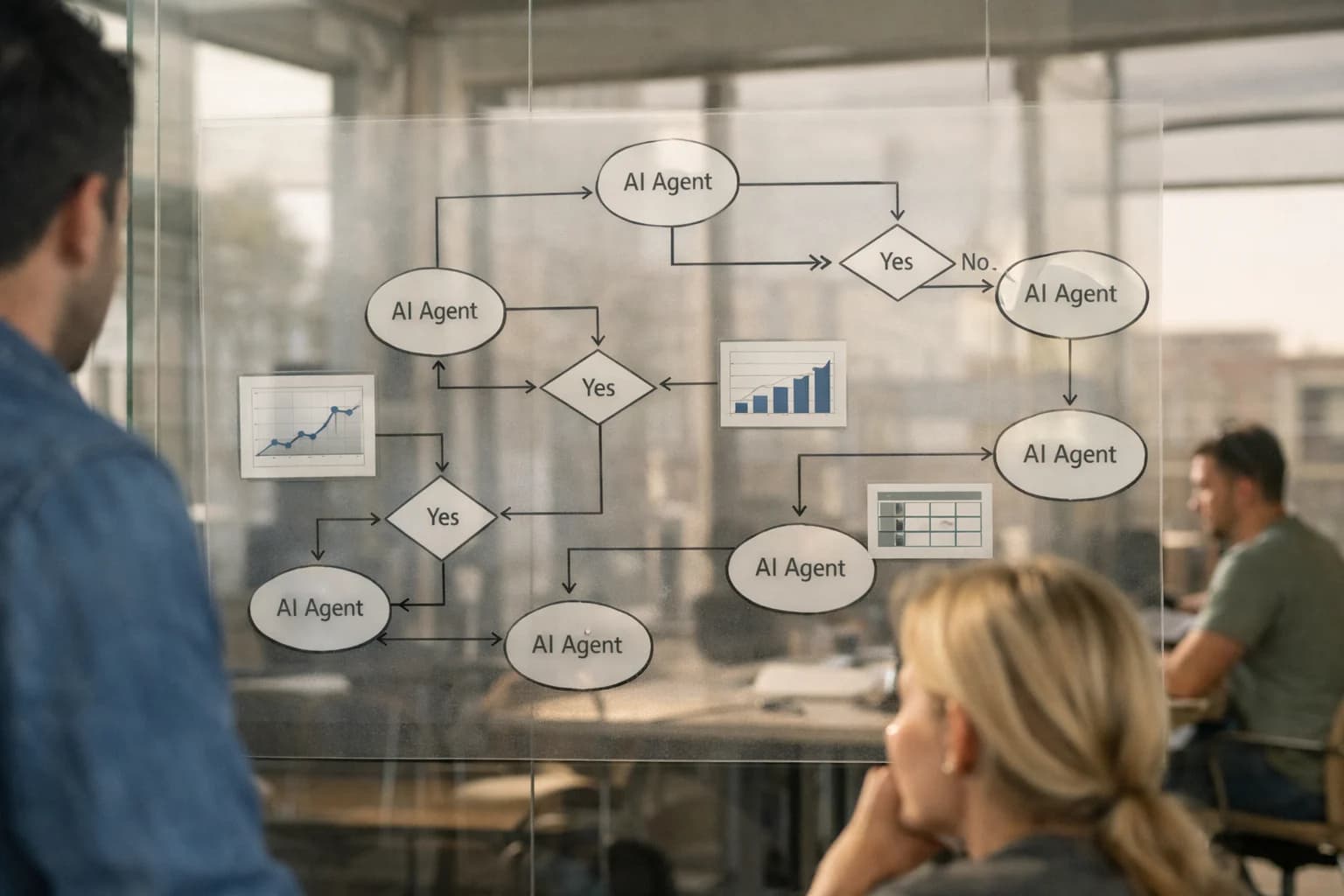
AI Integration with Payscale Manager Decision Assistance
Embed AI-powered coaching directly into Payscale's manager workflows to automate compensation guidance, draft justifications, and run compliance checks during merit and promotion cycles.
A practical blueprint for embedding AI-powered guidance directly into Payscale Manager's compensation decision workflows.
AI integration for Payscale Manager focuses on three primary surfaces: the compensation review worksheet, the manager justification field, and the approval routing queue. An AI agent, triggered via webhook or API call from Payscale, acts as a real-time coach. It receives context—employee history, current pay, proposed increase, budget status, and peer benchmarks—and generates actionable guidance. This isn't a replacement for the manager's judgment but a copilot that surfaces relevant policy, flags potential equity issues, and drafts narrative justifications based on performance data.
The implementation typically involves a secure middleware layer that orchestrates the flow: 1) Payscale Manager sends a decision event, 2) the AI service retrieves enriched data from connected HRIS (like Workday) and internal performance systems, 3) a governed LLM evaluates the proposal against rules and benchmarks, and 4) returns structured feedback to Payscale via its API. This feedback can populate a guidance panel, pre-fill the justification field, or trigger a compliance check in the approval workflow. The impact is operational: reducing manager hesitation, ensuring policy adherence, and cutting justification drafting time from 15-20 minutes to near-instant.
Rollout is phased, starting with a pilot group of managers during a merit cycle. Governance is critical: all AI suggestions should be logged with audit trails in a system like Datadog or LangSmith, and a human-in-the-loop review step is recommended for the first cycle. The AI's role is to augment Payscale's existing data, not to make autonomous decisions, ensuring managers retain final approval authority while being better informed.
MANAGER DECISION ASSISTANCE
Key Integration Points in Payscale
Core Workflow Touchpoints
AI integration for manager decision assistance is most impactful when embedded directly into the compensation workflows managers already use. Key surfaces include:
Merit & Promotion Cycles: Inject real-time guidance and justification drafting directly into the manager's compensation review interface. An AI agent can analyze the employee's profile against internal bands, market data, and equity peers to recommend a range and draft a narrative.
Compensation Planning Modules: Integrate with planning dashboards to provide proactive nudges. For example, flag employees approaching the top of their pay band or highlight high-performers with compensation below the market midpoint.
Approval Routing Workflows: Before a compensation decision is submitted for approval, an AI layer can perform a final compliance and equity check, ensuring the proposal aligns with budget and policy, reducing back-and-forth with HR.
These integrations turn Payscale from a reference tool into an active coaching partner within the manager's existing workflow.
PAYSCALE MANAGER DECISION ASSISTANCE
High-Value AI Use Cases for Manager Coaching
Integrating AI directly into Payscale's manager workflows provides real-time, contextual guidance during merit, promotion, and adjustment cycles. These use cases focus on augmenting manager decisions with data-driven support, reducing administrative burden, and ensuring consistency and compliance.
01
Real-Time Compensation Justification Drafting
AI analyzes the employee's profile, performance data, and internal equity benchmarks within Payscale to auto-generate a draft justification narrative for the proposed compensation change. The manager can edit and approve, turning a 30-minute writing task into a 2-minute review.
30 min -> 2 min
Justification drafting
02
In-Workflow Compliance & Budget Guardrails
As a manager inputs a proposed salary increase or bonus in Payscale, an AI agent cross-references the amount against policy rules, remaining budget, and pay equity cohorts. It provides instant, inline warnings or approvals, preventing out-of-cycle corrections.
Pre-emptive
Error prevention
03
Scenario Modeling for Retention Risks
When a manager views a high-performer's record, AI can simulate the impact of different compensation adjustments based on market data, internal ranges, and flight risk indicators. This provides a data-backed conversation starter for retention planning.
Informed counter-offers
Proactive retention
04
Automated Peer Group Analysis
For any employee in the review queue, AI automatically identifies and summarizes the compensation of a relevant peer group (by level, tenure, location, skill). This delivers the equity context managers need without manual spreadsheet work.
Batch -> Real-time
Equity analysis
05
Personalized Manager Coaching Playbooks
Based on a manager's historical compensation decisions and team outcomes, AI generates a personalized coaching summary before the review cycle. It highlights tendencies (e.g., compression risks) and suggests focus areas, served within the Payscale interface.
Targeted guidance
Improves decision quality
06
Conversational Policy & Range Q&A
A chat interface embedded in Payscale allows managers to ask natural language questions (e.g., "What's the range for a Senior Engineer in Denver?") and get instant answers grounded in the latest benchmark data and company policy, reducing HR ticket volume.
Self-service
Reduces HR support load
PAYSCALE MANAGER DECISION ASSISTANCE
Example AI-Powered Manager Workflows
These concrete workflows illustrate how AI agents integrate directly into Payscale's Manager Decision Assistance module, augmenting the compensation review process with real-time guidance, automated drafting, and compliance guardrails.
Trigger: A manager initiates a merit increase for a direct report within the Payscale compensation review cycle.
Context Pulled: The AI agent, via secure API, retrieves:
Employee's current salary, tenure, and performance rating.
Relevant pay band, compa-ratio, and market reference data from Payscale.
Historical merit increases for the team/role for context.
Any pre-written manager notes or feedback snippets.
Agent Action: Using a structured prompt, the LLM generates a draft justification narrative that:
Aligns with Data: Explicitly references the employee's compa-ratio and performance rating.
Provides Business Rationale: Connects individual contributions to team or company goals.
Ensures Consistency: Uses language aligned with the company's compensation philosophy.
Flags Anomalies: If the proposed increase is a statistical outlier vs. peers, it adds a note recommending manager review.
System Update: The drafted narrative is inserted into the Payscale justification field as a suggestion. The manager can edit, approve, or discard it.
Human Review Point: The manager must actively review and submit the final justification. The AI's role is purely assistive, maintaining manager ownership.
AI-ASSISTED MANAGER COACHING WITHIN PAYSCALE
Implementation Architecture: Data Flow & System Design
A production-ready blueprint for embedding AI agents into Payscale's Manager Decision Assistance workflows to guide compensation conversations.
The integration connects to Payscale's Compensation Management API and Insights Data Model, focusing on the employee_record, compensation_plan, and market_data objects. An AI agent, triggered via a secure webhook from a manager initiating a merit or promotion review in Payscale, receives a structured payload containing the employee's role, tenure, current pay, performance rating, and relevant market benchmarks. The agent's first task is a compliance and equity check, comparing the proposed increase against internal pay bands, similar roles within the department (using anonymized peer data), and historical patterns to flag potential outliers or unintended disparities before the manager proceeds.
The core workflow involves a multi-step reasoning process: 1) Contextual Analysis of the employee's career trajectory and the business unit's remaining budget. 2) Guidance Generation producing a concise, natural-language justification draft the manager can adapt, citing specific data points like market percentile movement. 3) Interactive Coaching where the manager can ask follow-up questions via a chat interface (embedded in Payscale's UI via a secure iFrame or sidebar) to explore 'what-if' scenarios, such as the impact of a higher bonus vs. base increase. All agent interactions are logged as a new coaching_session record in Payscale, linked to the compensation_event, creating a full audit trail for HR review.
Rollout follows a phased governance model. Phase 1 is a 'Advisor Mode' pilot where AI suggestions are clearly labeled as recommendations, requiring manager confirmation, with all outputs sampled for HR review. Phase 2, 'Guided Workflow', introduces soft guardrails, where proposals falling outside pre-defined policy boundaries require additional HR approval steps. The architecture is stateless and scales via a message queue, ensuring performance during peak compensation cycles. Crucially, no sensitive employee data is persisted in the AI layer; all context is ephemeral, with Payscale remaining the single source of truth. This design shifts manager support from static policy documents to dynamic, data-driven dialogue, reducing cycle times and increasing confidence in pay decisions.
IMPLEMENTATION PATTERNS
Code & Payload Examples
Listening for Manager Actions
AI integration begins by listening for specific events within Payscale's Manager Decision Assistance module. A secure webhook endpoint captures events when a manager opens a compensation case or initiates a justification draft.
python
# Example: Flask webhook handler for Payscale events
from flask import Flask, request, jsonify
import os
app = Flask(__name__)
@app.route('/webhook/payscale', methods=['POST'])
def payscale_webhook():
"""
Receives event payload from Payscale.
Triggers AI analysis for manager guidance.
"""
data = request.json
event_type = data.get('event')
employee_id = data.get('employee_id')
case_context = data.get('case_data', {})
# Validate and route the event
if event_type == 'manager_case_opened':
# Enqueue for AI processing
ai_payload = {
"employee_id": employee_id,
"job_code": case_context.get('job_code'),
"current_comp": case_context.get('current_salary'),
"proposed_change": case_context.get('proposed_change'),
"manager_notes": case_context.get('notes', '')
}
# Send to AI service queue
# ...
return jsonify({"status": "processing"}), 202
return jsonify({"status": "ignored"}), 200
if __name__ == '__main__':
app.run(port=5000)
This pattern ensures the AI agent activates only when a manager is actively making a decision, providing real-time, context-aware support.
AI-POWERED MANAGER COACHING
Realistic Time Savings & Operational Impact
How AI integration transforms key compensation planning tasks within Payscale Manager Decision Assistance, reducing administrative burden and improving decision quality.
Workflow
Before AI
After AI
Implementation Notes
Manager Justification Drafting
Manual composition, 15-30 minutes per case
AI-generated draft with compliance guardrails, 2-5 minutes review
Uses employee history, compa-ratio, and equity data; human final approval required
Compliance & Policy Check
Manual review of guidelines or HR ticket submission
Real-time flagging of outliers against pay bands and policy
Integrated into the proposal UI; explains rationale for flags
Market Benchmark Context
Manual lookup in separate reports or Salary.com integration
Inline, conversational explanation of relevant market data
Pulls from Payscale's own benchmarks; cites source data
Promotion & Merit Increase Guidance
Back-and-forth with HRBP or compensation team
AI-driven, data-informed increase range suggestions
Considers budget, tenure, performance rating, and internal equity
Employee Conversation Prep
Manager gathers data from multiple systems
Consolidated one-pager with talking points and FAQs
Synthesizes data from Payscale, HRIS, and performance platforms
Approval Routing & Documentation
Manual compilation of supporting documents for approver
Automated packet assembly with AI-generated summary
Automated summary of manager adoption and decision patterns
Provides HR with insights on coaching gaps and process bottlenecks
CONTROLLED DEPLOYMENT FOR MANAGER COACHING
Governance, Security, and Phased Rollout
A secure, phased approach to embedding AI guidance directly into Payscale's compensation workflows.
Integrating AI into Payscale Manager Decision Assistance requires a security-first architecture. AI agents interact with sensitive compensation data—employee salaries, performance ratings, proposed increases—via secure API calls to Payscale's platform. All prompts and generated justifications are logged with a full audit trail, linking each AI-suggested action to the manager, employee, and compensation cycle. Access is governed by existing Payscale role-based permissions, ensuring managers only receive guidance for employees within their purview. Data never leaves your controlled environment; AI models can be deployed within your VPC or via a private endpoint, with all payloads encrypted in transit and at rest.
A phased rollout minimizes risk and builds confidence. Phase 1 (Pilot): Enable AI for a controlled group of managers during a mock merit cycle. The AI provides draft justifications and compliance nudges, but all final submissions require manual review and approval. This phase validates the quality of guidance and gathers feedback. Phase 2 (Guided Production): Roll out to all managers for a live cycle, but implement a human-in-the-loop checkpoint. The AI surfaces its reasoning and suggested text, which the manager can edit or accept before the data is committed to Payscale. Phase 3 (Managed Automation): For trusted workflows (e.g., standard merit increases within guidelines), allow for automated data population, with systematic sampling for QA by HR business partners.
Governance is continuous. Establish a cross-functional steering committee (HR, Legal, IT, Compensation) to review AI-generated guidance logs monthly, checking for bias, compliance drift, or unexpected patterns. Use this feedback to iteratively refine the AI's underlying prompts and guardrails. This controlled, audit-ready approach ensures the AI integration acts as a scalable coach, not an uncontrolled actor, within your critical compensation processes. For related architectural patterns, see our guide on AI Integration for Compensation Platform APIs and Webhooks.
Enabling Efficiency, Speed & Accuracy
Intelligent Analysis, Decision & Execution
We build AI systems for teams that need search across company data, workflow automation across tools, or AI features inside products and internal software.
IMPLEMENTATION DETAILS
Frequently Asked Questions
Common technical and operational questions about integrating AI agents with Payscale's Manager Decision Assistance to automate compensation guidance and justification workflows.
The integration connects via Payscale's REST API and listens for specific events using webhooks. Key connection points include:
Compensation Review Events: Webhooks for when a manager opens a review for an employee or submits a proposed change.
Data Retrieval: API calls to fetch the employee's current compensation, job profile, relevant pay ranges, and recent performance data.
Context Injection: The AI agent receives a structured payload containing the manager's proposed action (e.g., merit increase, promotion, adjustment) and all relevant context.
Action Submission: The agent can write back draft justifications, flag potential issues, or suggest alternative amounts through API calls that update the review record.
A typical secure architecture places the AI agent in a middleware layer (like an Azure Function or AWS Lambda) that handles authentication, logging, and the orchestration between Payscale and the LLM provider.
About the author
Prasad Kumkar
CEO & MD, Inference Systems
Prasad Kumkar is the CEO & MD of Inference Systems and writes about AI systems architecture, LLM infrastructure, model serving, evaluation, and production deployment. Over 5+ years, he has worked across computer vision models, L5 autonomous vehicle systems, and LLM research, with a focus on taking complex AI ideas into real-world engineering systems.
His work and writing cover AI systems, large language models, AI agents, multimodal systems, autonomous systems, inference optimization, RAG, evaluation, and production AI engineering.
Partnered with leading AI, data, and software stack.
How We Work
Custom AI workflows for your Business
One-fit-all AI don't work for modern businesses. At Inferensys, we aim to understand your business & custom requirements; which we use to define most efficient agentic workflows, the data, and the tools for your business.
The first call is a practical review of your use case and the right next step.