
Inferensys

Integration

AI Integration for Brightwheel Parent Communications

A technical guide to embedding AI into Brightwheel's messaging surfaces to automate daily reports, personalize announcements, and reduce manual teacher outreach by 60-80%.
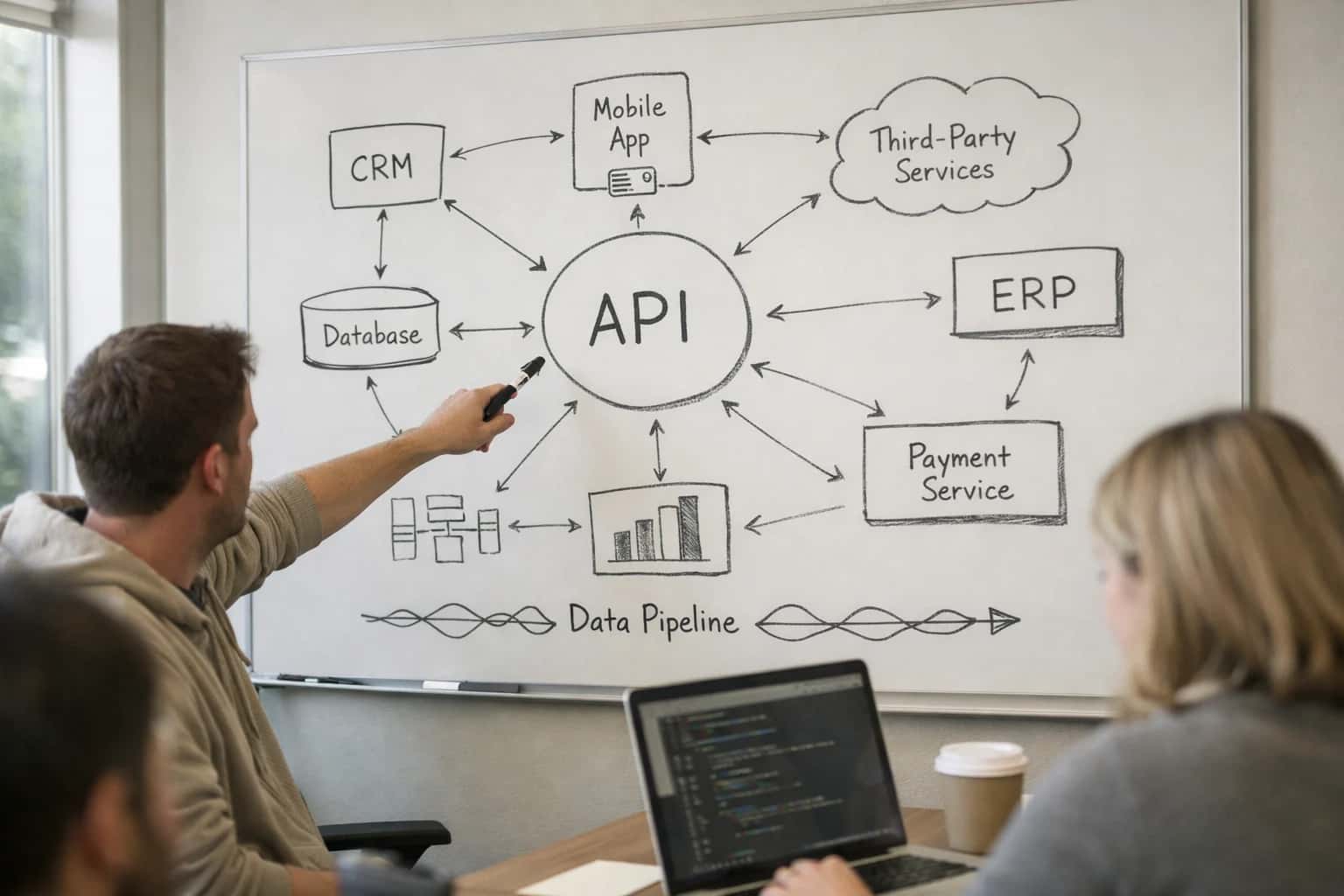
Enterprise integration architect reviewing API connections on laptop, diagram showing systems connecting, modern office setup.
ARCHITECTURE AND IMPLEMENTATION

Where AI Fits into Brightwheel's Communication Workflows

A practical blueprint for embedding AI into Brightwheel's messaging surfaces to automate routine outreach and personalize parent engagement.

AI integration connects to Brightwheel's core communication surfaces via its Messaging API and Webhooks. This allows an AI agent to act as a co-pilot for teachers and directors, handling high-volume, templated communications while preserving the human touch for complex or sensitive conversations. Key integration points include:

  • Automated Announcements: Generating and sending context-aware messages for closures, events, or reminders by pulling from the center's calendar and family profiles.
  • Personalized Daily Reports: Synthesizing teacher inputs (via voice notes or quick logs) into structured, narrative-style updates for each child, pushed via the POST /messages endpoint.
  • Intelligent Q&A: Listening to inbound parent messages via webhook (message.created), using a RAG system grounded in center policies and the child's schedule to draft accurate, instant replies for staff approval or direct sending.


Implementation typically involves a middleware layer that subscribes to Brightwheel webhooks and orchestrates AI actions. For example, a child.check_in event can trigger an AI workflow that:

  1. Checks the child's profile for upcoming medication schedules or allergy alerts.
  2. Drafts a personalized "good morning" confirmation to the primary guardian.
  3. Routes the draft to the lead teacher's dashboard for a one-tap "review and send." This reduces manual message composition from minutes to seconds while maintaining necessary human oversight. The impact is operational: teachers regain 1-2 hours per week otherwise spent on repetitive typing, and directors gain consistency in family communications.

Rollout requires a phased, center-specific approach. We start with a single, high-volume workflow—like automated payment reminders or daily report drafting—deployed in a single classroom. Governance is built in: all AI-generated messages are tagged in Brightwheel's audit logs, and a human-in-the-loop approval step is the default for initial phases. This controlled integration ensures the AI augments Brightwheel's trusted environment without disrupting established teacher-parent relationships. For technical teams, our approach is documented in our guide on Brightwheel API and Webhook integration.

ARCHITECTURAL SURFACES

Brightwheel APIs and Surfaces for AI Integration

The Core Channel for AI-Parent Engagement

Brightwheel's Messaging API provides programmatic access to the primary communication channel between teachers, directors, and families. This is the foundational surface for AI-driven personalization and automation.

Key Integration Points:

  • Send/Receive Messages: Push AI-generated daily summaries, personalized reminders, or announcements to individual parents, groups, or entire classrooms.
  • Webhook Events: Subscribe to events like message.sent, message.received, or message.read to trigger AI workflows. For example, an AI agent can analyze inbound parent questions and draft context-aware replies for staff approval.
  • Attachment Handling: Programmatically attach AI-generated documents (e.g., weekly learning summaries) or media.

AI Use Case: Automate the creation and sending of personalized "day-at-a-glance" reports by synthesizing teacher log entries (meals, naps, activities) into a natural language summary, sent via this API at the end of each day.

BRIGHTWHEEL INTEGRATION

High-Value AI Use Cases for Parent Communications

Integrate AI directly into Brightwheel's messaging surfaces to automate routine outreach, personalize updates at scale, and free teachers and directors from manual communication tasks.

01

Automated Daily Report Generation

Teachers provide quick voice notes or checklist inputs. AI synthesizes these into personalized, narrative-style daily reports for each child (meals, naps, activities, mood) and posts them via the Brightwheel Daily Report API. Turns fragmented notes into a 5-minute task.

Hours -> Minutes
Report creation
02

Intelligent Payment & Billing Reminders

Connect AI to Brightwheel's billing events and family ledger. Dynamically generate and send personalized SMS or in-app reminders for upcoming payments, past-due balances, or payment plan confirmations. Context-aware logic adjusts tone and timing based on family history.

Batch -> Real-time
Communication
03

Sentiment-Aware Announcement Responses

When a center announcement is posted, AI monitors parent replies and comments via Brightwheel's messaging webhooks. It performs sentiment analysis, flags concerns for immediate staff follow-up, and can auto-respond to common logistical questions (e.g., 'What time does the event start?').

Same day
Issue identification
04

Multi-Language Message Translation

Integrate real-time translation for outbound center announcements and inbound parent messages. AI detects language preference from family profiles or message content and provides translated text via the Brightwheel messaging surfaces, supporting inclusive communication for multilingual communities.

1 sprint
Initial deployment
05

Contextual, Proactive Alerts

Beyond simple event-triggered notifications. AI analyzes patterns (e.g., a child's recurring late pick-up, frequent absence on Mondays) and suggests or sends proactive, helpful messages to parents via Brightwheel's notification APIs, framed as supportive reminders rather than alerts.

06

AI-Powered Parent FAQ Agent

Deploy a conversational AI agent that integrates with Brightwheel's family data (schedules, billing, events). Parents can ask natural language questions in the app ("When is my next payment?") and receive instant, accurate answers without staff intervention, reducing inbound support volume.

>50%
Routine query deflection
BRIGHTWHEEL PARENT COMMUNICATIONS

Example AI Automation Workflows

These workflows illustrate how AI agents, triggered by Brightwheel's webhooks and powered by its APIs, can automate and personalize high-volume parent communications, freeing teachers and directors from manual outreach.

Trigger: Teacher submits a 'Daily Log' via the Brightwheel mobile app or web interface.

Context Pulled: The AI agent receives the webhook payload containing the child's ID, teacher's raw notes (e.g., "Ate all lunch, napped 1.5 hrs, played with blocks"), and timestamp.

Agent Action:

  1. Calls the Brightwheel API to fetch the child's name, parent/guardian details, and any known preferences (e.g., "loves details about art").
  2. Uses an LLM to transform the brief teacher notes into a warm, narrative-style paragraph, personalized for the child.
    json
    // Example LLM prompt structure
    {
      "system": "You are a helpful preschool teacher assistant. Create a positive, detailed 3-sentence summary of a child's day for their parents.",
      "user": "Child: Alex. Notes: Ate all of chicken and rice, napped from 1-2:30pm, built a tall tower with blocks. Parent preference: Loves hearing about creative play."
    }
  3. Structures the output with clear sections (Meals, Nap, Activities).

System Update: The agent posts the polished report as a new message to the child's Brightwheel feed via the POST /messages API, tagging it as a "Daily Report" and addressing the parent by name.

Human Review Point: Optional. For centers wanting oversight, the agent can first post the report to a private "Director Review" channel in Slack/Microsoft Teams via a webhook, where it can be approved with one click before being sent to parents.

SECURE, CONTROLLED, AND TEACHER-FIRST

Implementation Architecture: Data Flow and Guardrails

A production-ready architecture for integrating AI into Brightwheel's parent communication workflows, designed for security, accuracy, and minimal teacher disruption.

The integration connects to two primary surfaces in Brightwheel: the Messaging API for sending personalized updates and the Webhooks system for triggering AI actions based on events like a child's check-in, meal log, or nap entry. An AI orchestration layer, built on platforms like Microsoft Copilot Studio or CrewAI, listens for these webhook events. It then retrieves relevant child and classroom context from Brightwheel's REST API—such as the day's activities logged by the teacher, dietary notes, or developmental goals—to generate a structured, personalized narrative. This draft is then queued for human-in-the-loop review by the teacher via a simple approval interface embedded in Brightwheel's mobile or web app, ensuring accuracy and preserving the teacher's voice before the final message is sent via the Messaging API.

Critical guardrails are implemented at multiple levels. A content safety filter scans all AI-generated drafts for inappropriate language or potential privacy leaks (e.g., accidentally including another child's name). Role-based access control (RBAC) ensures AI agents only access data for children in the teacher's assigned classrooms. All message drafts, teacher approvals, and sent messages are logged to a secure audit trail, creating a full lineage for compliance. For high-stakes communications—like incident reports or allergy alerts—the system can be configured to bypass AI drafting entirely and use predefined, director-approved templates.

Rollout follows a phased, center-specific approach. We start with a single, high-value workflow like automated daily report summaries, piloting in one classroom. Teachers are trained on the review interface and provided clear opt-out controls. Performance is monitored via metrics like teacher time saved, parent response rates, and system accuracy. Based on feedback, workflows are refined before expanding to other communication types, such as weekly learning highlights or gentle payment reminders, and scaling to additional classrooms or centers. This controlled, iterative approach ensures the AI acts as a reliable copilot, enhancing—not replacing—the vital human connection between teachers and families.

BRIGHTWHEEL API INTEGRATION PATTERNS

Code and Payload Examples

Processing Parent Message Events

Brightwheel can send webhook events for new parent messages, replies, and message status updates. An AI agent listens for these events to draft automated, personalized responses or escalate complex queries.

Below is a Python FastAPI example that receives a message.created webhook, extracts context, and calls an LLM to generate a draft reply. The handler validates the webhook signature, retrieves relevant child/classroom data via Brightwheel's REST API for context, and posts the AI-generated draft back to the thread via the Messages API.

python
from fastapi import FastAPI, Request, HTTPException
import httpx
from pydantic import BaseModel
import os

app = FastAPI()
BRIGHTWHEEL_API_KEY = os.getenv('BW_API_KEY')

class WebhookPayload(BaseModel):
    event: str
    data: dict

@app.post('/webhooks/brightwheel-message')
async def handle_message_webhook(request: Request):
    payload = await request.json()
    # Validate webhook signature here
    
    if payload.get('event') == 'message.created':
        message_data = payload.get('data', {})
        thread_id = message_data.get('thread_id')
        family_id = message_data.get('family_id')
        
        # Fetch child/class context for the LLM
        async with httpx.AsyncClient() as client:
            children_resp = await client.get(
                f'https://api.brightwheel.com/v1/families/{family_id}/children',
                headers={'Authorization': f'Bearer {BRIGHTWHEEL_API_KEY}'}
            )
            child_info = children_resp.json()
        
        # Call LLM to generate a context-aware draft
        llm_prompt = f"Parent message: {message_data.get('body')}. Child info: {child_info}. Draft a friendly, informative reply."
        ai_draft = await call_llm(llm_prompt)
        
        # Post draft as a staff reply (saved as draft in Brightwheel)
        draft_payload = {
            'body': ai_draft,
            'status': 'draft',
            'thread_id': thread_id
        }
        async with httpx.AsyncClient() as client:
            await client.post(
                'https://api.brightwheel.com/v1/messages',
                json=draft_payload,
                headers={'Authorization': f'Bearer {BRIGHTWHEEL_API_KEY}'}
            )
    return {'status': 'processed'}
AI-PARENT COMMUNICATION AUTOMATION

Realistic Time Savings and Operational Impact

How AI integration transforms manual, time-consuming Brightwheel messaging tasks into efficient, personalized workflows, freeing up staff hours for direct care.

Workflow / TaskBefore AI IntegrationAfter AI IntegrationImplementation Notes

Daily Activity Summary Drafting

15-30 minutes per classroom

5-10 minutes with AI-assisted generation

AI drafts from teacher inputs; human review and personalization required

Personalized Payment Reminders

Manual list review and individual message crafting

Automated, context-aware sequences triggered by billing API

Rules-based personalization (e.g., first-time vs. repeat late); human oversight for exceptions

Broadcast Announcement Localization

One-size-fits-all message sent to all families

Segmented, role-aware messages (e.g., toddler vs. preschool parents)

Uses child room/age data from Brightwheel; director approves segments before send

Parent FAQ Response (Common Topics)

Staff interrupts tasks to answer repetitive schedule/billing questions

AI chatbot handles ~60% of common queries via parent app or webhook

Integrated via Brightwheel's APIs; escalates complex issues to staff with full context

Sentiment Analysis on Parent Feedback

Manual reading of message threads to gauge concerns

Automated weekly sentiment report highlighting at-risk families

Processes inbound messages via webhook; flags for director follow-up

Form Completion Follow-ups

Manual tracking of pending forms in spreadsheets

Automated reminders with pre-filled data links, triggered by form API events

Reduces administrative chase time; integrates with Brightwheel's digital forms

Emergency/Closure Notification Routing

Manual call tree or blanket SMS to all contacts

Intelligent routing based on child attendance status and contact priority

Uses real-time check-in data and parent contact rules; ensures critical reach

ARCHITECTING FOR TRUST AND SCALE

Governance, Security, and Phased Rollout

A practical framework for deploying AI in parent communications with built-in oversight and incremental value delivery.

A production AI integration for Brightwheel must operate within the platform's existing security model and data permissions. This means AI agents and workflows should authenticate via service accounts with scoped OAuth tokens, respecting role-based access control (RBAC) so a teacher's AI assistant only accesses data for their assigned classroom. All outbound API calls to LLM providers should be proxied through a secure gateway, stripping any PII before transmission and logging all prompts and completions for audit trails. Incoming webhooks from Brightwheel for new messages or parent replies should trigger serverless functions that process data in-memory, with no sensitive child or family data persisted in vector stores without explicit encryption and retention policies.

We recommend a phased rollout to manage risk and demonstrate value. Phase 1 could focus on a single, high-volume workflow like automating follow-ups for common parent questions (e.g., "What time is pickup today?") using a simple RAG system over your center's FAQ documents. This is low-risk, operates in a "copilot" mode where a teacher reviews and sends the AI-drafted response via Brightwheel's POST /messages API. Phase 2 expands to proactive, personalized announcements—like generating a weekly classroom summary from logged activities—which requires deeper integration with Brightwheel's Daily Reports and Activities APIs. Phase 3 introduces predictive alerts, such as identifying parents with declining engagement sentiment and suggesting personalized outreach, which involves analyzing historical message data via Brightwheel's reporting endpoints.

Governance is maintained through a human-in-the-loop layer and continuous evaluation. All AI-generated communications should be tagged with a metadata flag (e.g., "ai_assisted": true) in the custom data field of Brightwheel's message object. Establish a review queue in a separate dashboard (or using a tool like our AI Governance and LLMOps services) to sample messages for quality, tone, and accuracy. Set up automated guardrails to block messages containing certain keywords or to throttle message frequency per family to avoid spam. Finally, define clear success metrics—like reduction in manual message volume per teacher or increase in parent reply rates—and measure them against baseline data extracted from Brightwheel's analytics APIs to ensure the integration delivers tangible operational lift.

BRIGHTWHEEL AI INTEGRATION

Frequently Asked Questions

Common technical and operational questions about implementing AI to automate and personalize parent communications within Brightwheel.

AI connects to Brightwheel via its Messaging API and Webhooks. The typical integration pattern is:

  1. Trigger: A webhook event fires from Brightwheel (e.g., a child is checked in late, a new photo is posted, a payment is due).
  2. Context Enrichment: An AI agent receives the webhook payload and calls the Brightwheel API to fetch additional context (child's name, family details, recent activities).
  3. Action: A language model generates a personalized, context-aware message draft.
  4. Delivery & Logging: The system posts the message via the Brightwheel API and logs the interaction for auditability.

This keeps all communication within Brightwheel's native interface, maintaining a single thread of record.

Prasad Kumkar

About the author

Prasad Kumkar

CEO & MD, Inference Systems

Prasad Kumkar is the CEO & MD of Inference Systems and writes about AI systems architecture, LLM infrastructure, model serving, evaluation, and production deployment. Over 5+ years, he has worked across computer vision models, L5 autonomous vehicle systems, and LLM research, with a focus on taking complex AI ideas into real-world engineering systems.

His work and writing cover AI systems, large language models, AI agents, multimodal systems, autonomous systems, inference optimization, RAG, evaluation, and production AI engineering.


