AI integration for mobile and iGaming platforms connects at three key layers: the player interaction layer (app/website front-end, chat, notifications), the business logic and API layer (bonus engine, wallet service, game server), and the data and analytics layer (data warehouse, player tracking database, event streams). The goal is to inject intelligence into real-time workflows—like a player's next spin or bet placement—by calling AI services via secure APIs and webhooks, while keeping the certified Random Number Generator (RNG) and core wallet transactions completely isolated and unchanged.

Integration
AI for Mobile and iGaming Platform Integration
A technical guide for online casino operators on connecting AI engines to mobile gaming and iGaming platforms for real-time responsible gaming interventions, personalized game recommendations, and cross-channel player journey analysis.
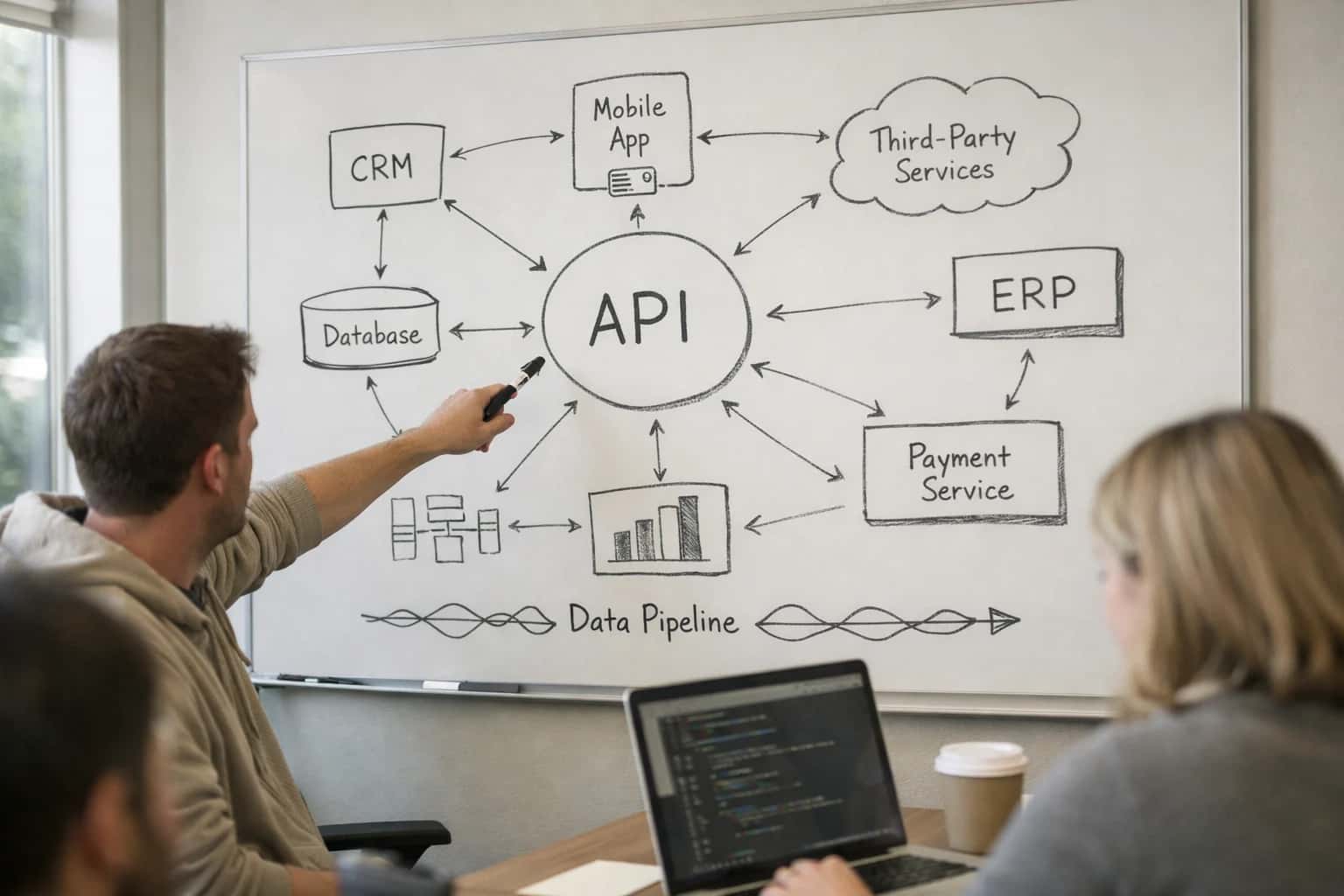
ARCHITECTURE AND ROLLOUT
Where AI Fits in the Mobile and iGaming Stack
A practical blueprint for integrating AI into live mobile casino and sports betting platforms without disrupting core gaming engines.
High-value implementation surfaces include the bonus and promotional engine, where AI can personalize free spin offers or deposit match bonuses in real-time based on session behavior. The responsible gaming module is another critical point, where AI models can analyze bet patterns and velocity to trigger automated cooling-off prompts or limit-setting suggestions via in-app messages. For player support, AI agents can be integrated into live chat or help centers, pulling context from the player's recent game history and open transactions to resolve common issues without escalating to a human agent, reducing handle time.
A production rollout typically uses a sidecar architecture. An AI middleware service subscribes to player event streams (via Kafka or platform webhooks) and makes real-time inferences. The results—a recommendation score, a risk flag, a chat response—are passed back to the iGaming platform through its existing APIs. Governance is paramount: all AI-driven communications and offers must be logged with the player ID, timestamp, and model version for audit trails. Rollouts should start with a single, non-intrusive use case like personalized game recommendations on the lobby screen, measured for engagement lift before expanding to more sensitive areas like financial incentives or interventions.
ARCHITECTURE BLUEPRINT
Key Integration Surfaces in Mobile/iGaming Platforms
Real-Time Player Data Ingestion
The core of any AI integration is a reliable, low-latency connection to the player data layer. Mobile and iGaming platforms expose APIs for player profiles, real-time session activity, and transactional events (bets, deposits, withdrawals).
Key API Endpoints to Integrate:
GET /player/{id}/profilefor demographic and tier data.POST /events/sessionwebhook for live gameplay events (game launch, bet placed, cashout).GET /wallet/transactionsfor deposit and withdrawal history.
AI Use Case Connection:
- Feed this stream into an AI engine to calculate player engagement scores and risk profiles in real-time.
- Trigger responsible gaming interventions within the same session, not hours later.
- Use session-level data to power next-game recommendations as the player is still active.
Implementation Note: Ensure your AI service can handle bursty event volumes during peak hours and maintain stateful player contexts for the duration of a session.
MOBILE & iGAMING PLATFORMS
High-Value AI Use Cases for Online Operators
Integrate AI directly into your mobile and iGaming platforms to move from reactive operations to predictive, personalized player experiences. These use cases connect to core systems for real-time decisioning, automated compliance, and revenue optimization.
01
Real-Time Responsible Gaming Interventions
Connect AI models to player session data streams (bet frequency, stake changes, time-on-device) to detect early signs of problematic play. Automatically trigger graduated interventions—from in-app wellness messages to mandatory cool-off periods—directly within the gaming client via platform APIs. This creates a proactive compliance layer that satisfies regulators and protects players.
Batch -> Real-time
Intervention speed
02
Personalized Game & Offer Recommendations
Build a next-best-action engine that ingests real-time play data (game preferences, volatility tolerance, session spend) from the platform's player tracking module. Use collaborative filtering and reinforcement learning to surface hyper-personalized game carousels and bonus offers within the mobile app UI, boosting engagement and lifetime value.
1 sprint
Pilot deployment
03
Cross-Channel Player Journey Analysis
Unify player data from mobile app, web client, and loyalty program into a single vector-based profile. Use AI to analyze the omnichannel journey, identifying friction points (e.g., deposit drop-off on mobile) and high-value pathways. Feed these insights back into the platform's marketing module to orchestrate seamless, context-aware campaigns.
Weeks -> Hours
Journey mapping
04
Intelligent Deposit & Bonus Fraud Screening
Integrate AI agents with the platform's payment processing and bonus engine APIs. Analyze deposit patterns, device fingerprints, and bonus claim behavior in real-time to score transaction risk. Automatically route high-risk cases for manual review while approving legitimate players instantly, reducing fraud losses without harming the player experience.
Same day
Alert review
05
Dynamic In-Game Content & Difficulty Adjustment
For skill-based or hybrid games, integrate AI models with the game server's event bus. Analyze player performance metrics to dynamically adjust game difficulty or unlock special content, creating a tailored challenge curve. This maintains engagement for both casual and high-skill players, directly impacting session length and retention.
06
Automated Player Support & Query Resolution
Deploy an AI support agent integrated with the platform's helpdesk API and player account data. Use RAG over knowledge bases (bonus T&Cs, KYC docs) and real-time access to player transaction history to resolve common queries (e.g., 'Where's my bonus?') within the app chat. Escalate complex cases to human agents with full context, reducing support ticket volume.
Hours -> Minutes
Resolution time
IMPLEMENTATION PATTERNS
Example AI-Driven Workflows for iGaming
These concrete workflows demonstrate how to connect AI agents to mobile gaming and iGaming platforms. Each pattern outlines the trigger, data context, AI action, and system update to automate player engagement, responsible gaming, and operational efficiency.
Trigger: A player's real-time activity feed from the iGaming platform indicates a rapid succession of high-value bets or extended session duration beyond a calculated baseline.
Context/Data Pulled:
- Current session data: duration, bet frequency, average bet size, net loss.
- Historical player profile: risk tier, deposit limits, past self-exclusion flags.
- Recent transaction history: deposits within the last 24 hours.
Model/Agent Action:
- An AI agent evaluates the session against the player's profile and jurisdictional responsible gaming rules.
- It calculates a real-time risk score and determines if an intervention is warranted.
- If triggered, the agent drafts a personalized, compliant message (e.g., "We've noticed extended play. Remember, you set a $500 daily deposit limit. Your current session is at 45 minutes.").
System Update/Next Step:
- The agent calls the iGaming platform's player messaging API to queue the intervention message for in-app display.
- It simultaneously creates a log entry in the compliance audit trail with the risk score and action taken.
- For high-risk scores, it can trigger a workflow in the support ticketing system (e.g., Zendesk) to flag the account for host follow-up.
Human Review Point: All high-severity interventions (e.g., those recommending a mandatory cool-off period) are routed to a live responsible gaming specialist for approval before the system action is finalized.
CONNECTING AI ENGINES TO REAL-TIME PLAYER JOURNEYS
Implementation Architecture: Data Flow and System Design
A production-ready blueprint for integrating AI models into mobile and iGaming platforms to power real-time interventions and personalization.
The core integration surfaces the iGaming platform's player event stream—typically via a Kafka or RabbitMQ queue—and the player profile API. Key data objects include real-time wager events, session duration, game preferences, deposit history, and responsible gaming flags. An AI inference service subscribes to this stream, evaluating each event against models for personalized recommendation, churn risk, and responsible gaming (RG) compliance. For RG, the system might flag a rapid-fire betting pattern and, via a webhook, trigger an in-game 'take a break' message or temporarily disable the 'quick spin' feature through the platform's player management API.
High-value workflows are orchestrated by lightweight AI agents that call specialized models. For example, a Next-Best-Game Agent analyzes a player's last five sessions and live gameplay to call a recommendation model, then pushes a personalized game tile via the platform's content management system (CMS) API. A Cross-Channel Journey Agent correlates mobile play with later desktop login and CRM offer redemptions, updating a unified player profile in a vector database (like Pinecone) to enable semantic search for the support team. Implementation requires careful rate limiting on platform APIs and idempotent processing of player events to avoid duplicate interventions.
Rollout should be phased, starting with read-only analytics and shadow-mode predictions before enabling any live interventions. Governance is critical: all AI-driven actions must be logged to an audit trail linked to the player ID, with clear human-in-the-loop approval steps for high-stakes actions like bonus issuance or play limits. Use A/B testing frameworks native to the iGaming platform to measure impact on key metrics like session length, deposit frequency, and RG incident rates. For a detailed look at the player data models that feed these systems, see our guide on AI-Powered Player Analytics for Casino Management Systems.
INTEGRATION PATTERNS FOR REAL-TIME PLAYER ENGAGEMENT
Code and Payload Examples
Real-Time Intervention Trigger
Integrate AI with the iGaming platform's player event stream to detect and act on risky play patterns. A common pattern is to deploy a lightweight model that consumes real-time gameplay data (bet size, frequency, session duration) and posts alerts to a webhook for immediate action, such as triggering a responsible gaming message or a mandatory cool-off period.
python# Example: Webhook handler for responsible gaming alert import requests import json # Payload from AI risk-scoring service alert_payload = { "player_id": "PLR_829174", "platform_id": "mobile_casino_v2", "risk_score": 0.87, "trigger": "session_duration_exceeded", "session_minutes": 142, "recommended_action": "push_intervention", "intervention_id": "RG_COOL_OFF_15MIN" } # Post to iGaming platform's intervention API response = requests.post( "https://api.igaming-platform.com/v1/player-interventions", json=alert_payload, headers={"Authorization": f"Bearer {API_KEY}"} ) # Log response for audit if response.status_code == 202: print(f"Intervention queued for {alert_payload['player_id']}") else: print(f"Failed to queue intervention: {response.text}")
This pattern allows the AI system to operate as a decoupled service, pushing high-confidence alerts into the platform's native player management workflows without disrupting core gaming transactions.
MOBILE & IGAMING OPERATIONS
Realistic Operational Impact and Time Savings
How AI integration transforms key workflows by connecting to player data streams, responsible gaming modules, and marketing engines in real-time.
| Workflow | Before AI | After AI | Implementation Notes |
|---|---|---|---|
Responsible Gaming Intervention | Manual review of flagged play patterns, often post-session | Real-time risk scoring triggers automated in-session pop-ups or cool-off prompts | Integrates with player activity API; human review for high-risk escalations |
Personalized Game Recommendations | Static carousels or broad genre-based suggestions | Dynamic recommendations based on real-time session behavior and historical preferences | Leverages game metadata and player interaction events; A/B test for engagement lift |
Cross-Channel Player Journey Analysis | Siloed reports from mobile app, web, and CRM | Unified player profile with AI-generated journey insights and predicted next action | Requires event stream unification; outputs feed into marketing automation platform |
Deposit and Bonus Fraud Screening | Rule-based checks with high false-positive rates | AI model scores transactions for fraud risk, prioritizing manual review | Trains on historical fraud data; integrates with payment gateway webhooks |
Customer Support Triage for VIPs | All inquiries enter same queue, VIPs identified manually | AI identifies high-value players and routes inquiries to dedicated agent pool | Connects to player tier API and support ticket system; reduces VIP wait time |
Promotional Offer Personalization | Segment-based blasts with static offer values | Dynamic offer generation (e.g., free spin amount, bonus match %) based on predicted player value | Uses player lifetime value model; integrates with promotional engine API |
Player Churn Risk Identification | Monthly analysis of inactive players | Daily scoring of active players with churn risk alerts to player development team | Model consumes session frequency, deposit patterns, and game engagement data |
ARCHITECTING FOR REGULATED REAL-TIME PLAY
Governance, Compliance, and Phased Rollout
Deploying AI for mobile and iGaming requires a governance-first architecture that respects gaming regulations, player privacy, and real-time system performance.
Integrate AI as a governed decision layer between your iGaming platform's core player wallet, game server, and responsible gaming modules. Key touchpoints include the player profile API (for real-time session data), the bonus engine (for offer eligibility), the transaction ledger (for spend analysis), and the RG/AML alerting system. AI models should operate on a low-latency event stream, consuming gameplay events (bet, win, session duration) and player attributes (deposit history, KYC status) to generate recommendations or interventions, which are then enforced by the platform's existing business logic and audit trails.
A phased rollout is critical. Start with read-only analytics and alerting—using AI to surface high-risk player segments or game affinity patterns to human operators via existing dashboards. Phase two introduces low-risk automation, such as AI-triggered responsible gaming notifications or personalized game recommendations in the lobby, which require player opt-in. The final phase enables closed-loop interventions, like AI-suggested deposit limits or cooling-off periods, which must be configured to require mandatory manual review and approval by a licensed operator before any system-level change is applied to a player account, ensuring compliance with jurisdictional rules.
Governance requires a three-layer control system: 1) Prompt and model governance to ensure AI-generated communications (e.g., responsible gaming messages) are pre-approved and non-promotional, 2) Decision logging that ties every AI inference to the raw player data snapshot that triggered it, stored immutably alongside the platform's existing transaction logs for regulator scrutiny, and 3) Human-in-the-loop workflows for any action impacting player funds or account status, routed through your platform's existing case management or host tasking system. This architecture ensures AI augments—never autonomously overrides—the operator's duty of care.
For ongoing compliance, establish a model monitoring stack that tracks for drift in player behavior predictions and regularly back-tests AI recommendations against actual player outcomes (e.g., did players who received a game recommendation show higher engagement without increased negative play?). Integrate these checks into your platform's standard change management and release processes, treating AI model updates with the same rigor as game server patches. This controlled, incremental approach de-risks innovation while delivering measurable operational gains in player protection and personalization.
Enabling Efficiency, Speed & Accuracy
Intelligent Analysis, Decision & Execution
We build AI systems for teams that need search across company data, workflow automation across tools, or AI features inside products and internal software.
Talk to Us
Search across company data
Give teams answers from docs, tickets, runbooks, and product data with sources and permissions.
Useful when people spend too long searching or get different answers from different systems.
Enterprise searchRAGPermissions
Read more
Automate internal workflows
Use AI to route work, draft outputs, trigger actions, and keep approvals and logs in place.
Useful when repetitive work moves across multiple tools and teams.
AI agentsWorkflow automationGovernance
Read more
Add AI to products and internal tools
Build assistants, guided actions, or decision support into the software your team or customers already use.
Useful when AI needs to be part of the product, not a separate tool.
AI integrationDecision supportModel routing
Read moreIMPLEMENTATION BLUEPRINT
Frequently Asked Questions for iGaming AI Integration
Practical answers for technical leaders planning to integrate AI into mobile casino apps and iGaming platforms. Focused on architecture, data flows, and responsible rollout.
AI should integrate at key decision points where it can add value without interrupting core gameplay. Common injection surfaces include:
- Pre-Session & Lobby: Use AI for personalized game recommendations as the player loads the app, based on their historical play patterns and real-time segmentation from the Player Management System (PMS).
- During Play (Real-Time): Integrate via a sidecar service that consumes game event streams (e.g., bet size, speed, session duration). This powers responsible gaming interventions, which are surfaced as non-intrusive in-app messages or prompts to set limits.
- Post-Session & Communication: Trigger AI workflows after a session ends. Analyze the play data to generate personalized recap emails, tailored bonus offers, or win/loss statements with contextual insights.
Key Integration Pattern: Deploy AI agents as microservices that subscribe to Kafka topics or webhooks from your gaming platform. The agents process events, call LLMs or models, and push actions back to the platform's marketing or messaging APIs. This keeps the core game client lightweight and the AI layer decoupled.

About the author
Prasad Kumkar
CEO & MD, Inference Systems
Prasad Kumkar is the CEO & MD of Inference Systems and writes about AI systems architecture, LLM infrastructure, model serving, evaluation, and production deployment. Over 5+ years, he has worked across computer vision models, L5 autonomous vehicle systems, and LLM research, with a focus on taking complex AI ideas into real-world engineering systems.
His work and writing cover AI systems, large language models, AI agents, multimodal systems, autonomous systems, inference optimization, RAG, evaluation, and production AI engineering.
LinkedIn
Limited slotsGet a Free AI Consultation
Partnered with leading AI, data, and software stack.





How We Work
Custom AI workflows for your Business
One-fit-all AI don't work for modern businesses. At Inferensys, we aim to understand your business & custom requirements; which we use to define most efficient agentic workflows, the data, and the tools for your business.
01
Review the use case
We understand the task, the users, and where AI can actually help.
Read more02
Pick the right approach
We define what needs search, automation, or product integration.
Read more03
Build the first useful version
We implement the part that proves the value first.
Read more04
Improve from there
We add the checks and visibility needed to keep it useful.
Read moreThe first call is a practical review of your use case and the right next step.
Talk to Us