AI integration for campground administrative workflows focuses on the document-centric systems within platforms like Campground Master, where vendor agreements, local permit files, insurance certificates, and compliance checklists are stored. The integration surfaces typically include the platform's document management modules, vendor records, and calendar/reminder systems for renewal dates. An AI agent can be configured to monitor designated folders or tagged records, automatically extracting key dates, parties, obligations, and clauses from uploaded PDFs and Word documents.

Integration
Campground Contract and Permit Management AI
A technical blueprint for using AI to automate vendor contract analysis, track permit renewals, and ensure regulatory compliance within Campground Master, Campspot, ResNexus, and Staylist document systems.
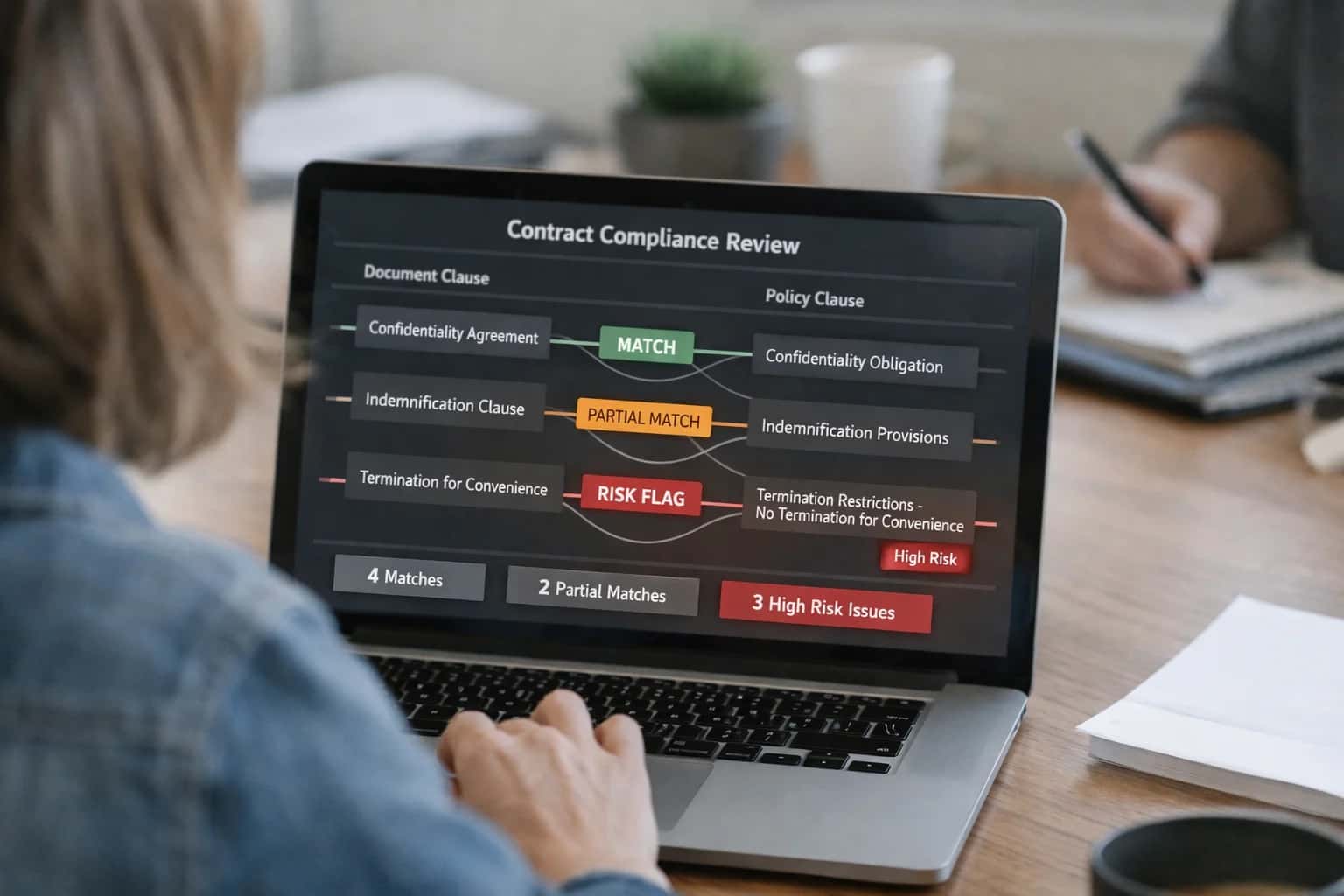
CONTRACT & PERMIT MANAGEMENT
Where AI Fits in Campground Administrative Workflows
A technical blueprint for integrating AI into the back-office workflows of campground contract review, permit tracking, and compliance assurance.
For implementation, the AI system connects via the platform's API (or a secure cloud storage sync) to access new and existing documents. A common workflow involves: 1) Automated intake and classification of a new vendor contract, 2) LLM-powered clause extraction to flag non-standard terms, liability limits, or auto-renewal clauses, 3) Obligation and date parsing to populate a tracking dashboard and sync critical dates (like permit expirations) to the platform's native calendar, and 4) Proactive alerting to managers via email or in-platform notifications 30, 60, or 90 days before a renewal is required. This shifts administrative work from manual calendar watching and document review to exception-based management.
Rollout should start with a pilot on a single document type—such as health department permits—to validate accuracy and build trust. Governance is critical; a human-in-the-loop approval step should be required for any AI-generated summary or action before it updates the core system. Furthermore, all AI interactions should create an audit trail within the campground platform, logging which document was processed, what was extracted, and any alerts generated. This ensures compliance and provides a clear lineage for audits.
This integration matters because it directly reduces operational risk and administrative overhead. Instead of relying on staff memory or spreadsheets, park managers gain a systematic, always-on assistant for critical compliance and financial documents. The impact is measured in fewer lapsed permits, improved negotiation positions on vendor contracts through faster review, and hours recovered each week for managers previously spent on manual document digging. For a deeper look at connecting these workflows to broader business intelligence, see our guide on Campground Reporting and Business Intelligence AI.
ADMINISTRATIVE WORKFLOWS
Integration Touchpoints Across Campground Platforms
Vendor & Supplier Contracts
AI integrates with the vendor management modules in platforms like Campground Master to streamline the entire contract lifecycle. This involves connecting to the document storage system where agreements for landscaping, waste disposal, utility services, and retail suppliers are kept.
Key workflows include:
- Automated Clause Extraction: AI reviews incoming vendor contracts to flag non-standard terms, auto-rate compliance, and highlight key obligations (e.g., liability, termination clauses).
- Renewal Forecasting: By analyzing contract end dates and historical performance data, AI generates proactive alerts for contract renewals or renegotiations weeks in advance.
- Obligation Tracking: Post-signature, AI monitors operational data (e.g., delivery logs, service tickets) to ensure vendor performance meets the contractual SLAs, automatically flagging discrepancies for manager review.
This integration turns a static document repository into an active compliance and cost-management system.
CAMPGROUND MANAGEMENT PLATFORMS
High-Value AI Use Cases for Contracts & Permits
AI integration for Campground Master, ResNexus, and Staylist can automate high-friction administrative workflows, reduce compliance risk, and free up managers to focus on guest experience. These use cases target the document systems and compliance tracking modules within your campground platform.
01
Automated Vendor Contract Review
AI agents ingest new vendor agreements (e.g., from food suppliers, maintenance contractors) uploaded to Campground Master's document repository. They extract key terms (pricing, SLA, termination clauses), flag non-standard language against your master service agreement, and route exceptions for manager review. Workflow: Upload → AI Review → Manager Alert/Approve → Digital Filing.
Hours -> Minutes
Review cycle
02
Permit Renewal Tracking & Alerting
AI monitors permit expiration dates stored in custom fields or attached files within ResNexus or Campground Master. It cross-references renewal lead times (e.g., 90 days for health department, 60 days for fire marshal) and automatically generates tasks, calendar invites, and reminder emails to the responsible manager, preventing lapses. Integration: Platform Data → AI Scheduler → Task/Email Creation.
Zero Missed Deadlines
Compliance goal
03
Compliance Document Assembly for Audits
For scheduled or surprise audits (health, safety, insurance), an AI copilot queries the platform to assemble required evidence packets. It pulls recent inspection reports, staff training certificates, permit copies, and maintenance logs from linked records, generates a summarized cover sheet, and packages them into a single PDF for submission. Value: Eliminates last-minute, manual document scrambling.
1-2 Days -> 2 Hours
Audit prep time
04
Insurance Certificate Validation
When a new vendor or contractor is onboarded, AI reviews their uploaded insurance certificate (often a scanned PDF or image in Campground Master). It validates policy dates, coverage types, and limits against your campground's requirements. Missing or insufficient coverage triggers an automated request to the vendor and holds related purchase orders or site access approvals.
Batch -> Real-time
Validation
05
Group Booking Contract Generation
For large group or event bookings in Staylist or ResNexus, AI uses the booking details (dates, group size, sites, amenities) to populate a standardized contract template. It inserts specific terms, pricing, deposit schedule, and cancellation policies, then routes the draft for manager review and e-signature via integrated tools like DocuSign. Impact: Accelerates the quote-to-contract cycle for high-value bookings.
Same Day
Contract turnaround
06
Regulatory Change Monitoring & Impact Analysis
AI monitors official sources for regulatory updates (ADA, wastewater, fire codes) relevant to your campground's location and classification. When a change is detected, it analyzes your platform's data (site maps, facility records) to assess impact, flags affected operational areas, and suggests updates to internal checklists or permit tracking workflows in Campground Master.
Proactive vs. Reactive
Compliance posture
CAMPFOUND CONTRACT & PERMIT MANAGEMENT
Example AI-Powered Administrative Workflows
These workflows demonstrate how AI agents can automate high-friction administrative tasks by connecting to Campground Master's document storage, vendor records, and compliance calendars. Each flow is triggered by real-world events and results in a system update or a task for human review.
Trigger: A new vendor contract PDF is uploaded to the designated folder in Campground Master's document management system.
AI Agent Action:
- Extracts the PDF text and identifies key parties, dates, terms, and clauses.
- Cross-references the vendor name against the platform's
Vendorobject to check for existing relationships and past performance notes. - Analyzes clauses against a pre-defined risk library (e.g., auto-renewal terms, liability limits, termination notice periods).
- Generates a summary memo highlighting:
- Key obligations (payment terms, service SLAs)
- 3-5 potential risk flags with explanations
- Any missing standard clauses required by procurement policy
System Update: The memo is attached to the contract record in Campground Master. A task is automatically created in the Procurement Manager's queue with a due date 3 days before the signature deadline, containing the AI summary and a link to the full document.
FOR CAMPGROUND MASTER ADMINISTRATIVE WORKFLOWS
Implementation Architecture: Data Flow & System Design
A practical blueprint for integrating AI into Campground Master's document and compliance systems to automate contract review and permit tracking.
The integration architecture connects an AI orchestration layer to Campground Master's core administrative modules, primarily its document management system and vendor/asset records. The data flow begins by monitoring designated folders or database tables for new vendor contracts, permit applications, and renewal notices. Using Campground Master's API or a file sync service, documents are securely ingested into a processing queue. An AI agent then extracts key entities—such as dates, clauses, fees, and parties—using a combination of OCR for scanned PDFs and direct parsing for digital files. This structured data is mapped back to corresponding Vendor, Permit, and Site objects within Campground Master, creating or updating records with extracted terms and critical dates.
For contract review, the AI compares clauses against a configurable compliance rulebook (e.g., insurance requirements, termination windows) and flags deviations for human review, appending analysis notes directly to the document record. For permit management, the system creates timeline-driven tasks in Campground Master's work order or calendar module, triggering alerts for upcoming renewals, inspections, or submissions. The design includes an audit log within Campground Master that tracks every AI action—document processed, field updated, alert generated—ensuring full traceability for compliance audits.
Rollout is typically phased, starting with a single document type (e.g., vendor service agreements) and a pilot user group like the operations manager. Governance is managed through a human-in-the-loop approval step for all AI-recommended updates before they are committed to the live system. This architecture does not require replacing Campground Master; it acts as an intelligent middleware layer that enhances existing administrative workflows, turning manual document piles into structured, actionable data and automated compliance calendars.
CAMPFIRE CONTRACTS & PERMITS
Code & Payload Examples for Common Integrations
AI-Powered Contract Clause Extraction
Integrate an AI agent with Campground Master's document storage (e.g., an S3 bucket or document object) to automatically review vendor agreements for landscaping, waste disposal, or supply contracts. The agent extracts key terms—renewal dates, pricing escalations, termination clauses—and logs them into a custom Vendor_Contract__c object or a related table for tracking.
Example Python payload for sending a contract PDF to an LLM for analysis:
pythonimport boto3 import json from inference_client import InferenceClient # Fetch contract from Campground Master's linked storage s3 = boto3.client('s3') contract_pdf = s3.get_object(Bucket='campground-docs', Key='vendor_agreements/landscaping_2024.pdf') # Prepare payload for AI analysis payload = { "document_bytes": contract_pdf['Body'].read(), "analysis_type": "contract_review", "extraction_fields": [ "parties", "effective_date", "termination_date", "auto_renewal", "payment_terms", "liability_clauses" ], "platform_context": "Campground_Master_Vendor_Module" } # Call Inference Systems' orchestration layer client = InferenceClient(api_key=os.environ['INFERENCE_API_KEY']) result = client.process_document(payload) # Map result to Campground Master custom object contract_record = { "Vendor_Name": result['extracted_data']['parties']['vendor'], "Contract_Start_Date": result['extracted_data']['effective_date'], "Renewal_Date": result['extracted_data']['termination_date'], "Terms_Summary": json.dumps(result['extracted_data']['payment_terms']) } # POST to Campground Master REST API endpoint
CONTRACT & PERMIT WORKFLOWS
Realistic Time Savings & Operational Impact
How AI integration with Campground Master's document and compliance modules changes administrative timelines and reduces manual oversight.
| Workflow | Before AI | After AI | Key Notes |
|---|---|---|---|
Vendor contract review | Manual reading, 2-4 hours per contract | AI-assisted summary & red flag detection, 15-30 minutes | Highlights key clauses, auto-links to vendor record |
Permit renewal tracking | Spreadsheet calendar checks, weekly manual review | Automated monitoring & alerts 60 days prior | AI scans permit documents for expiration dates |
Compliance checklist audit | Full-day manual verification across documents | AI cross-checks documents against checklist, flags gaps | Generates audit-ready report with evidence citations |
Insurance certificate validation | Manual review for coverage levels & dates | AI extracts & validates data, flags non-compliant certificates | Auto-updates vendor status in Campground Master |
New permit application drafting | Manual form filling from scratch, 3-5 hours | AI pre-fills from previous applications & site data | Ensures consistency, reduces data entry errors |
Regulatory change impact analysis | Ad-hoc manual research when issues arise | AI monitors sources, alerts on relevant changes | Proactive risk management for license conditions |
Document search & retrieval | Manual folder navigation, 5-15 minutes per search | Semantic search across all contracts & permits | Natural language queries (e.g., 'indemnity clauses for 2024') |
IMPLEMENTATION BLUEPRINT
Governance, Security & Phased Rollout Strategy
A controlled approach to integrating AI into sensitive administrative workflows for campground contracts and permits.
Integrating AI into Campground Master's contract and permit workflows requires a security-first architecture. The AI agent should operate as a read-only analysis layer for initial review, pulling documents from designated folders or document management modules via secure API calls. All AI-generated summaries, red flags, or renewal suggestions should be written to a separate audit log object within Campground Master, creating a clear lineage of AI activity without modifying original vendor contracts or permit files. User access to AI features must respect existing Campground Master role-based permissions, ensuring only authorized managers or compliance officers can trigger reviews or view AI outputs.
A phased rollout minimizes operational risk. Phase 1 (Pilot): Target a single, low-risk workflow—such as AI-assisted review of standard equipment rental addendums. Configure the agent to flag missing insurance clauses or incorrect dates, with outputs sent to a dedicated queue for human validation. Phase 2 (Expansion): Extend to permit renewal tracking, connecting the AI to calendar or task modules to scan for expiration dates and draft renewal checklists based on jurisdiction. Phase 3 (Automation): For trusted workflows, enable automated alerts and draft compliance summaries, but maintain a human-in-the-loop approval step for any AI-generated communication or task creation before it's committed to the live system.
Governance is critical for compliance-heavy operations. Establish a review board with operations, legal, and IT stakeholders to evaluate AI suggestions before they influence decisions. Use Campground Master's native reporting to track AI accuracy rates (e.g., how often flagged clauses were deemed relevant by staff) and adoption metrics. For a deeper technical dive on connecting AI to campground document systems, see our guide on AI Integration for Campground Master. To understand how to build a secure data pipeline for such integrations, review our architecture notes on Campground API Automation and Integration Hubs with AI.
Enabling Efficiency, Speed & Accuracy
Intelligent Analysis, Decision & Execution
We build AI systems for teams that need search across company data, workflow automation across tools, or AI features inside products and internal software.
Talk to Us
Search across company data
Give teams answers from docs, tickets, runbooks, and product data with sources and permissions.
Useful when people spend too long searching or get different answers from different systems.
Enterprise searchRAGPermissions
Read more
Automate internal workflows
Use AI to route work, draft outputs, trigger actions, and keep approvals and logs in place.
Useful when repetitive work moves across multiple tools and teams.
AI agentsWorkflow automationGovernance
Read more
Add AI to products and internal tools
Build assistants, guided actions, or decision support into the software your team or customers already use.
Useful when AI needs to be part of the product, not a separate tool.
AI integrationDecision supportModel routing
Read moreCAMPFIRE CONTRACTS & PERMITS
FAQ: Technical & Commercial Questions
Practical questions for campground operators and IT teams evaluating AI to streamline vendor contracts, permit renewals, and compliance documentation within systems like Campground Master.
The integration connects via the campground platform's APIs (e.g., Campground Master's document management module) and/or cloud storage connectors (like S3, SharePoint, or Google Drive).
Typical connection pattern:
- API Ingestion: The AI system polls or receives webhooks for new documents uploaded to designated folders (e.g.,
Vendor_Contracts,Permit_Renewals). - Secure Access: Uses OAuth 2.0 or API keys with read-only permissions to access document metadata and content.
- Processing Pipeline: Documents (PDFs, Word files, scanned images) are extracted, text is OCR'd if needed, and the content is chunked for analysis.
- Context Enrichment: The system links documents to relevant platform records (e.g., vendor ID, site number, permit type) using metadata tags or by parsing reference numbers within the document.
Security Note: No raw documents are stored permanently in the AI system. Processed text is encrypted in transit and at rest, with access logs for audit trails.

About the author
Prasad Kumkar
CEO & MD, Inference Systems
Prasad Kumkar is the CEO & MD of Inference Systems and writes about AI systems architecture, LLM infrastructure, model serving, evaluation, and production deployment. Over 5+ years, he has worked across computer vision models, L5 autonomous vehicle systems, and LLM research, with a focus on taking complex AI ideas into real-world engineering systems.
His work and writing cover AI systems, large language models, AI agents, multimodal systems, autonomous systems, inference optimization, RAG, evaluation, and production AI engineering.
LinkedIn
Limited slotsGet a Free AI Consultation
Partnered with leading AI, data, and software stack.





How We Work
Custom AI workflows for your Business
One-fit-all AI don't work for modern businesses. At Inferensys, we aim to understand your business & custom requirements; which we use to define most efficient agentic workflows, the data, and the tools for your business.
01
Review the use case
We understand the task, the users, and where AI can actually help.
Read more02
Pick the right approach
We define what needs search, automation, or product integration.
Read more03
Build the first useful version
We implement the part that proves the value first.
Read more04
Improve from there
We add the checks and visibility needed to keep it useful.
Read moreThe first call is a practical review of your use case and the right next step.
Talk to Us