AI integration for Qlik and data warehouses operates in three primary layers: data preparation, associative exploration, and insight delivery. At the data layer, AI agents can monitor and enrich warehouse tables (e.g., in Snowflake, BigQuery, or Databricks) before data is loaded into Qlik's in-memory engine, suggesting new joins, flagging data quality issues, or generating calculated fields. Within the Qlik Sense app, AI can interact with the associative data model via the Qlik Engine API to perform automated 'what-if' analysis, test user-generated hypotheses against the data, or identify hidden segments the associative engine surfaces but a human might miss.

Integration
Qlik and Data Warehouse AI Integration
Architect AI workflows that leverage Qlik's associative model to explore data warehouse relationships, generate hypotheses, and automate the discovery of hidden patterns in enterprise data.
ARCHITECTURE BLUEPRINT
Where AI Fits in the Qlik and Data Warehouse Stack
A practical guide to positioning AI agents between Qlik's associative engine and your enterprise data warehouse to automate discovery and insight generation.
The high-value workflow is an automated discovery agent. This agent is triggered on a schedule (e.g., nightly after data reload) or by a change in a key metric. It uses the Qlik API to systematically explore the associative model, asking questions like 'What factors are most correlated with customer churn this month?' or 'Which region's sales deviation is most unusual?'. The agent doesn't just return a chart; it generates a narrative summary of the finding, cites the supporting data points, and can even draft a Qlik Insight Advisor-style commentary or create a snapshot bookmark for a dashboard sheet. This turns Qlik from a tool for answering known questions into a system for proactively uncovering unknown patterns.
For production rollout, this architecture requires careful governance. AI-generated insights should be surfaced in a dedicated Qlik alerting dashboard or via email/Slack integration, with clear labeling as 'AI-suggested'. Implement an approval workflow where a data steward can validate, discard, or promote findings to official reports. Use Qlik's section access and the AI system's own RBAC to ensure insights are only generated from data the agent is authorized to query, maintaining compliance with your warehouse's security model. The goal is not to replace the analyst but to augment them, reducing the time from data refresh to actionable insight from hours to minutes.
ARCHITECTURE PATTERNS
Key Integration Surfaces for AI in Qlik
Direct Query and Explanation Layer
The Qlik Associative Engine API is the primary surface for AI agents to interact with the in-memory data model. This enables agents to perform context-aware exploration that mirrors a human analyst's workflow.
Key integration points:
- Session Management: Create and manage engine sessions via REST API to load apps and maintain state for conversational analysis.
- HyperCube Queries: Execute
GetHyperCubeDatacalls to retrieve aggregated data, dimensional breakdowns, and measure values based on natural language prompts translated to selections. - Explanation Generation: Use the engine's selection state and data relationships to generate plain-English summaries of "why" a KPI changed, referencing associated dimensions and excluded values.
Implementation pattern: An AI agent receives a user question, translates it into a series of field selections and clear operations via the Engine API, retrieves the resulting data hypercube, and uses an LLM to generate an insight narrative grounded in the associative model's context.
ARCHITECTING INTELLIGENT ANALYTICS
High-Value AI Use Cases for Qlik and Data Warehouses
Move beyond static dashboards. These AI integration patterns connect Qlik's associative engine with your data warehouse to automate discovery, generate hypotheses, and deliver action-oriented insights directly within your analytics workflows.
01
Automated Hypothesis Generation
AI agents scan the associative data model and warehouse relationships to propose and test business hypotheses. For example: 'Is the dip in West Region sales correlated with recent support ticket spikes in that area?' This turns passive exploration into proactive insight discovery.
Discovery -> Minutes
Insight velocity
02
Narrative Dashboard Commentary
Integrate LLMs with the Qlik Sense API to auto-generate plain-English explanations for KPI movements, chart trends, and outlier detection. Commentary is grounded in the underlying data model and warehouse context, providing instant context for business users.
Manual -> Automated
Report preparation
03
Predictive What-If Analysis
Build a copilot that lets users ask 'What happens to profitability if we increase marketing spend by 15%?' The AI formulates the scenario, queries the warehouse via Qlik's engine, runs a lightweight forecast model, and visualizes the outcome in a new sheet.
1 sprint
Implementation scope
04
Anomaly Detection & Root Cause Triage
Deploy AI monitors on key warehouse-fed metrics. When an anomaly is detected (e.g., sudden inventory turnover drop), the system automatically drills through Qlik's associative links to correlated dimensions and sources, proposing the most likely root cause for analyst review.
Hours -> Minutes
Mean time to diagnosis
05
Self-Service Query Translation
Embed a natural language interface where users ask questions like 'Show me top products by region last quarter.' The AI translates this into proper Qlik Sense selections and set analysis, executes the query against the associative model, and renders the result, democratizing complex data exploration.
Citizen Analyst Enablement
Primary outcome
06
Data Quality & Lineage Intelligence
Use AI to analyze Qlik app metadata and warehouse lineage. The system identifies broken data associations, flags schema drift in source tables, and automatically generates impact reports showing which dashboards and business units are affected by a given data issue.
Proactive Governance
Operational shift
QLIK AND DATA WAREHOUSE INTEGRATION
Example AI-Powered Analytics Workflows
These workflows illustrate how AI agents, connected to Qlik's associative engine and your cloud data warehouse, can automate discovery, generate hypotheses, and trigger operational actions. Each flow is designed to augment, not replace, existing analyst and business user workflows.
This workflow proactively identifies unexpected changes in key metrics and initiates a guided investigation.
- Trigger: A scheduled agent queries the Qlik Engine JSON API for the latest values of pre-defined KPIs (e.g., daily sales, conversion rate, support ticket volume) stored in a Snowflake or BigQuery fact table.
- Context/Data Pulled: The agent retrieves the historical trend for each KPI and uses a statistical model to flag deviations beyond a dynamic threshold. For any anomaly, it uses Qlik's associative model to pull related dimensions and measures (e.g., by region, product line, campaign, customer segment) into context.
- Model/Agent Action: An LLM agent, grounded with the contextual data, analyzes the associative relationships. It generates a hypothesis for the root cause (e.g., "The 15% drop in Region X sales is strongly associated with a recent price increase for Product Y and a competitor promotion identified in social sentiment data.").
- System Update/Next Step: The agent creates a summary ticket in Jira Service Management or a note in Salesforce, attaching the hypothesis and a link to a pre-filtered Qlik dashboard focused on the anomaly. It also sends a Slack/Teams alert to the relevant operations team.
- Human Review Point: The operations team reviews the AI-generated hypothesis within the linked Qlik app, using the associative model to validate or refine the finding before taking action.
FROM INSIGHT TO ACTION
Implementation Architecture: Data Flow and System Design
A practical architecture for connecting Qlik's associative intelligence with AI agents to automate pattern discovery and trigger operational workflows.
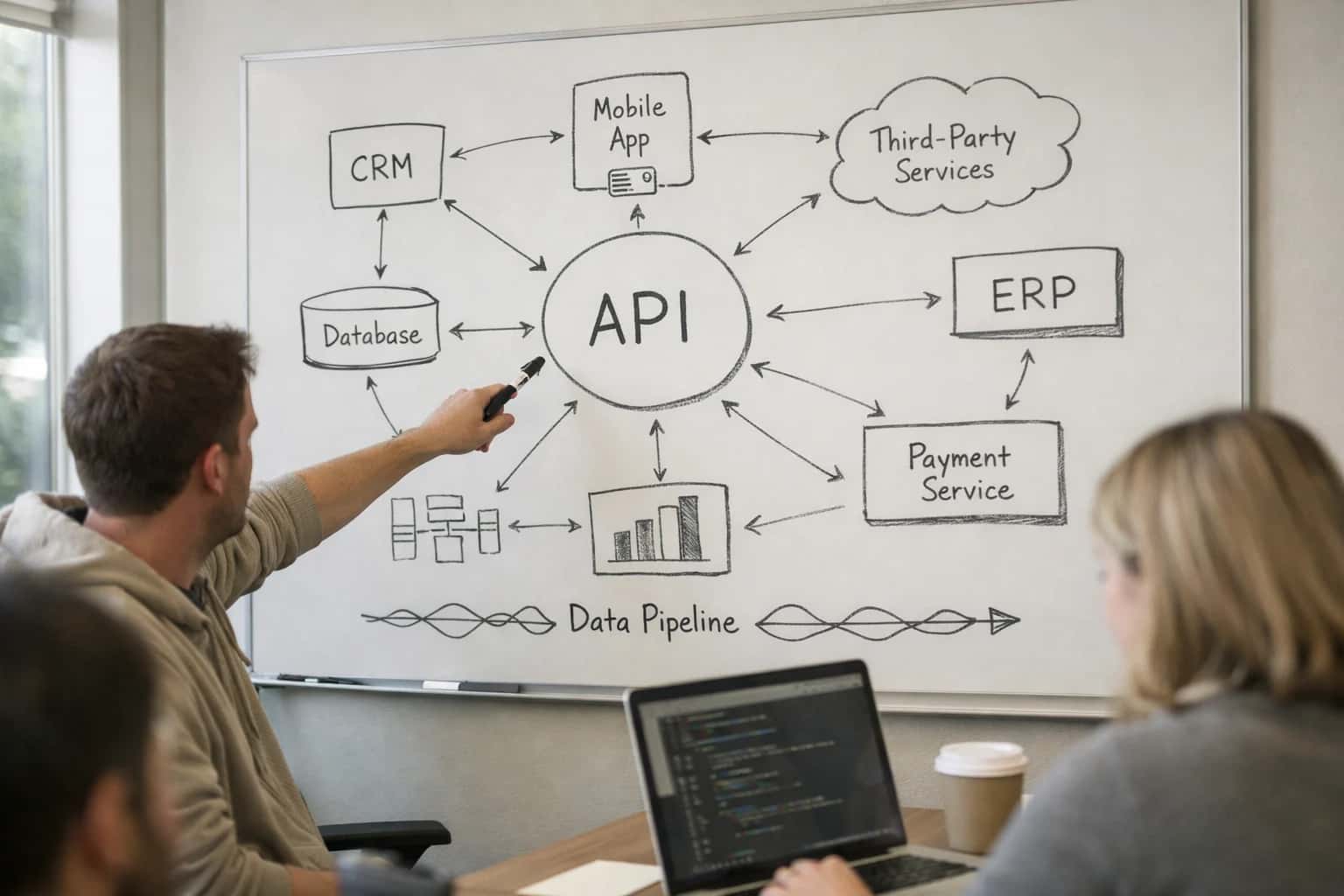
The core integration pattern involves a bi-directional data flow between Qlik's associative engine, your cloud data warehouse (Snowflake, BigQuery, Databricks), and Inference Systems' AI orchestration layer. Qlik Sense apps, via the Qlik Engine API and Qlik Sense Repository Service (QRS) API, expose in-memory data models and sheet object selections. This context—including field values, selections, and the underlying associative data model—is passed as structured prompts to an AI agent. The agent, grounded in your warehouse's broader historical data via a RAG pipeline against a vector store, performs the analytical heavy lifting: generating hypotheses, identifying hidden correlations, or explaining unexpected clusters surfaced by a user's exploration.
The AI agent's output—a narrative insight, a recommended action, or a new hypothesis—is then routed back into the business workflow. This can take several forms:
- Embedded Commentary: Returning a plain-English summary to be displayed directly within a Qlik Sense sheet object via extension or as a text object.
- Operational Trigger: Using a webhook to create a record in a connected system like Salesforce (for a sales opportunity), Jira (for a bug ticket), or Coupa (for a procurement alert) based on the AI's finding.
- Data Enrichment Loop: Writing a new flag, segment, or prediction back to a staging table in the data warehouse, which can then be reloaded into the Qlik app, creating a closed-loop analytics system.
Governance and rollout are managed through a centralized orchestrator that handles authentication (via Qlik JWT or certificates), controls which apps and sheets can trigger agents, enforces data privacy filters, and maintains an audit log of all AI-generated insights and triggered actions. A phased implementation typically starts with a single high-impact Qlik app—like a sales performance or supply chain dashboard—where analysts already spend time manually investigating 'why' behind the visuals. The AI integration is added as a 'Explain This' button or an automated nightly insight digest, providing immediate value without disrupting existing user workflows.
QLIK AND DATA WAREHOUSE AI INTEGRATION
Code and Payload Examples
Retrieving Associative Context for LLM Grounding
Use the Qlik Engine JSON API to fetch the current selection state and associated data from an app session. This provides the essential context (selected dimensions, measures, and related values) to ground an LLM query, ensuring generated insights are relevant to the user's active analysis.
javascript// Example using the Enigma.js library const enigma = require('enigma.js'); const schema = require('enigma.js/schemas/12.20.0.json'); async function getAppSelections(appId) { const session = enigma.create({ schema, url: `wss://your-qlik-cloud.com/app/${appId}`, createSocket: url => new WebSocket(url) }); const global = await session.open(); const app = await global.openDoc(appId); // Get current selections const selectionState = await app.getSelectionState(); // Get hypercube data for a specific object (e.g., a table) const hypercube = await app.createHyperCubeObject('MyTable', { qDimensions: [{ qDef: { qFieldDefs: ['Product'] } }], qMeasures: [{ qDef: { qDef: 'Sum(Sales)' } }], qInitialDataFetch: [{ qWidth: 2, qHeight: 10 }] }); const data = await hypercube.getHyperCubeData('/qHyperCubeDef', [ { qTop: 0, qLeft: 0, qWidth: 2, qHeight: 10 } ]); await session.close(); return { selections: selectionState, sampleData: data }; }
This context payload is then sent to an LLM endpoint alongside a user's natural language question to generate a relevant, data-grounded response.
QLIK AND DATA WAREHOUSE AI INTEGRATION
Realistic Time Savings and Operational Impact
How AI agents augmenting Qlik's associative engine and data warehouse queries change analyst workflows and business outcomes.
| Metric | Before AI | After AI | Notes |
|---|---|---|---|
Hypothesis Generation | Manual data exploration across tables | AI suggests high-potential relationships | Analyst reviews and validates AI-proposed links |
Anomaly Investigation | Hours of manual drill-down and correlation | AI flags outliers with probable cause narratives | Focus shifts from finding to validating the root cause |
Executive Report Drafting | Manual synthesis of dashboard insights | AI generates first-draft narrative with citations | Analyst refines tone, adds strategic context |
Data Quality Check | Scheduled manual audits or reactive fixes | AI continuously monitors for schema drift and outliers | Proactive alerts reduce downstream report errors |
Ad-Hoc Analysis Request | Next-business-day turnaround for complex queries | Same-day initial insights via conversational interface | AI handles initial data fetch and simple analysis; complex logic still requires expert |
Model Relationship Validation | Manual testing of joins and associations | AI reviews data model, suggests optimizations | Reduces risk of incorrect associative logic in new apps |
Insight-to-Action Workflow | Manual export to email or task system | AI triggers automated alerts or creates Jira tickets | Requires integration with operational systems like CRM or ITSM |
ARCHITECTING CONTROLLED AI FOR ENTERPRISE DATA
Governance, Security, and Phased Rollout
A practical guide to implementing secure, governed AI workflows that connect Qlik's associative model with your data warehouse.
A production AI integration for Qlik must respect the security and governance boundaries of your enterprise data warehouse (e.g., Snowflake, BigQuery, Databricks, Redshift). This means implementing a reverse ETL pattern where AI agents query the warehouse directly via its native APIs or a secure data gateway, rather than moving raw data into a separate AI silo. Your agents should operate with service account credentials scoped to specific schemas or views, and all generated insights or hypotheses should be written back to a dedicated audit table in the warehouse before being surfaced in Qlik. This keeps your data lineage clean, audit trails intact, and access controlled by your existing warehouse RBAC.
A phased rollout is critical for user adoption and risk management. Start with a read-only discovery agent that allows analysts to ask natural language questions against a single, well-modeled subject area (e.g., "show me sales trends for product X last quarter"). The agent uses the Qlik Associative Engine's understanding of data relationships to generate and execute optimized SQL, returning a plain-English summary. Phase two introduces predictive and prescriptive workflows, such as automated anomaly detection on key warehouse metrics, with alerts pushed to a Qlik dashboard. The final phase enables action-oriented insights, where the AI suggests data-driven actions (e.g., "investigate inventory levels in the Northwest region") and can trigger workflows in connected systems like your ERP or CRM via webhooks.
Governance is not an afterthought. Every AI-generated insight should be traceable back to the source warehouse query, model version, and prompt configuration. Implement a human-in-the-loop review step for initial deployments, where key insights are flagged for analyst verification before being published to executive dashboards. Use Qlik's own section access and security rules to control which user roles can see or trigger AI features. This controlled approach ensures AI augments your BI practice without introducing unvetted conclusions or breaking compliance with data policies.
Enabling Efficiency, Speed & Accuracy
Intelligent Analysis, Decision & Execution
We build AI systems for teams that need search across company data, workflow automation across tools, or AI features inside products and internal software.
Talk to Us
Search across company data
Give teams answers from docs, tickets, runbooks, and product data with sources and permissions.
Useful when people spend too long searching or get different answers from different systems.
Enterprise searchRAGPermissions
Read more
Automate internal workflows
Use AI to route work, draft outputs, trigger actions, and keep approvals and logs in place.
Useful when repetitive work moves across multiple tools and teams.
AI agentsWorkflow automationGovernance
Read more
Add AI to products and internal tools
Build assistants, guided actions, or decision support into the software your team or customers already use.
Useful when AI needs to be part of the product, not a separate tool.
AI integrationDecision supportModel routing
Read moreQLIK AND DATA WAREHOUSE AI INTEGRATION
Frequently Asked Questions
Practical questions for architects and analytics leaders planning to augment Qlik's associative engine with generative AI for automated insight discovery and hypothesis generation.
The integration uses Qlik's REST APIs and the associative engine as a governed query layer. The typical secure flow is:
- Trigger: A user asks a natural language question in a chat interface or a scheduled job initiates an analysis.
- Query Translation: An LLM (like GPT-4 or Claude) translates the question into a structured data request, referencing Qlik's data model objects (e.g., fields, tables).
- Execution via Qlik: The translated request is sent to the Qlik Engine API via a secure service account with appropriate data access rights (Section Access). Qlik executes the query against its in-memory model, which is already connected to your warehouse (Snowflake, BigQuery, etc.).
- Result Handling: The aggregated, non-row-level result set is returned to the AI agent for analysis.
This pattern ensures the AI never has direct, unfettered access to the raw data warehouse. All queries are audited through Qlik's standard logging, and data permissions are enforced by Qlik's existing security model.

About the author
Prasad Kumkar
CEO & MD, Inference Systems
Prasad Kumkar is the CEO & MD of Inference Systems and writes about AI systems architecture, LLM infrastructure, model serving, evaluation, and production deployment. Over 5+ years, he has worked across computer vision models, L5 autonomous vehicle systems, and LLM research, with a focus on taking complex AI ideas into real-world engineering systems.
His work and writing cover AI systems, large language models, AI agents, multimodal systems, autonomous systems, inference optimization, RAG, evaluation, and production AI engineering.
LinkedIn
Limited slotsGet a Free AI Consultation
Partnered with leading AI, data, and software stack.





How We Work
Custom AI workflows for your Business
One-fit-all AI don't work for modern businesses. At Inferensys, we aim to understand your business & custom requirements; which we use to define most efficient agentic workflows, the data, and the tools for your business.
01
Review the use case
We understand the task, the users, and where AI can actually help.
Read more02
Pick the right approach
We define what needs search, automation, or product integration.
Read more03
Build the first useful version
We implement the part that proves the value first.
Read more04
Improve from there
We add the checks and visibility needed to keep it useful.
Read moreThe first call is a practical review of your use case and the right next step.
Talk to Us