An effective copilot connects to the ALM platform's data layer—pulling context from active pull requests in GitHub or GitLab, linked work items in Azure Boards or Jira, recent pipeline runs, and project documentation in wikies or Confluence. This creates a unified, real-time knowledge graph the assistant can query. The integration surface is typically a sidebar widget, chat interface, or slash command within the developer's existing IDE or web interface, minimizing context switching.

Integration
Engineering Copilots for ALM Platforms
Build contextual AI assistants that integrate with Azure DevOps, GitLab, GitHub, and Jira to answer questions about codebases, documentation, and project status directly within developer workflows.
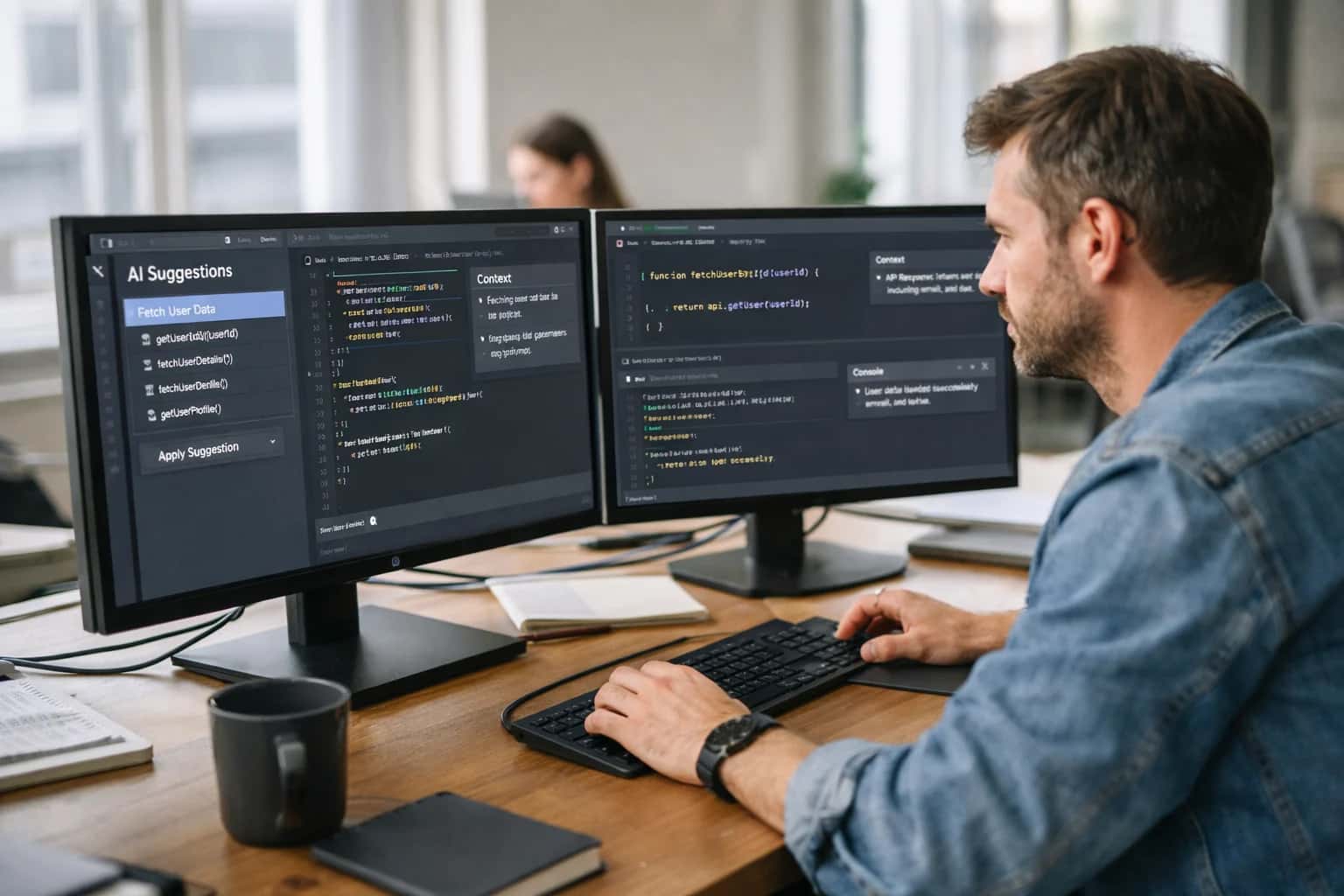
ARCHITECTURE FOR CONTEXTUAL ASSISTANTS
Where AI Copilots Fit into the ALM Stack
Engineering copilots are not standalone chatbots; they are contextual assistants integrated into the surfaces where developers already work.
Implementation involves deploying a secure backend service that subscribes to platform webhooks (e.g., for new PRs, issue comments, or commits) and maintains a vector index of relevant code, docs, and discussions. When a developer asks "What's the error pattern in these failed pipeline runs?", the copilot retrieves logs from Azure Pipelines or GitLab CI/CD, analyzes them with an LLM, and returns a concise summary with links. Use cases include: - Codebase Q&A: Answering questions about architecture or why a function was changed by searching commit history and ADRs. - Incident Triage: Summarizing a Jira issue linked to a production alert by pulling in recent deploys and related changes. - Onboarding Assistance: Guiding new hires through repository structure and team norms based on project documentation.
Rollout should start with a pilot team and a narrowly scoped knowledge base—often a single service repository and its related ALM artifacts. Governance is critical: all copilot interactions should be logged with user, query, and data sources for auditability. Implement role-based access control (RBAC) to ensure the assistant only surfaces information the user is permissioned to see, respecting the ALM platform's existing project and repo-level security. A human-in-the-loop review step for generated code snippets or architectural suggestions is recommended before these are committed to the main branch.
CONTEXTUAL AI ASSISTANTS FOR DEVELOPER TOOLS
Integration Surfaces for Engineering Copilots
Code Context & Review Assistance
Copilots integrate directly into the source code management layer of ALM platforms to provide contextual assistance during active development.
Key Integration Points:
- Pull/Merge Request Interfaces: Embed AI agents to summarize changes, suggest reviewers, and flag potential conflicts based on historical data.
- Inline Code Comments: Connect to the commenting API to answer developer questions about specific lines, functions, or dependencies.
- Branch & Commit Analysis: Use webhooks to trigger AI analysis of new commits for security patterns, code smells, or links to existing issues.
Example Workflow: When a developer opens a PR in GitHub, an AI agent automatically:
- Fetches the diff and linked Jira issue.
- Generates a summary of changes in plain English.
- Checks the commit history for similar past changes and surfaces relevant code snippets.
- Posts a comment with its analysis directly on the PR thread.
This turns the PR interface into a proactive knowledge hub, reducing back-and-forth and accelerating review cycles.
CONTEXTUAL AI ASSISTANTS FOR DEVELOPER TOOLS
High-Value Use Cases for Engineering Copilots
Engineering copilots integrated directly into ALM platforms move beyond generic code completion to become contextual assistants for the entire software delivery lifecycle. These use cases show where AI can connect to Azure DevOps, GitLab, GitHub, and Jira to answer questions, automate workflows, and provide insights using your team's own code, documentation, and project data.
01
Contextual Codebase Q&A Assistant
Implement a RAG-powered assistant that indexes your private repositories, wikis, and ADRs. Developers ask questions in natural language (e.g., 'How do we handle authentication in the billing service?') and get answers with citations to relevant code snippets, architecture diagrams, and past decisions. Integrates via chat interfaces in GitLab, Teams/Slack, or a dedicated web panel.
Minutes vs. Hours
Finding tribal knowledge
02
Pull/Merge Request Summarization & Risk Analysis
Automatically generate concise, non-technical summaries of PR/MR diffs for product managers and stakeholders. The copilot analyzes code changes, linked issues, and commit messages to highlight potential impacts, security concerns, and testing needs. Posts the summary as a comment in GitHub, GitLab, or Azure Repos.
Batch -> Real-time
Review readiness
03
Jira/GitHub Issues Triage & Enrichment Agent
An AI agent monitors new issues and pull requests. It reads the description, classifies the issue (bug vs. feature), suggests labels, estimates initial story points based on historical similar work, and asks the reporter for missing information (like reproduction steps or acceptance criteria). Works within Jira Automation or GitHub Actions.
Same day
Initial triage SLA
04
Release Changelog & Communication Drafting
At the end of a sprint or release cycle, the copilot synthesizes data from completed Jira issues, merged PRs, and deployment records. It drafts a structured changelog for engineers and a customer-facing release notes summary, highlighting new features, bug fixes, and known issues. Triggers from a pipeline stage in Azure DevOps or GitLab CI.
1 sprint
Recurring manual task
05
Onboarding & Runbook Navigator
A role-specific assistant for new engineers or on-call responders. It answers questions about local setup, debugging procedures, and incident response by retrieving information from runbooks, README.md files, and past incident post-mortems stored in the ALM ecosystem. Can be accessed via a dedicated slash command in your team's chat platform.
Hours -> Minutes
Ramp-up time
06
Backlog Grooming & Dependency Mapping
During backlog refinement sessions, the copilot analyzes epic and user story descriptions in Azure Boards or Jira. It suggests related stories, identifies potential technical dependencies by scanning code repos, and proposes draft acceptance criteria based on similar past work. Presents findings in a side-panel view within the ALM tool.
Prioritization aid
Reduces oversight
CONTEXTUAL ENGINEERING ASSISTANTS
Example Copilot Workflows and Interactions
These workflows illustrate how an Engineering Copilot integrates directly into developer tools, pulling context from code, issues, and documentation to assist without context-switching. Each example shows a trigger, the data gathered, the AI action, and the resulting system update or user interaction.
Trigger: A developer highlights a block of unfamiliar code in their IDE (VS Code, JetBrains) or directly within a GitHub/GitLab merge request preview.
Context Gathered: The copilot agent retrieves:
- The selected code snippet.
- The file's recent commit history and author from the repository.
- Related Jira issue or Azure DevOps work item linked in commit messages.
- Any existing code comments or documentation in adjacent files.
AI Action: The model generates a plain-English explanation of:
- What the code does functionally.
- Key libraries or patterns used.
- Potential side effects or dependencies.
- Links to relevant internal wiki pages or API docs.
System Update / User Interaction: The explanation is displayed in a hover card or sidebar panel within the IDE. The developer can ask follow-up questions (e.g., "How do I modify this for async?" or "Show me a test example") in a chat interface, with responses grounded in the codebase.
Human Review Point: The explanation is for assistance only; no code is auto-modified. The developer controls any changes.
FROM STATIC DOCS TO CONTEXTUAL AGENTS
Implementation Architecture: Data Flow and Tool Calling
An engineering copilot is not a chatbot; it's a secure, context-aware agent that executes actions and retrieves data on behalf of developers, directly within their ALM platform.
The core architecture connects a reasoning engine (like GPT-4 or Claude) to your ALM platform's APIs via a secure middleware layer. This layer handles authentication, rate limiting, and tool calling. The copilot's "tools" are API endpoints for platforms like Azure DevOps (REST API), GitLab GraphQL API, GitHub REST API, or Jira Cloud API. Each tool allows the agent to perform a specific action: get_recent_pull_requests, search_work_items, create_branch, or query_build_status. The agent's context is built from a RAG (Retrieval-Augmented Generation) pipeline that indexes your private code repositories, wiki pages (Confluence, GitHub Wikis), and recent issue history, enabling it to answer questions about your specific codebase and projects.
A typical user interaction flows through distinct phases: 1) Intent Parsing & Auth: A developer asks, "What's blocking PR #452?" in a Teams channel or Jira comment. The request is routed to the middleware, which validates the user's RBAC permissions against the target project. 2) Tool Planning & Execution: The agent determines it needs to call the get_pull_request_details tool for PR 452, then the get_linked_work_items tool to find associated Jira tickets. 3) Synthesis & Response: The agent receives raw API payloads, synthesizes a natural language summary ("PR #452 is blocked on Jira ticket PROJ-123, which is awaiting QA sign-off. The last build failed due to a unit test in service/auth.py."), and cites its sources. For actionable requests like "Create a bug ticket for this," it would call the create_issue tool with a drafted title and description.
Rollout requires a phased approach, starting with read-only tools (search, summarize) for a pilot team to build trust and audit logs. Governance is critical: all tool calls must be logged with user ID, timestamp, and input/output payloads for audit trails. Implement approval gates for write operations (like merging PRs) and set context boundaries to ensure the RAG system only retrieves data from projects the user already has access to within the ALM platform. This architecture turns static documentation and scattered API data into a proactive assistant that reduces context-switching and accelerates developer workflows from hours to minutes.
ENGINEERING COPILOT IMPLEMENTATION
Code and Configuration Patterns
Core Integration Pattern
An engineering copilot is typically deployed as a middleware agent service that sits between the chat interface (e.g., Slack, Teams, IDE plugin) and the ALM platform's APIs. It uses a Retrieval-Augmented Generation (RAG) pattern to ground responses in your specific codebase, documentation, and project data.
Key components:
- Query Router: Classifies user intent (e.g., "code question," "project status," "how-to").
- Retriever: Uses vector search (via Pinecone, Weaviate) over indexed repositories, wikis, and Jira/GitLab issues.
- Orchestrator: Calls relevant ALM REST APIs (GitHub, GitLab, Azure DevOps, Jira) to fetch real-time data like open pull requests or build status.
- Response Generator: Synthesizes retrieved context and API data into a coherent, sourced answer using a hosted LLM.
- Audit Log: Records all queries and generated responses for security and improvement.
This architecture keeps credentials and data flows secure, avoiding direct LLM access to your systems.
ENGINEERING COPILOT IMPACT
Realistic Time Savings and Operational Impact
How contextual AI assistants integrated into Azure DevOps, GitLab, or Jira change daily workflows for developers, leads, and managers.
| Workflow | Before AI | After AI | Notes |
|---|---|---|---|
Codebase Q&A for new hires | Hours searching wikis, asking peers | Minutes with contextual assistant | Answers grounded in project docs, ADRs, and recent commits |
Understanding a complex PR/MR | Manual code review, tracing issue links | AI-generated summary of changes and risks | Reviewer focuses on high-value logic, not comprehension |
Investigating a production bug | Grep logs, trace commits, read tickets | AI correlates commits, tickets, logs for root cause | Provides draft incident summary and linked work items |
Updating project documentation | Manual copy-paste from code comments | AI drafts release notes or updates runbooks | Engineer reviews and edits, reducing initial drafting time |
Daily stand-up preparation | Manual scan of boards and pull requests | AI-generated personal status update draft | Based on your recent commits, PR reviews, and assigned tickets |
Finding relevant code examples | Search across repos, hope for comments | Semantic search retrieves similar patterns | Leverages vector embeddings of code and documentation |
On-call handoff and context sharing | Manual notes in Slack or wiki | AI summarizes recent incidents and active alerts | Integrated with PagerDuty or Opsgenie for alert context |
CONTROLLED DEPLOYMENT FOR ENGINEERING COPILOTS
Governance, Security, and Phased Rollout
Deploying an AI assistant into your development workflow requires a deliberate approach to security, data governance, and user adoption.
A production-ready copilot integration must respect your ALM platform's existing security model. This means the AI agent should authenticate using service principals or OAuth scoped to a dedicated service account, inheriting permissions from Azure DevOps project collections, GitLab groups, or Jira projects. All queries and generated content should be logged with full audit trails, linking actions to specific users, work items (like Azure DevOps Work Item ID or Jira Issue Key), and code repositories. The system should never store sensitive code, credentials, or intellectual property in external LLM training datasets without explicit, audited consent.
A phased rollout is critical for managing change and measuring impact. Start with a pilot group in a non-critical project, enabling the copilot for specific, low-risk surfaces first:
- Phase 1 (Read-Only Q&A): Deploy a RAG-based assistant that can answer questions about project documentation,
READMEfiles, and recent sprint goals by querying indexed content from Azure Wiki, GitLab Pages, or Confluence. All answers cite sources. - Phase 2 (Contextual Code Analysis): Enable the assistant to analyze code in the context of active pull requests or merge requests in GitHub or GitLab, providing summaries and answering questions about specific functions—but not generating or modifying code.
- Phase 3 (Action-Oriented Assistance): Introduce guarded generation capabilities, such as drafting Jira issue comments from commit messages or suggesting test cases based on a user story's acceptance criteria. All generative outputs require a human review step before being committed to the system of record.
Governance is maintained through a central prompt management layer that defines the copilot's persona, response boundaries, and approved tools. This layer enforces rules like "do not generate production database queries" or "always reference the company's coding standards document." Coupled with a feedback loop where engineers can flag unhelpful or incorrect responses, this creates a controlled, iterative improvement cycle. The goal is not to replace engineer judgment but to augment it with a consistent, secure, and traceable assistant that reduces context-switching and accelerates discovery.
Enabling Efficiency, Speed & Accuracy
Intelligent Analysis, Decision & Execution
We build AI systems for teams that need search across company data, workflow automation across tools, or AI features inside products and internal software.
Talk to Us
Search across company data
Give teams answers from docs, tickets, runbooks, and product data with sources and permissions.
Useful when people spend too long searching or get different answers from different systems.
Enterprise searchRAGPermissions
Read more
Automate internal workflows
Use AI to route work, draft outputs, trigger actions, and keep approvals and logs in place.
Useful when repetitive work moves across multiple tools and teams.
AI agentsWorkflow automationGovernance
Read more
Add AI to products and internal tools
Build assistants, guided actions, or decision support into the software your team or customers already use.
Useful when AI needs to be part of the product, not a separate tool.
AI integrationDecision supportModel routing
Read moreENGINEERING COPILOT IMPLEMENTATION
Frequently Asked Questions
Practical questions for teams evaluating AI assistants integrated into Azure DevOps, GitLab, or Jira to answer questions about code, docs, and project status.
We implement a secure, retrieval-augmented generation (RAG) architecture that keeps your data private.
- Data Indexing: Your code repositories (from Azure Repos, GitLab, or GitHub), wiki pages (Confluence, Azure DevOps Wiki), and relevant issue/work item history are indexed into a private vector database (like Pinecone or Weaviate) deployed within your cloud environment. This creates a searchable knowledge layer.
- Secure Query Flow: When a developer asks a question in the copilot interface (e.g., a chat pane in Teams or embedded in the ALM UI), the query is sent to your backend service.
- Context Retrieval: The service performs a semantic search against the private vector index to find the most relevant code snippets, documentation excerpts, or closed issue threads.
- Grounded Response: This retrieved context is packaged into a prompt and sent to the LLM (like OpenAI or Azure OpenAI), instructing it to answer only using the provided context. Your source code is never sent directly to the model as training data.
- Access Enforcement: The backend service respects your existing ALM platform permissions (via OAuth or PATs) to ensure the copilot only retrieves data the user is already authorized to see.
This pattern ensures the AI provides accurate, context-specific answers without exposing proprietary intellectual property.

About the author
Prasad Kumkar
CEO & MD, Inference Systems
Prasad Kumkar is the CEO & MD of Inference Systems and writes about AI systems architecture, LLM infrastructure, model serving, evaluation, and production deployment. Over 5+ years, he has worked across computer vision models, L5 autonomous vehicle systems, and LLM research, with a focus on taking complex AI ideas into real-world engineering systems.
His work and writing cover AI systems, large language models, AI agents, multimodal systems, autonomous systems, inference optimization, RAG, evaluation, and production AI engineering.
LinkedIn
Limited slotsGet a Free AI Consultation
Partnered with leading AI, data, and software stack.





How We Work
Custom AI workflows for your Business
One-fit-all AI don't work for modern businesses. At Inferensys, we aim to understand your business & custom requirements; which we use to define most efficient agentic workflows, the data, and the tools for your business.
01
Review the use case
We understand the task, the users, and where AI can actually help.
Read more02
Pick the right approach
We define what needs search, automation, or product integration.
Read more03
Build the first useful version
We implement the part that proves the value first.
Read more04
Improve from there
We add the checks and visibility needed to keep it useful.
Read moreThe first call is a practical review of your use case and the right next step.
Talk to Us