Modern release management in platforms like Azure DevOps Pipelines, GitHub Actions, and GitLab CI/CD involves orchestrating dozens of interdependent steps: environment provisioning, infrastructure deployment, database migrations, service rollouts, smoke tests, and post-deployment monitoring. AI integrates at the orchestration layer to analyze historical pipeline data, monitor real-time system health, and dynamically adjust the release flow. Key integration points include the release pipeline YAML/JSON definitions, approval gate APIs, artifact repositories, and monitoring/observability webhooks that feed status back into the ALM platform.

Integration
AI-Driven Release Coordination and Deployment
Integrate AI to automate release pipeline orchestration, analyze deployment risks, generate intelligent changelogs, and coordinate approvals across Azure DevOps, GitHub Actions, and GitLab CI/CD.
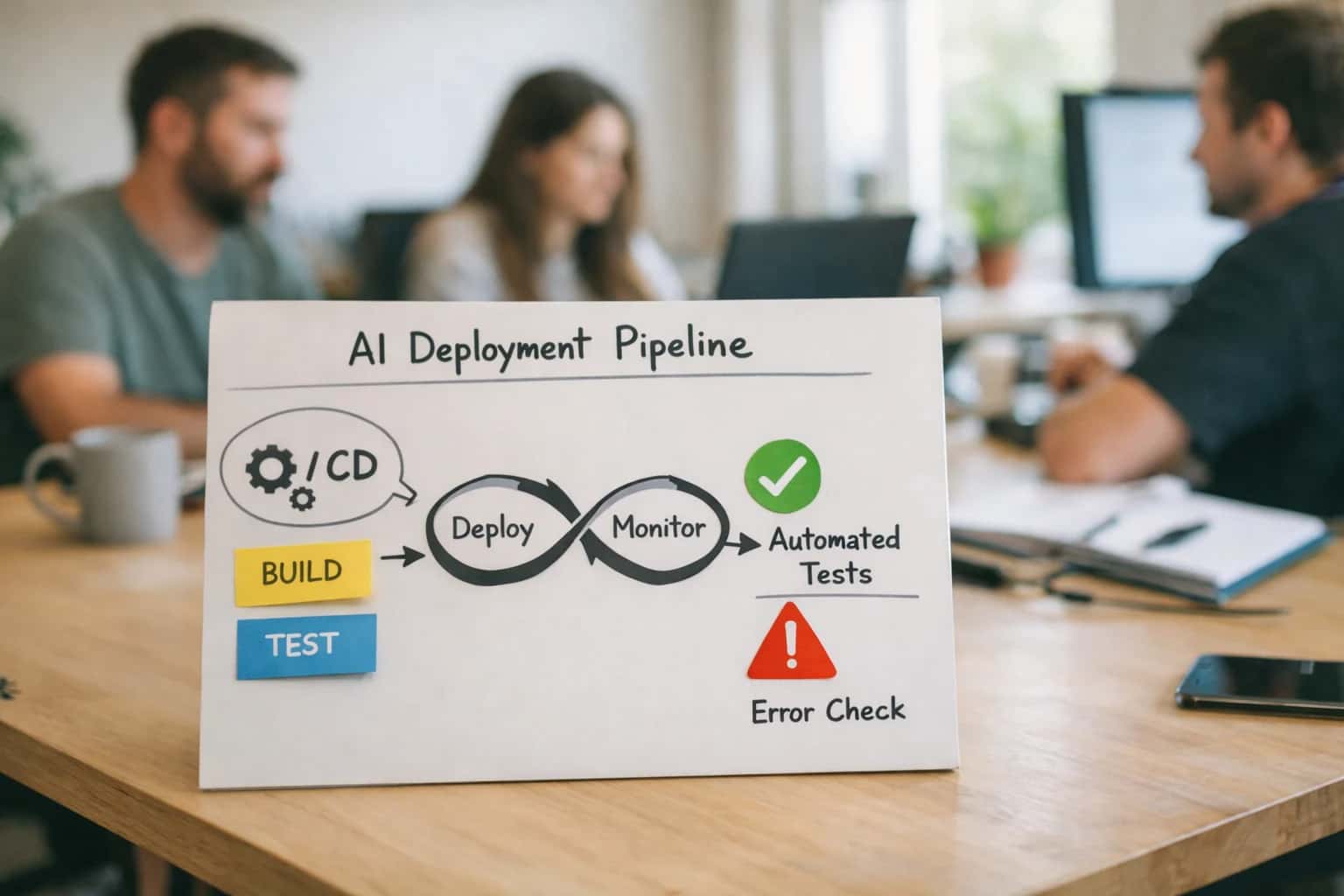
FROM MANUAL COORDINATION TO INTELLIGENT ORCHESTRATION
Where AI Fits into Modern Release Management
AI transforms release management from a coordination-heavy, risk-averse process into a data-driven, predictive workflow that accelerates delivery while maintaining control.
High-impact use cases center on risk mitigation and operational efficiency. For example, an AI agent can be triggered at a pipeline's approval gate to: analyze linked Jira issues or Azure DevOps work items for incomplete dependencies; cross-reference the deployment branch with recent production incident reports; evaluate the test coverage and flaky test history of the artifacts; and synthesize a risk summary and recommended action (proceed, rollback, or pause) for the release manager. This moves decision-making from manual checklist review to an evidence-based, automated advisory system, turning multi-hour coordination into minutes.
A production implementation wires an AI orchestration service as a middleware layer between your CI/CD platform and your operational data sources. This service subscribes to pipeline webhook events, enriches them with context from Jira, Datadog/Splunk, SonarQube, and vulnerability scanners, processes the data through a risk-scoring model, and posts results back to the pipeline via a status check or approval gate comment. Governance is maintained through a human-in-the-loop design: the AI provides the analysis and recommendation, but the final promote-to-prod action requires a human approval or an automated pass based on a configurable risk threshold.
Rollout should be phased, starting with non-production pipelines to build trust in the AI's recommendations. The ultimate goal isn't full automation but augmented intelligence—giving release engineers and DevOps teams a copilot that handles the data synthesis and pattern recognition, freeing them to focus on complex exceptions and strategic improvements. This approach turns release management from a bottleneck into a competitive advantage, enabling same-day releases instead of next-week deployments.
ARCHITECTURE BLUEPRINT
AI Integration Points Across Major ALM Platforms
AI Integration for CI/CD Pipelines
This layer connects AI to the execution and coordination engines of your release process. The goal is to move from reactive monitoring to predictive orchestration.
Key Integration Points:
- Pipeline Triggers & Gates: Use AI to analyze commit messages, linked work items, and test results to dynamically approve or hold deployments in Azure Pipelines, GitHub Actions, or GitLab CI/CD.
- Failure Analysis & Remediation: Integrate AI to parse pipeline logs, classify failures (e.g., flaky test vs. infrastructure), and suggest or even execute remediation steps via API calls.
- Resource Optimization: AI models can predict pipeline duration and resource needs, enabling dynamic scaling of agents or runners to reduce costs and queue times.
Example Workflow: An AI agent monitors a deployment to a staging environment. It detects a performance regression in synthetic tests, automatically creates a Jira issue linked to the pipeline run, and recommends rolling back the release based on pre-defined risk thresholds.
FROM PIPELINE TO PRODUCTION
High-Value Use Cases for AI in Release Coordination
Release coordination is a high-stakes, multi-team process often bottlenecked by manual reviews, fragmented data, and reactive firefighting. These AI integration patterns connect directly to your CI/CD pipelines and project boards to automate the heavy lifting, reduce risk, and accelerate delivery.
01
Automated Risk Analysis for Deployment Gates
AI analyzes the current release candidate against historical data from Jira, Git commits, and past pipeline runs. It flags high-risk changes—like commits from a previously buggy module, large refactors, or missing tests—and provides a summarized risk score to approvers in Azure DevOps Release Gates or GitHub Environments. This moves gate reviews from manual checklist verification to data-driven, instant risk assessment.
Batch -> Real-time
Risk assessment
02
Intelligent Changelog & Release Note Generation
Instead of manually curating commits, AI automatically synthesizes a human-readable changelog. It pulls data from Git commit messages, linked Jira issues/GitHub Issues, and pull request descriptions to categorize changes (e.g., Features, Bugs, Infrastructure), summarize impact, and highlight breaking changes. This draft is pushed to the release pipeline or Confluence page for final review, ensuring stakeholders are informed.
1 sprint
Saved per release
03
Cross-Platform Release Coordination Agent
An AI agent monitors and orchestrates status across a fragmented toolchain. It answers questions like "Is the backend service deployed yet?" by querying GitLab CI/CD, checks feature flags in LaunchDarkly, and validates cloud infrastructure in Terraform Cloud. It can post consolidated status updates to a Slack/Teams channel or update a central Jira Release Ticket, eliminating the need for manual status sync meetings.
Hours -> Minutes
Status coordination
04
Predictive Rollback & Hotfix Guidance
When a post-deployment incident is logged in ServiceNow or Jira Service Management, AI immediately correlates it with the recent release. It analyzes error logs, performance metrics, and the specific changes deployed to predict the most likely faulty component. It then suggests a precise rollback commit or generates the first draft of a hotfix pull request, dramatically reducing MTTR.
Same day
Faster root cause
05
Dynamic Resource & Environment Scheduling
AI optimizes the utilization of shared, costly staging/pre-production environments. By analyzing pipeline queue times, team sprint schedules from Azure Boards, and dependency graphs, it can propose or automatically adjust pipeline schedules to minimize conflicts. It can also trigger automated environment teardown and spin-up in Kubernetes based on predicted need, reducing cloud spend and wait times.
06
Compliance & Audit Trail Synthesis
For regulated industries, AI automates the creation of auditable release evidence. It connects to GitHub, Azure Repos, Jira, and SonarQube to extract a verifiable trail: which code was reviewed, which tests passed, who approved the deployment, and what security scans were clean. It compiles this into a structured report for auditors, turning a multi-day manual process into an automated pipeline artifact.
Hours -> Minutes
Audit pack creation
IMPLEMENTATION PATTERNS
Example AI-Enhanced Release Workflows
These concrete workflows illustrate how AI agents and automations can be wired into Azure DevOps Pipelines, GitHub Actions, and GitLab CI/CD to orchestrate releases, manage risk, and coordinate teams.
Trigger: A release pipeline reaches a designated 'Approval' stage (e.g., pre-prod).
Context Pulled: The AI agent ingests:
- Recent commits and associated Jira/ADO work items from the release branch.
- Open high/blocker severity bugs linked to the release.
- Results of the latest security and performance test runs.
- Deployment history of the involved services to the target environment.
Agent Action: A risk-scoring model analyzes the context to generate a release health summary and a recommended action (Go, No-Go, or Go with Conditions). The summary highlights:
- New, untested code volume.
- Presence of known high-risk changes.
- Test coverage gaps for modified components.
- Any recent rollbacks in the target environment.
System Update: The recommendation and summary are posted as a comment on the pipeline run and sent to a designated Teams/Slack channel. If the recommendation is Go, the pipeline can be configured to auto-proceed. A No-Go or Conditions triggers a mandatory review by the release manager.
Human Review Point: The release manager reviews the AI-generated summary and recommendation before manually overriding or approving the gate.
FROM MANUAL COORDINATION TO AUTONOMOUS ORCHESTRATION
Architecture for a Production AI Release Agent
A practical blueprint for integrating an AI agent into your CI/CD pipelines to automate release coordination, risk analysis, and stakeholder communication.
A production-ready AI release agent acts as an orchestrator that sits between your planning tools (like Jira or Azure Boards) and your execution pipelines (GitHub Actions, GitLab CI/CD, Azure Pipelines). It ingests data from multiple sources: the commit history and pull request summaries from your Git platform, the current sprint backlog and issue status from your project management tool, and real-time pipeline status and deployment logs. The agent's core function is to synthesize this data to answer critical questions: What is actually being released? What are the key risks based on recent changes and historical failure patterns? Who needs to be notified or provide approval?
The implementation typically involves a service that listens for webhooks from pipeline completion events. Upon trigger, it executes a multi-step workflow: 1) Context Retrieval: It fetches the associated work items (e.g., Jira issues linked via commit messages) and recent changes. 2) Risk Analysis: Using a configured LLM, it analyzes commit messages, linked bug fixes, and recent test results to generate a risk summary (e.g., 'High risk due to major database schema change in this commit'). 3) Action Orchestration: Based on policy rules (e.g., high-risk releases require manager approval), it can update a release dashboard, post a summary to a Teams/Slack channel, create an approval task in ServiceNow or Jira, or even hold the deployment in a queue pending manual "/approve".
Governance and rollout are critical. Start with a 'copilot' mode where the agent generates draft release notes and risk assessments for a human to review and send. Implement audit logging for every AI-generated action and decision. Use feature flags to control the agent's autonomy level (e.g., read-only, advisory, or fully autonomous for low-risk releases to pre-production). The final architecture should treat the AI agent as a policy-driven workflow automaton, not a black box, ensuring engineers retain oversight while delegating the repetitive coordination tasks that delay releases.
AI-DRIVEN RELEASE COORDINATION
Code and Payload Examples
Analyzing Deployment Risk with AI
Integrate AI into your CI/CD pipeline to analyze commits, Jira tickets, and test results before a deployment. The agent evaluates risk factors like recent failure patterns, code complexity changes, and linked incident history.
Example Python API Call (Azure DevOps):
pythonimport requests import openai # Fetch pipeline context def analyze_release_risk(pipeline_run_id, project_name): ado_url = f"https://dev.azure.com/{ORG}/{project_name}/_apis/pipelines/{pipeline_run_id}" headers = {"Authorization": f"Bearer {ADO_TOKEN}"} run_details = requests.get(ado_url, headers=headers).json() # Build context for AI context = f""" Pipeline: {run_details['pipeline']['name']} Branch: {run_details['sourceBranch']} Recent failures in similar stages: {get_failure_rate(run_details)} Linked work items: {get_linked_work_items(run_details)} """ # Call LLM for risk assessment response = openai.chat.completions.create( model="gpt-4o", messages=[ {"role": "system", "content": "You are a release risk analyst. Evaluate the following deployment context and output a risk score (Low/Medium/High) with 2-3 key concerns."}, {"role": "user", "content": context} ] ) return response.choices[0].message.content
This pattern allows you to gate deployments or flag high-risk releases for manual review, reducing production incidents.
AI-DRIVEN RELEASE COORDINATION
Realistic Time Savings and Operational Impact
How AI integration transforms manual, high-friction release processes into streamlined, data-driven workflows across Azure DevOps Pipelines, GitHub Actions, and GitLab CI/CD.
| Process | Before AI | After AI | Key Impact |
|---|---|---|---|
Deployment Risk Analysis | Manual review of Jira tickets & commit history | Automated analysis of linked issues, code changes, and past failures | Identifies high-risk releases 80% faster; reduces post-deployment incidents |
Changelog & Release Notes Drafting | Engineer manually compiles changes from multiple sources | AI auto-generates draft from PR descriptions, commits, and resolved tickets | Cuts drafting time from 2-3 hours to 15-20 minutes per release |
Approval Coordination & Compliance Checks | Manual Slack/email pings and spreadsheet tracking | AI agent routes approvals, checks for required sign-offs, and updates status | Reduces release hold time from 'next day' to 'same day' for standard releases |
Post-Deployment Verification & Rollback Triggers | Reactive monitoring; manual log checking after user reports | AI monitors key metrics and logs, suggests rollback if anomalies exceed threshold | Enables proactive issue detection; MTTR for deployment-related issues cut by ~40% |
Pipeline Failure Triage | Engineer investigates logs to diagnose root cause | AI summarizes failure, suggests likely culprit (e.g., test flake, config error) | Reduces average diagnostic time from 30+ minutes to under 5 minutes |
Cross-Team Dependency Mapping | Manual coordination via meetings and tribal knowledge | AI analyzes project boards and code repos to auto-identify impacted teams | Prevents missed dependencies; cuts coordination overhead by ~50% |
Release Communication | Manual updates to multiple channels (Slack, email, wiki) | AI generates and publishes structured updates to pre-defined channels | Ensures consistent, timely communication; frees up ~1-2 hours per release cycle |
ARCHITECTING FOR CONTROL AND CONFIDENCE
Governance, Security, and Phased Rollout
A production-ready AI integration for release coordination requires deliberate controls, secure data handling, and a phased rollout to manage risk and build trust.
The integration architecture must enforce strict data governance, connecting only to authorized release pipelines, deployment logs, and change management records within Azure DevOps, GitLab CI/CD, or GitHub Actions. AI agents should operate with service principal or OAuth tokens scoped to read-only access for analysis and write access only to designated surfaces like release notes or approval comments. All prompts, model outputs, and agent decisions should be logged to a dedicated audit trail, linking back to the original pipeline run, commit SHA, and user who triggered the action for full traceability.
A phased rollout is critical for managing change. Start with a read-only analysis phase, where AI monitors pipeline health and deployment risks, generating internal reports without taking action. Next, introduce human-in-the-loop workflows, such as AI-drafted changelogs that require a release manager's approval before being posted. Finally, enable controlled automation for low-risk, repetitive tasks like tagging successful deployments or updating related Jira issues, while keeping high-stakes decisions like production promotions or rollbacks under manual control. This approach allows teams to build confidence in the AI's judgment within their specific environment.
Security is paramount, especially when integrating with mission-critical deployment systems. All calls to external LLM APIs (OpenAI, Anthropic, Azure OpenAI) should be proxied through a secure gateway to enforce data loss prevention (DLP) policies, stripping sensitive keys, internal URLs, or PII before leaving your network. Vector embeddings for RAG-based risk analysis should be generated and stored on-premises or within your cloud tenant. Furthermore, implement circuit breakers and fallback procedures so that if the AI service is unavailable or returns low-confidence recommendations, the release process defaults to a known-safe manual workflow without blocking delivery.
Enabling Efficiency, Speed & Accuracy
Intelligent Analysis, Decision & Execution
We build AI systems for teams that need search across company data, workflow automation across tools, or AI features inside products and internal software.
Talk to Us
Search across company data
Give teams answers from docs, tickets, runbooks, and product data with sources and permissions.
Useful when people spend too long searching or get different answers from different systems.
Enterprise searchRAGPermissions
Read more
Automate internal workflows
Use AI to route work, draft outputs, trigger actions, and keep approvals and logs in place.
Useful when repetitive work moves across multiple tools and teams.
AI agentsWorkflow automationGovernance
Read more
Add AI to products and internal tools
Build assistants, guided actions, or decision support into the software your team or customers already use.
Useful when AI needs to be part of the product, not a separate tool.
AI integrationDecision supportModel routing
Read moreAI-DRIVEN RELEASE COORDINATION AND DEPLOYMENT
Frequently Asked Questions
Practical questions for engineering leaders planning to integrate AI into their CI/CD pipelines and release management workflows.
AI integrates via webhooks, API calls, and event listeners to your pipeline orchestrators (Azure Pipelines, GitHub Actions, GitLab CI/CD).
Typical integration points:
- Pipeline Triggers: AI agents can be invoked at key stages (e.g., post-merge, pre-deployment) via pipeline YAML steps or API calls.
- Artifact & Log Analysis: The system pulls build artifacts, deployment logs, test results, and linked work items (from Jira or Azure Boards) to provide context.
- Risk Scoring & Summarization: An LLM analyzes the changeset, recent incident history, and test coverage to generate a deployment risk score and a concise changelog summary.
- Orchestration & Gating: Based on the analysis, the AI can:
- Recommend proceeding, holding, or rolling back.
- Automatically update deployment status in your ALM tool.
- Route high-risk deployments for manual approval via Slack or Teams.
- Post-Deployment: The agent monitors initial metrics and can trigger rollback workflows or create post-mortem tickets if anomalies are detected.
This creates a closed-loop system where AI augments, not replaces, your existing pipeline gates and approval chains.

About the author
Prasad Kumkar
CEO & MD, Inference Systems
Prasad Kumkar is the CEO & MD of Inference Systems and writes about AI systems architecture, LLM infrastructure, model serving, evaluation, and production deployment. Over 5+ years, he has worked across computer vision models, L5 autonomous vehicle systems, and LLM research, with a focus on taking complex AI ideas into real-world engineering systems.
His work and writing cover AI systems, large language models, AI agents, multimodal systems, autonomous systems, inference optimization, RAG, evaluation, and production AI engineering.
LinkedIn
Limited slotsGet a Free AI Consultation
Partnered with leading AI, data, and software stack.





How We Work
Custom AI workflows for your Business
One-fit-all AI don't work for modern businesses. At Inferensys, we aim to understand your business & custom requirements; which we use to define most efficient agentic workflows, the data, and the tools for your business.
01
Review the use case
We understand the task, the users, and where AI can actually help.
Read more02
Pick the right approach
We define what needs search, automation, or product integration.
Read more03
Build the first useful version
We implement the part that proves the value first.
Read more04
Improve from there
We add the checks and visibility needed to keep it useful.
Read moreThe first call is a practical review of your use case and the right next step.
Talk to Us