W&B Sweeps acts as the experimentation engine within the broader LLMOps lifecycle, specifically between the initial model selection and the final candidate promotion to a model registry. For teams fine-tuning open-source models like Llama 3 or Mistral, sweeps automate the search across critical parameters: learning_rate, num_epochs, batch_size, lora_rank, and scheduler configurations. This is not just about accuracy; sweeps can be configured for multi-objective optimization, balancing validation loss against inference latency and estimated GPU cost—key considerations for deploying cost-effective models.

Integration
AI Integration with Weights and Biases Sweeps
Orchestrate large-scale hyperparameter sweeps for LLM fine-tuning using W&B's sweep controllers. Optimize for multiple objectives like accuracy, latency, and cost across distributed cloud GPU clusters.
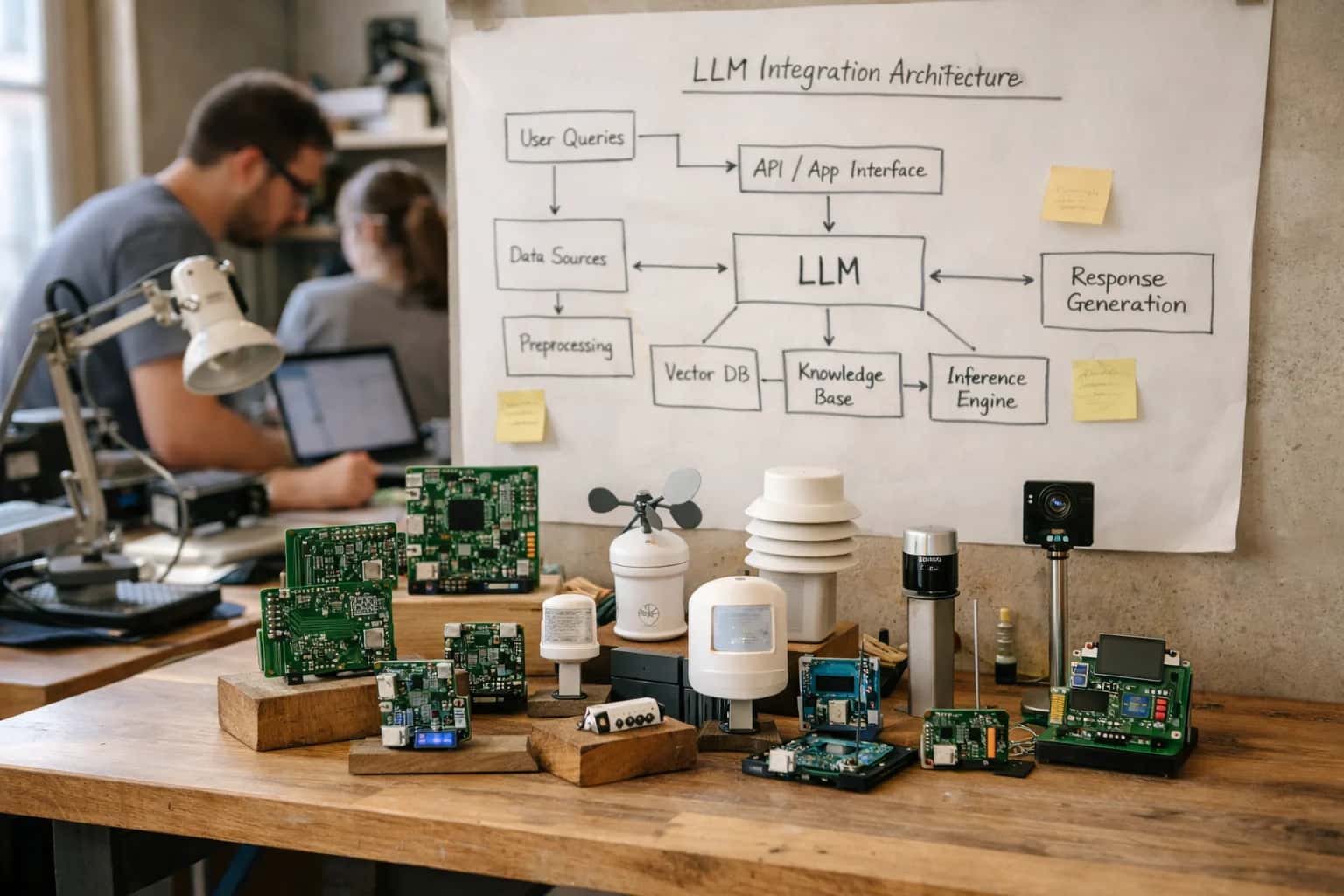
OPTIMIZING FINE-TUNING AT SCALE
Where W&B Sweeps Fit in the LLM Development Lifecycle
Integrating Weights & Biases Sweeps orchestrates systematic hyperparameter optimization for production LLM fine-tuning, turning a manual, iterative process into a governed, reproducible pipeline.
A production integration typically wires the W&B sweep controller into your training pipeline on Kubernetes or cloud GPU clusters (e.g., AWS SageMaker, GCP Vertex AI). The pipeline submits a sweep configuration defining the search method (grid, random, Bayesian) and metric goals. As each job runs, W&B automatically logs metrics, system resources, and even model checkpoints as artifacts. Engineering teams gain a centralized dashboard to compare hundreds of runs, identify Pareto-optimal candidates, and terminate underperforming trials early to control cloud spend.
Governance is enforced by linking the winning sweep run directly to the W&B Model Registry. The promoted model version carries full lineage back to its hyperparameters, training code commit, and dataset version. Before a model is deployed, this lineage can be reviewed alongside drift metrics from tools like Arize AI and policy checks from Credo AI, creating a controlled promotion path from experimentation to production. This closed-loop process ensures that the LLMs powering customer agents or RAG systems are both performant and auditable.
ARCHITECTURE PATTERNS
Key W&B Surfaces for Sweep Orchestration
Programmatic Sweep Launch and Control
The core of orchestration is the wandb.sweep() API and the Sweep Controller. This surface allows you to define hyperparameter search spaces (grid, random, Bayesian) in YAML or programmatically, then launch and manage sweeps from your training pipeline code.
Key Integration Points:
- Sweep Configuration as Code: Store sweep YAML definitions in Git and inject environment-specific parameters (e.g., GPU cluster endpoints, budget limits).
- Dynamic Agent Provisioning: Use the API to scale agents up/down based on queue depth, integrating with Kubernetes job operators or cloud instance managers.
- Programmatic Halt/Resume: Build automation to pause sweeps on cost overruns or resume them after model registry approvals.
python# Example: Launching a sweep from a pipeline import wandb sweep_config = { 'method': 'bayes', 'metric': {'name': 'validation_loss', 'goal': 'minimize'}, 'parameters': { 'learning_rate': {'min': 1e-5, 'max': 1e-3}, 'batch_size': {'values': [16, 32, 64]} } } sweep_id = wandb.sweep(sweep_config, project="llm-fine-tuning") # Integrate with your orchestrator to run `wandb.agent(sweep_id)` on worker nodes
OPTIMIZING HYPERPARAMETER SEARCH FOR PRODUCTION LLMS
High-Value Use Cases for LLM Sweep Orchestration
Weights & Biases Sweeps automate the search for optimal LLM configurations across multiple objectives. These cards detail key integration patterns where orchestrated sweeps deliver measurable operational improvements in fine-tuning efficiency, cost control, and model performance.
01
Multi-Objective Fine-Tuning for Production RAG
Orchestrate sweeps that simultaneously optimize for answer accuracy, retrieval latency, and inference cost when fine-tuning embedding models or small LLMs for Retrieval-Augmented Generation systems. Define custom metrics in W&B that balance semantic search recall with token usage, finding Pareto-optimal configurations for live applications.
Batch -> Automated
Search process
02
Cost-Constrained Adapter Tuning
Run parameter-efficient fine-tuning (PEFT) sweeps (LoRA, QLoRA) with a hard budget constraint. Use W&B's sweep controller to maximize task performance (e.g., instruction following) while minimizing GPU-hour consumption and adapter size, directly linking optimal configurations to deployment pipelines in SageMaker or vLLM.
1 sprint
Typical tuning cycle
03
Cross-Validation for Small, Domain-Specific Datasets
Automate k-fold cross-validation within a sweep when fine-tuning on limited, high-value datasets (e.g., legal contracts, medical notes). W&B tracks performance variance across folds, preventing overfitting and identifying hyperparameters that generalize best before promotion to the model registry.
Reduce overfitting risk
Primary benefit
04
Comparative Benchmarking of Open-Source LLMs
Launch parallel sweeps across multiple base models (e.g., Llama 3, Mistral, Qwen) on a standardized task. Use W&B's reporting dashboards to compare Pareto frontiers of accuracy vs. latency, providing data-driven model selection for your specific use case and infrastructure.
Data-driven selection
Outcome
05
Optimizing Inference Parameters for Deployment
Sweep over inference-time parameters—temperature, top-p, max tokens—for a frozen production model. Integrate with A/B testing frameworks to find settings that maximize business metrics (e.g., user satisfaction scores, conversion rates) rather than just perplexity, directly informing runtime configuration.
Hours -> Minutes
Optimization time
06
Hyperparameter Search for Multi-Agent Workflows
Coordinate sweeps that tune the decision thresholds, tool-calling confidence, and LLM routing logic within a LangChain or CrewAI multi-agent system. W&B tracks end-to-end workflow success rate and cost, optimizing the orchestration layer that governs specialized sub-agents.
Complex system tuning
Scope
PRODUCTION PATTERNS
Example Sweep Workflows for LLM Fine-Tuning
Hyperparameter optimization is a critical, resource-intensive phase in LLM development. These workflows illustrate how to orchestrate W&B Sweeps for production-grade fine-tuning jobs, balancing model performance, inference cost, and training efficiency across distributed GPU clusters.
Trigger: A new dataset of 50k high-quality support ticket resolutions is prepared and versioned in W&B Artifacts.
Workflow:
- Sweep Configuration: A sweep is configured in W&B to optimize for a composite objective:
score = 0.6 * accuracy + 0.3 * (1 / avg_latency) + 0.1 * (1 / training_cost). Accuracy is measured by LLM-as-a-judge against a golden set. Latency and cost are estimated using proxy models based on parameter count and sequence length. - Parameter Space: The sweep explores:
learning_rate: log uniform between 1e-5 and 5e-4lora_r: [8, 16, 32, 64]batch_size: [8, 16, 32] (adjusted per GPU memory)num_epochs: [1, 2, 3]
- Orchestration: The sweep controller launches 50+ concurrent runs on a Kubernetes cluster with mixed GPU types (A100, H100). Each run:
- Pulls the dataset artifact.
- Fine-tunes a base Llama 3.1 8B model using QLoRA.
- Logs metrics, checkpoints, and a sample of outputs to W&B.
- Outcome: The top 3 configurations by composite score are automatically registered to the W&B Model Registry. A report is generated for the team, showing the trade-off frontier between accuracy, latency, and cost.
FROM EXPERIMENT TO PRODUCTION
Implementation Architecture: Connecting Sweeps to Your LLM Pipeline
A practical guide to orchestrating Weights & Biases Sweeps for systematic LLM fine-tuning and RAG optimization.
Integrating W&B Sweeps into your LLM pipeline means treating hyperparameter optimization as a first-class, automated workflow. The typical architecture involves a sweep controller (managed by W&B) that launches parallel training jobs across your cloud GPU cluster (e.g., AWS SageMaker, GCP Vertex AI, or Kubernetes). Each job tests a unique combination of parameters—learning rate, batch size, LoRA rank, optimizer choice—while logging metrics like validation loss, accuracy, and per-token cost back to a central W&B project. For RAG pipelines, sweeps can also optimize retrieval parameters such as chunk size, overlap, and top-k values, linking optimal configurations directly to vector store indexing jobs in your data pipeline.
Production rollout requires connecting the sweep's output—the best-performing model configuration—to your model registry and CI/CD pipeline. We implement automation that, upon sweep completion, registers the winning model version in W&B Model Registry, triggers validation tests on a hold-out dataset, and, if metrics pass SLA thresholds, promotes the model artifact to a staging environment. This creates a closed loop where experimentation directly feeds deployment. Governance is enforced through RBAC in W&B to control who can launch costly sweeps and integrated cost tracking to attribute cloud GPU spend to specific projects, preventing budget overruns.
For teams managing multiple models, the integration extends to orchestrating sweeps across model variants (e.g., different base LLMs like Llama 3 and Mixtral) and use cases. We structure W&B projects to separate sweeps for a customer support fine-tune from those optimizing a legal RAG system, each with its own performance objectives and approval workflows. The final architecture ensures sweeps are not isolated research but a governed, automated component of your LLMOps lifecycle, providing auditable lineage from experiment to production inference endpoint. For related patterns on managing these promoted models, see our guide on AI Integration with Weights and Biases Model Registry.
W&B SWEEP CONTROLLERS FOR LLM FINE-TUNING
Code Patterns and Configuration Examples
Defining Multi-Objective Hyperparameter Search
A W&B sweep orchestrates parallel fine-tuning jobs across a GPU cluster. The configuration YAML defines the search space, strategy, and objectives. For LLMs, key parameters include learning rate, batch size, LoRA rank, and scheduler warmup steps. You optimize for a composite metric balancing validation loss, inference latency, and training cost.
yamlprogram: train_finetune.py method: bayes metric: name: composite_score goal: maximize parameters: learning_rate: distribution: log_uniform min: 1e-6 max: 1e-4 per_device_train_batch_size: values: [4, 8, 16] lora_r: values: [8, 16, 32, 64] num_train_epochs: value: 3 early_terminate: type: hyperband min_iter: 5
This configuration uses Bayesian optimization to efficiently navigate the high-dimensional space, with early termination via Hyperband to prune underperforming runs, conserving GPU hours.
LLM FINE-TUNING OPTIMIZATION
Operational Impact: Before and After Sweep Automation
How orchestrating hyperparameter sweeps with Weights & Biases transforms the model development lifecycle for production LLMs.
| Metric | Before AI | After AI | Notes |
|---|---|---|---|
Sweep Configuration Time | Manual YAML/script drafting | Template-driven, version-controlled configs | Reduces errors and ensures reproducibility across teams |
Hyperparameter Search Scope | Limited, sequential grid searches | Parallel, multi-objective Bayesian optimization | Explores larger space for better accuracy/latency/cost trade-offs |
GPU Cluster Utilization | Static allocation, frequent idle time | Dynamic job scheduling based on sweep priority | Lowers cloud costs by maximizing cluster throughput |
Result Analysis & Model Selection | Manual spreadsheet comparison | Automated leaderboards with custom metric sorting | Accelerates decision from days to hours with clear visual evidence |
Model Registry Promotion | Manual artifact upload and tagging | Automated promotion of top-performing runs | Ensures lineage from sweep experiment to production model version |
Experiment Reproducibility | Ad-hoc notes, scattered logs | Complete lineage: code, data, config, environment | Critical for audit trails and debugging performance regressions |
Team Collaboration & Review | Email threads, shared screenshots | Centralized W&B reports with interactive dashboards | Enables asynchronous review and knowledge sharing across data science and MLOps |
PRODUCTION HYPERPARAMETER SWEEPS
Governance, Cost Control, and Phased Rollout
A disciplined approach to managing large-scale LLM fine-tuning experiments, from initial exploration to governed production deployment.
A Weights & Biases Sweep orchestrates dozens to hundreds of concurrent fine-tuning jobs across GPU clusters. Governance starts with defining the sweep configuration—the search space for parameters like learning rate, batch size, and LoRA rank—and the objective metric, which is often a composite score balancing validation loss, inference latency, and estimated API cost. For production readiness, we integrate the sweep controller with your cloud's resource quotas and job queues (e.g., Kubernetes with GPU scheduling) to prevent runaway costs and ensure fair resource allocation across teams.
Cost control is enforced at multiple layers. The W&B sweep can be configured with an early termination policy, automatically stopping poorly performing runs before they consume full epochs of compute. We instrument each training job to log detailed metrics—GPU hours, token processing volume, and cloud spend—back to the central W&B run. This creates a single pane for FinOps analysis, allowing you to attribute costs to specific model variants, teams, or projects. For sensitive data, we implement secure handling of training datasets and model artifacts using W&B's private artifact storage and access controls.
A phased rollout mitigates risk. We recommend starting with a broad, shallow sweep across a wide parameter space on a small, representative data subset to identify promising regions. The best-performing configurations are then promoted to a deep, narrow sweep for full-dataset training. Finally, the top 2-3 models are registered in the W&B Model Registry and deployed to a staging environment for integration testing and evaluation against business metrics (e.g., accuracy on a held-out test set, performance under load). This staged approach provides clear gates for stakeholder review before any model is promoted to serve live traffic.
Post-deployment, the lineage tracked in W&B—linking the production model back to its exact sweep run, hyperparameters, training data version, and evaluation reports—becomes critical for auditability and reproducibility. This integrated workflow transforms hyperparameter optimization from an ad-hoc research activity into a governed, cost-aware engineering process. For related patterns on managing the full model lifecycle, see our guides on /integrations/ai-governance-and-llmops-platforms/ai-integration-with-weights-and-biases-model-registry and /integrations/ai-governance-and-llmops-platforms/ai-integration-with-weights-and-biases-lineage-tracking.
Enabling Efficiency, Speed & Accuracy
Intelligent Analysis, Decision & Execution
We build AI systems for teams that need search across company data, workflow automation across tools, or AI features inside products and internal software.
Talk to Us
Search across company data
Give teams answers from docs, tickets, runbooks, and product data with sources and permissions.
Useful when people spend too long searching or get different answers from different systems.
Enterprise searchRAGPermissions
Read more
Automate internal workflows
Use AI to route work, draft outputs, trigger actions, and keep approvals and logs in place.
Useful when repetitive work moves across multiple tools and teams.
AI agentsWorkflow automationGovernance
Read more
Add AI to products and internal tools
Build assistants, guided actions, or decision support into the software your team or customers already use.
Useful when AI needs to be part of the product, not a separate tool.
AI integrationDecision supportModel routing
Read moreIMPLEMENTING LARGE-SCALE SWEEPS
Frequently Asked Questions (FAQ)
Common questions from MLOps and data science teams orchestrating hyperparameter optimization for LLM fine-tuning using Weights & Biases Sweeps.
Multi-objective optimization requires defining a custom metric in your sweep configuration. You typically create a weighted composite score.
Example sweep.yaml configuration:
yamlprogram: train_llm.py method: bayes metric: name: composite_score goal: maximize parameters: learning_rate: distribution: log_uniform min: -6 max: -4 batch_size: values: [8, 16, 32] lora_rank: values: [8, 16, 32, 64]
In your training script (train_llm.py), calculate the composite score:
pythonimport wandb # After training/evaluation... accuracy = 0.89 # Your evaluation metric latency_ms = 245 # Inference latency per token cost_per_1k_tokens = 0.012 # Estimated inference cost # Normalize and weight (example weights) norm_accuracy = accuracy # 0-1 scale norm_latency = 1.0 - min(latency_ms / 1000, 1.0) # Target <1s norm_cost = 1.0 - min(cost_per_1k_tokens / 0.05, 1.0) # Target <$0.05 composite_score = (0.5 * norm_accuracy) + (0.3 * norm_latency) + (0.2 * norm_cost) wandb.log({ "accuracy": accuracy, "latency_ms": latency_ms, "cost_per_1k_tokens": cost_per_1k_tokens, "composite_score": composite_score })
The Bayesian optimizer will search for parameters that maximize your composite_score. You can adjust weights based on business priorities and use W&B's parallel coordinates plot to visualize trade-offs.

About the author
Prasad Kumkar
CEO & MD, Inference Systems
Prasad Kumkar is the CEO & MD of Inference Systems and writes about AI systems architecture, LLM infrastructure, model serving, evaluation, and production deployment. Over 5+ years, he has worked across computer vision models, L5 autonomous vehicle systems, and LLM research, with a focus on taking complex AI ideas into real-world engineering systems.
His work and writing cover AI systems, large language models, AI agents, multimodal systems, autonomous systems, inference optimization, RAG, evaluation, and production AI engineering.
LinkedIn
Limited slotsGet a Free AI Consultation
Partnered with leading AI, data, and software stack.





How We Work
Custom AI workflows for your Business
One-fit-all AI don't work for modern businesses. At Inferensys, we aim to understand your business & custom requirements; which we use to define most efficient agentic workflows, the data, and the tools for your business.
01
Review the use case
We understand the task, the users, and where AI can actually help.
Read more02
Pick the right approach
We define what needs search, automation, or product integration.
Read more03
Build the first useful version
We implement the part that proves the value first.
Read more04
Improve from there
We add the checks and visibility needed to keep it useful.
Read moreThe first call is a practical review of your use case and the right next step.
Talk to Us