Moving LLMs from prototype to production requires linking the experiment tracking and model registry in Weights & Biases (W&B) to the serving infrastructure running models like vLLM or Text Generation Inference (TGI). This integration creates a closed-loop system where every production prediction can be traced back to the exact model version, training data, and hyperparameters logged during development. For engineering teams, this means serving metrics—such as GPU utilization, request latency, and token throughput—are no longer siloed from the model's lineage and performance benchmarks.

Integration
AI Integration with Weights and Biases Model Serving
Monitor performance, resource utilization, and costs of self-hosted LLM model servers (vLLM, TGI) using W&B integrations. Link production serving metrics directly to the original experiment and model version for complete LLMOps lineage.
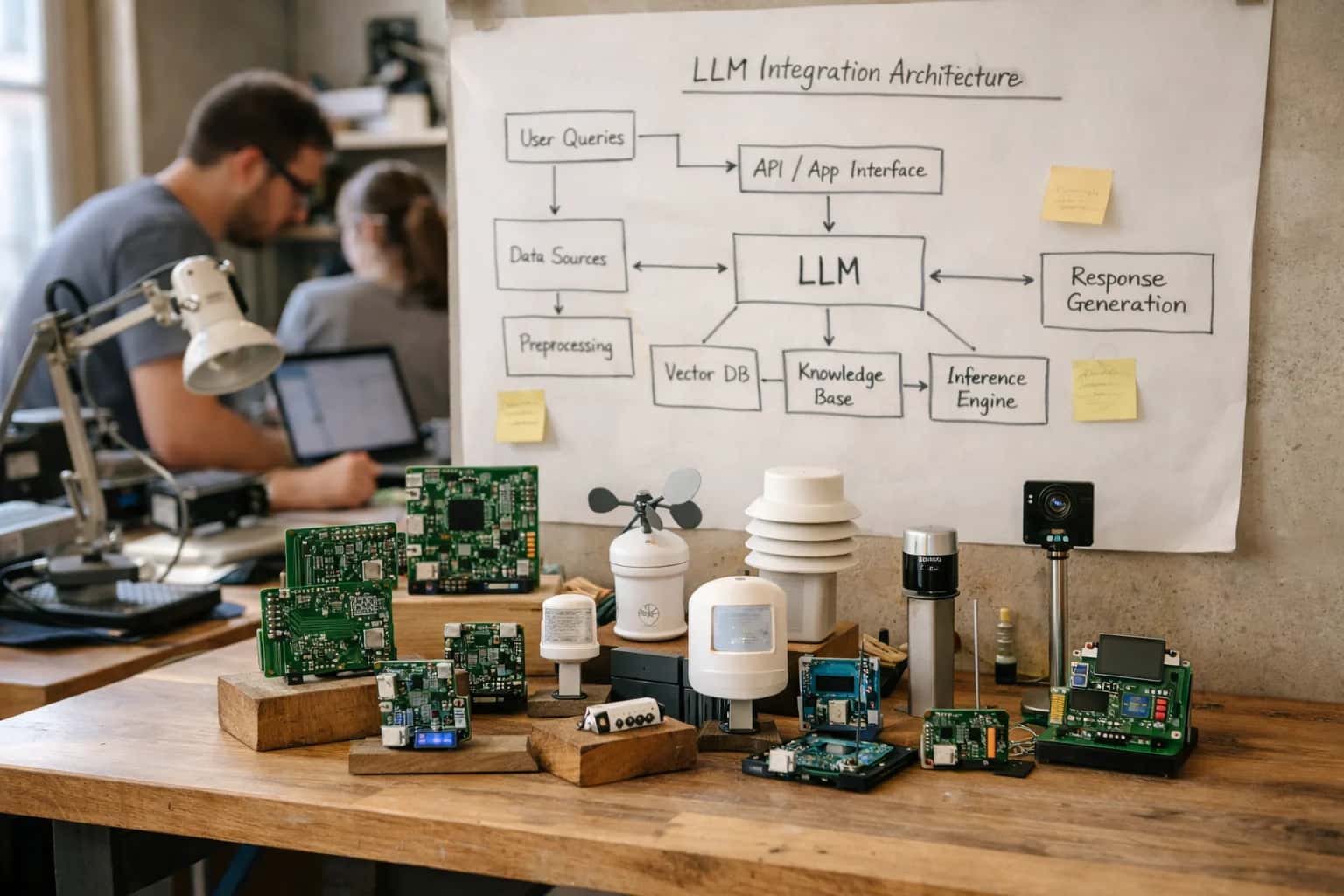
FROM DEVELOPMENT TO PRODUCTION OPS
Where AI Fits: Bridging LLM Experiments to Production Serving
Connecting Weights & Biases to self-hosted LLM serving stacks for unified observability from experiment to inference.
Implementation involves instrumenting your model servers to emit metrics to W&B via its logging SDK or Prometheus integration. Key data points include per-request latency, error rates, GPU memory usage, and batch size efficiency. By tagging these metrics with the model_version and experiment_run_id from the W&B Model Registry, you can correlate production performance degradation with specific code commits, data shifts, or hardware changes. This allows MLOps engineers to answer critical questions: Did the new fine-tuned Llama 3 model increase p99 latency? Is the observed throughput drop related to the updated quantization config?
Governance and rollout benefit from this traceability. Canary deployments can be monitored by comparing the performance of new model versions against the baseline directly within W&B dashboards. Automated alerts can be configured to trigger if key serving SLOs are breached, prompting a rollback to a previous model version in the registry. Furthermore, this linkage is essential for audit trails in regulated industries, providing evidence that the model in production is the approved version, with its behavior monitored against established benchmarks.
MONITORING SELF-HOSTED LLM SERVERS
Key Integration Surfaces in Weights & Biases Model Serving
Direct Inference Engine Telemetry
Integrating W&B with self-hosted LLM servers like vLLM and Text Generation Inference (TGI) provides foundational observability into serving infrastructure. Key metrics to capture include:
- GPU Utilization & Memory: Track VRAM usage per model to prevent out-of-memory errors and optimize batch sizing.
- Request Throughput & Latency: Monitor tokens-per-second and end-to-end latency (p50, p95, p99) to ensure performance SLAs are met.
- Queue Depth & Errors: Observe request backlog and failure rates (e.g., timeout, validation errors) to identify scaling needs.
This telemetry is typically collected via the serving engine's Prometheus endpoints or custom logging hooks, then streamed to W&B using its logging SDK. Linking these real-time metrics back to the original experiment run in W&B creates a closed feedback loop, showing how model architecture and training decisions impact production resource consumption.
PRODUCTION LLM OBSERVABILITY
High-Value Use Cases for W&B Model Serving Integration
Connect Weights & Biases to your self-hosted LLM endpoints (vLLM, TGI) to monitor performance, resource utilization, and business impact, creating a closed-loop system between model development and live operations.
01
Real-Time Performance & Cost Monitoring
Stream inference logs (latency, token usage, errors) from vLLM/TGI endpoints directly into W&B dashboards. Track p95 latency SLOs and correlate token consumption with cloud spend, enabling FinOps for AI. Set alerts for performance degradation or cost spikes.
Batch -> Real-time
Monitoring granularity
02
Drift Detection & Automated Retraining Triggers
Use W&B to monitor embedding drift and output distribution shifts in production RAG pipelines. Link drift alerts from the serving layer back to the original experiment and dataset version in the W&B registry, automatically triggering evaluation jobs or scheduling retraining pipelines.
Proactive
Model decay detection
03
Canary Analysis & Safe Model Rollouts
Implement canary deployments for new LLM model versions or fine-tunes. Use W&B to A/B test production traffic, comparing key metrics (user feedback scores, business KPIs) between the baseline and canary. Statistically validate improvements before full rollout.
1 sprint
Validation cycle
04
Unified Lineage from Inference to Experiment
Trace a problematic production prediction back to its source. W&B serving integrations link each inference to the exact model version, prompt template, and hyperparameters used, stored in the W&B Model Registry. Crucial for debugging and regulatory audits.
Minutes
Root cause analysis
05
GPU Utilization & Infrastructure Optimization
Monitor GPU memory, utilization, and queue lengths from your model servers. Visualize trends in W&B to rightsize instance types, plan for scaling events, and identify inefficient batching configurations, reducing cloud costs while maintaining SLA.
Hours -> Minutes
Capacity planning
06
Business KPI Correlation for AI Product Owners
Go beyond technical metrics. Ingest business events (e.g., support ticket closure, lead conversion) and correlate them with LLM usage data in W&B. Build dashboards that show how model performance impacts operational outcomes like deflection rate or sales cycle time.
Actionable
Business intelligence
FOR WEIGHTS & BIASES MODEL SERVING
Example Monitoring and Alerting Workflows
For teams running self-hosted LLM inference (vLLM, TGI), integrating with Weights & Biases transforms raw serving metrics into actionable intelligence. These workflows connect real-time performance to the original experiment lineage, enabling proactive operations.
Trigger: W&B alerts on a p95 latency SLO breach for a specific model variant in production.
Context Pulled:
- The alert includes the model name, version tag (e.g.,
llama-3-70b-instruct:prod-v2), and serving endpoint. - The system automatically queries the W&B Model Registry for the lineage of the offending model version.
- It retrieves the previous stable model version (
prod-v1) and its associated performance baseline from past experiment runs.
Agent Action:
- An orchestration agent analyzes the latency spike, checking for correlated metrics like GPU memory utilization, queue depth, and error rates from the serving infrastructure.
- It executes a diagnostic query against the W&B experiment linked to
prod-v2, comparing its evaluation metrics (e.g., accuracy on a holdout set) toprod-v1to rule out a quality regression as the cause.
System Update:
- If infrastructure issues are confirmed (e.g., GPU throttling), the agent creates a ticket in the team's incident management system (e.g., Jira, PagerDuty).
- If the model itself is suspect, and
prod-v1's metrics are stable, the agent triggers an automated CI/CD pipeline to update the serving configuration's model tag, rolling back toprod-v1.
Human Review Point: A summary of the incident, diagnostic data, and the rollback action is posted to a dedicated Slack channel for the MLOps team's review.
MONITORING SELF-HOSTED LLM SERVERS
Implementation Architecture: Data Flow and Components
A production-ready architecture for linking Weights & Biases (W&B) to vLLM or TGI inference endpoints, creating a unified lineage from model experiments to serving performance.
The core integration connects your self-hosted LLM serving layer (e.g., vLLM, Text Generation Inference) to W&B's experiment tracking and model registry. This is achieved by instrumenting your inference API with the wandb SDK or OpenTelemetry exporters. For each request, you log key serving metrics—such as generation latency (p50, p95), GPU memory utilization, tokens-per-second, and request queue depth—as a W&B run. This run is linked to the specific model version in the W&B Model Registry, creating a closed-loop where production performance is traceable back to the original training experiment, hyperparameters, and evaluation dataset.
A typical deployment involves three components: 1) An instrumented inference server that emits metrics to W&B via background threads or async callbacks, 2) A W&B Model Registry entry that stores the model artifact (e.g., Hugging Face repo, S3 path) and is tagged with the deployment environment (dev/staging/prod), and 3) Custom W&B dashboards that aggregate serving metrics across model versions and hardware profiles. This setup allows MLOps teams to answer critical questions: Is the newly promoted llama-3-70b-instruct fine-tune performing within latency SLAs on our A100 clusters? Has GPU memory usage drifted since the last model version, indicating a potential quantization issue?
Rollout and governance require embedding this telemetry into your existing CI/CD and serving infrastructure. We recommend integrating the W&B logging calls into your model server's health check and readiness probes, and setting up W&B alerts for metric thresholds (e.g., latency > 2s, error rate > 1%). For audit trails, ensure each inference log includes a model_registry_id and inference_id that can be cross-referenced with your API gateway logs. This architecture not only provides operational visibility but also feeds performance data back into the model development cycle, informing decisions about future fine-tuning, hardware provisioning, and model optimization efforts like quantization or distillation.
MONITORING SELF-HOSTED LLM SERVERS
Code and Configuration Examples
Integrating vLLM with W&B Prometheus
To monitor a vLLM inference server, you first expose its Prometheus metrics endpoint. Configure W&B to scrape these metrics, linking them to the specific model version in the W&B Model Registry.
Key Metrics to Track:
vllm:request_latency_seconds:p99vllm:gpu_utilization_percentvllm:request_success_totalvllm:num_requests_executing
Example vLLM Launch Command:
bashpython -m vllm.entrypoints.openai.api_server \ --model meta-llama/Llama-3.1-8B-Instruct \ --served-model-name llama-3.1-8b \ --port 8000 \ --enable-metrics \ --metric-interval 10
This exposes metrics at http://localhost:8000/metrics. Use the W&B Prometheus integration to create dashboards that correlate high GPU utilization with increased P99 latency, providing ops teams with actionable alerts for scaling decisions.
MONITORING SELF-HOSTED LLM SERVERS
Operational Impact: Time Saved and Risks Mitigated
This table illustrates the operational impact of integrating Weights & Biases monitoring with self-hosted LLM inference servers like vLLM or TGI, shifting from reactive troubleshooting to proactive, data-driven management.
| Metric | Before AI | After AI | Notes |
|---|---|---|---|
Model Performance Issue Detection | Days to weeks via user complaints | Hours via automated drift & anomaly alerts | Proactive detection of accuracy decay or latency spikes before users are impacted. |
Root Cause Analysis for Degradation | Manual log correlation across systems | Linked traces from serving layer back to experiment & model version | W&B lineage connects production issues to specific model versions, prompts, or data slices. |
Resource Utilization & Cost Visibility | Monthly cloud bill review; manual instance monitoring | Real-time GPU/CPU metrics & token cost tracking per model | Enables rightsizing of inference clusters and forecasting for scaling decisions. |
Model Version Rollout Confidence | Manual testing in staging; limited production comparison | A/B test performance & business metrics in W&B dashboard | Statistical validation of new model versions against baselines before full rollout. |
Compliance & Audit Trail Creation | Manual spreadsheet for model change logs | Automated lineage from training data to production inference | Immutable record for regulatory inquiries (e.g., which model version made a specific decision). |
Team Collaboration on Incidents | War rooms with fragmented data from different tools | Shared W&B reports with unified metrics, charts, and discussion threads | Context for on-call engineers and post-mortems, reducing mean time to resolution (MTTR). |
Scheduled Model Health Reviews | Ad-hoc, often skipped due to time constraints | Automated weekly reports & executive dashboards | Ensures continuous oversight of model SLAs and business impact without manual effort. |
PRODUCTION-READY MODEL SERVING
Governance, Security, and Phased Rollout
Integrating Weights & Biases with self-hosted LLM serving stacks requires a deliberate approach to security, access control, and staged deployment.
A production integration starts by securing the data flow between your model servers (vLLM, TGI) and the W&B backend. This involves configuring service accounts with least-privilege access, encrypting metrics and trace data in transit, and ensuring no sensitive prompt or completion data is logged unless explicitly intended for debugging. W&B projects should be structured to mirror your environments—dev, staging, production—with strict RBAC to control who can view serving metrics, alter alert thresholds, or promote model versions from the registry. For air-gapped or high-security deployments, we architect integrations with W&B's on-premise or private cloud offerings.
A phased rollout is critical for managing risk. Start by instrumenting a single, non-critical endpoint in a development environment, validating that GPU utilization, request latency, and error rates are correctly captured in W&B's dashboards. Next, progress to a canary deployment in staging, where you can correlate W&B's performance metrics with synthetic load tests and business logic validation. Finally, roll out to production using a blue-green or gradual traffic shift, with W&B alerts configured to trigger rollback if key SLOs—like p95 latency or error rate—are breached. This process turns W&B from a passive observability tool into an active deployment gatekeeper.
Long-term governance means treating the W&B integration as a source of truth for model operations. Link every production inference back to the exact model version, experiment run, and prompt template in W&B's lineage graph. Implement approval workflows in your CI/CD pipeline that require a W&B model registry stage change (e.g., from staging to production) and a passing review of key metrics before deployment. For ongoing compliance, use W&B's reporting features to generate audit trails showing model performance, drift detection alerts, and resource cost attribution over time, essential for frameworks like NIST AI RMF or internal AI review boards. This closed-loop integration ensures your LLM serving infrastructure is as governable and reliable as any other enterprise software component.
Enabling Efficiency, Speed & Accuracy
Intelligent Analysis, Decision & Execution
We build AI systems for teams that need search across company data, workflow automation across tools, or AI features inside products and internal software.
Talk to Us
Search across company data
Give teams answers from docs, tickets, runbooks, and product data with sources and permissions.
Useful when people spend too long searching or get different answers from different systems.
Enterprise searchRAGPermissions
Read more
Automate internal workflows
Use AI to route work, draft outputs, trigger actions, and keep approvals and logs in place.
Useful when repetitive work moves across multiple tools and teams.
AI agentsWorkflow automationGovernance
Read more
Add AI to products and internal tools
Build assistants, guided actions, or decision support into the software your team or customers already use.
Useful when AI needs to be part of the product, not a separate tool.
AI integrationDecision supportModel routing
Read moreIMPLEMENTATION WORKFLOWS
Frequently Asked Questions
Common integration patterns for monitoring self-hosted LLM serving endpoints (vLLM, TGI) with Weights & Biases to link production performance back to the original experiment and model lineage.
You integrate W&B's logging SDK directly into your inference service or a sidecar monitoring agent.
Typical Implementation Steps:
- Add W&B SDK: Install
wandbin your serving container or environment. - Initialize Run: Initialize a W&B run at server startup, often as a
servicetype run, linking it to the source model artifact from the W&B Model Registry. - Log Key Metrics: Instrument your
/generateendpoint handler to log:- Performance: Per-request latency (time to first token, total generation time), tokens-per-second.
- Resource Utilization: GPU memory usage, GPU utilization %, request queue depth.
- Request Metadata: Input/output token counts, model name/version.
- Example Logging Snippet:
python
import wandb import time # Initialize (often done at server start) wandb.init(project="llm-production-monitoring", job_type="inference", config={"model_name": "meta-llama/Llama-3-8B-Instruct", "serving_engine": "vLLM"}) # Inside your request handler start_time = time.time() output = llm.generate(prompt) generation_time = time.time() - start_time wandb.log({ "generation_latency_seconds": generation_time, "total_tokens": output.total_tokens, "tokens_per_second": output.total_tokens / generation_time }) - Run Continuously: The W&B run persists, logging metrics over time to create a live dashboard of server health.

About the author
Prasad Kumkar
CEO & MD, Inference Systems
Prasad Kumkar is the CEO & MD of Inference Systems and writes about AI systems architecture, LLM infrastructure, model serving, evaluation, and production deployment. Over 5+ years, he has worked across computer vision models, L5 autonomous vehicle systems, and LLM research, with a focus on taking complex AI ideas into real-world engineering systems.
His work and writing cover AI systems, large language models, AI agents, multimodal systems, autonomous systems, inference optimization, RAG, evaluation, and production AI engineering.
LinkedIn
Limited slotsGet a Free AI Consultation
Partnered with leading AI, data, and software stack.





How We Work
Custom AI workflows for your Business
One-fit-all AI don't work for modern businesses. At Inferensys, we aim to understand your business & custom requirements; which we use to define most efficient agentic workflows, the data, and the tools for your business.
01
Review the use case
We understand the task, the users, and where AI can actually help.
Read more02
Pick the right approach
We define what needs search, automation, or product integration.
Read more03
Build the first useful version
We implement the part that proves the value first.
Read more04
Improve from there
We add the checks and visibility needed to keep it useful.
Read moreThe first call is a practical review of your use case and the right next step.
Talk to Us