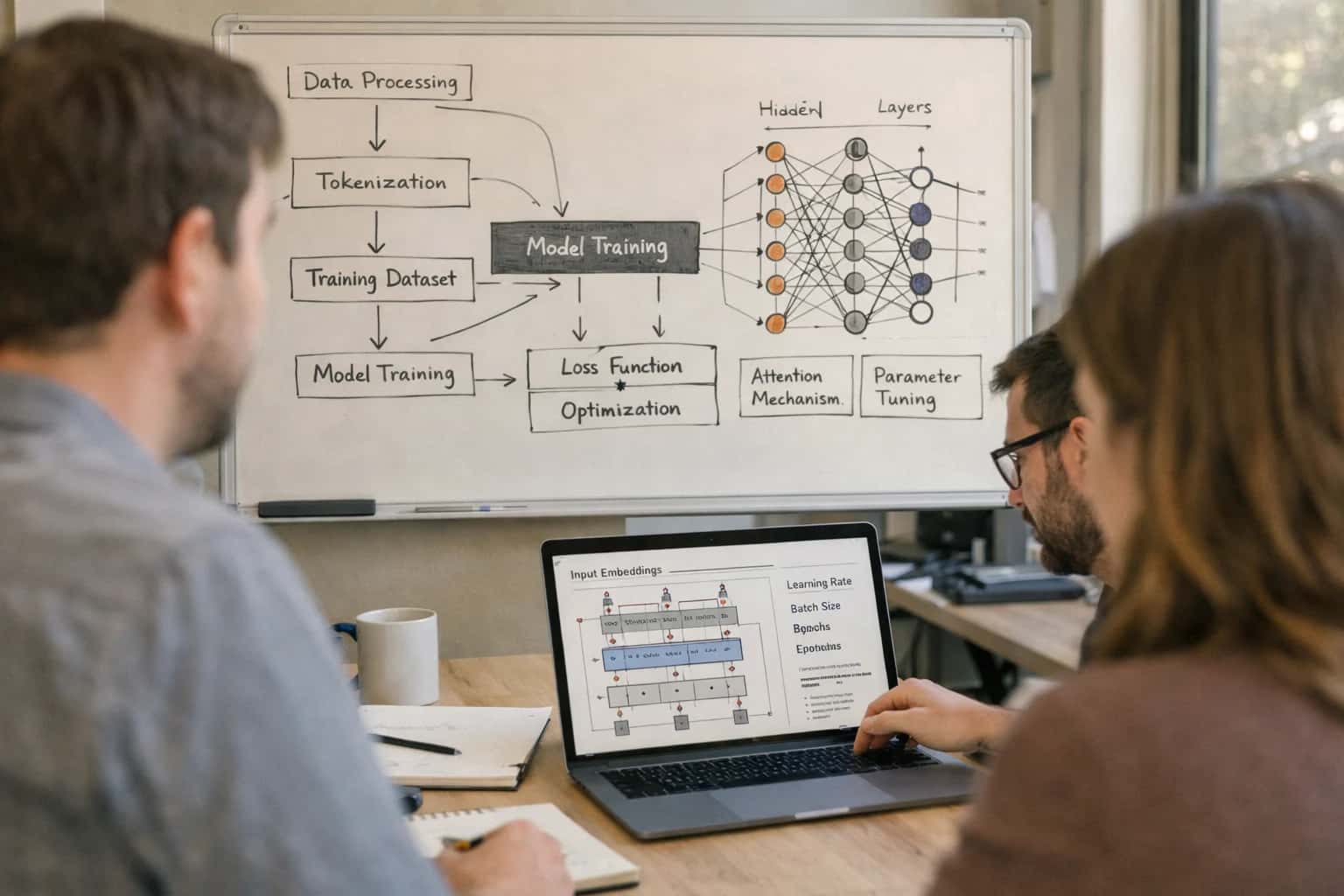
In a typical LLM stack, the W&B API acts as the central logging and coordination layer. Your LangChain applications, custom inference endpoints, and fine-tuning pipelines all send telemetry—prompts, completions, latencies, token usage, and custom metrics—to W&B via its public API. This creates a unified experiment timeline and model registry, separate from your application's business logic but critical for its governance.

Integration
AI Integration with Weights and Biases API Integrations
Build custom integrations between Weights & Biases and your internal platforms to automate LLM experiment tracking, model governance, and deployment workflows.
ARCHITECTURE
Where W&B API Integrations Fit in Your LLM Stack
Weights & Biases (W&B) is the connective tissue between your LLM development environment and the production systems that need governed, observable AI.
For production integrations, this means instrumenting key surfaces: your RAG retrieval functions log chunk relevance scores; your agent tool-calling loops record each step and its cost; your A/B testing framework pushes variant performance to W&B for statistical comparison. The API also enables two-way integration: your CI/CD pipeline can query the W&B Model Registry to promote a model version, and your monitoring dashboard can pull real-time metrics to alert on drift. This turns W&B from a data science notebook tool into the system of record for your LLM operations.
Rollout requires a phased approach. Start by integrating W&B logging into a single, high-value LLM workflow (e.g., a customer support summarization agent). Use the API to capture a baseline of performance and cost. Next, integrate the W&B webhooks to notify your alerting system (like PagerDuty) when a new model experiment is ready for staging review. Finally, build automation that uses the W&B SDK to enforce promotion gates, ensuring a model's accuracy and fairness metrics pass thresholds before it's deployed. This layered integration ensures every LLM decision in production is traceable back to the experiment that created it.
BUILDING GOVERNED LLM PIPELINES
Key W&B API Surfaces for Custom Integration
Core Logging for LLM Development
The W&B Run API (wandb.init(), wandb.log()) is the primary surface for instrumenting LLM development workflows. Integrate it directly into your fine-tuning scripts, prompt engineering loops, and RAG pipeline evaluations to capture a complete lineage.
Key Integration Points:
- Log Hyperparameters & Configs: Track model names (e.g.,
meta-llama/Llama-3-8B-Instruct), LoRA settings, and prompt template versions. - Stream Metrics: Log per-iteration training loss, validation accuracy, and custom scores like retrieval hit rate.
- Capture Artifacts: Version training datasets, fine-tuned adapter weights, and vector store indexes as W&B Artifacts, linking them to the run.
- Log Prompts & Completions: Sample and log input-output pairs for qualitative analysis, tagging them with metadata like
costandlatency.
This creates a searchable, reproducible record for every experiment, essential for debugging and audit trails.
W&B API INTEGRATIONS
High-Value Integration Use Cases
Connect Weights & Biases to your internal platforms and CI/CD pipelines to automate governance, enhance collaboration, and streamline the LLM lifecycle from experiment to production.
01
CI/CD Pipeline Integration
Embed W&B logging into your CI/CD runners (GitHub Actions, Jenkins, GitLab CI) to automatically track experiments, log metrics, and register model versions triggered by code commits or pull requests. This creates a direct lineage from git hash to model artifact, enabling reproducible builds and automated promotion gates.
Batch -> Automated
Deployment workflow
02
Internal Model Hub Synchronization
Use the W&B Model Registry API as the source of truth for approved LLM models. Automatically sync registered models (Staging/Production aliases) to internal model hubs or serving platforms (SageMaker, vLLM clusters). This enforces a formal promotion workflow and ensures serving infrastructure always uses the correct, governed model version.
1 sprint
Eliminates manual sync
03
Feature Store Logging for LLM Fine-Tuning
Stream feature vectors and training datasets from your feature store (Feast, Tecton) to W&B as Artifacts. This links fine-tuned LLM performance directly to the exact data snapshot used for training, providing critical lineage for debugging model drift or compliance audits.
Complete Lineage
Data to model
04
Custom Dashboards for Cross-Functional Teams
Leverage the W&B API to build custom, role-based dashboards that pull experiment data, production metrics, and cost reports. Provide engineers, product managers, and compliance officers with tailored views without requiring direct W&B access, centralizing visibility.
Same day
Stakeholder reporting
05
Automated Governance Evidence Collection
Integrate W&B with governance platforms like Credo AI via API. Automatically export experiment parameters, model cards, and evaluation results as audit trail evidence for risk assessments and regulatory reporting, turning MLOps activity into compliance artifacts.
Hours -> Minutes
Evidence gathering
06
Cost Attribution and FinOps Reporting
Poll the W&B API to aggregate LLM training and inference costs (GPU hours, API token usage) across projects and teams. Feed this data into internal chargeback systems or FinOps dashboards to attribute cloud spend and manage budgets for AI initiatives.
Per-team visibility
Spend tracking
W&B API AND WEBHOOK AUTOMATIONS
Example Integration Workflows
Practical workflows that connect Weights & Biases to your internal systems, enabling automated governance, observability, and operational control for LLM development and deployment.
Trigger: A new model run is logged to W&B with specific performance metrics exceeding a defined threshold.
Workflow:
- A CI/CD pipeline (e.g., GitHub Actions, Jenkins) completes a model training or evaluation job, logging results to a W&B run.
- A custom script uses the
wandbSDK to query the run, checking metrics like evaluation loss, accuracy, or a custom business score against promotion criteria defined in a config file. - If criteria are met, the script calls the W&B Public API to register the model artifact in the W&B Model Registry, tagging it with an alias like
staging-candidate. - The script then triggers a deployment pipeline (e.g., to SageMaker or a Kubernetes cluster), passing the model artifact URI from the registry.
- A webhook from the deployment system posts back to a W&B Artifact, updating its metadata with the deployment environment and status, creating a complete lineage from experiment to production.
Human Review Point: The promotion criteria can include a manual approval gate. The script can create a ticket in Jira or post to a Slack channel for a lead data scientist to approve before the API call to register the model is executed.
CONNECTING W&B TO YOUR INTERNAL PLATFORMS
Implementation Architecture: Data Flow and Components
A practical blueprint for integrating Weights & Biases APIs into your internal development and deployment systems.
A production integration with Weights & Biases (W&B) typically involves three core data flows: experiment logging, model registry events, and webhook-driven automation. Your internal CI/CD pipeline (e.g., GitHub Actions, Jenkins) or custom training platform becomes the source, instrumented with the wandb SDK to log prompts, completions, metrics, and artifacts. This data flows to W&B's cloud or on-prem instance. Concurrently, your internal model hub or feature store can be configured to push metadata to W&B via its public REST API, creating a unified lineage record that links internal assets (datasets, model binaries) to W&B experiments.
The reverse flow is triggered by key events in the W&B lifecycle. Using W&B's webhook system, you can listen for events like run.finished, artifact.created, or model.version.created. These events, containing rich payloads, can be sent to an internal API gateway or message queue (e.g., Kafka, AWS EventBridge). This enables automated downstream actions such as: triggering a model validation job in your CI/CD, updating a status dashboard, promoting a model version to a staging environment, or creating a ticket in Jira for a compliance review when a new model is registered.
Governance and rollout require careful planning of authentication and RBAC. Use W&B's Service Accounts with scoped API keys for system-to-system communication, and map internal team structures to W&B Projects and Teams for access control. For a phased rollout, start by integrating a single high-value workflow—like fine-tuning an embedding model—to establish the pattern. Use the integration to create a closed-loop system: track experiments in W&B, register the best model, automate its deployment via webhooks, and then feed its production performance metrics from your monitoring stack back into W&B as a new experiment run for continuous analysis.
INTEGRATING W&B WITH INTERNAL SYSTEMS
Code and Payload Examples
Automating LLM Experiment Tracking in CI/CD
Integrate W&B's Python SDK into your CI/CD pipelines (e.g., GitHub Actions, Jenkins) to automatically log fine-tuning jobs, prompt evaluations, and RAG pipeline tests. This creates a searchable history linking code commits to model performance, enabling rollback and audit trails.
Example: GitHub Actions Step for Fine-Tuning Log
yaml- name: Run and Log Fine-Tuning Job env: WANDB_API_KEY: ${{ secrets.WANDB_API_KEY }} run: | python scripts/fine_tune_llm.py \ --model "meta-llama/Llama-3.2-3B-Instruct" \ --dataset "data/training_v2.jsonl" \ --wandb_project "llm-finetuning-prod" \ --wandb_run_name "${{ github.sha }}-${{ github.run_id }}"
This pattern ensures every pipeline execution is captured in W&B with a unique run name derived from the Git SHA and workflow ID, providing full lineage from code change to model artifact.
LLM DEVELOPMENT AND DEPLOYMENT
Operational Impact: Before and After W&B API Integration
This table contrasts the manual, fragmented workflows typical of LLM development with the streamlined, governed operations enabled by integrating Weights & Biases APIs into internal platforms and CI/CD pipelines.
| Metric | Before AI Integration | After W&B API Integration | Notes |
|---|---|---|---|
Experiment Tracking | Scattered local logs, spreadsheets, or ad-hoc scripts | Centralized, versioned runs with automatic logging via API | Enables reproducible research and team collaboration |
Model Promotion to Production | Manual validation, email threads, and error-prone artifact transfers | Automated CI/CD gates using Model Registry API for staged promotions | Links production models directly to experiment lineage and validation results |
Cost Attribution & FinOps | Monthly invoice surprises; manual aggregation of API usage | Project- and team-level cost tracking via integrated SDK logging | Provides granular visibility for budget management and optimization |
Production Model Monitoring | Reactive; reliant on application logs and user complaints | Proactive drift & performance alerts via integrated webhooks to monitoring dashboards | Webhooks can trigger retraining pipelines or page on-call engineers |
Compliance & Audit Readiness | Manual evidence collection for model cards and risk assessments | Automated lineage and artifact storage via Artifacts API for audit trails | Traces prediction to exact training data, code, and prompt version |
Cross-Functional Review | Static slide decks and fragmented status updates | Dynamic, shared W&B Reports & Dashboards embedded in internal wikis | Real-time visibility for data science, engineering, product, and compliance teams |
Hyperparameter Optimization | Manual, sequential runs or custom scripting | Automated sweeps orchestrated via Sweeps API across cloud GPU clusters | Systematically explores trade-offs between accuracy, latency, and cost |
PRODUCTION-READY INTEGRATION
Governance, Security, and Phased Rollout
A practical approach to integrating Weights & Biases with your internal platforms, ensuring secure, governed, and scalable LLM operations.
Integrating the Weights & Biases API into your internal stack requires a clear governance model from day one. This means mapping W&B's core entities—Projects, Runs, Models, and Artifacts—to your internal access controls and data policies. For instance, you can use W&B's API to programmatically enforce that experiments logging sensitive customer data are tagged, stored in a private project with strict RBAC, and linked to a specific, approved model registry entry. Webhooks can be configured to notify your security information and event management (SIEM) platform when a new production model is registered, triggering an automated compliance review in a system like ServiceNow or Jira.
A phased rollout is critical for managing risk and building team adoption. Start with a pilot phase, integrating W&B's logging SDK into a single, non-critical LLM development pipeline—like a RAG prototype for internal documentation. Use the API to pull experiment data into a dedicated dashboard for the pilot team. In the expansion phase, integrate W&B with your CI/CD system (e.g., GitHub Actions, GitLab CI) to automatically create runs for every commit, and with your internal model hub to promote models only if they have a 'staging' alias in the W&B Model Registry. Finally, the production phase involves full integration with deployment platforms (SageMaker, Kubernetes) where the API is used to fetch the exact model artifact and prompt version approved for launch, creating an immutable audit trail from code commit to live inference.
Security is not an afterthought. All interactions with the W&B API should use service accounts with scoped permissions, and API keys must be managed through a secrets manager (e.g., HashiCorp Vault, AWS Secrets Manager). For air-gapped or highly regulated environments, consider a proxy layer that caches W&B artifacts internally and audits all outbound requests. This layered approach ensures your LLM development gains W&B's powerful observability without compromising on enterprise security or operational control. For related patterns on governing the entire LLM lifecycle, see our guides on AI Integration with Credo AI for Controlled AI Operations and AI Integration for LangChain Tracing and Evaluation.
Enabling Efficiency, Speed & Accuracy
Intelligent Analysis, Decision & Execution
We build AI systems for teams that need search across company data, workflow automation across tools, or AI features inside products and internal software.
Talk to Us
Search across company data
Give teams answers from docs, tickets, runbooks, and product data with sources and permissions.
Useful when people spend too long searching or get different answers from different systems.
Enterprise searchRAGPermissions
Read more
Automate internal workflows
Use AI to route work, draft outputs, trigger actions, and keep approvals and logs in place.
Useful when repetitive work moves across multiple tools and teams.
AI agentsWorkflow automationGovernance
Read more
Add AI to products and internal tools
Build assistants, guided actions, or decision support into the software your team or customers already use.
Useful when AI needs to be part of the product, not a separate tool.
AI integrationDecision supportModel routing
Read moreW&B API INTEGRATION
Frequently Asked Questions
Practical questions for engineering and MLOps teams building custom integrations between Weights & Biases and internal platforms to govern LLM development and deployment.
Integrating W&B into your CI/CD pipeline (e.g., GitHub Actions, Jenkins, GitLab CI) involves using the W&B SDK to automatically log experiments from your training jobs.
Typical workflow:
- Trigger: A merge to your
mainbranch or a scheduled job kicks off a pipeline that runs a fine-tuning script (e.g., using Hugging Face Transformers or OpenAI's fine-tuning API). - Authentication: The pipeline injects a
WANDB_API_KEYas a secret into the job environment. - Logging: Your training script initializes a W&B run using
wandb.init(), specifying the project name and config parameters (model, dataset version, hyperparameters). - Artifact Storage: Key outputs like the final model weights, tokenizer, and evaluation results are logged as W&B Artifacts using
wandb.log_artifact(). - Registry Promotion: Upon successful validation, the pipeline can use the W&B Public API to programmatically promote the resulting model artifact to the
StagingorProductionstage in the W&B Model Registry.
Example CI/CD Step Snippet:
yaml# GitHub Actions Example - name: Fine-tune LLM and Log to W&B env: WANDB_API_KEY: ${{ secrets.WANDB_API_KEY }} run: | python scripts/fine_tune_llm.py \ --model "meta-llama/Llama-3.1-8B" \ --dataset-version "dataset:v2" \ --wandb-project "llm-fine-tuning-prod"
This creates a complete, auditable lineage from code commit to trained model artifact.

About the author
Prasad Kumkar
CEO & MD, Inference Systems
Prasad Kumkar is the CEO & MD of Inference Systems and writes about AI systems architecture, LLM infrastructure, model serving, evaluation, and production deployment. Over 5+ years, he has worked across computer vision models, L5 autonomous vehicle systems, and LLM research, with a focus on taking complex AI ideas into real-world engineering systems.
His work and writing cover AI systems, large language models, AI agents, multimodal systems, autonomous systems, inference optimization, RAG, evaluation, and production AI engineering.
LinkedIn
Limited slotsGet a Free AI Consultation
Partnered with leading AI, data, and software stack.





How We Work
Custom AI workflows for your Business
One-fit-all AI don't work for modern businesses. At Inferensys, we aim to understand your business & custom requirements; which we use to define most efficient agentic workflows, the data, and the tools for your business.
01
Review the use case
We understand the task, the users, and where AI can actually help.
Read more02
Pick the right approach
We define what needs search, automation, or product integration.
Read more03
Build the first useful version
We implement the part that proves the value first.
Read more04
Improve from there
We add the checks and visibility needed to keep it useful.
Read moreThe first call is a practical review of your use case and the right next step.
Talk to Us