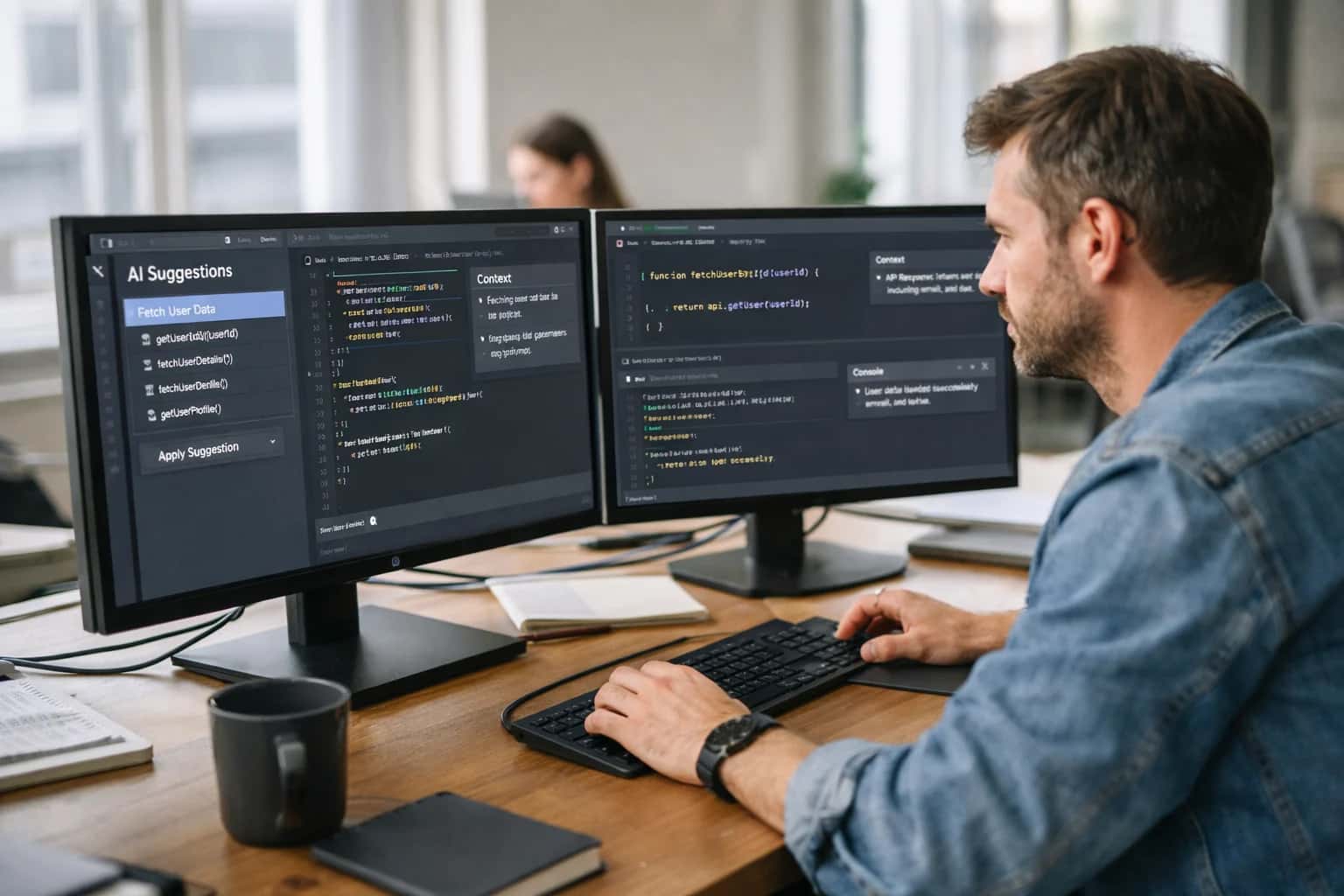
GitHub Copilot connects to the core surfaces of UiPath Studio where custom code is required: within C# or VB.NET code activities for complex business logic, Invoke Method activities for .NET library calls, and custom activity development projects for reusable components. The integration provides context-aware suggestions for UiPath-specific objects like UiPath.Core.Activities, UiPath.UIAutomation.Activities, and the UiPath.WebAPI client, reducing the time spent looking up SDK documentation or writing boilerplate code for error handling, retry logic, and logging.

Integration
AI Integration for GitHub Copilot in UiPath
Connect GitHub Copilot to UiPath Studio to accelerate RPA development with AI-generated code for custom activities, C# scripts, and integration logic. Reduce development time for complex automations.
ARCHITECTING AI-ASSISTED AUTOMATION
Where AI Fits in UiPath Development
Integrating GitHub Copilot into UiPath development workflows accelerates the creation of custom activities, C# scripts, and integration logic, shifting automation development from manual coding to AI-assisted design.
High-impact use cases include generating scripts for data transformation between automation steps, writing API client code to call external services (including other AI models), and creating custom validation logic for attended automation. For example, Copilot can suggest the C# code to parse a complex JSON response from a web service and map it to a UiPath DataTable, or write the logic to handle exceptions in a Try Catch activity. This shifts development from hours of manual scripting to minutes of guided code completion, especially for developers less familiar with .NET or the UiPath SDK.
A production implementation typically wires Copilot into the developer's local Visual Studio or VS Code environment used for custom activity projects, while also providing a shared prompt library for common UiPath patterns. Governance focuses on code review checkpoints for AI-generated scripts, particularly for automations handling sensitive data or financial transactions, and maintaining a library of approved code snippets in a shared Component Orchestrator or Git repository. Rollout starts with a pilot group building non-critical automations, establishing patterns for using Copilot to generate test cases within UiPath.Testing activities and documentation comments that align with RPA governance standards.
CONNECTING GITHUB COPILOT TO AUTOMATION DEVELOPMENT
UiPath Development Surfaces for AI Integration
Accelerating Custom .NET Activity Creation
GitHub Copilot integrates directly into the Visual Studio environment used for building UiPath custom activities. When developers create new C# classes that inherit from CodeActivity or NativeActivity, Copilot suggests boilerplate code for argument definitions, Execute method overrides, and proper error handling patterns.
Key Integration Points:
- Code Generation for Activity Properties: Copilot can auto-generate the
InArgument<T>andOutArgument<T>property definitions based on the activity's intended purpose. - InvokeMethod Workflows: For activities that call external APIs or services, Copilot suggests the HttpClient initialization, async/await patterns, and JSON serialization code required for robust integration logic.
- Validation and Logging: It prompts the addition of
ValidationHelperchecks andLogMessagecalls to align with UiPath best practices for debugging and runtime visibility.
This surface reduces the time to scaffold and test new reusable automation components from hours to minutes.
AI-ENHANCED AUTOMATION DEVELOPMENT
High-Value Use Cases for Copilot in UiPath
Integrating GitHub Copilot into UiPath development workflows transforms how automation engineers build, debug, and maintain robots. By providing context-aware code suggestions within UiPath Studio, Copilot accelerates the creation of custom activities, complex C# scripts, and integration logic, turning hours of manual coding into minutes of assisted development.
01
Custom Activity Development
Generate boilerplate and logic for .NET Class Library projects that define reusable UiPath activities. Copilot suggests code for input/output arguments, validation, logging, and error handling, ensuring new activities integrate seamlessly with the UiPath design surface and execution engine.
1 sprint -> 2 days
Development time
02
C# Scripting within Workflows
Accelerate the creation of Invoke Code activities and VB Expression conversions. Copilot provides real-time suggestions for data manipulation, API calls using HttpClient, JSON/XML parsing with Newtonsoft.Json, and exception handling, directly within the UiPath Studio script editor.
Hours -> Minutes
Script writing
03
Orchestrator API Integration Logic
Write code to interact with the UiPath Orchestrator REST API for managing queues, jobs, assets, and robots. Copilot helps generate authentication headers (Bearer token handling), construct request payloads, and parse responses to build robust, self-healing automation workflows.
Batch -> Real-time
Orchestration
04
Exception Handling & Retry Frameworks
Design sophisticated try-catch blocks and retry mechanisms for unreliable systems. Copilot suggests patterns for logging to Orchestrator, implementing exponential backoff, and creating custom exception types to improve robot resilience and auditability.
05
Data Table & Excel Automation
Generate efficient LINQ queries and DataTable transformations for processing Excel files or database results. Copilot assists with filtering, sorting, grouping, and joining operations, reducing manual loop construction and speeding up data-heavy RPA processes.
Same day
Data workflow build
06
AI Center & LLM Integration Scripts
Build the glue code that connects UiPath robots to AI Center ML skills or external LLM APIs like OpenAI. Copilot helps craft HTTP requests, format prompts, parse structured outputs (JSON), and handle fallback logic for AI-enhanced document processing and decisioning.
Hours -> Minutes
Integration wiring
INTEGRATING GITHUB COPILOT WITH UIPATH STUDIO
Example AI-Assisted RPA Development Workflows
Connecting GitHub Copilot to UiPath Studio transforms how developers build automations. These workflows illustrate how AI-assisted code generation accelerates the creation of custom activities, complex C# scripts, and integration logic, reducing manual coding time and improving accuracy.
Trigger: A developer needs a custom UiPath activity to call a proprietary internal API that isn't covered by standard HTTP activities.
Workflow:
- In UiPath Studio, the developer creates a new Code Activity and opens the
.csfile for the Execute method. - They write a descriptive comment in the method body:
// Call the internal Inventory API to check stock levels. Endpoint is POST /api/v1/stock, requires an item SKU in the body and returns an integer quantity. Use HttpClient with the base URL from a config asset. - GitHub Copilot Action: Copilot suggests the complete C# implementation, including:
- Instantiating
HttpClientwith properusingstatement. - Reading the
baseUrlfrom aGetAssetactivity. - Constructing the JSON payload and setting headers.
- Adding async/await patterns and basic error handling with
try-catch. - Parsing the response and assigning the result to the activity's output argument.
- Instantiating
- System Update: The developer reviews, tweaks, and accepts the suggestion. The custom activity is now ready to be used in workflows, with all boilerplate code handled.
- Human Review Point: The developer must validate the generated code against the actual API specification and add any necessary authentication logic (e.g., API key headers) that Copilot may have inferred but not implemented.
AI-ENHANCED AUTOMATION DEVELOPMENT
Implementation Architecture: Connecting Copilot to UiPath
Integrate GitHub Copilot directly into UiPath Studio to accelerate the development of custom activities, C# scripts, and integration logic for intelligent automation.
The integration connects GitHub Copilot's context window to the specific surfaces within UiPath Studio where developers write code: the Code Editor for C# scripts within Sequences and Flowcharts, the Custom Activity project templates for building reusable components, and the Invoke Code activities for embedding business logic. By training Copilot on UiPath's UiPath.Core.Activities namespace, common UiPath.UIAutomation.Activities patterns, and the structure of workflow.xaml files, the assistant can generate syntactically correct code snippets that interact with UI elements, manage queues (UiPath.Core.QueueItem), handle exceptions, and call external APIs—directly within the automation project's context.
A practical implementation uses a local Copilot extension or a middleware agent that injects project-specific context. This agent reads the current .xaml workflow to understand the surrounding activities and variables, then enriches Copilot's prompt with relevant System and UiPath namespace references. For example, when writing a script to process an Excel range, Copilot can suggest code using UiPath.Excel.Activities and the project's defined DataTable variable. High-impact use cases include:
- Generating data transformation logic for
For Each Rowactivities. - Writing custom retry and error handling blocks for brittle selectors.
- Drafting integration code to call AI models from
HTTP Requestactivities for document classification or sentiment analysis within a bot. - Creating boilerplate for custom activities, including proper attribute decoration for the Activity Designer.
Rollout and governance focus on sandboxed development environments and code review gates. Since Copilot suggestions may introduce dependencies or logic that affects bot stability, we recommend a workflow where generated code is first used in debugging sequences or isolated Try Catch blocks. Implementation typically involves configuring Copilot with a project-level .editorconfig to enforce UiPath naming conventions and using post-generation validation scripts to check for compatibility with target Orchestrator versions. This approach reduces manual scripting time for complex automations from hours to minutes while maintaining the reliability required for production RPA pipelines.
AI-ASSISTED AUTOMATION DEVELOPMENT
Code Examples and Patterns
Generating C# for Custom Activities
GitHub Copilot accelerates the creation of UiPath custom activities by suggesting boilerplate code for the Execute method, input/output arguments, and logging. This is critical for wrapping proprietary APIs or complex logic into reusable components.
Typical Workflow:
- Define the activity's properties in the designer.
- Use Copilot in Visual Studio to generate the core C# class structure.
- Refine the generated code to handle UiPath's
CodeActivityContextand implement robust error handling.
csharp// GitHub Copilot suggestion for a custom HTTP activity [Category("HTTP")] public class CustomHttpRequest : CodeActivity<string> { [RequiredArgument] public InArgument<string> Url { get; set; } protected override string Execute(CodeActivityContext context) { var url = Url.Get(context); using (var client = new HttpClient()) { // Copilot can suggest HttpClient best practices here var response = client.GetAsync(url).Result; response.EnsureSuccessStatusCode(); return response.Content.ReadAsStringAsync().Result; } } }
AI-ASSISTED AUTOMATION DEVELOPMENT
Realistic Time Savings and Development Impact
This table illustrates the tangible impact of integrating GitHub Copilot into UiPath development workflows, focusing on realistic time savings and quality improvements for common RPA development tasks.
| Development Task | Before AI Integration | After AI Integration | Implementation Notes |
|---|---|---|---|
Custom C# activity creation | 2-4 hours of manual coding and debugging | 30-60 minutes with AI-suggested boilerplate and logic | Copilot suggests patterns for UiPath activities, interfaces, and argument handling. |
Complex data parsing script | Manual regex/loop development (1-2 hours) | AI-assisted logic generation (20-30 minutes) | Copilot accelerates script writing for JSON/XML parsing within workflows. |
Error handling and logging logic | Ad-hoc, inconsistent implementation | Consistent, templated code suggestions | Enforces best practices for retry mechanisms and exception logging. |
API integration code for web services | Referencing external docs and trial/error (3+ hours) | Context-aware client and payload generation (1 hour) | Copilot uses OpenAPI specs or common patterns to generate HTTP request code. |
Workflow argument and variable definition | Manual type definition and scope management | AI-suggested structures based on usage | Reduces runtime errors from mismatched data types. |
Code review and refactoring | Manual line-by-line review for standards | AI-assisted suggestions for optimization | Identifies redundant code and suggests cleaner patterns. |
Documentation (comments, README) | Often deferred or minimal | AI-generated summaries from code context | Improves maintainability and knowledge transfer for complex automations. |
CONTROLLED AUTOMATION DEVELOPMENT
Governance, Security, and Phased Rollout
Integrating GitHub Copilot into UiPath requires a structured approach to manage code quality, intellectual property, and operational risk.
A secure integration architecture typically involves a dedicated, isolated development environment where the GitHub Copilot extension is enabled for UiPath Studio. This environment should have restricted internet egress, using a proxy to log all Copilot API calls for audit and compliance. Code suggestions are generated locally within Studio for custom C# activities, VB.NET scripts in Invoke Code activities, or libraries for orchestrating external AI models. All generated code must be committed to a private repository with branch protection rules, triggering automated scans for secrets, license compliance (to avoid Copilot's public code suggestions), and basic logic validation before merging into the main automation project.
Rollout follows a phased, use-case-driven model. Phase 1 targets attended automation developers building complex custom activities, where Copilot assists with boilerplate code for .NET class libraries and error handling. Phase 2 expands to unattended process development, using Copilot to generate integration logic for calling external APIs (like document intelligence services) from within workflows. Each phase includes a peer review checkpoint where a senior automation architect validates the AI-suggested code for maintainability and alignment with UiPath best practices, such as proper use of UiPath.Core packages and state management.
Governance is enforced through a combination of technical guardrails and process. A central UiPath.Copilot.Guidelines repository holds approved prompt templates and examples of accepted patterns for common scenarios like Excel data manipulation or JSON parsing. Security teams configure Copilot to filter suggestions from public code matching the company's IP domain. Finally, a lightweight review board—comprising RPA leads, enterprise architects, and security—meets quarterly to assess the impact on development velocity and code defect rates, adjusting policies for new use cases like generating test sequences for Orchestrator APIs or scripts for AI Center model deployment.
Enabling Efficiency, Speed & Accuracy
Intelligent Analysis, Decision & Execution
We build AI systems for teams that need search across company data, workflow automation across tools, or AI features inside products and internal software.
Talk to Us
Search across company data
Give teams answers from docs, tickets, runbooks, and product data with sources and permissions.
Useful when people spend too long searching or get different answers from different systems.
Enterprise searchRAGPermissions
Read more
Automate internal workflows
Use AI to route work, draft outputs, trigger actions, and keep approvals and logs in place.
Useful when repetitive work moves across multiple tools and teams.
AI agentsWorkflow automationGovernance
Read more
Add AI to products and internal tools
Build assistants, guided actions, or decision support into the software your team or customers already use.
Useful when AI needs to be part of the product, not a separate tool.
AI integrationDecision supportModel routing
Read moreIMPLEMENTATION WORKFLOWS
Frequently Asked Questions
Explore concrete patterns for integrating GitHub Copilot's AI-powered code suggestions into UiPath automation development, from custom activity creation to C# script debugging.
This workflow accelerates the development of reusable .NET components for your automation library.
- Trigger: A developer defines the requirements for a new activity (e.g., "activity to validate and format a JSON string from a scraped web table").
- Context Provided: The developer opens a C# class file in their IDE (like Visual Studio) within a UiPath Activities project. They write a clear class definition and method signature, then invoke Copilot.
- Copilot Action: GitHub Copilot, trained on public .NET and UiPath SDK patterns, suggests the complete method body. This includes:
- Using
Newtonsoft.JsonorSystem.Text.Jsonfor parsing. - Implementing proper
Invokemethod structure withIn/Outargument handling. - Adding try-catch blocks for error handling compatible with UiPath's
SystemException. - Generating XML documentation comments for the activity's properties.
- Using
- System Update: The developer reviews, tests, and refines the suggested code. Once validated, the
.nupkgis built and published to a private feed or the local%ProgramData%\UiPath\Packagesfolder. - Human Review Point: The activity's logic, especially for business-critical data transformation, must be peer-reviewed before deployment to production robots.

About the author
Prasad Kumkar
CEO & MD, Inference Systems
Prasad Kumkar is the CEO & MD of Inference Systems and writes about AI systems architecture, LLM infrastructure, model serving, evaluation, and production deployment. Over 5+ years, he has worked across computer vision models, L5 autonomous vehicle systems, and LLM research, with a focus on taking complex AI ideas into real-world engineering systems.
His work and writing cover AI systems, large language models, AI agents, multimodal systems, autonomous systems, inference optimization, RAG, evaluation, and production AI engineering.
LinkedIn
Limited slotsGet a Free AI Consultation
Partnered with leading AI, data, and software stack.





How We Work
Custom AI workflows for your Business
One-fit-all AI don't work for modern businesses. At Inferensys, we aim to understand your business & custom requirements; which we use to define most efficient agentic workflows, the data, and the tools for your business.
01
Review the use case
We understand the task, the users, and where AI can actually help.
Read more02
Pick the right approach
We define what needs search, automation, or product integration.
Read more03
Build the first useful version
We implement the part that proves the value first.
Read more04
Improve from there
We add the checks and visibility needed to keep it useful.
Read moreThe first call is a practical review of your use case and the right next step.
Talk to Us