GitHub Copilot excels at generating code within the IDE, but its real power is unlocked when its suggestions are connected to the enterprise systems that govern the software development lifecycle. This means wiring Copilot's output to platforms like Jira Software for automatic ticket updates, ServiceNow for change management compliance, and GitHub Actions or Jenkins for pre-commit validation. The integration surfaces are the APIs and webhooks of these systems, listening for code commit events, pull request metadata, or Copilot usage logs to trigger downstream workflows.

Integration
AI Integration for GitHub Copilot
Connect GitHub Copilot to enterprise systems like Jira, ServiceNow, and CI/CD pipelines to automate issue linking, compliance checks, and deployment workflows, extending AI beyond the IDE.
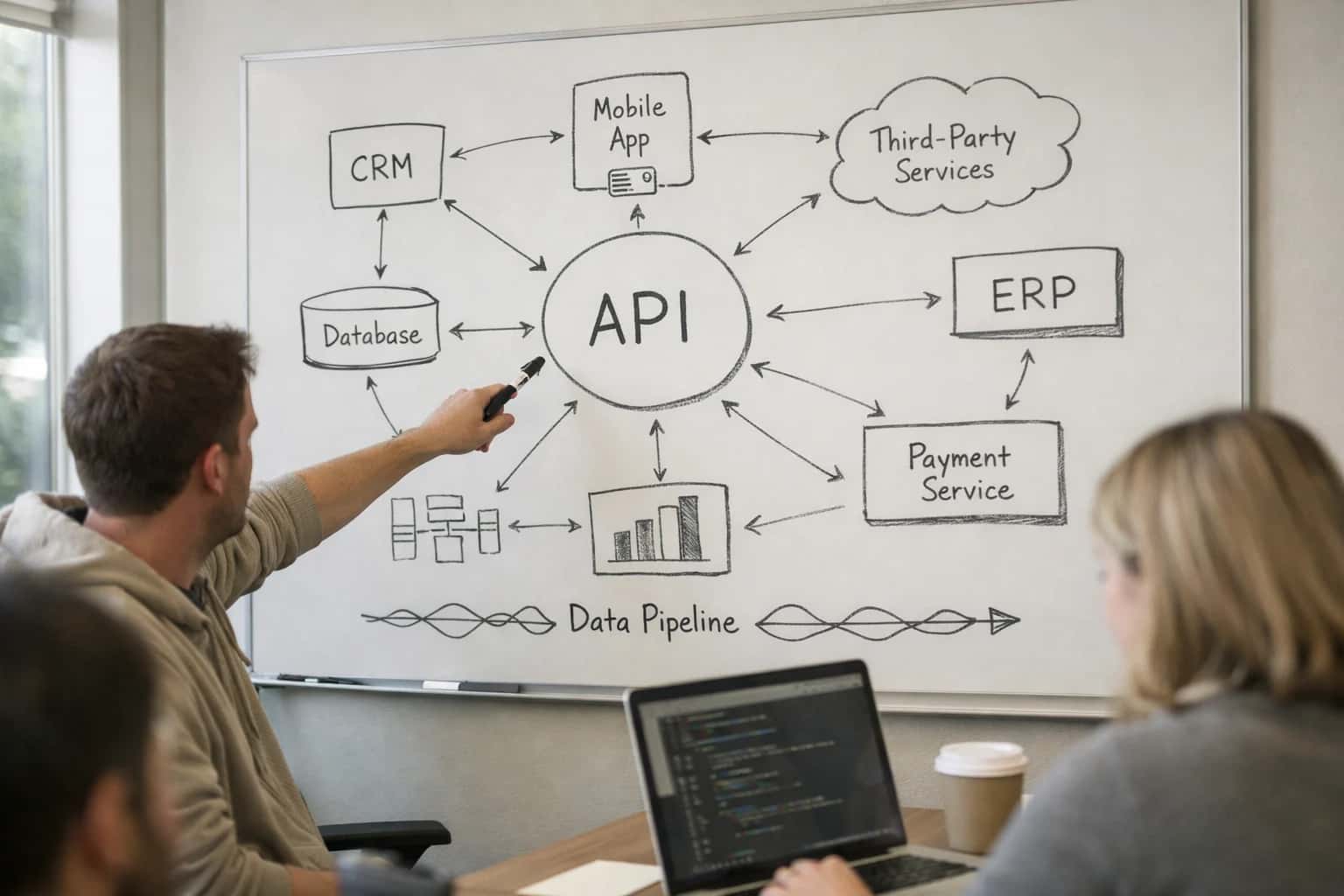
ENTERPRISE INTEGRATION ARCHITECTURE
Extend GitHub Copilot Beyond the IDE
Connect GitHub Copilot's code generation to Jira, ServiceNow, and CI/CD pipelines for automated issue linking, compliance checks, and deployment workflows.
A practical implementation uses a middleware agent or a set of GitHub Actions that intercepts Copilot-influenced code changes. For example, when a developer accepts a Copilot suggestion that resolves a Jira issue key mentioned in the branch name, the agent can automatically: transition the Jira ticket to 'In Review', post the code snippet as a comment, and tag the relevant reviewer. For ServiceNow, the same flow can generate a pre-populated Change Request record, attaching code diffs and risk assessments derived from the modified modules and test coverage data.
Rollout requires a phased approach: start with non-production repositories, instrumenting audit logs to track Copilot's impact on cycle time and defect rates. Governance is critical; implement prompt guardrails to avoid generating code that violates internal security policies or uses deprecated libraries. By treating Copilot not just as a coding assistant but as a node in your engineering automation graph, you shift from faster code completion to faster, more auditable, and system-aware software delivery.
INTEGRATION SURFACES
Where AI Connects to the GitHub Ecosystem
The Core Development Surface
GitHub Copilot operates primarily within the IDE, analyzing open files, project structure, and recent changes to provide inline code completions and function suggestions. For integration, this surface is extended by connecting Copilot's context to external systems.
Key integration points include:
- Project Context: Injecting metadata from Jira tickets, ServiceNow incidents, or design specs (Figma) into the IDE's context window to guide feature development.
- Compliance & Security: Running generated code snippets against internal policy engines or security scanners (like Snyk or Checkmarx) in real-time to flag violations before acceptance.
- Knowledge Retrieval: Augmenting Copilot's training with internal APIs, code patterns, and architectural decisions stored in a vector database, enabling suggestions grounded in your specific tech stack.
This transforms Copilot from a general-purpose assistant to a domain-aware engineering copilot.
EXTENDING COPILOT BEYOND THE IDE
High-Value Integration Use Cases
GitHub Copilot excels at code completion, but its real enterprise value emerges when its suggestions are connected to the systems that define business logic, compliance rules, and delivery workflows. These integrations turn Copilot from a developer tool into a platform-aware engineering copilot.
01
Jira-Aware Code Generation
Connect Copilot to Jira's API so code suggestions are informed by the active ticket's acceptance criteria, story points, and linked architectural decisions. Automatically generate commit messages and branch names from Jira summaries, and flag code changes that deviate from the ticket's scope.
Context in <1s
Ticket data fetch
02
ServiceNow Script Acceleration
Augment ServiceNow scripting (Business Rules, Script Includes, Flow Designer) with Copilot trained on your GlideRecord patterns and integration standards. Generate boilerplate for common ITSM automations, like auto-assigning incidents based on CI data or updating CMDB records post-deployment.
1 sprint
Platform script development
03
Compliance-Guided Development
Integrate Copilot with internal policy engines and security scanners (e.g., Snyk, Checkmarx). Suggestions automatically avoid deprecated libraries, flag insecure patterns, and recommend approved alternatives based on your organization's software bill of materials (SBOM) and vulnerability databases.
Pre-merge
Policy enforcement
04
CI/CD Pipeline-Aware Completions
Connect Copilot to your pipeline configuration (GitHub Actions, Azure DevOps YAML). Get intelligent suggestions for build steps, environment variables, and deployment gates based on the target branch and recent pipeline success/failure patterns. Generate code for custom pipeline tasks or integration tests.
Batch -> Real-time
Pipeline feedback loop
05
Internal API & SDK Code Generation
Point Copilot at your internal API specifications (OpenAPI/Swagger) and SDK documentation. Drastically accelerate development of service clients, contract tests, and sample payloads by generating context-aware code that matches your organization's authentication patterns and data models.
Hours -> Minutes
Client boilerplate
06
Architecture Pattern Enforcement
Integrate Copilot with your internal design system documentation and architectural decision records (ADRs). Suggestions steer developers toward approved patterns for microservice communication, database access, logging, and observability, reducing drift and standardizing code quality.
Same day
Pattern adoption
EXTENDING COPILOT BEYOND THE IDE
Example Integrated Workflows
These workflows demonstrate how to connect GitHub Copilot's code generation to enterprise systems, transforming it from a developer assistant into a connected automation engine. Each example outlines a concrete trigger, the data context provided to Copilot, the resulting action, and the system update.
Trigger: A developer starts a new coding session and provides a high-level task description in a comment.
Context/Data Pulled:
- The developer's IDE plugin calls a secure service that queries the Jira API.
- The service searches for open tickets assigned to the developer matching keywords from the description.
- Relevant ticket details (key, summary, description, acceptance criteria) are fetched and formatted.
Model/Agent Action:
- This enriched context ("You are working on Jira ticket PROJ-123: 'Fix user authentication timeout'. Acceptance criteria: Session should persist for 24 hours. Here is the current auth module...") is passed alongside the developer's code prompt to GitHub Copilot.
- Copilot generates code suggestions that are explicitly aligned with the ticket's requirements.
System Update/Next Step:
- A post-generation hook automatically creates a Git branch with a standardized name (e.g.,
feature/PROJ-123-fix-auth-timeout). - The initial commit message is pre-populated with the Jira ticket key and summary.
- The Jira ticket status is automatically transitioned from
To DotoIn Progressvia webhook.
Human Review Point: The developer reviews all generated code before committing. The integration only automates context gathering and administrative tasks.
BEYOND THE IDE
Implementation Architecture: Data Flow & Guardrails
Connecting GitHub Copilot to enterprise systems requires a secure, governed data flow that respects code context and operational boundaries.
A production integration typically uses a middleware layer (like a secure API gateway or orchestration service) to broker requests between the developer's IDE and external systems like Jira, ServiceNow, or internal knowledge bases. This layer manages authentication, rate limiting, and prompt enrichment, injecting relevant context—such as Jira ticket details, CI/CD pipeline status, or internal API specifications—into the Copilot session as code comments or in-context files. This transforms generic suggestions into system-aware completions for tasks like generating a function that matches a ticket's acceptance criteria or auto-formatting a commit message linked to a specific epic.
Critical guardrails are implemented at this orchestration layer. All outgoing code suggestions and incoming context data should be logged with developer identity, timestamp, and source system for audit trails. For sensitive workflows (e.g., generating code that interacts with production data), you can implement a human-in-the-loop approval step, where certain Copilot-triggered actions, like creating a deployment script, generate a review task in the team's project management tool before execution. Additionally, a vector-based policy engine can screen suggestions against internal security and architectural standards, flagging or filtering out code patterns that violate compliance rules.
Rollout follows a phased approach: start with read-only context enrichment (pulling ticket data into the IDE) in a single team, then progress to write-back automations (like auto-updating ticket status on commit) with explicit opt-in. Governance is maintained through centralized prompt templates and a curated library of approved context sources, ensuring Copilot operates within a controlled, value-driven scope that accelerates development without introducing unmanaged risk or context sprawl.
CONNECTING COPILOT TO ENTERPRISE SYSTEMS
Code & Payload Examples
Injecting Ticket Context into the IDE
Connect GitHub Copilot to Jira's API to provide real-time, issue-specific context. This enables Copilot to generate code changes, branch names, and commit messages directly linked to active development work. The integration typically uses a secure token to fetch the issue summary, description, and acceptance criteria, injecting them as in-line comments or a dedicated context panel within the IDE.
Example Payload & Pseudocode:
python# Fetch Jira issue for current branch import requests def get_jira_context(issue_key): headers = {"Authorization": f"Bearer {JIRA_API_TOKEN}"} response = requests.get( f"https://your-domain.atlassian.net/rest/api/3/issue/{issue_key}", headers=headers ) issue = response.json() # Extract key fields for Copilot context context = f""" // JIRA ISSUE: {issue['key']} // SUMMARY: {issue['fields']['summary']} // DESCRIPTION: {issue['fields']['description']['content'][0]['content'][0]['text']} """ return context
This context is then made available to Copilot, allowing it to suggest code relevant to the ticket's requirements, such as implementing a specific API endpoint or fixing a bug described in the issue.
GITHUB COPILOT ENTERPRISE INTEGRATION
Realistic Time Savings & Operational Impact
How connecting GitHub Copilot to enterprise systems like Jira, ServiceNow, and CI/CD pipelines changes development workflows.
| Metric | Before AI | After AI | Notes |
|---|---|---|---|
Issue-to-code context | Manual Jira lookup, copy/paste ticket details | Automated ticket context injection into IDE | Copilot suggests code with Jira summary, acceptance criteria |
Commit message generation | Manual drafting from memory or partial notes | AI-generated from staged diff and linked ticket | Ensures consistency, includes ticket ID and change summary |
CI/CD pipeline debugging | Manual log scanning, trial-and-error fixes | AI-suggested fixes based on pipeline failure patterns | Analyzes logs from Jenkins/GitHub Actions to propose code or config changes |
Compliance check (pre-commit) | Manual review for secrets, licensing headers | AI-assisted inline suggestions and block completions | Flags potential PII, suggests approved open-source license templates |
ServiceNow change request sync | Manual update of change ticket after deployment | Automated status update via webhook on pipeline success | Reduces CMDB drift, keeps ITIL records current |
Code review preparation | Manual creation of summary for reviewers | AI-generated PR description and change highlights | Context for reviewers includes linked design docs and test impact |
Internal API usage | Searching internal docs or previous code | Copilot suggests calls based on internal API schema | Pulls from OpenAPI specs in repository, reduces incorrect implementations |
ENTERPRISE-READY AI FOR DEVELOPMENT
Governance, Security, and Phased Rollout
Integrating GitHub Copilot at scale requires a deliberate approach to security, compliance, and user adoption to maximize productivity without introducing risk.
A production integration for GitHub Copilot extends beyond the IDE, connecting its code suggestions to enterprise systems like Jira, ServiceNow, and CI/CD pipelines. This requires a secure architecture where AI-generated code is treated as a first-class artifact. Key considerations include:
- API Gateway & Secure Tool Calling: All external calls from Copilot-powered agents to internal systems (e.g., to fetch Jira ticket context or validate against a compliance database) must be routed through a secure API gateway with proper authentication, rate limiting, and audit logging.
- Data Context Boundaries: Define which repositories, branches, and internal knowledge bases Copilot can access. Use repository-level permissions and environment variables to prevent accidental exposure of sensitive code or credentials in suggestions.
- Audit Trail for AI-Generated Code: Implement commit signing or tagging to distinguish AI-assisted code blocks, enabling traceability for compliance reviews and later analysis of AI's impact on code quality.
A phased rollout is critical for managing change and measuring impact. Start with a pilot group focused on high-value, low-risk workflows:
- Phase 1: Internal Knowledge Augmentation: Connect Copilot to internal design system documentation and API specs. Measure reduction in context-switching and time to first correct implementation.
- Phase 2: Workflow Automation: Integrate with Jira or Azure DevOps to auto-generate branch names, commit messages from ticket summaries, and draft pull request descriptions. Track the automation of manual, repetitive tasks.
- Phase 3: Compliance & Security Guardrails: Integrate with static analysis (SAST) and software composition analysis (SCA) tools in the CI/CD pipeline. Use AI to suggest fixes for flagged issues before merge, reducing mean time to remediation.
Governance ensures the integration remains a controlled asset, not a shadow IT risk. Establish a lightweight review board to:
- Curate Prompt Templates & System Contexts: Maintain approved, organization-specific prompt starters and context files that guide Copilot towards your architectural patterns and coding standards.
- Monitor for Model Drift & Suggestion Quality: Implement basic LLMOps checks to track if code acceptance rates change with new model versions and to flag areas where suggestions frequently introduce bugs or security antipatterns.
- Define a Clear Rollback Path: Have a process to swiftly disable specific AI-augmented workflows (e.g., automated ticket linking) if they produce unexpected results, without disrupting core development activities. This controlled approach, managed by Inference Systems, transforms GitHub Copilot from a personal productivity tool into a governed platform asset that accelerates development velocity predictably and safely.
Enabling Efficiency, Speed & Accuracy
Intelligent Analysis, Decision & Execution
We build AI systems for teams that need search across company data, workflow automation across tools, or AI features inside products and internal software.
Talk to Us
Search across company data
Give teams answers from docs, tickets, runbooks, and product data with sources and permissions.
Useful when people spend too long searching or get different answers from different systems.
Enterprise searchRAGPermissions
Read more
Automate internal workflows
Use AI to route work, draft outputs, trigger actions, and keep approvals and logs in place.
Useful when repetitive work moves across multiple tools and teams.
AI agentsWorkflow automationGovernance
Read more
Add AI to products and internal tools
Build assistants, guided actions, or decision support into the software your team or customers already use.
Useful when AI needs to be part of the product, not a separate tool.
AI integrationDecision supportModel routing
Read moreGITHUB COPILOT ENTERPRISE INTEGRATION
Frequently Asked Questions
Practical questions for engineering leaders extending GitHub Copilot beyond the IDE to connect with enterprise systems, automate workflows, and govern AI-assisted development.
This requires a middleware agent that listens to events from both systems.
Typical Workflow:
- Trigger: A developer accepts a significant Copilot code suggestion within their IDE (VS Code, JetBrains).
- Context Capture: A lightweight IDE extension or Git hook captures the accepted suggestion's context (file, function, summary) and the associated Git branch or commit.
- Agent Action: A backend integration service (agent) is triggered. It:
- Uses the branch name (e.g.,
feature/JIRA-123-add-auth) or parses the commit message to identify the linked ticket ID. - Calls the Jira/ServiceNow API to fetch the ticket details (summary, description, status).
- Calls an LLM (like GPT-4) with a prompt: "Given code change [snippet] for ticket [ticket details], generate a concise status update for the ticket."
- Uses the branch name (e.g.,
- System Update: The agent posts the generated update as a comment on the Jira/ServiceNow ticket.
python
# Example payload to Jira REST API payload = { "body": "AI-Assisted Development Update: Implemented user authentication middleware as suggested by GitHub Copilot. Code is staged in branch 'feature/JIRA-123-add-auth'. Ready for review." } - Governance: This flow should be opt-in per developer or team, logged for audit, and include a human review step before posting for critical tickets.

About the author
Prasad Kumkar
CEO & MD, Inference Systems
Prasad Kumkar is the CEO & MD of Inference Systems and writes about AI systems architecture, LLM infrastructure, model serving, evaluation, and production deployment. Over 5+ years, he has worked across computer vision models, L5 autonomous vehicle systems, and LLM research, with a focus on taking complex AI ideas into real-world engineering systems.
His work and writing cover AI systems, large language models, AI agents, multimodal systems, autonomous systems, inference optimization, RAG, evaluation, and production AI engineering.
LinkedIn
Limited slotsGet a Free AI Consultation
Partnered with leading AI, data, and software stack.





How We Work
Custom AI workflows for your Business
One-fit-all AI don't work for modern businesses. At Inferensys, we aim to understand your business & custom requirements; which we use to define most efficient agentic workflows, the data, and the tools for your business.
01
Review the use case
We understand the task, the users, and where AI can actually help.
Read more02
Pick the right approach
We define what needs search, automation, or product integration.
Read more03
Build the first useful version
We implement the part that proves the value first.
Read more04
Improve from there
We add the checks and visibility needed to keep it useful.
Read moreThe first call is a practical review of your use case and the right next step.
Talk to Us