In a production AI stack, multi-step orchestration sits between the LLM reasoning layer and the enterprise API layer. It is responsible for decomposing high-level goals (e.g., "research a market and draft a report") into a sequence of discrete, executable tasks. With CrewAI, this is modeled as a crew of specialized agents (Researcher, Analyst, Writer) each assigned specific roles, goals, and tools. The orchestration engine manages the handoff of context and results between agents, ensuring the output of one (a research summary) becomes the input for the next (analysis). This layer is where you define the business logic of the workflow: the sequence, the success criteria, and the error-handling paths.

Integration
Multi-Step Orchestration with CrewAI
A technical blueprint for designing and deploying sequential, hierarchical AI agent workflows with CrewAI. Learn how specialized agents hand off context to automate complex processes like research, analysis, and reporting.
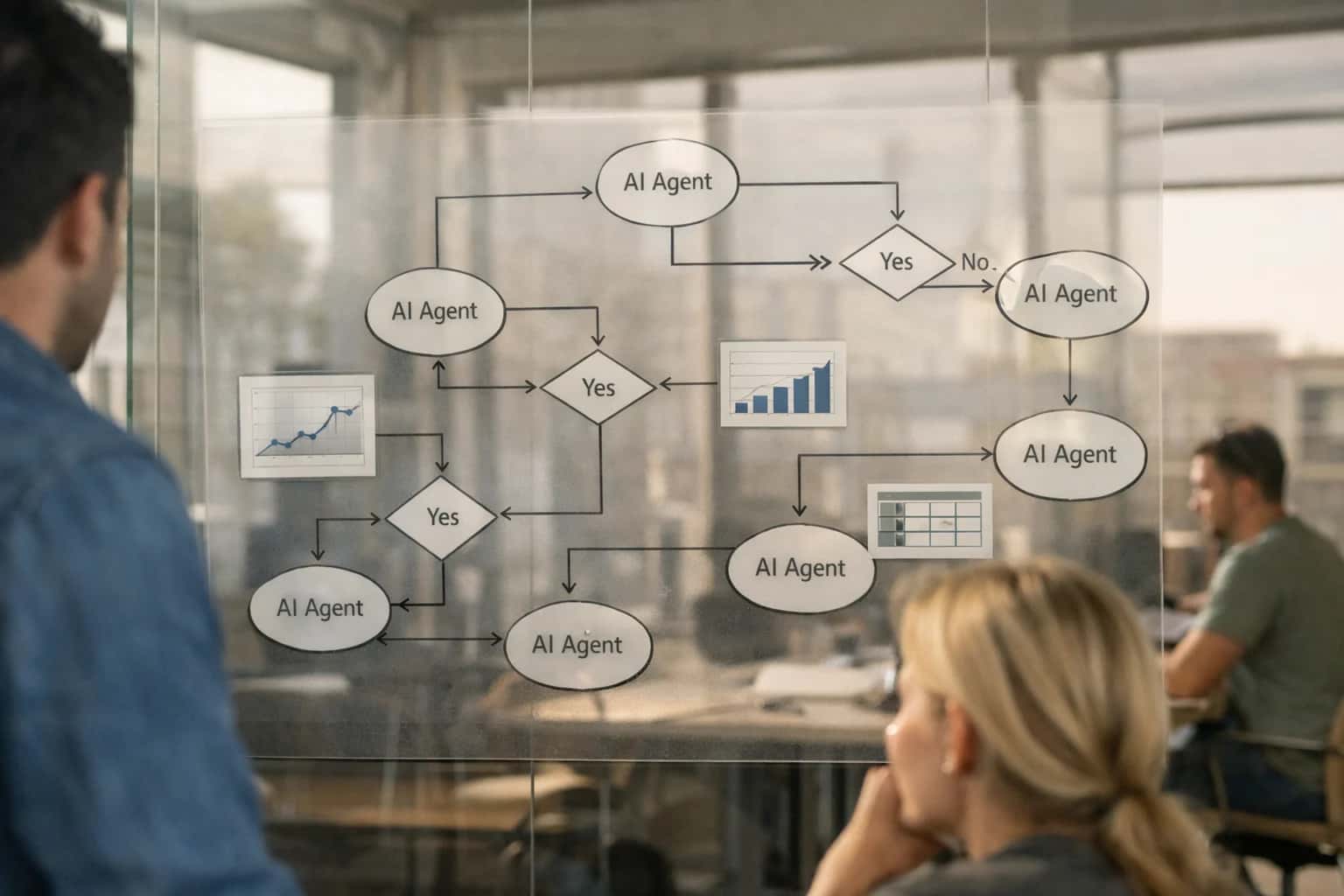
ARCHITECTURAL BLUEPINT
Where Multi-Step Orchestration Fits in the AI Stack
Multi-step orchestration is the execution layer that connects AI reasoning to enterprise systems, turning agentic workflows into reliable business operations.
For enterprise integration, the orchestration layer must be stateful and auditable. CrewAI crews are typically deployed as containerized services (e.g., Docker on Kubernetes) that listen for triggers—a webhook from a CRM, a message on a queue like RabbitMQ, or a scheduled cron job. Each agent within the crew is equipped with custom tools that are essentially Python functions calling your internal APIs (Salesforce REST API, SAP OData, ServiceNow Table API). The orchestration engine maintains a context window and an execution log, which is crucial for debugging and compliance. For example, a workflow to process a sales deal might sequence: Agent 1 fetches deal data from Salesforce, Agent 2 enriches it with external firmographic data, Agent 3 scores the opportunity, and a final Manager Agent decides whether to escalate or log the result back to Salesforce.
Rollout and governance require treating these orchestrated crews as production microservices. This means implementing standard operational practices: version control for crew definitions (tasks, agent roles, tools), secret management for API credentials, and comprehensive logging of each agent's actions, tool calls, and LLM prompts. A key pattern is the human-in-the-loop (HITL) node, where the orchestration is designed to pause at a specific step (e.g., before sending a customer email) and route the decision to a Slack approval channel or a Power Automate flow. This controlled handoff between autonomous agents and human oversight is what makes multi-step orchestration with platforms like CrewAI viable for regulated or high-stakes business processes, moving beyond prototypes to production-grade automation. For related patterns on deploying these systems at scale, see our guide on Enterprise AI Agent Integration with CrewAI.
ARCHITECTURE PATTERNS
Core CrewAI Surfaces for Orchestration
The Task Object
CrewAI's Task object is the fundamental unit of work for orchestration. It defines the objective, the agent responsible, and the expected output format. This is where you inject business logic and guardrails.
Key Integration Surfaces:
description: The natural language instruction for the agent. This is often dynamically populated from an external trigger (e.g., a Jira ticket summary or a support case description).expected_output: A precise template (e.g., JSON schema, markdown report) that structures the agent's result for downstream consumption by other systems or agents.async_execution&context: Enable sequential workflows where one agent's output becomes the next agent's input, forming a hand-off chain for processes like research → analysis → reporting.
Example Trigger: A webhook from your CRM creates a new Task to "Analyze lead 'Acme Corp' from Salesforce and draft a personalized outreach email."
MULTI-AGENT WORKFLOW PATTERNS
High-Value Use Cases for CrewAI Orchestration
CrewAI excels at coordinating specialized agents to complete complex, multi-step processes. These patterns show how to operationalize agent teams for backend automation, data analysis, and cross-system workflows.
01
Automated Research & Report Generation
A Researcher Agent scours internal databases and web sources, a Data Analyst Agent processes findings, and a Writer Agent synthesizes a structured report. This turns a multi-day manual research task into a same-day automated workflow.
Days -> Hours
Report timeline
02
Intelligent Customer Support Triage
A Classifier Agent analyzes inbound support tickets from Zendesk or ServiceNow. A Resolver Agent queries knowledge bases for solutions. A Human Escalation Agent drafts a summary and routes only complex cases to a live agent, reducing manual triage by 60-80%.
Batch -> Real-time
Triage speed
03
Proactive IT Alert Diagnosis
A Monitor Agent ingests alerts from Splunk or Datadog. A Diagnostician Agent correlates events and executes runbook steps via API. A Communications Agent drafts incident summaries for Slack. This creates an autonomous Tier-1 response layer.
1 sprint
Typical implementation
04
Sales & Marketing Lead Orchestration
A Scoring Agent enriches HubSpot or Salesforce leads with firmographic data. A Content Agent drafts personalized outreach. A Scheduling Agent proposes meeting times. Agents hand off context to move leads through the funnel without manual rep intervention.
Hours -> Minutes
Lead response time
05
Financial Anomaly Detection & Reporting
A Reconciliation Agent pulls data from NetSuite or QuickBooks, flagging variances. An Analyst Agent investigates patterns. A Compliance Agent drafts audit-ready commentary. This automates a critical month-end close sub-process with full audit trail.
Manual -> Automated
Review process
06
Dynamic Document Processing Workflow
An Ingestion Agent classifies incoming documents in SharePoint or Box. An Extraction Agent uses OCR and LLMs to pull key fields. A Validation Agent checks against business rules and routes exceptions for human review, streamlining back-office operations.
Batch -> Real-time
Processing mode
CREWAI IMPLEMENTATION PATTERNS
Detailed Workflow Examples
These multi-agent workflows illustrate how CrewAI orchestrates specialized roles, tool usage, and context hand-offs to automate complex business processes. Each example details the trigger, agent roles, data flow, and system updates.
Trigger: A scheduled job (e.g., weekly) or a manual request via API/webhook.
Agent Roles & Flow:
- Research Manager Agent: Receives the trigger with a target company list. It decomposes the task and assigns sub-tasks.
- Web Researcher Agent: Equipped with a
search_webtool (via Serper API or Brave Search). Executes searches for recent news, funding rounds, and product launches for each target. Returns raw snippets and URLs. - Financial Data Agent: Uses a
get_financialstool (via SEC Edgar or Crunchbase API) to pull recent filings or funding details. Extracts key metrics. - Analyst Agent: Receives context from both Researcher and Financial agents. Uses an LLM to synthesize findings, identify strategic threats/opportunities, and draft narrative insights.
- Report Generator Agent: Takes the analyst's output. Uses a
create_slideorupdate_google_doctool to format the insights into a structured report (PPT/PDF/Doc).
System Update: The final report is saved to a designated SharePoint/Google Drive folder, and a notification with a summary is posted to a Slack/Teams channel via a final tool call.
FROM PROTOTYPE TO PRODUCTION
Implementation Architecture: Data Flow & Guardrails
A practical blueprint for deploying resilient, governed multi-agent systems with CrewAI.
A production CrewAI integration follows a containerized, event-driven pattern. The core orchestration engine—a Python service defining your Crew with its Agents, Tasks, and Process—is packaged as a Docker container. This service listens for job triggers from a message queue (like RabbitMQ or AWS SQS) or an HTTP webhook endpoint. Each incoming event, such as a new support ticket ID or a daily report generation signal, is wrapped in a context object and passed to the crew's kickoff() method. The crew then executes its sequential or hierarchical task plan, with agents passing context and results via the shared_goal and output attributes. This decoupled design allows the AI layer to scale independently from your core business applications.
Tool execution requires strict guardrails. Each agent's custom tools—functions for API calls to Salesforce, SQL queries, or document generation—are wrapped in error handling, timeout logic, and structured logging. We implement a tool registry that validates inputs against schemas and enforces role-based access before execution. For instance, an agent with a 'Research' role may have read-only access to your Zendesk API, while a 'Coordinator' agent can write back to your project management tool. All tool calls, their parameters, and results are logged to an audit trail (often in a dedicated agent_operations table) for traceability and compliance. This is critical for regulated workflows where you must demonstrate how an AI-driven decision was reached.
Rollout is phased, with a human-in-the-loop (HITL) safety net. The initial deployment often runs in a shadow mode, where the crew processes real data but its outputs are compared against human decisions without taking autonomous action. For example, a crew designed to triage IT tickets would generate suggested categories and assignees, which are reviewed by an analyst before the ServiceNow ticket is actually updated. Gradual autonomy is introduced through confidence scoring and escalation rules. A low-confidence analysis from the crew's Researcher agent can automatically route the entire task to a Slack channel for human review via a dedicated HumanProxy agent. This phased approach de-risks deployment and builds organizational trust in the agentic workflow.
Governance is managed through environment segregation and model abstraction. Production crews do not call LLM APIs directly with hardcoded keys. Instead, they interface with an internal model gateway that handles authentication, rate limiting, cost tracking, and can seamlessly switch between providers (e.g., from GPT-4 to Claude 3) or fall back to a less expensive model for simpler tasks. The entire crew's execution—including token usage, task durations, and success/failure states—is monitored via OpenTelemetry traces exported to observability platforms like Datadog or Grafana. This architecture ensures your multi-step AI operations are as observable, maintainable, and secure as any other microservice in your stack. For related patterns on deploying agents as backend services, see our guide on Agent Workflow Automation with CrewAI.
MULTI-STEP ORCHESTRATION WITH CREWAI
Code & Configuration Patterns
Defining Linear Workflows
Sequential chains are the most common pattern for processes like research, analysis, and reporting. You define a series of agents, each with a specific role, and a list of tasks where the output of one becomes the input to the next.
In this pattern, the sequential_process is used. The CrewAI execution engine ensures tasks are completed in order and context is passed correctly. This is ideal for workflows where each step depends on the previous result, such as a data analyst agent processing raw data, then a report writer agent generating a summary.
pythonfrom crewai import Agent, Task, Crew, Process # Define Agents researcher = Agent( role='Market Researcher', goal='Find the latest trends in AI agent platforms', backstory='An expert analyst with access to industry reports.' ) writer = Agent( role='Technical Writer', goal='Create a concise summary report', backstory='A skilled writer who distills complex information.' ) # Define Tasks with Explicit Outputs research_task = Task( description='Research AI agent platform adoption trends for Q4.', agent=researcher, expected_output='A bulleted list of key trends with data sources.' ) write_task = Task( description='Write a one-page summary based on the research findings.', agent=writer, expected_output='A well-formatted markdown report.', context=[research_task] # This task depends on the research output ) # Create and Execute the Sequential Crew crew = Crew( agents=[researcher, writer], tasks=[research_task, write_task], process=Process.sequential ) result = crew.kickoff()
MULTI-AGENT WORKFLOW ORCHESTRATION
Realistic Time Savings & Operational Impact
How a CrewAI-powered agent system transforms complex, multi-step processes by automating coordination and task handoffs between specialized AI agents.
| Process Step | Manual / Legacy Approach | With CrewAI Orchestration | Implementation Notes |
|---|---|---|---|
Competitive Market Research | Analyst spends 4-8 hours gathering data, compiling reports | Research agent completes in 45-60 minutes, drafts initial summary | Agents query APIs, scrape public data, and synthesize findings sequentially |
Weekly Performance Report Generation | Manager collates data from 5+ systems, writes narrative (3-5 hours) | Orchestrated agent team produces draft in 20 minutes for review | Analyst agent pulls metrics, Writer agent drafts, Reviewer agent checks for anomalies |
Technical Support Ticket Triage & Routing | Tier 1 agent reads ticket, consults KB, manually assigns (10-15 mins/ticket) | Triage agent categorizes & suggests assignment in <60 seconds | Uses classification, historical data lookup, and skills-based routing logic |
Proposal Drafting from RFP Requirements | Sales engineer parses RFP, writes sections, coordinates reviews (1-2 days) | Orchestrated draft with compliance check completed in 2-4 hours | Specialist agents handle technical, commercial, and legal sections with a manager agent overseeing |
Customer Onboarding Workflow Execution | CSM manually sends emails, creates tasks, follows up across systems | Agent crew triggers welcome sequence, sets up accounts, monitors completion | Orchestrator agent manages state and handoffs between communication, setup, and check-in agents |
Regulatory Document Gap Analysis | Compliance officer manually compares new rules against existing docs (weeks) | Analysis agent identifies potential gaps and flags sections in days | Requires fine-tuned agent for document parsing and another for regulation mapping |
Multi-Source Data Reconciliation | Analyst exports, vlookups, and manually reconciles discrepancies (hours per dataset) | Reconciliation agent runs comparisons, highlights exceptions for review | Agents are equipped with data access tools and validation rules; human reviews exceptions |
OPERATIONALIZING CREWAI AGENT SYSTEMS
Governance, Security, and Phased Rollout
Deploying multi-agent systems requires a deliberate approach to control, security, and incremental value delivery.
Production CrewAI deployments are governed through three primary layers: agent-level permissions, tool execution controls, and audit logging. Each agent role (e.g., ResearchAgent, AnalystAgent, ApproverAgent) is assigned a specific set of allowed tools, which are functions that call your internal APIs or databases. Tool calls should be routed through a central gateway service that enforces rate limits, validates payloads against data loss prevention (DLP) policies, and injects user context for row-level security in downstream systems like Salesforce or NetSuite. All agent interactions, including task assignments, tool calls with inputs/outputs, and hand-off context, are written to an immutable audit log, essential for compliance and debugging.
Security is implemented at the infrastructure and data plane. We recommend containerizing each CrewAI crew and its supporting services (e.g., vector database, cache) and deploying them within your private cloud VPC. Agent-to-agent communication and tool calls remain inside this secure network perimeter. Sensitive data, such as PII or financials retrieved from enterprise systems, is never sent to a public LLM endpoint; instead, use a private instance of models like Llama 3 or Azure OpenAI with data encryption in transit and at rest. CrewAI's context-passing mechanism allows you to keep raw sensitive data within your environment, sending only sanitized summaries or structured data to the LLM when necessary.
A phased rollout mitigates risk and builds organizational trust. Start with a single, internal-facing crew handling a non-critical but time-consuming workflow, such as summarizing daily support tickets or generating first drafts of weekly operational reports. This Phase 1 validates the architecture, governance, and agent collaboration in a controlled setting. Phase 2 introduces a human-in-the-loop approval node, where a key output (e.g., a customer email drafted by an agent) is routed for human review and sign-off in a system like Slack or Microsoft Teams before being sent. Finally, Phase 3 expands to multiple, autonomous crews running on scheduled triggers or listening to event queues, handling higher-stakes processes like lead scoring or financial anomaly detection, with well-defined escalation paths.
This structured approach ensures your CrewAI investment delivers reliable, secure automation that integrates seamlessly with your existing identity providers, monitoring stacks, and change management processes. For detailed patterns on tool calling security or audit log schemas, see our guide on Enterprise AI Agent Integration with CrewAI.
Enabling Efficiency, Speed & Accuracy
Intelligent Analysis, Decision & Execution
We build AI systems for teams that need search across company data, workflow automation across tools, or AI features inside products and internal software.
Talk to Us
Search across company data
Give teams answers from docs, tickets, runbooks, and product data with sources and permissions.
Useful when people spend too long searching or get different answers from different systems.
Enterprise searchRAGPermissions
Read more
Automate internal workflows
Use AI to route work, draft outputs, trigger actions, and keep approvals and logs in place.
Useful when repetitive work moves across multiple tools and teams.
AI agentsWorkflow automationGovernance
Read more
Add AI to products and internal tools
Build assistants, guided actions, or decision support into the software your team or customers already use.
Useful when AI needs to be part of the product, not a separate tool.
AI integrationDecision supportModel routing
Read moreIMPLEMENTATION AND OPERATIONS
Frequently Asked Questions
Common technical and operational questions for teams architecting multi-step, multi-agent systems with CrewAI.
CrewAI provides several mechanisms for managing shared context. The key is designing your Task objects and agent role definitions effectively.
Primary Pattern: Task Output as Context
- Each
Taskhas anoutputattribute. By settingoutput_fileor capturing the output programmatically, you can pass it ascontextto a subsequent task. - Example: A Researcher agent's report becomes the context for an Analyst agent.
Using a Vector Store for Persistent Memory
- For processes requiring access to a large knowledge base or historical data, integrate a vector database (e.g., Pinecone, Weaviate) as a tool for all agents.
- Agents can query the vector store for relevant context before executing their task.
- This is essential for workflows like competitive analysis where past reports need recall.
Implementation Snippet:
pythonfrom crewai import Agent, Task, Crew from langchain.tools import Tool from langchain.vectorstores import Pinecone # Assume vectorstore is initialized retrieval_tool = Tool( name="Knowledge Base Search", func=lambda query: vectorstore.similarity_search(query), description="Searches past project reports and data" ) researcher = Agent( role='Senior Researcher', goal='Find latest market trends', tools=[retrieval_tool], backstory="...", verbose=True ) # Tasks defined with explicit context dependencies
Governance: Audit the context passed between agents by logging task inputs/outputs to a centralized store like an S3 bucket or database for traceability.

About the author
Prasad Kumkar
CEO & MD, Inference Systems
Prasad Kumkar is the CEO & MD of Inference Systems and writes about AI systems architecture, LLM infrastructure, model serving, evaluation, and production deployment. Over 5+ years, he has worked across computer vision models, L5 autonomous vehicle systems, and LLM research, with a focus on taking complex AI ideas into real-world engineering systems.
His work and writing cover AI systems, large language models, AI agents, multimodal systems, autonomous systems, inference optimization, RAG, evaluation, and production AI engineering.
LinkedIn
Limited slotsGet a Free AI Consultation
Partnered with leading AI, data, and software stack.





How We Work
Custom AI workflows for your Business
One-fit-all AI don't work for modern businesses. At Inferensys, we aim to understand your business & custom requirements; which we use to define most efficient agentic workflows, the data, and the tools for your business.
01
Review the use case
We understand the task, the users, and where AI can actually help.
Read more02
Pick the right approach
We define what needs search, automation, or product integration.
Read more03
Build the first useful version
We implement the part that proves the value first.
Read more04
Improve from there
We add the checks and visibility needed to keep it useful.
Read moreThe first call is a practical review of your use case and the right next step.
Talk to Us