AI integrates with Odoo's cash flow management by connecting to three primary data streams via the Odoo ORM or REST API: Sales Orders, Purchase Orders, and the Account Move (Journal Entries) model. The system analyzes open orders for committed revenue and expenses, cross-references historical payment patterns from the account.payment and account.move.line tables, and ingests real-time bank statement data via the account.bank.statement.line object. This creates a unified forecast model that updates as deals close, bills are approved, and payments are recorded.

Integration
Intelligent Cash Flow Forecasting for Odoo
A practical guide for SMBs to implement AI-driven cash flow forecasting within Odoo by analyzing open sales orders, purchase orders, and historical payment patterns to predict short-term liquidity.
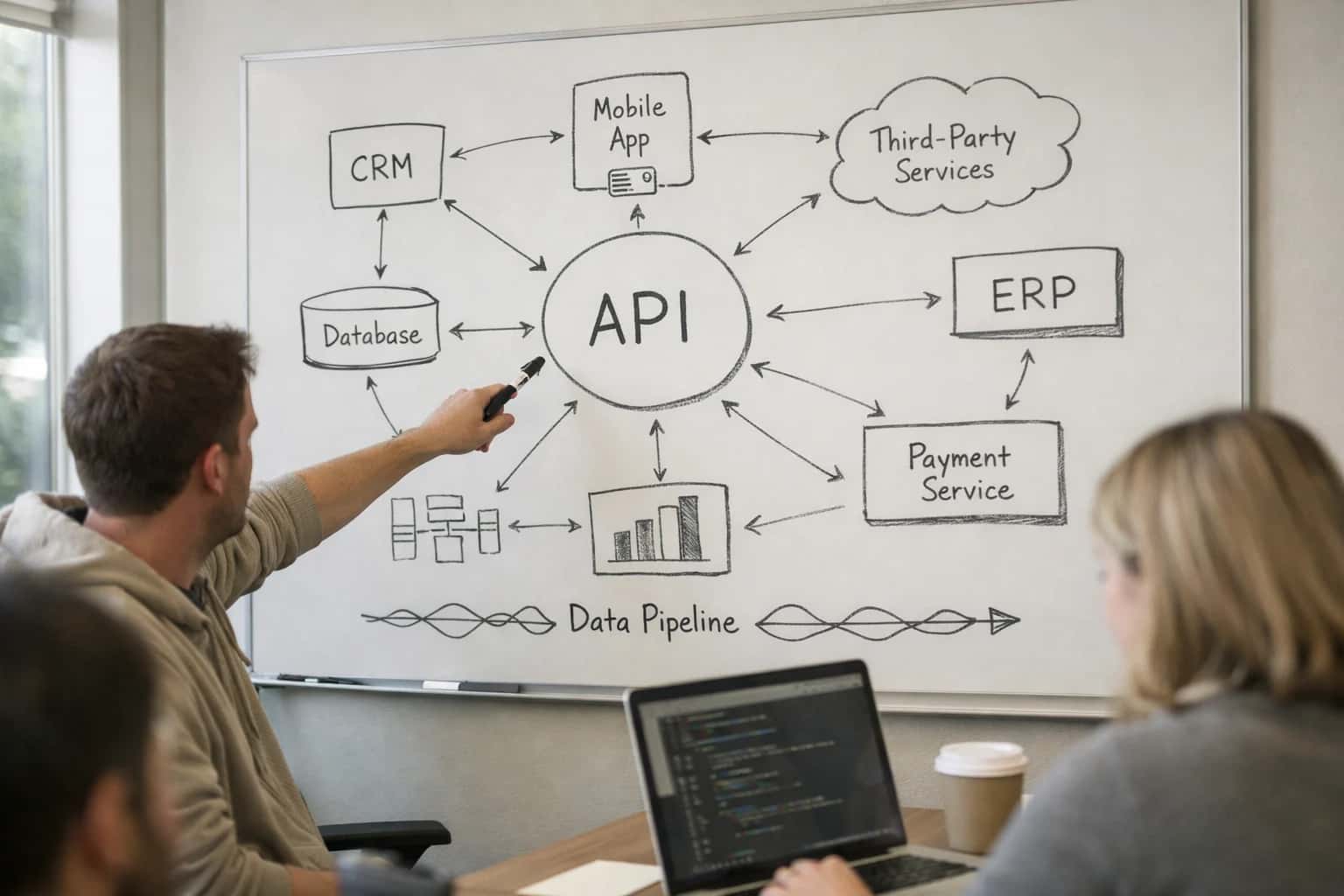
ARCHITECTURE AND ROLLOUT
Where AI Fits into Odoo's Cash Flow Management
A practical blueprint for implementing AI-driven cash flow forecasting by connecting to Odoo's core data objects and automation layer.
Implementation typically involves a background service (e.g., a Python-based AI agent) that polls Odoo's API on a scheduled basis. It uses the forecast to trigger automated workflows within Odoo, such as creating draft vendor payments for approval when cash is predicted to be high, or generating To-Do activities for sales managers to follow up on key invoices ahead of a predicted shortfall. The AI can also post Notes directly to relevant sales orders or partner records, providing context for predicted delays. This turns a static report into an active management tool, reducing the manual effort of consolidating spreadsheets.
Rollout should start with a single currency and a subset of predictable customers/vendors to calibrate the model. Governance is critical: forecasts should be stored in a custom Odoo model (e.g., ai.cash.forecast) with a clear audit trail, and a weekly review workflow should be established where the finance manager validates AI-generated suggestions before any automated actions are executed. This human-in-the-loop approach ensures trust and allows the model to learn from corrections, improving accuracy over time without disrupting existing accounting controls.
INTELLIGENT CASH FLOW FORECASTING
Key Odoo Modules and Data Surfaces for AI Integration
The Core of Your Forecast
Cash flow forecasting begins with analyzing open commitments. In Odoo, this means tapping into the sale.order and purchase.order models via the API. An AI model needs access to:
- Open Sales Orders (
sale.order): Filtered by statesaleordonebut not yet invoiced. Key fields includeamount_total,date_order,commitment_date, andpartner_idfor customer payment history. - Open Purchase Orders (
purchase.order): Filtered by statepurchaseordonebut not yet billed. Key fields areamount_total,date_order,date_planned, andpartner_idfor vendor payment terms.
This data provides the known future inflows and outflows. The AI's job is to predict the timing variance based on historical fulfillment and payment patterns, turning static dates into probabilistic cash events.
INTELLIGENT CASH FLOW FORECASTING FOR ODOO
High-Value Use Cases for AI-Powered Forecasting
Practical AI integration patterns that connect directly to Odoo's sales, purchase, and accounting modules to transform static spreadsheets into dynamic, data-driven cash flow forecasts for SMBs.
01
Automated Forecast from Open Orders
An AI agent continuously monitors Odoo Sales Orders and Purchase Orders to predict cash inflows and outflows. It analyzes order dates, payment terms, and historical fulfillment rates to build a rolling 90-day forecast, updating in real-time as deals progress or POs are approved.
Batch -> Real-time
Forecast refresh
02
Customer Payment Behavior Modeling
Integrates with Odoo's Invoicing and Partner Ledger to analyze historical payment patterns for each customer. The AI predicts likely payment dates for outstanding invoices, adjusting the forecast for habitual late-payers and flagging high-risk accounts for proactive collections.
Same day
Risk identification
03
Scenario Planning for Inventory Purchases
Connects forecasted cash positions with Odoo Inventory demand predictions. The AI simulates the cash impact of different reorder strategies and supplier payment terms, helping procurement and finance collaborate on optimal purchase timing without jeopardizing liquidity.
1 sprint
Implementation timeline
04
Anomaly Detection in Forecast Variance
Continuously compares forecasted vs. actual cash positions from Odoo Bank Statements. The AI identifies significant variances, traces them back to specific sales orders, purchase orders, or unexpected payments, and alerts the finance team with root-cause analysis for continuous model improvement.
05
Executive Cash Dashboard
An AI-powered dashboard embedded within Odoo that synthesizes data from Sales, Purchases, and Accounting. It provides plain-language insights, highlights key cash drivers for the period, and recommends actions (e.g., "Accelerate collections from Customer X to cover upcoming supplier payment").
06
Automated Cash Position Reporting
Replaces manual weekly cash calls. An autonomous agent runs on a schedule, queries the relevant Odoo APIs, generates a formatted cash report with commentary, and distributes it via email or posts it to a dedicated Odoo Discuss channel for the leadership team.
Hours -> Minutes
Report generation
IMPLEMENTATION PATTERNS
Example AI Forecasting Workflows in Odoo
These workflows illustrate how to connect AI models to Odoo's core modules to automate and enhance cash flow predictions, moving from reactive reporting to proactive financial management.
Trigger: Scheduled job runs every Monday morning.
Context Pulled:
- Open Sales Orders (from
sale.order) with expected delivery dates within the next 90 days. - Open Purchase Orders (from
purchase.order) with expected receipt dates. - Unpaid Customer Invoices (from
account.move) and their due dates from the past 30 days. - Unpaid Vendor Bills (from
account.move) and their due dates. - Historical bank statement payment velocity data (average days from invoice date to payment).
AI Agent Action: A forecasting model analyzes the aggregated data to predict daily cash inflows and outflows for the upcoming 13-week period. It weights probabilities based on historical on-time payment rates per customer/vendor and typical delays.
System Update:
The agent creates a new forecast record in a custom Odoo model (cash.flow.forecast), linking predicted daily balances. It flags any days where the projected balance falls below a configurable safety threshold.
Human Review Point: An email alert is sent to the CFO or controller with a link to the forecast record. The Odoo chatter log on the forecast record is updated with the agent's confidence score and key assumptions (e.g., "Forecast assumes Customer X pays 2 days late based on last 6 invoices").
BUILDING A PRODUCTION-GRADE FORECASTING PIPELINE
Implementation Architecture: Data Flow, APIs, and Guardrails
A practical blueprint for connecting AI models to Odoo's data model to generate and operationalize cash flow predictions.
The core of the integration is a scheduled agent that queries Odoo's ORM via its Python API or JSON-RPC API. It extracts time-series data from key objects: account.move (journal entries), sale.order (open orders), purchase.order (committed spend), and account.payment (historical payment velocity). This data is aggregated, cleansed, and sent to a forecasting service—which could be a hosted LLM with function calling, a fine-tuned time-series model, or a rules-based engine—to generate probabilistic cash flow projections for the next 30, 60, and 90 days.
Results are written back to Odoo as configurable custom fields on the res.company or account.fiscalyear models, or as records in a dedicated cash.flow.forecast model. For actionable insights, the system can create Odoo Activities or Discuss channel messages for the finance manager, highlighting critical shortfalls or surpluses. Guardrails include configurable confidence thresholds to suppress low-probability alerts, RBAC to control who sees forecasts, and a full audit log of all data queries and prediction runs stored within Odoo's logging framework.
Rollout follows a phased approach: start with a read-only dashboard view in Odoo's UI showing AI-generated forecasts alongside actuals. Next, enable automated daily runs with email digests to the CFO. Finally, integrate predictions into Odoo's automation rules (base.automation) to trigger workflows, such as automatically drafting a supplier payment proposal when a cash surplus is predicted. This architecture ensures the AI augments Odoo's native workflows without disrupting existing accounting controls. For related patterns on data synchronization, see our guide on AI-ready data pipelines for finance platforms.
IMPLEMENTATION PATTERNS
Code and Payload Examples
Triggering a Forecast and Fetching Odoo Data
An AI-driven forecast is typically triggered by a scheduled job, a manual user action, or a significant change in open orders. This example uses a Python script that calls Odoo's External API to fetch the necessary transactional data before sending it to an AI forecasting service.
Key data points to retrieve:
- Open Sales Orders:
sale.orderrecords with state'sale'or'done'but not yet invoiced. - Open Purchase Orders:
purchase.orderrecords confirmed but not yet received. - Historical AR/AP:
account.moverecords (invoices and bills) with their payment terms and actual payment dates. - Bank Balance: Current balance from
account.bank.statement.
pythonimport requests import json from datetime import datetime, timedelta # Odoo API Connection ODOO_URL = "https://your-odoo-instance.com" DB = "your_database" USERNAME = "api_user" PASSWORD = "api_key" # Authenticate auth_url = f"{ODOO_URL}/web/session/authenticate" auth_payload = { "jsonrpc": "2.0", "params": { "db": DB, "login": USERNAME, "password": PASSWORD, }, } session = requests.Session() session.post(auth_url, json=auth_payload) # Search for open sales orders search_url = f"{ODOO_URL}/web/dataset/call_kw" search_payload = { "jsonrpc": "2.0", "method": "call", "params": { "model": "sale.order", "method": "search_read", "args": [[('state', 'in', ['sale', 'done']), ('invoice_status', '!=', 'invoiced')]], "kwargs": { "fields": ["id", "name", "amount_total", "date_order", "partner_id", "payment_term_id"] }, }, } response = session.post(search_url, json=search_payload) open_sales_orders = response.json().get('result', []) # Package data for AI service forecast_request_payload = { "timestamp": datetime.utcnow().isoformat(), "data_source": "odoo", "open_sales_orders": open_sales_orders, # ... include other fetched datasets } # Send to Inference Systems forecasting endpoint # response = requests.post(FORECASTING_SERVICE_URL, json=forecast_request_payload)
INTELLIGENT CASH FLOW FORECASTING
Realistic Time Savings and Business Impact
How AI integration transforms manual cash flow analysis in Odoo from a periodic, reactive task into a continuous, predictive process.
| Metric | Before AI | After AI | Notes |
|---|---|---|---|
Forecast Generation Frequency | Monthly or quarterly | Weekly or daily | AI automates data aggregation from sales, purchases, and banking modules. |
Time to Update Forecast | 4-8 hours manual compilation | Minutes, with automated refresh | Eliminates manual spreadsheet work pulling data from Odoo. |
Scenario Analysis | Manual, limited to 1-2 scenarios | Automated, multiple 'what-if' models | AI runs scenarios on demand (e.g., late payment impact, sales spike). |
Data Source Integration | Manual export/import from separate modules | Automated real-time sync via Odoo API | Connects Sales Orders, Purchase Orders, Invoices, and Bank Statements. |
Anomaly & Risk Flagging | Reactive, discovered during review | Proactive alerts for deviations | AI monitors forecast vs. actuals, flags unexpected payment delays or shortfalls. |
Report Preparation & Distribution | Manual report creation for stakeholders | Automated report generation and sharing | AI generates narrative summaries and visual charts, emails to management. |
Rollout & Adoption Timeline | Pilot: 4-6 weeks for manual process design | Pilot: 2-3 weeks for integration & tuning | Focus shifts from process design to validating AI model accuracy on historical data. |
PRACTICAL IMPLEMENTATION FOR ODOO
Governance, Security, and Phased Rollout
A secure, governed approach to deploying AI-driven cash flow forecasting without disrupting your live Odoo operations.
A production-ready integration connects to Odoo's REST API or XML-RPC endpoints, typically using a dedicated integration user with scoped permissions (account.account, sale.order, purchase.order, account.move.line). The AI service runs as a separate, containerized microservice that polls for new data or reacts to Odoo webhooks for events like a confirmed sales order or a posted vendor bill. This keeps the core Odoo instance stable and allows the AI model to operate on a replicated dataset, ensuring forecast calculations don't impact transactional performance.
Security is managed through Odoo's native Access Control Lists (ACLs) and API token rotation. All data in transit is encrypted, and the AI service logs every forecast generation and data access for audit trails. Forecasts are written back to a custom Odoo model (e.g., ai.cash.flow.forecast) with clear lineage tags, allowing finance managers to review AI-suggested figures before any official financial records are altered. Human-in-the-loop approval can be configured for material variances before forecasts are shared with stakeholders.
We recommend a three-phase rollout: 1) Shadow Mode: The AI generates forecasts for a closed historical period, allowing the finance team to compare its accuracy against actuals without any operational impact. 2) Assisted Mode: Forecasts are generated for the current period and presented within a custom Odoo dashboard as a "draft" recommendation, requiring a manager's review and manual publication. 3) Automated Mode: For trusted workflows (e.g., short-term weekly outlook), forecasts are auto-published to a designated report, with automated alerts for any prediction that falls outside a configured confidence threshold, triggering a manual review.
Enabling Efficiency, Speed & Accuracy
Intelligent Analysis, Decision & Execution
We build AI systems for teams that need search across company data, workflow automation across tools, or AI features inside products and internal software.
Talk to Us
Search across company data
Give teams answers from docs, tickets, runbooks, and product data with sources and permissions.
Useful when people spend too long searching or get different answers from different systems.
Enterprise searchRAGPermissions
Read more
Automate internal workflows
Use AI to route work, draft outputs, trigger actions, and keep approvals and logs in place.
Useful when repetitive work moves across multiple tools and teams.
AI agentsWorkflow automationGovernance
Read more
Add AI to products and internal tools
Build assistants, guided actions, or decision support into the software your team or customers already use.
Useful when AI needs to be part of the product, not a separate tool.
AI integrationDecision supportModel routing
Read moreIMPLEMENTATION GUIDE
Frequently Asked Questions
Common questions from finance leaders and Odoo administrators planning to add AI-driven cash flow forecasting to their existing stack.
The AI model requires structured access to key Odoo objects and their historical trends. We typically integrate with the following modules via Odoo's external API or direct database connection (with appropriate safeguards):
Core Data Sources:
- Sales Orders (
sale.order): Open orders, order lines, expected delivery dates, and customer payment terms. - Invoices (
account.move): All customer invoices (AR) and vendor bills (AP), including status (posted,paid), due dates, amounts, and payment history. - Purchase Orders (
purchase.order): Open POs, committed spend, and expected receipt dates. - Bank Statements (
account.bank.statement): Historical transaction data to analyze actual cash in/out patterns and payment velocity. - Partners (
res.partner): Customer and vendor profiles to understand payment behavior (e.g., this vendor typically pays 5 days late).
Implementation Note: The initial setup involves mapping these Odoo models to the forecasting service. We recommend starting with a 12-month historical data pull for model training, followed by real-time syncs via scheduled jobs or webhooks for new transactions.

About the author
Prasad Kumkar
CEO & MD, Inference Systems
Prasad Kumkar is the CEO & MD of Inference Systems and writes about AI systems architecture, LLM infrastructure, model serving, evaluation, and production deployment. Over 5+ years, he has worked across computer vision models, L5 autonomous vehicle systems, and LLM research, with a focus on taking complex AI ideas into real-world engineering systems.
His work and writing cover AI systems, large language models, AI agents, multimodal systems, autonomous systems, inference optimization, RAG, evaluation, and production AI engineering.
LinkedIn
Limited slotsGet a Free AI Consultation
Partnered with leading AI, data, and software stack.





How We Work
Custom AI workflows for your Business
One-fit-all AI don't work for modern businesses. At Inferensys, we aim to understand your business & custom requirements; which we use to define most efficient agentic workflows, the data, and the tools for your business.
01
Review the use case
We understand the task, the users, and where AI can actually help.
Read more02
Pick the right approach
We define what needs search, automation, or product integration.
Read more03
Build the first useful version
We implement the part that proves the value first.
Read more04
Improve from there
We add the checks and visibility needed to keep it useful.
Read moreThe first call is a practical review of your use case and the right next step.
Talk to Us