AI integration for Odoo's reconciliation targets the account.bank.statement.line and account.move.line objects. The system operates as a background service that listens for new bank statement lines via Odoo's webhooks or polls the account.bank.statement model. For each unmatched line, an AI agent analyzes the payment_ref, partner_name, amount, and date, then queries Odoo's ORM for potential matches in open invoices (account.move with type out_invoice/in_invoice), bills, and journal entries. The agent uses a combination of fuzzy matching on references, amount validation (including multi-currency tolerance), and date proximity to propose the most likely match, writing a suggestion to a custom field or creating a draft reconciliation record for review.

Integration
Intelligent Bank Reconciliation for Odoo
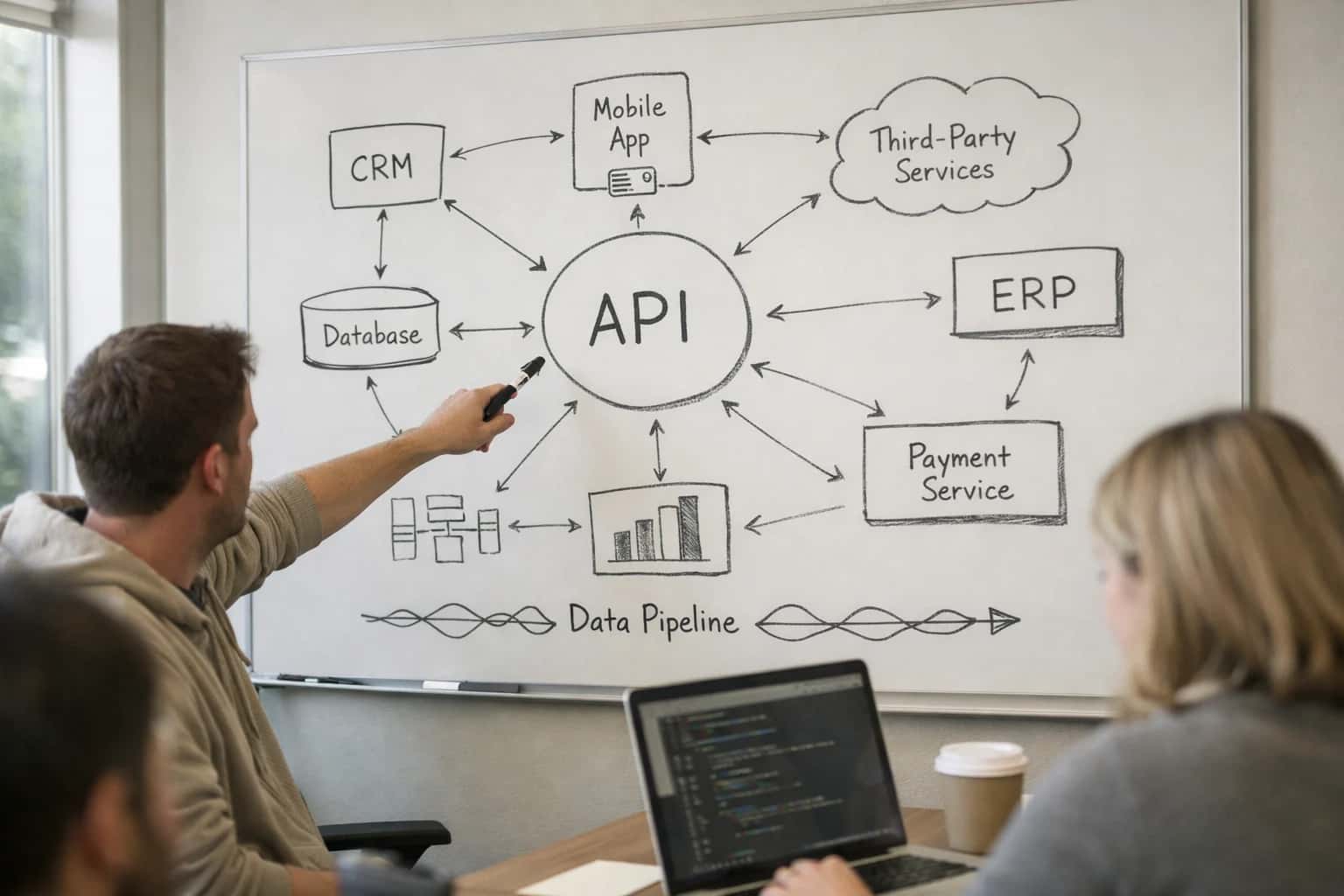
Where AI Fits into Odoo's Reconciliation Workflow
A technical blueprint for integrating AI agents into Odoo's bank reconciliation process to automate high-volume transaction matching.
High-value workflows include multi-currency reconciliation where the AI calculates the effective exchange rate for the statement date using Odoo's currency tables, and batch suggestion for end-of-day statement files with hundreds of lines. The impact is operational: reducing manual review from hours to minutes for businesses with high transaction volume, and minimizing the unreconciled items that bleed into the next accounting period. Implementation typically involves a dedicated Odoo module that adds an AI reconciliation panel, using Odoo's jsonrpc or direct ORM calls from a secure, containerized service. This keeps the core Odoo instance stable while the AI handles the computationally intensive matching logic.
Rollout should be phased, starting with a supervised learning period where the AI's suggestions require accountant approval via a custom chatter widget on the statement line. This builds trust and provides labeled data to fine-tune matching rules. Governance is critical: all AI suggestions and overrides must be logged to Odoo's mail.message or a custom audit model, preserving a clear trail for compliance. For production, the service should include circuit breakers to halt processing if match confidence scores drop below a threshold, ensuring no erroneous automated posts. This approach makes AI a copilot for the finance team, not a black-box replacement, fitting seamlessly into Odoo's existing validation and posting workflows.
Key Odoo Modules and APIs for AI Reconciliation
The Accounting Engine
Odoo's account module provides the foundational data model for reconciliation. Key objects include:
account.move(Journal Entries): The central transaction record. AI systems analyze these for potential matches against bank statement lines.account.move.line(Journal Items): The debit/credit lines within a move. AI matching logic operates at this granular level, examining partner, account, amount, and currency.account.journal: Defines the books (e.g., Bank, Cash, Sales). AI reconciliation typically targets thebankjournal type.account.reconcile.model: Odoo's native rule engine for simple auto-reconciliation. An AI layer can augment these rules with fuzzy matching and context-aware suggestions for complex, high-volume, or multi-currency transactions that the standard rules miss.
High-Value Use Cases for AI-Powered Reconciliation
Odoo's open API and modular design make it an ideal platform for embedding intelligent reconciliation. These use cases target specific workflows where AI reduces manual effort, improves accuracy, and accelerates the financial close.
Multi-Currency Transaction Matching
AI analyzes bank statement lines and Odoo's account.move records, using fuzzy logic on dates, amounts, and references to match transactions across different currencies. It accounts for exchange rate fluctuations and bank fees, proposing matches for review within the Bank Reconciliation widget, turning a manual, error-prone task into a guided review.
High-Volume Bank Feed Automation
For businesses with hundreds of daily transactions, AI acts as a pre-processor for Odoo's bank feeds. It clusters similar transactions, learns from past manual reconciliations to suggest rules, and flags outliers (e.g., duplicate debits, unusual amounts) before they hit the accountant's queue. Integrates via Odoo's account.bank.statement.line webhooks.
Purchase-to-Payment Reconciliation
Connects Odoo's purchase.order, account.move (bill), and bank payment records. AI performs a three-way match, verifying the bank payment against the approved bill and original PO. It automatically reconciles clean matches and creates a task in Odoo's Discuss app for the AP team to resolve discrepancies, closing the procurement loop.
Sales-to-Cash Application
AI matches incoming customer payments (from bank statements) to open account.move (invoice) records in Odoo. It handles partial payments, unapplied credits, and complex customer references. For unmatched cash, it suggests potential invoices based on customer payment history and creates draft reconciliation lines, dramatically reducing AR team's research time.
Intercompany Balance Reconciliation
For multi-company Odoo instances, AI automates the reconciliation of intercompany payable/receivable accounts (account.move.line). It identifies and pairs offsetting entries across companies, proposes eliminating journal entries, and generates a discrepancy report for any mismatches, streamlining the consolidation process for the group controller.
Reconciliation Exception Triage & Routing
AI classifies unreconciled items from automated runs (e.g., 'Bank Error', 'Missing Invoice', 'Payment on Account') and routes them to the appropriate team or individual in Odoo via automated tasks or Chatter messages. It enriches tasks with context from related records, ensuring the right person can resolve the issue without switching contexts.
Example AI Reconciliation Workflows
These workflows illustrate how AI agents can be integrated with Odoo's accounting and bank statement modules to automate high-volume reconciliation, reduce manual effort, and improve accuracy for multi-currency operations.
Trigger: A new bank statement line is imported into Odoo via an API-connected bank feed or uploaded CSV file.
Context/Data Pulled: The AI agent retrieves the new statement line details (amount, date, counterparty name, reference) and queries Odoo's account.move.line model for open customer invoices (account.move with type out_invoice), vendor bills (in_invoice), and journal items within a configurable date and amount tolerance window.
Model or Agent Action: A lightweight embedding model converts the statement line text (e.g., 'ACME Corp Invoice 1001') and Odoo transaction descriptions into vectors. A similarity search is performed against the vector store of open items. The agent evaluates the top candidate matches, checks for duplicate payment risks, and applies business rules (e.g., match to the oldest invoice first).
System Update: The agent calls Odoo's account.bank.statement.line API to create a proposed reconciliation, linking the statement line to the matched Odoo journal item(s). It adds a confidence score and matching rationale as a note.
Human Review Point: Proposals with a confidence score below a defined threshold (e.g., 92%) are flagged in a dedicated 'Review' queue within the Odoo reconciliation interface. The accountant can approve, reject, or manually match.
Implementation Architecture: Data Flow and System Design
A practical, event-driven architecture for deploying AI-powered bank reconciliation directly within Odoo's accounting workflow.
The integration is built on Odoo's webhook and API-first architecture. The core data flow begins when a new bank statement is imported or finalized in the account.bank.statement model. A webhook triggers the AI reconciliation service, which fetches the statement lines alongside candidate transactions from Odoo's account.move.line (journal items) for the relevant accounts and date range. The AI engine, typically a hosted service using models like OpenAI's GPT-4 or a fine-tuned classifier, analyzes each statement line's amount, date, counterparty name (from the statement narrative), and currency. It then performs a multi-stage match against the candidate pool: exact matches (amount, date, reference), fuzzy matches (amount with date tolerance, partial name similarity), and suggested matches for high-volume lines like recurring payments or bank fees, where the AI proposes the most likely Odoo partner and account based on historical patterns.
For each match, the service returns a structured payload to Odoo via its external API (/api/account.bank.statement.line). High-confidence matches (e.g., exact amount and reference) are posted automatically, creating the reconciliation (account.move.line.reconcile) and updating the statement line status. Lower-confidence suggestions are presented to the accountant within a custom Odoo module view as a review queue, showing the AI's reasoning and confidence score. The accountant can approve, reject, or manually correct the suggestion with a single click, which trains the model via feedback loops. For multi-currency transactions, the system consults Odoo's currency rate tables to normalize amounts before matching, and flags any rate discrepancies for review.
Rollout is phased: start with a single bank account and currency in a sandbox company to validate match accuracy and tune thresholds. Governance is managed through Odoo's built-in access controls (only users with the Accountant role see the AI queue) and a dedicated audit log model that records every AI-suggested match, the user action taken, and the final reconciliation state. This creates a clear trail for period-end reviews. The system is designed for resilience: if the AI service is unavailable, Odoo's standard manual reconciliation remains fully functional, and pending statements can be processed once connectivity is restored.
Code and Payload Examples
Core Matching Algorithm
The AI reconciliation system compares bank statement lines against Odoo's account.move.line records. It uses a multi-pass fuzzy matching strategy, prioritizing exact matches before falling back to probabilistic ones.
Key Matching Criteria:
- Amount & Date: Primary match on amount (± small tolerance for fees) and transaction date (± configurable days).
- Reference/Description: Semantic similarity between bank line description and Odoo move line
nameorreffields using embeddings. - Partner: If a partner is identified from the description, it's matched against Odoo's
res.partnerrecords.
Python Pseudocode for the matching engine:
pythondef find_candidate_matches(bank_line, odoo_unreconciled_lines): candidates = [] for odoo_line in odoo_unreconciled_lines: score = 0 # Amount match (with tolerance for bank fees) if abs(bank_line.amount - odoo_line.amount) <= config.amount_tolerance: score += 40 # Date proximity date_diff = abs((bank_line.date - odoo_line.date).days) if date_diff <= config.date_window: score += max(0, 30 - date_diff) # Decrease score with increasing diff # Description similarity via embeddings (e.g., OpenAI) desc_sim = get_similarity(bank_line.description, odoo_line.name) score += desc_sim * 30 if score > config.match_threshold: candidates.append({"odoo_line": odoo_line, "score": score}) return sorted(candidates, key=lambda x: x["score"], reverse=True)
This logic runs for each bank line, suggesting the top candidate(s) for accountant review or auto-reconciliation.
Realistic Time Savings and Operational Impact
This table illustrates the typical operational improvements when augmenting Odoo's standard reconciliation with an AI-powered matching system, based on implementations for mid-sized businesses with 500-5,000 monthly bank statement lines.
| Process Step | Manual / Standard Odoo | With AI-Powered Reconciliation | Implementation Notes |
|---|---|---|---|
Initial Transaction Matching | 2-4 hours per statement | 15-30 minutes per statement | AI suggests high-confidence matches; human reviews exceptions. |
Multi-Currency Line Handling | Manual rate lookup & calculation | Automated rate application & amount validation | Integrates with Odoo's currency module for live rates. |
Exception Identification & Triage | Manual scan for duplicates, outliers | Automated flagging with reason codes | Flags potential duplicates, unusual amounts, and missing partners. |
Unreconciled Items Workflow | Spreadsheet tracking, manual follow-up | Centralized dashboard with action items | Items are categorized (e.g., 'Needs Invoice', 'Bank Error') for assigned resolution. |
Audit Trail & Match Justification | Manual notes in Odoo chatter | Automated log with match score and rationale | Provides explainable audit trail for each suggested match. |
Month-End Close Bottleneck | Reconciliation often a 1-2 day delay | Reconciliation completed in same-day close | Enables faster financial reporting by accelerating the final reconciliation step. |
Team Skill Dependency | Requires experienced accountant | Junior staff can review & confirm AI suggestions | Reduces dependency on tribal knowledge for complex matching rules. |
Governance, Security, and Phased Rollout
A practical approach to deploying AI for bank reconciliation in Odoo with built-in oversight and incremental value.
A production-grade AI reconciliation system for Odoo must operate within the platform's existing security model and audit framework. This means the AI agent should be a credentialed Odoo user with permissions scoped to the account.bank.statement and account.move models, and all suggested matches and adjustments should be logged as activities or notes within the relevant Odoo records. The system's core logic—fetching statement lines via the Odoo API, calling the matching service, and posting suggestions back—should run in a secure, isolated environment. All data exchanges with external AI/ML services for fuzzy matching or multi-currency analysis should be encrypted, and no raw financial data should persist in external systems beyond the transaction lifetime.
A phased rollout is critical for user adoption and risk management. Start with a shadow mode where the AI processes statements and generates match suggestions in a separate dashboard without making any changes to Odoo's live accounting data. This allows reconciliation clerks to review AI performance and build trust. Phase two introduces assisted reconciliation, where the AI presents ranked suggestions directly within the Odoo bank reconciliation interface, requiring a user to accept each match. The final phase enables auto-reconciliation for high-confidence matches (e.g., perfect amount, date, and reference number), but only for a defined set of trusted bank accounts and within configurable transaction amount limits. All auto-matched transactions must be flagged in Odoo for easy audit and reversal.
Governance is maintained through Odoo's native tools. Use Odoo's Approval Workflows to require a supervisor's sign-off for any AI-suggested journal entry that falls outside pre-defined rules (e.g., matches over a certain amount, or matches creating new partners). Implement daily reconciliation exception reports sent to the finance manager, highlighting unmatched lines, low-confidence AI suggestions, and any overrides made by users. This creates a closed-loop control system where the AI augments the team's efficiency while the finance team retains full visibility and control over the general ledger.
Enabling Efficiency, Speed & Accuracy
Intelligent Analysis, Decision & Execution
We build AI systems for teams that need search across company data, workflow automation across tools, or AI features inside products and internal software.
Talk to Us
Search across company data
Give teams answers from docs, tickets, runbooks, and product data with sources and permissions.
Useful when people spend too long searching or get different answers from different systems.

Automate internal workflows
Use AI to route work, draft outputs, trigger actions, and keep approvals and logs in place.
Useful when repetitive work moves across multiple tools and teams.

Add AI to products and internal tools
Build assistants, guided actions, or decision support into the software your team or customers already use.
Useful when AI needs to be part of the product, not a separate tool.
Frequently Asked Questions
Practical questions for architects and finance leads planning an AI-powered bank reconciliation system for Odoo. Focused on multi-currency handling, data flows, and production rollout.
The integration connects at two primary layers within Odoo's architecture:
-
API Layer for Transaction Data: The agent uses Odoo's External API (XML-RPC or JSON-RPC) to fetch unreconciled bank statement lines (
account.bank.statement.line) and the corresponding pool of candidate transactions fromaccount.move.line(Journal Items). Key filters include date ranges, amounts, currencies, and partner IDs to narrow the search space. -
Webhook for Real-Time Processing: For high-volume environments, we configure Odoo to send a webhook payload to our agent service whenever a new bank statement line is imported or created. The payload includes the line ID, amount, currency, and date. The agent processes it and posts back match suggestions via API.
Example Payload for a Candidate Search:
python# Agent queries Odoo for potential matches for a statement line candidate_moves = odoo_client.execute_kw( 'account.move.line', 'search_read', [[ ('account_id.reconcile', '=', True), ('reconciled', '=', False), ('date', '<=', statement_line_date), ('company_id', '=', statement_line_company_id), '|', ('amount_residual', '=', line_amount), # Exact match ('amount_residual', 'in', [line_amount * 0.99, line_amount * 1.01]) # Fuzzy match ]], {'fields': ['id', 'name', 'date', 'amount_residual', 'partner_id', 'currency_id']} )
The agent then uses this context, plus historical match patterns, to rank and suggest the most probable match.

About the author
Prasad Kumkar
CEO & MD, Inference Systems
Prasad Kumkar is the CEO & MD of Inference Systems and writes about AI systems architecture, LLM infrastructure, model serving, evaluation, and production deployment. Over 5+ years, he has worked across computer vision models, L5 autonomous vehicle systems, and LLM research, with a focus on taking complex AI ideas into real-world engineering systems.
His work and writing cover AI systems, large language models, AI agents, multimodal systems, autonomous systems, inference optimization, RAG, evaluation, and production AI engineering.
Partnered with leading AI, data, and software stack.





How We Work
Custom AI workflows for your Business
One-fit-all AI don't work for modern businesses. At Inferensys, we aim to understand your business & custom requirements; which we use to define most efficient agentic workflows, the data, and the tools for your business.
01
Review the use case
We understand the task, the users, and where AI can actually help.
Read more02
Pick the right approach
We define what needs search, automation, or product integration.
Read more03
Build the first useful version
We implement the part that proves the value first.
Read more04
Improve from there
We add the checks and visibility needed to keep it useful.
Read moreThe first call is a practical review of your use case and the right next step.
Talk to Us