
Inferensys

Integration

AI-Powered Financial Close for Odoo

Automate the manual, error-prone month-end close in Odoo using AI to verify moves, propose adjustments, and lock periods, reducing close time from days to hours for product businesses.
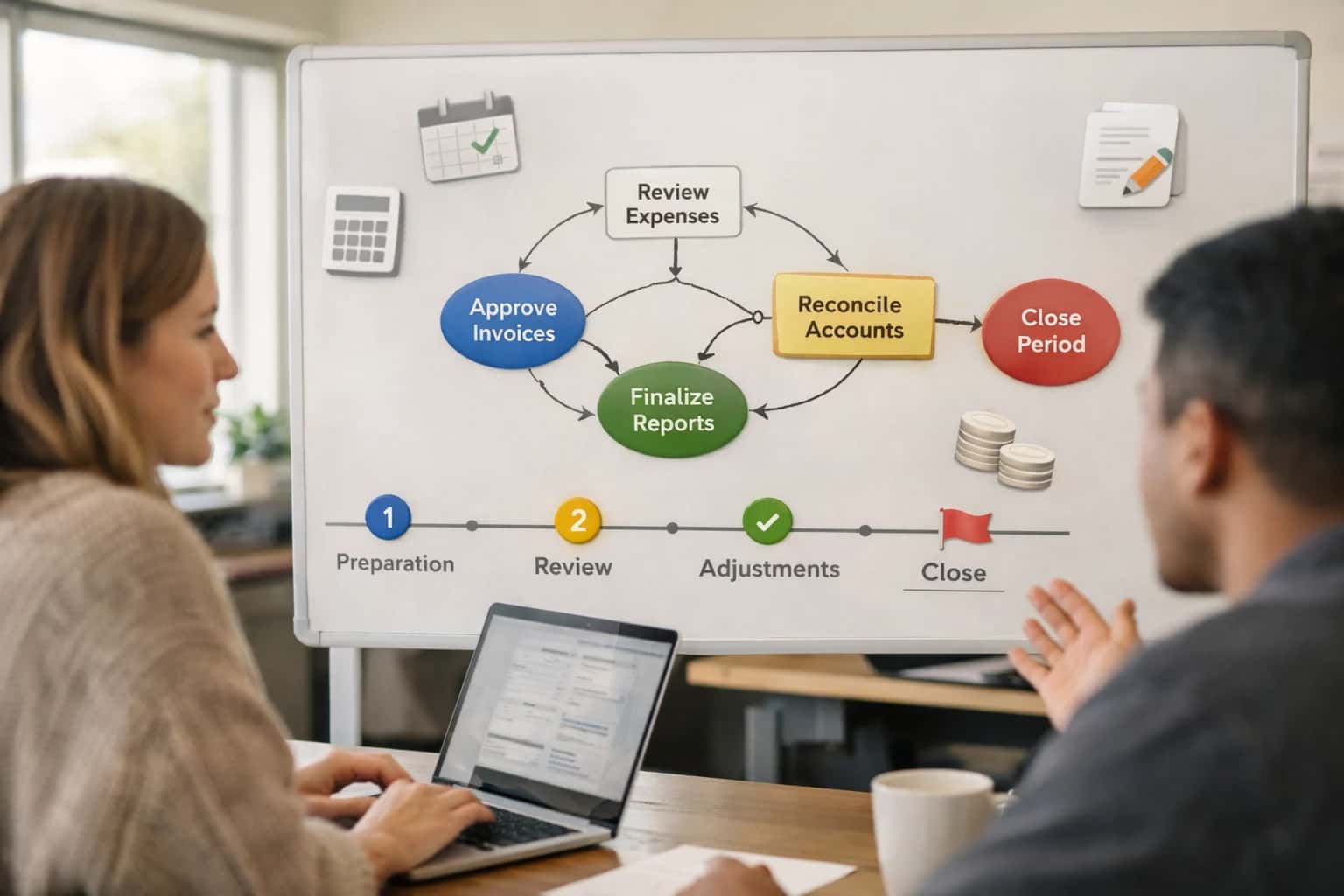
Accountant using AI for financial close automation, accounting software on screen, home office evening work session.
ARCHITECTURE AND ROLLOUT

Where AI Fits in Odoo's Financial Close

A practical blueprint for integrating AI agents into Odoo's accounting modules to automate and secure the period-end close.

The financial close in Odoo is a multi-step workflow across its Accounting, Invoicing, and Bank Reconciliation apps. AI fits into this process by acting as a systematic orchestrator and reviewer, targeting key surfaces:

  • Journal Entry Validation: Scanning the account.move model to verify all period transactions are posted and correctly dimensioned.
  • Reconciliation Review: Analyzing account.bank.statement.line records to identify and propose matches for unreconciled transactions.
  • Trial Balance Analysis: Querying the account.account and account.move.line models to detect unusual balances or missing accruals before locking.

Implementation typically involves a dedicated AI service layer that polls Odoo's REST API or listens for webhooks on key events (e.g., account.move.post). This service runs validation agents that:

  1. Execute pre-close checks against a configurable rule set.
  2. Generate a summary report of proposed adjusting entries (e.g., for prepaid expenses or accrued revenue) as draft journal entries in Odoo.
  3. Initiate approval workflows via Odoo's built-in chatter or dedicated approval apps, ensuring human oversight. The impact is a shift from a manual, sequential review to a parallel, AI-assisted verification, reducing the close timeline from days to hours for product businesses.

Rollout should be phased, starting with a single entity or subsidiary. Governance is critical: all AI-proposed entries must be logged in a custom ai.audit.trail model with traceability back to the source data and prompting logic. The final step—period locking via the account.period object—should remain a manual, role-based control (RBAC) action. This architecture ensures AI augments the finance team's control, rather than bypassing it, making the close process both faster and more auditable.

AI-POWERED FINANCIAL CLOSE

Odoo Modules and Surfaces for AI Integration

Core GL and Period Management

The Accounting module (account) is the primary surface for automating the financial close. AI integration focuses on the Journal Entries model (account.move) and the Fiscal Periods (account.fiscal.year and account.period).

Key automation points:

  • Journal Entry Validation: Use AI to scan unposted moves (state='draft') at period-end, checking for missing accounts, unbalanced debits/credits, or unusual amounts against historical patterns.
  • Adjusting Entry Proposals: Based on reconciled bank statements (account.bank.statement) or unreconciled items, AI can suggest and draft adjusting entries directly in Odoo.
  • Period Locking: Trigger automated closure workflows via the write method on period objects to prevent post-closing modifications, ensuring audit integrity.

Integration is typically via Odoo's External API (XML-RPC/JSON-RPC) or by developing a custom module that injects AI logic into the validate and post methods of the accounting models.

WORKFLOW AUTOMATION

High-Value Use Cases for AI in Odoo Close

Integrate AI agents directly into Odoo's accounting modules to automate the period-end close, reduce manual errors, and provide real-time visibility for finance teams in product businesses.

01

Automated Journal Entry Verification

AI reviews all posted moves (account.move) before period lock, flagging entries missing required fields, incorrect tax codes, or unusual amounts. It suggests corrections and creates a verification report for the controller.

Hours -> Minutes
Review time
02

Intelligent Bank Reconciliation

Agent connects to bank APIs or ingests statements, then matches transactions to Odoo's account.bank.statement.line at scale. It learns from manual overrides to improve future matches and highlights unreconciled items for priority review.

Batch -> Real-time
Matching cadence
03

AI-Powered Adjusting Entry Proposals

Analyzes trial balance variances and open items (prepayments, accruals) to propose adjusting journal entries. The agent drafts entries in a review queue within the account.journal module, complete with supporting calculations and audit notes.

04

Multi-Company Consolidation Support

For businesses using Odoo's multi-company features, AI automates the aggregation and elimination of intercompany transactions. It prepares consolidation worksheets and ensures all child company periods are closed before the parent.

1 sprint
Typical setup
05

Close Checklist Orchestration

An AI workflow engine manages the entire close sequence. It triggers tasks (run depreciation, review AR aging), assigns them to team members via Odoo's messaging, verifies completion, and only then allows the period lock via account.period.

06

Anomaly & Risk Reporting

Continuously monitors the GL (account.move.line) for anomalies like duplicate vendor payments, unusual inventory write-offs, or margin deviations. Generates a pre-close risk report emailed to the CFO, linking directly to suspicious records.

FOR ODOO ACCOUNTING

Example AI-Driven Close Workflows

These workflows illustrate how AI agents can orchestrate and accelerate the financial close process in Odoo, reducing manual effort and closing the books faster for product businesses.

Trigger: Scheduled nightly during the close period.

Context Pulled: The AI agent queries Odoo's account.move model for all draft journal entries (state='draft') created in the period, along with linked documents (e.g., stock.picking for inventory, sale.order for sales).

Agent Action:

  1. Validates each entry against configured business rules (e.g., debit/credit balance, required analytic account tags for projects, tax account mapping).
  2. Cross-references entries with source documents to ensure amounts and dates match.
  3. For entries with missing information, the agent can query related models or use a small language model (LLM) to analyze the entry description and suggest the correct account or analytic tag.

System Update: Entries that pass validation are automatically posted (state='posted'). Entries with issues are flagged in a dedicated Odoo chatter thread on the journal entry with a clear explanation (e.g., "Missing analytic tag for Project X") and assigned to the responsible accountant.

Human Review Point: All flagged entries require manual review and correction before the agent will attempt to post them again.

A PRODUCTION-READY BLUEPRINT

Implementation Architecture: Data Flow and Guardrails

A secure, auditable architecture for automating Odoo's financial close with AI agents.

The integration connects to Odoo's External API and webhook system to create a closed-loop automation layer. Core data flows include:

  • Ingestion: AI agents poll the account.move and account.move.line models for unposted journal entries at period-end, and fetch account.bank.statement data for reconciliation status.
  • Processing: Using a dedicated vector database for historical context, agents analyze entries for completeness, propose necessary adjusting journal entries (AJEs) based on accrual and deferral patterns, and validate that all subsidiary ledgers tie to the general ledger.
  • Action: Approved proposals are written back to Odoo via API to create draft journal entries. The agent can then execute the period locking sequence by calling the res.company model's fiscalyear_lock_date field, but only after a defined approval workflow is satisfied.

Guardrails are engineered at multiple levels to ensure control and auditability. The system employs:

  • Role-Based Access Control (RBAC): AI agent permissions are scoped via Odoo's API keys, mirroring user groups (e.g., Accountant, Adviser), preventing unauthorized writes.
  • Human-in-the-Loop Approvals: All proposed AJEs and the final lock command are routed through a configurable approval queue, which can be managed within Odoo's mail.activity system or a separate dashboard.
  • Immutable Audit Trail: Every agent action—data fetch, analysis, proposal, and write-back—is logged with a full context payload to a separate audit table (ai_agent_audit_log), creating an immutable record for compliance and debugging.
  • Fallback & Rollback Procedures: The architecture includes idempotent operations and snapshotting of the account.move state before any batch operations, enabling safe rollback if a proposed batch of entries fails validation.

Rollout follows a phased, zero-disruption pattern. Implementation typically starts in a parallel audit mode, where agents analyze and propose close actions but require manual execution in Odoo for several cycles. This builds trust and refines prompt logic. Governance is maintained by treating the AI agent's prompts, logic rules, and model context as version-controlled assets, allowing finance controllers to review and approve changes to the 'close logic' just as they would a manual closing checklist. The final architecture doesn't replace the accountant; it automates the procedural heavy-lifting, shifting their role to exception handling and strategic analysis.

ODOO FINANCIAL CLOSE WORKFLOWS

Code and Payload Examples

Validating Unposted Moves at Period End

Before locking a period, an AI agent can query Odoo's account.move model to identify any draft or posted moves that are missing required fields or have unbalanced debits/credits. The agent uses Odoo's ORM via XML-RPC or the JSON-RPC API to fetch records, applies validation logic, and returns a structured report for review.

Example Python call to fetch and validate moves:

python
import xmlrpc.client

# Connect to Odoo API
url = 'https://your-odoo-instance.com'
db = 'your_database'
username = 'api_user'
password = 'api_key'

common = xmlrpc.client.ServerProxy(f'{url}/xmlrpc/2/common')
uid = common.authenticate(db, username, password, {})
models = xmlrpc.client.ServerProxy(f'{url}/xmlrpc/2/object')

# Search for draft moves in the closing period
period_id = 25  # Target closing period
move_ids = models.execute_kw(db, uid, password,
    'account.move', 'search',
    [[['state', '=', 'draft'], ['date', '<=', '2024-03-31']]]
)

# Read move details for AI analysis
move_details = models.execute_kw(db, uid, password,
    'account.move', 'read',
    [move_ids, ['name', 'date', 'journal_id', 'line_ids']]
)

# AI validation logic would analyze `move_details`
# Returns list of moves needing attention

This script retrieves all draft journal entries for a given period-end date. An AI layer would then analyze each entry's lines for common close errors (e.g., missing analytic tags, unbalanced amounts, incorrect account types) and flag them for the accountant.

AI-AUGMENTED CLOSE WORKFLOWS

Realistic Time Savings and Operational Impact

How AI integration transforms the manual, error-prone period-end close in Odoo into a streamlined, controlled process for product businesses.

Close TaskManual Process (Before AI)AI-Augmented Process (After AI)Key Impact & Notes

Transaction Verification & Posting

Manual review of journals, sales, and purchase registers for unposted moves.

AI agent scans all modules, flags exceptions, and proposes batch posting actions.

Reduces review time from hours to minutes; ensures no move is missed before lock.

Bank & Credit Card Reconciliation

Line-by-line matching of statement lines to Odoo bank transactions.

AI suggests high-confidence matches; accountant reviews and confirms exceptions.

Cuts reconciliation effort by 60-70%; focuses human effort on complex discrepancies.

Accrual & Prepayment Adjustments

Manual calculation and journal entry creation based on spreadsheets.

AI analyzes open POs, contracts, and bills to propose adjusting entries with correct accounts/dimensions.

Standardizes accrual logic; reduces entry errors and prep time by 50%.

Intercompany & Multi-Company Eliminations

Manual consolidation entries prepared in spreadsheets outside Odoo.

AI identifies intercompany transactions across Odoo databases and generates elimination entries.

Automates a high-risk, tedious task; ensures accurate consolidated reporting.

Trial Balance Review & Variance Analysis

Manual P&L and Balance Sheet review to spot unusual fluctuations.

AI runs anomaly detection on account balances, highlights variances > threshold, and provides narrative explanation.

Shifts focus from finding issues to analyzing root causes; provides audit-ready documentation.

Period Lock & User Access Control

Manual checklist verification before locking periods in Settings.

AI workflow orchestrator confirms all tasks are complete, then prompts for final lock and restricts posting permissions.

Enforces close discipline; prevents post-close adjustments without proper oversight.

Close Package & Reporting

Manual compilation of reports, supporting schedules, and checklists for stakeholders.

AI auto-generates close package (TB, key reports, variance summaries) and distributes via configured channels.

Delivers consistent close documentation same-day instead of next-day; improves stakeholder communication.

OPERATIONALIZING AI FOR THE FINANCIAL CLOSE

Governance, Security, and Phased Rollout

A controlled, audit-ready approach to deploying AI agents within Odoo's accounting workflow.

A production AI integration for Odoo's financial close must respect the platform's data model and user permissions. Implementation typically involves creating a dedicated Odoo user for the AI agent with role-based access control (RBAC) scoped to the account.move, account.journal, and account.account objects. All AI-suggested adjusting entries are written to a staging area like a custom Draft Journal model, requiring manual review and approval by a designated accountant before posting to the live ledger. This creates a clear, immutable audit trail within Odoo's native logging system, linking every AI action to a human approver.

Security is managed at the API and data layer. The AI service authenticates via Odoo's OAuth 2.0 or API keys, with all communication encrypted in transit. Sensitive financial data is never persisted in the AI system's vector stores for training; context is retrieved in real-time via Odoo's ORM or REST API for a specific task and then discarded. For multi-company setups, the AI agent's access is scoped per-company database to enforce data isolation, mirroring Odoo's own multi-tenant architecture.

A phased rollout minimizes risk and builds user trust. Phase 1 targets read-only analysis: the AI reviews unposted moves and reconciliation status, generating a daily "Close Readiness" report in Odoo's messaging system. Phase 2 introduces supervised automation: the AI proposes draft adjusting entries for prepaid expenses or accrued revenue, which are pushed to the staging area for accountant approval. Phase 3 enables closed-loop automation for low-risk, repetitive tasks like period locking after all validations pass. Each phase includes user training and feedback loops via Odoo's Discuss module, ensuring the AI augments—rather than disrupts—the existing finance team's workflow.

IMPLEMENTATION AND WORKFLOW

Frequently Asked Questions

Common questions about integrating AI agents into Odoo's accounting module to automate and secure the financial close process.

The AI agent executes a multi-step verification workflow via Odoo's API:

  1. Trigger: Scheduled daily during the close window or manually initiated by the controller.
  2. Context Pull: The agent queries Odoo's account.move model with filters for the period in question (state='posted', date within period). It also fetches the list of all journals (account.journal) configured for the company.
  3. Agent Action: The agent cross-references the posted entries against the journal list, identifying any journals with zero posted moves. It then runs a secondary check for draft or unposted entries that reference the closing period.
  4. System Update: The agent logs its findings in a dedicated ai.close.audit model (a custom Odoo object we create). If all journals are clear, it updates the period's checklist. If gaps are found, it creates a follow-up task in Odoo's Project app or sends a notification to the responsible accountant.
  5. Human Review Point: The agent does not auto-post entries. It flags discrepancies for human review, providing a direct link to the problematic journal or draft entry within Odoo.
Prasad Kumkar

About the author

Prasad Kumkar

CEO & MD, Inference Systems

Prasad Kumkar is the CEO & MD of Inference Systems and writes about AI systems architecture, LLM infrastructure, model serving, evaluation, and production deployment. Over 5+ years, he has worked across computer vision models, L5 autonomous vehicle systems, and LLM research, with a focus on taking complex AI ideas into real-world engineering systems.

His work and writing cover AI systems, large language models, AI agents, multimodal systems, autonomous systems, inference optimization, RAG, evaluation, and production AI engineering.



