AI integrates with QuickBooks Online primarily through its REST API, webhooks, and the Intuit Developer ecosystem. The key surfaces for automation are the platform's core transactional modules: Invoices, Bills, Bank Transactions (Bank Feeds), Journal Entries, and Reports. An effective integration layers AI agents on top of these APIs to handle tasks like categorizing uncoded bank transactions, drafting invoice reminders based on AR aging data, extracting line-item details from uploaded vendor bills, and generating narrative explanations for profit-and-loss variances. This turns QuickBooks from a system of record into an intelligent, proactive financial assistant.

Integration
AI Integration for QuickBooks Online
A practical blueprint for connecting AI to QuickBooks Online's API to automate bookkeeping, invoice processing, and financial reporting for SMBs and accounting firms.
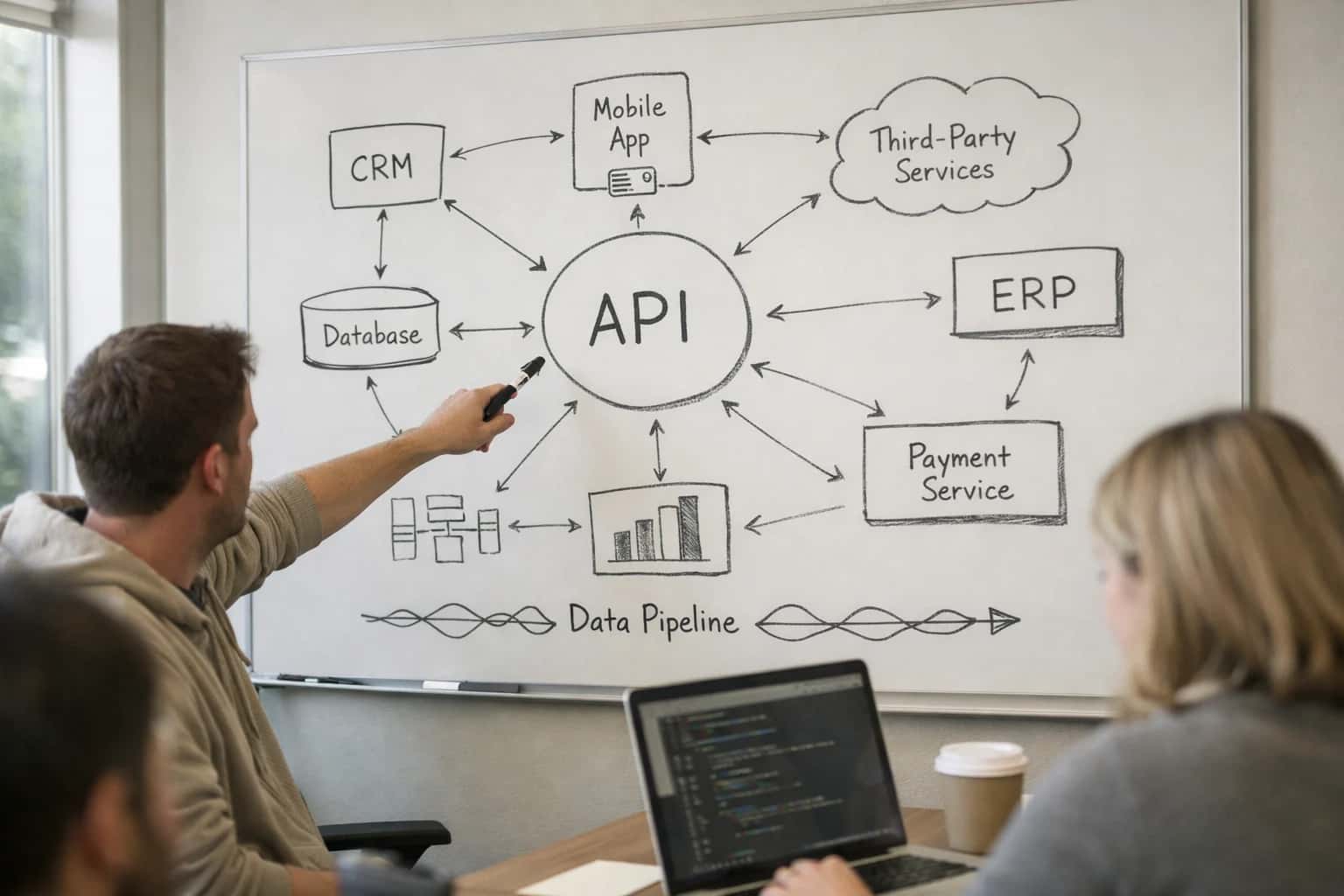
ARCHITECTURE AND ROLLOUT
Where AI Fits into QuickBooks Online
A practical blueprint for connecting AI to QuickBooks Online's API to automate bookkeeping, enhance reporting, and streamline financial operations.
A production implementation typically involves a middleware layer that subscribes to QuickBooks webhooks for events like Invoice.created or Payment.updated. This layer uses AI to process the event—for example, using an LLM to analyze a new bill's description and suggest the correct Account and Class—and then posts the enriched data back via the API. For workflows like month-end close, an AI orchestration agent can call the Reports API to fetch a TrialBalance, identify unreconciled items or rounding errors, and create a checklist for the accountant. Governance is critical: all AI-suggested entries should be logged in a separate audit trail and, for material amounts, require human-in-the-loop approval before posting to the live QuickBooks company file.
Rollout should start with a single, high-volume workflow to demonstrate value and build trust. A common starting point is AI-powered bank reconciliation, where the system matches bank statement lines to open invoices and bills, presenting matches and exceptions in a dedicated UI for the bookkeeper to review. This reduces manual effort from hours to minutes while keeping the accountant in control. Successful adoption depends on configuring the AI with your chart of accounts and business rules, and establishing clear RBAC so that only authorized users can approve AI-generated journal entries or send automated communications to customers.
AI-READY API ENDPOINTS
Key Integration Surfaces in QuickBooks Online
Automate Bookkeeping and Categorization
The Transaction API (/v3/company/{realmId}/journalentry, /purchase, /invoice) is the primary surface for AI-driven bookkeeping. This is where AI agents read and write to the general ledger.
Typical AI Workflows:
- Automated Categorization: Ingest uncategorized bank transactions via the
BankTransactionendpoint and apply AI to suggest or post the correct account, class, and customer/vendor. - Journal Entry Drafting: Generate adjusting or recurring journal entries based on rules or natural language instructions, using the
JournalEntryobject for audit-compliant posting. - Anomaly Detection: Continuously monitor posted transactions for duplicates, unusual amounts, or out-of-policy entries by polling these endpoints.
Implementation Note: Use webhooks on the Purchase, Invoice, and JournalEntry entities to trigger real-time AI review as transactions are created or updated, enabling same-day cleanup instead of month-end reconciliation.
INTEGRATION BLUEPRINTS
High-Value AI Use Cases for QuickBooks
Practical AI integration patterns that connect directly to QuickBooks Online's API to automate high-effort workflows, reduce manual data entry, and provide real-time financial insights for SMB owners and accounting teams.
01
Automated Transaction Categorization & Cleanup
AI agents monitor the bank feed and credit card imports via the Banking API, applying learned rules to categorize transactions, suggest payees, and flag uncategorized items for review. This reduces daily bookkeeping from hours to minutes and ensures a clean GL.
Hours -> Minutes
Daily bookkeeping
02
Intelligent Invoice Processing & AR Follow-up
Integrate AI with the Sales API (Invoices, Estimates) and Email to draft invoices from project data, send automated payment reminders based on aging reports, and apply cash receipts. Agents can prioritize collections by customer risk score.
Batch -> Real-time
Collections workflow
03
AI-Powered Anomaly & Fraud Detection
Continuously analyze the Transaction, Bill, and Vendor APIs to establish baselines and flag anomalies like duplicate payments, unusual vendor activity, or expense spikes. Alerts are routed via webhook to Slack or email for immediate controller review.
Same day
Issue identification
04
Automated Month-End Close Assistance
Orchestrate the closing checklist by querying the Reports API for reconciliation status, suggesting adjusting journal entries via the JournalEntry API, and verifying all sub-ledgers are locked. This provides an audit trail and reduces close cycle time.
1 sprint
Implementation timeline
05
Narrative Financial Reporting & Insights
AI systems query the Reports API (Profit & Loss, Balance Sheet) and use LLMs to generate plain-English executive summaries, explain variances to budget/forecast, and highlight key cash flow drivers—automating report distribution to stakeholders.
Daily
Insight generation
06
Document Intelligence for AP Automation
Deploy OCR + NLP models to extract data from vendor invoices and receipts emailed to a dedicated inbox. AI matches line items to Purchase objects or suggests new vendors, then creates Bills via the API for approval, slashing manual data entry.
80%+
Data entry reduction
QUICKBOOKS ONLINE INTEGRATION PATTERNS
Example AI-Powered Workflows
These concrete workflows illustrate how AI agents connect to QuickBooks Online's API to automate high-volume, manual finance tasks. Each pattern shows the trigger, data flow, AI action, and system update.
Trigger: A new bank deposit transaction appears in the connected bank feed via the QBO Bank Feeds API.
Context Pulled: The AI agent retrieves:
- The deposit details (amount, date, payer name from memo line).
- A list of open invoices for the last 90 days from the
InvoiceAPI endpoint, filtered by customer.
AI Agent Action:
- Uses fuzzy matching on payer name and amount to identify the most likely invoice(s).
- If a single invoice matches, it creates a
Paymentobject. - If a partial payment or multiple invoices are possible, it generates a summary for human review, flagging the uncertainty.
System Update:
- For clear matches, the agent automatically posts the
Paymentvia the QBO API, applying it to the correct invoice and updating the AR aging report. - A log entry is created in an external audit table recording the match confidence and action taken.
Human Review Point: All matches below a 95% confidence threshold are routed to a "Needs Review" queue in a connected task management system (e.g., Asana) for an accounts receivable clerk to verify.
CONNECTING AI AGENTS TO THE QUICKBOOKS ONLINE API
Implementation Architecture & Data Flow
A production-ready integration pattern for adding AI to QuickBooks Online's core modules without disrupting existing workflows.
The integration connects via QuickBooks Online's REST API v3 and Webhooks, typically using a middleware layer (like an n8n or custom Node.js service) to orchestrate AI agents. Key data objects for AI interaction include Invoices, Bills, JournalEntries, Customers, Vendors, and the Reports API. The flow is event-driven: a new bill upload triggers an OCR agent, the extracted data is validated against the Vendor and Purchase records, and a draft Bill object is created in QuickBooks for approval. For bookkeeping, a scheduled agent reviews uncategorized transactions from the BankFeed, suggests accounts based on historical patterns and vendor names, and posts JournalEntry suggestions to a review queue.
High-impact workflows are built around specific surfaces: Bank Reconciliation agents use fuzzy matching algorithms on transaction descriptions and amounts; Collections agents query the Accounts Receivable Aging Detail Report, segment customers by risk, and draft follow-up emails logged as Customer notes; Month-End Close agents orchestrate a checklist by calling the Trial Balance Report, identifying unreconciled accounts, and prompting the accountant for adjusting entries. Each agent action is logged with a Reference ID back to the QuickBooks transaction for a full audit trail. Governance is managed through a human-in-the-loop pattern, where all AI-proposed entries above a configurable threshold (e.g., $500) or for new vendors require manual approval within QuickBooks before posting.
Rollout follows a phased approach: start with read-only agents for anomaly detection on the GeneralLedger feed, then progress to assisted writing for transaction categorization, and finally to autonomous agents for high-volume, rule-based tasks like payment application. The architecture is designed for resilience—failed API calls are queued for retry, and all AI-generated content is versioned and stored externally. This approach allows finance teams to incrementally automate repetitive tasks like data entry and initial review, shifting focus to exception handling and strategic analysis, while maintaining strict control over the financial data within QuickBooks' native permission and audit systems.
QUICKBOOKS ONLINE
Code & API Integration Patterns
Automating Core Bookkeeping
The QuickBooks Online API provides robust endpoints for managing transactions, which are the primary surface for AI-driven bookkeeping agents. Use the JournalEntry and Purchase objects to post automated entries and bills.
A typical AI workflow involves:
- Ingesting raw data from bank feeds, emails, or document scans.
- Classifying and coding transactions using an LLM, referencing vendor history and account mappings.
- Creating and posting the validated entry via the API.
Key endpoints include POST /v3/company/{realmId}/journalentry and POST /v3/company/{realmId}/purchase. Implement idempotency keys to prevent duplicate postings from retries. This pattern is foundational for services like AI-Powered Bookkeeping for QuickBooks.
python# Example: Post an AI-suggested Journal Entry import requests headers = { 'Authorization': 'Bearer {ACCESS_TOKEN}', 'Accept': 'application/json', 'Content-Type': 'application/json', 'Request-Id': 'idempotency_key_123' # Prevent duplicates } journal_entry_payload = { "Line": [ { "DetailType": "JournalEntryLineDetail", "Amount": 250.00, "JournalEntryLineDetail": { "PostingType": "Credit", "AccountRef": {"value": "42"} # Accounts Payable } }, { "DetailType": "JournalEntryLineDetail", "Amount": 250.00, "JournalEntryLineDetail": { "PostingType": "Debit", "AccountRef": {"value": "80"} # Office Supplies Expense } } ] } response = requests.post( f'https://quickbooks.api.intuit.com/v3/company/{realmId}/journalentry', headers=headers, json=journal_entry_payload )
AI INTEGRATION FOR QUICKBOOKS ONLINE
Realistic Time Savings & Business Impact
A practical comparison of manual workflows versus AI-augmented processes, showing realistic efficiency gains for SMB owners and accounting teams.
| Process | Manual Workflow | AI-Augmented Workflow | Impact & Notes |
|---|---|---|---|
Transaction Categorization | Manual review of bank feed lines, 2-3 hours/week | AI suggests codes, human approves, 30-45 minutes/week | Reduces data entry fatigue; learns from corrections |
Invoice Data Entry | Manual keying from PDF/email, 5-10 min per invoice | AI extracts line items & totals, human verifies, 1-2 min per invoice | Eliminates typos; frees time for vendor relationship management |
Month-End Reconciliation | Line-by-line matching, 4-8 hours per period | AI matches 80-90% of transactions, flags exceptions, 1-2 hours | Accelerates close; provides audit-ready exception report |
Expense Report Auditing | Visual receipt review against policy, 15+ min per report | AI scans receipts, flags policy violations, 2-3 min per report | Ensures consistent policy enforcement; reduces reimbursement delays |
Financial Report Generation | Manual data pull, spreadsheet manipulation, 2-3 hours | AI queries Reporting API, drafts narrative summary, 30 min review | Shifts effort from data gathering to insight analysis |
Collections Triage | Manual review of AR aging report to prioritize calls | AI scores customer risk, suggests contact sequence, daily digest | Focuses collector effort on highest-risk accounts |
1099/Year-End Prep | Manual vendor review and data compilation, 1-2 days | AI identifies reportable vendors, pre-fills forms, 2-4 hours | Reduces compliance risk and last-minute scramble |
PRODUCTION-READY IMPLEMENTATION
Governance, Security & Phased Rollout
A secure, governed rollout of AI for QuickBooks Online requires careful planning around data access, user permissions, and incremental value delivery.
A production integration must respect QuickBooks Online's data model and API limits. This means architecting around the JournalEntry, Invoice, Bill, and Purchase objects with proper error handling for rate limits. Security is paramount: AI agents should operate under a dedicated, scoped OAuth 2.0 app with permissions limited to specific endpoints (e.g., com.intuit.quickbooks.accounting for write access). All AI-initiated writes should be logged in a separate audit trail, referencing the source transaction ID and the agent's reasoning, before syncing back to QuickBooks via POST or PATCH calls.
We recommend a phased rollout to manage risk and demonstrate value:
- Phase 1: Read-Only Analysis & Alerts. Deploy agents that consume webhooks for new transactions and bank feeds to provide categorization suggestions and anomaly flags via a separate dashboard, with no writes back to QuickBooks.
- Phase 2: Assisted Write-Back with Human Approval. Implement a workflow where AI proposes journal entries or invoice coding, but a bookkeeper must approve each action in a queue before the system executes the API call to QuickBooks.
- Phase 3: Conditional Autopilot for Low-Risk Tasks. For trusted rules (e.g., categorizing recurring vendor bills under $500), enable fully automated write-back, with daily summary reports sent to the finance controller for oversight.
Governance extends to the AI models themselves. Use a structured prompt management system to ensure consistency in tasks like transaction description normalization or expense category mapping. Implement a feedback loop where bookkeepers can correct AI suggestions, which then retrains the underlying rules or fine-tunes the model. This controlled, iterative approach minimizes disruption, builds trust with the finance team, and ensures the AI augments—rather than replaces—the critical human oversight required in accounting. For related architectural patterns, see our guide on AI-Powered Bank Reconciliation for QuickBooks.
Enabling Efficiency, Speed & Accuracy
Intelligent Analysis, Decision & Execution
We build AI systems for teams that need search across company data, workflow automation across tools, or AI features inside products and internal software.
Talk to Us
Search across company data
Give teams answers from docs, tickets, runbooks, and product data with sources and permissions.
Useful when people spend too long searching or get different answers from different systems.
Enterprise searchRAGPermissions
Read more
Automate internal workflows
Use AI to route work, draft outputs, trigger actions, and keep approvals and logs in place.
Useful when repetitive work moves across multiple tools and teams.
AI agentsWorkflow automationGovernance
Read more
Add AI to products and internal tools
Build assistants, guided actions, or decision support into the software your team or customers already use.
Useful when AI needs to be part of the product, not a separate tool.
AI integrationDecision supportModel routing
Read moreAI INTEGRATION FOR QUICKBOOKS ONLINE
Frequently Asked Questions
Practical answers for technical buyers and finance leaders evaluating how to add AI agents and automation to QuickBooks Online's accounting workflows.
AI integrations connect to QuickBooks Online via its official REST API using OAuth 2.0 for secure, token-based authentication. Implementation follows a least-privilege model:
- Scoped Permissions: The integration requests only the necessary scopes (e.g.,
com.intuit.quickbooks.accountingfor transactions,com.intuit.quickbooks.paymentfor invoices). - API Gateway & Rate Limiting: All calls are routed through a managed gateway that handles Intuit's rate limits, request queuing, and automatic retries.
- Data Residency & Encryption: Customer data is processed in-memory or within your designated cloud environment; PII is never stored in our models. All data in transit is encrypted via TLS 1.2+.
- Audit Logging: Every API call (read/write) is logged with user context, timestamp, and entity ID for full auditability.
This architecture ensures the AI layer operates as a controlled, compliant extension of your existing QuickBooks access.

About the author
Prasad Kumkar
CEO & MD, Inference Systems
Prasad Kumkar is the CEO & MD of Inference Systems and writes about AI systems architecture, LLM infrastructure, model serving, evaluation, and production deployment. Over 5+ years, he has worked across computer vision models, L5 autonomous vehicle systems, and LLM research, with a focus on taking complex AI ideas into real-world engineering systems.
His work and writing cover AI systems, large language models, AI agents, multimodal systems, autonomous systems, inference optimization, RAG, evaluation, and production AI engineering.
LinkedIn
Limited slotsGet a Free AI Consultation
Partnered with leading AI, data, and software stack.





How We Work
Custom AI workflows for your Business
One-fit-all AI don't work for modern businesses. At Inferensys, we aim to understand your business & custom requirements; which we use to define most efficient agentic workflows, the data, and the tools for your business.
01
Review the use case
We understand the task, the users, and where AI can actually help.
Read more02
Pick the right approach
We define what needs search, automation, or product integration.
Read more03
Build the first useful version
We implement the part that proves the value first.
Read more04
Improve from there
We add the checks and visibility needed to keep it useful.
Read moreThe first call is a practical review of your use case and the right next step.
Talk to Us