AI integration for NetSuite targets three primary surfaces: the SuiteTalk REST/SOAP APIs for data exchange, SuiteScript 2.x for server-side workflow automation, and the SuiteAnalytics Connect ODBC/JDBC layer for direct querying. The most impactful AI agents typically connect to the Transaction, Customer, Vendor, and Journal Entry records, as well as custom objects for project accounting or multi-entity consolidations. This allows AI to operate on the same real-time data model your finance team uses daily.

Integration
AI Integration for NetSuite
Enterprise integration pattern for connecting AI to NetSuite's SuiteTalk API and SuiteScript to automate reconciliation, anomaly detection, and financial consolidation workflows.
ARCHITECTURE AND ROLLOUT
Where AI Fits into the NetSuite Stack
A practical blueprint for embedding AI agents into NetSuite's core financial workflows without disrupting your existing ERP foundation.
Implementation follows a phased pattern, starting with read-only agents for anomaly detection and reporting, then progressing to assisted-write workflows. For example, an AI agent for automated reconciliation can be deployed as a Scheduled Script that polls the Bank Statement and Cash Sale records via SuiteTalk, uses an LLM to propose matches, and creates a custom record of suggested reconciliations for a controller's review. This pattern maintains NetSuite's native audit trails and approval chains while dramatically reducing manual review time from hours to minutes.
Governance is critical. All AI-driven actions should be routed through NetSuite's existing Role-Based Permissions and Approval Workflows. We architect integrations where the AI agent acts as a super-user assistant, but final journal postings, payment releases, or period closures require a human click within the NetSuite UI or a formal approval step. This ensures compliance and control, especially for SOX-regulated environments. Rollout typically begins in a Sandbox environment, using a subset of production data to train and validate the agent's logic before a controlled go-live.
For teams evaluating this integration, the highest ROI use cases are often automated intercompany matching, real-time variance analysis during the financial close, and intelligent collections prioritization based on customer payment history and open AR. These workflows leverage NetSuite's existing data strength while adding an AI layer for pattern recognition and proactive suggestion, turning your ERP from a system of record into a system of intelligence.
ENTERPRISE ERP PLATFORMS
Key NetSuite Surfaces for AI Integration
The Automation and Integration Layer
SuiteScript (2.x/2.1) provides the server-side JavaScript runtime for building custom logic, workflows, and integrations directly within NetSuite. This is the primary surface for embedding AI agents.
Key Integration Points:
- Scheduled Scripts: Deploy AI agents to run periodic tasks like anomaly detection on journal entries, automated reconciliation matching, or financial consolidation workflows.
- User Event Scripts: Inject AI logic before or after record submissions (e.g., before a Vendor Bill is approved, an AI can validate coding against historical patterns).
- RESTlets: Expose custom endpoints for secure, bidirectional communication between external AI services and NetSuite data. Use RESTlets to receive processed data from an AI pipeline (like extracted invoice line items) and create/update records.
Implementation Pattern: An external AI service processes documents or analyzes trends, then calls a NetSuite RESTlet with a structured JSON payload. The RESTlet script validates the data and creates the appropriate transaction or record.
ENTERPRISE ERP AUTOMATION
High-Value AI Use Cases for NetSuite
Integrating AI with NetSuite's SuiteTalk API and SuiteScript layer automates high-volume, manual finance and operations workflows. These patterns target specific modules to deliver operational speed and accuracy for controllers, accountants, and operations teams.
01
Automated Period-End Close
Orchestrates the financial close sequence across NetSuite subsidiaries. AI agents use SuiteScript to validate all subledger postings, run reconciliation reports, propose adjusting entries for review, and manage the closing checklist, reducing close timeline from days to hours.
Days -> Hours
Close acceleration
02
Intelligent Journal Entry Processing
Augments the Journal Entry module. AI analyzes source documents (invoices, contracts) via SuiteTalk, suggests accurate account and dimension mappings, and drafts complete journal entries for accountant review within NetSuite, minimizing manual data entry and coding errors.
Batch -> Real-time
Processing mode
03
Anomaly Detection in AP & AR
Monitors the Vendor Bill and Invoice records in real-time. Machine learning models identify outliers like duplicate payments, unusual discounts, or suspicious vendor activity, flagging them in custom dashboards or creating support cases for investigation.
Proactive Alerts
Risk reduction
04
AI-Powered Bank Reconciliation
Connects to bank feeds via SuiteTalk to match statement lines to NetSuite transactions (Payments, Deposits, Journal Entries). AI handles complex multi-currency matches and exceptions, presenting a shortlist of unreconciled items for final review, slashing manual effort.
Hours -> Minutes
Reconciliation time
05
Dynamic Financial Reporting & Insights
Leverages the SuiteAnalytics Connect API. AI agents generate narrative explanations for P&L variances, create executive summaries from saved searches, and automate the distribution of tailored financial packs to department heads, turning raw data into actionable intelligence.
Same day
Report delivery
06
Smart Collections Management
Integrates with the Customer and Transaction records. AI segments the AR aging report by risk score, automates personalized dunning email sequences via SuiteScript, and logs all communications back to the customer record, improving cash flow without alienating customers.
Prioritized Worklist
Collector focus
PRODUCTION-READY PATTERNS
Example AI Agent Workflows in NetSuite
These are concrete, API-driven workflows showing how AI agents connect to NetSuite's SuiteTalk REST and SuiteScript to automate high-effort finance and operations tasks. Each pattern includes the trigger, data context, agent action, and system update.
Trigger: A scheduled SuiteScript 2.1 script runs post-close, or a RESTlet is called after a bulk journal import.
Context/Data Pulled:
- The agent queries the
JournalEntryrecord via SuiteTalk for entries posted in the last period. - It pulls related
Subsidiary,Department,Class, andLocationdata for dimensional context. - Historical averages and standard deviations for account/dept combinations are retrieved from a separate analytics store.
Model/Agent Action:
- A classification model flags entries that are statistical outliers in amount or that break learned posting patterns (e.g., a debit to an unusual account for a given department).
- An LLM reviews the
memofield of flagged entries for inconsistencies or missing documentation. - The agent generates a summary of potential issues, ranking them by risk score.
System Update/Next Step:
- Findings are written to a custom
AI_Reconciliation_Alertrecord in NetSuite. - A workflow in NetSuite triggers and assigns the alert to the appropriate controller or senior accountant.
- The agent can also post a comment directly to the Journal Entry record via its
InternalId.
Human Review Point: All flagged entries require human sign-off before any automatic reversal or adjustment is made. The agent only proposes corrective journal entries, which are created as Pending in a custom record for approval.
HOW AI INTEGRATES WITH NETSUITE'S DATA MODEL
Typical Implementation Architecture
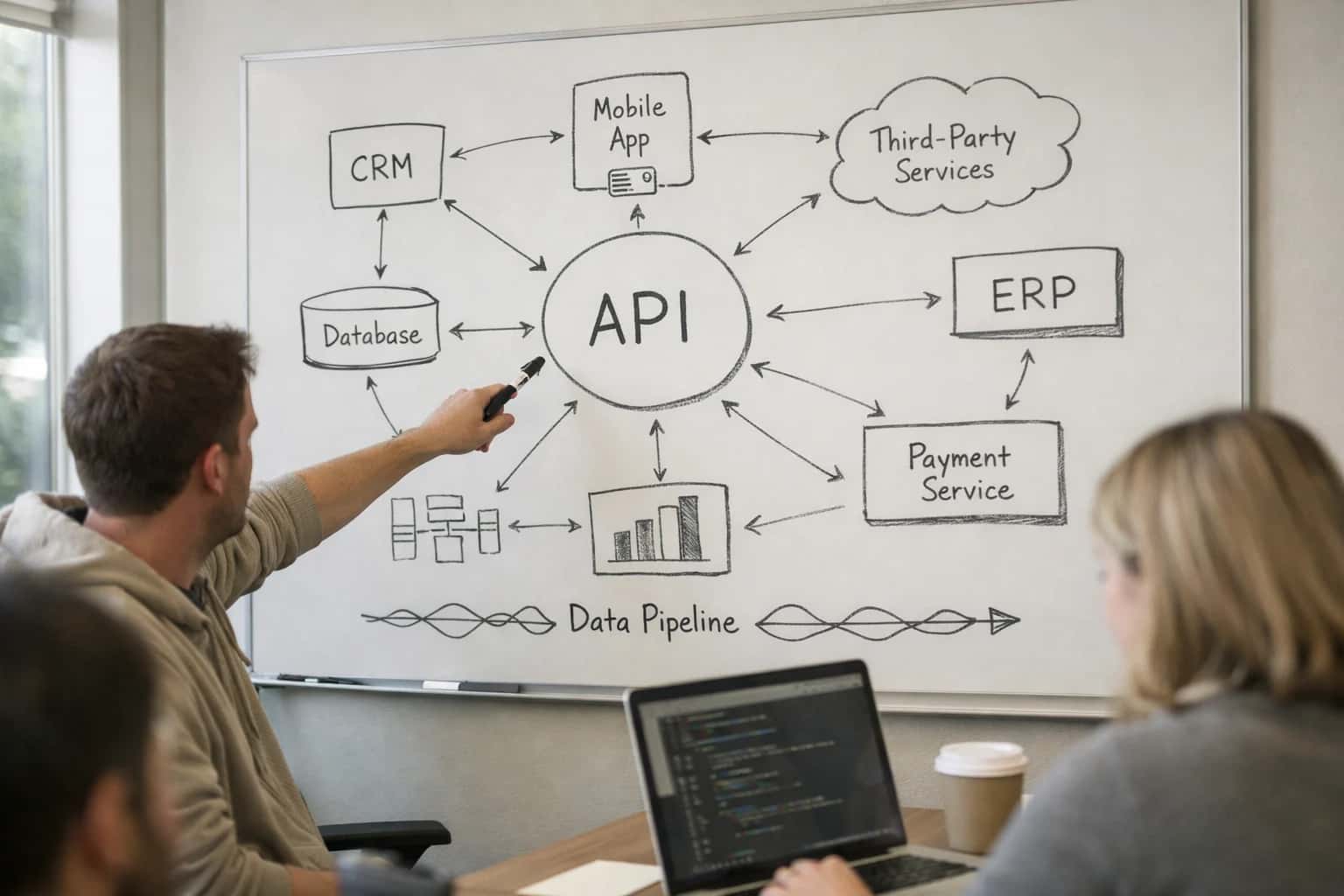
A production-ready AI integration for NetSuite connects to its SuiteTalk API and SuiteScript layer, acting as an intelligent orchestration engine for financial workflows.
The core integration pattern uses NetSuite's SuiteTalk REST/SOAP Web Services as the primary data conduit. AI agents are deployed as external microservices that authenticate via Token-Based Authentication (TBA), querying and updating key records like Transactions (Invoices, Bills, Journal Entries), Customers, Vendors, and Custom Records. For real-time triggers, we deploy SuiteScript 2.x User Event or Scheduled Scripts that call out to AI endpoints via N/https module, enabling event-driven automation—for example, sending a new journal entry to an AI for anomaly scoring the moment it's saved.
High-value workflows are built by chaining AI operations to NetSuite's native processes. A typical reconciliation agent might: 1) Pull unreconciled bank statement lines via SuiteTalk, 2) Use a vector search against historical transaction descriptions and amounts to find potential matches, 3) Return a confidence-scored match list with proposed GL accounts, and 4) Create a Custom Record to log AI suggestions for accountant review before posting. For period-close automation, an AI orchestrator can call a series of Saved Searches and SuiteAnalytics Connect queries to validate data completeness, then use SuiteScript to lock periods or create adjusting journal entry proposals.
Governance and rollout are critical. We implement a phased approval workflow where AI suggestions are written to staging custom records or queue records, requiring a finance user's review in NetSuite before any GL postings are executed. All AI actions are logged to a custom Audit Trail record, capturing the prompt, model used, input data snapshot, and output. This creates a transparent, reversible layer of automation. Initial deployments typically focus on a single subsidiary or department, using NetSuite's Role-Based Permissions to control access, before scaling to multi-entity consolidation workflows. For deeper technical patterns, see our guide on AI Governance for Financial Systems.
NETSUITE INTEGRATION PATTERNS
Code and Payload Examples
Automating Journal Entry Review
Use a scheduled SuiteScript to scan newly posted journal entries, flagging anomalies for finance review. This script runs post-batch, calling an external AI service via RESTlet to evaluate entries against learned patterns for amount, account, period, and user.
javascript// SuiteScript 2.x - Scheduled Script for Anomaly Detection define(['N/record', 'N/search', 'N/https'], (record, search, https) => { function execute(context) { // 1. Search for recent journal entries const jeSearch = search.create({ type: search.Type.JOURNAL_ENTRY, filters: [ ['posting', 'within', 'lastweek'], 'AND', ['mainline', 'is', 'F'] ], columns: ['internalid', 'tranid', 'account', 'amount', 'postingperiod'] }); const anomalyPayload = []; jeSearch.run().each((result) => { anomalyPayload.push({ internalid: result.getValue('internalid'), tranid: result.getValue('tranid'), account: result.getValue('account'), amount: result.getValue('amount'), period: result.getValue('postingperiod') }); return true; }); // 2. Call external AI service for scoring const aiResponse = https.post({ url: 'https://your-ai-service/inference', body: JSON.stringify({ entries: anomalyPayload }), headers: { 'Content-Type': 'application/json' } }); const scoredEntries = JSON.parse(aiResponse.body); // 3. Create custom record for flagged anomalies scoredEntries.filter(e => e.risk_score > 0.8).forEach((flaggedEntry) => { record.create({ type: record.Type.CUSTOM_RECORD, isDynamic: true, defaultValues: { custrecord_je_reference: flaggedEntry.internalid, custrecord_risk_score: flaggedEntry.risk_score, custrecord_reason: flaggedEntry.reason } }); }); } return { execute: execute }; });
This pattern creates an automated audit trail, reducing manual review by pre-screening 100% of entries.
NETSUITE FINANCE AUTOMATION
Realistic Time Savings and Operational Impact
This table outlines typical time savings and operational improvements when integrating AI with NetSuite's core finance modules. These are directional estimates based on production implementations, assuming a phased rollout starting with high-volume, rule-based tasks.
| Finance Workflow | Before AI Integration | After AI Integration | Implementation Notes |
|---|---|---|---|
Bank Reconciliation | Hours per account, manual line-by-line matching | Minutes, with AI suggesting matches for 80-90% of transactions | Leverages SuiteScript to fetch transactions, AI flags exceptions for review |
Journal Entry Processing | Manual data entry from source documents; prone to coding errors | AI extracts and suggests entries; accountant reviews and posts | Integrates with NetSuite's Journal Entry API; human-in-the-loop for approval |
Intercompany Matching | Multi-day process across entities, spreadsheets, and emails | Automated daily matching with variance alerts | Uses SuiteTalk to pull data from subsidiary records; AI handles currency and timing differences |
AP Invoice Processing | Manual keying from PDF/email; 3-way matching is a checklist | AI extracts line items, matches to PO/Receipt; routes for approval | Deployed via Suitelet for user interface; learns from vendor and GL patterns |
Month-End Close Checklist | Manual status tracking across teams via email and spreadsheets | AI-driven orchestration dashboard with automated task verification | Built on NetSuite's workflow engine; provides real-time close status to controllers |
Anomaly Detection (e.g., Duplicate Payments) | Periodic manual audit or post-facto discovery | Real-time monitoring with alerts before payment runs | Analyzes Vendor Payment and Bill records via scheduled script; low false-positive rate target |
Financial Report Generation & Commentary | Analyst manually runs reports and writes narrative summaries | AI auto-generates reports with variance explanations from saved searches | Connects to NetSuite's Analytics/Report API; templates ensure compliance with narrative style |
ENTERPRISE AI INTEGRATION
Governance, Security, and Phased Rollout
A practical blueprint for deploying AI in NetSuite with enterprise-grade controls and a low-risk adoption path.
Integrating AI with NetSuite requires a security-first architecture that respects the platform's native data model and access controls. Our standard pattern uses NetSuite's SuiteTalk REST API and SuiteScript 2.x to create a dedicated integration layer. This layer acts as a secure broker, handling all communication between NetSuite's core objects—like Transaction, Customer, Vendor, and Journal Entry—and external AI services. All AI tool calls are authenticated via OAuth 2.0 and scoped to specific roles, ensuring actions respect NetSuite's existing Role-Based Access Control (RBAC). Audit trails are maintained both within NetSuite's system notes and the AI platform's logs, creating a verifiable chain of custody for every AI-generated suggestion or automated entry.
We recommend a phased rollout to de-risk implementation and demonstrate value incrementally. A typical sequence starts with a read-only pilot focused on anomaly detection, where AI analyzes historical journal entries and vendor bills to flag outliers for human review—no writes back to NetSuite. The second phase introduces assistive automation, such as AI agents that draft collection emails or propose reconciliation matches, which require a user's approval via a custom SuiteScript button or workflow action before any system update. The final phase enables controlled autonomous workflows for high-volume, rule-based tasks like automated payment application or recurring journal entry posting, governed by pre-defined business rules and exception queues.
Governance is managed through a combination of NetSuite's native features and the AI orchestration layer. Key controls include: - Approval Workflows: AI-initiated changes to critical records (e.g., customer credit limits, manual journal entries) can be routed through NetSuite's built-in approval workflows. - Sandbox-First Testing: All AI logic is developed and validated in a NetSuite Sandbox, with a full regression test suite run before deployment to Production. - Performance and Drift Monitoring: We instrument the integration to track latency, token usage, and the quality of AI outputs, setting alerts for model drift or integration errors. This structured approach ensures the AI augments your finance team's work without introducing operational or compliance risk. For related architectural patterns, see our guides on AI Integration for SAP S/4HANA Finance and AI Governance and LLMOps Platforms.
Enabling Efficiency, Speed & Accuracy
Intelligent Analysis, Decision & Execution
We build AI systems for teams that need search across company data, workflow automation across tools, or AI features inside products and internal software.
Talk to Us
Search across company data
Give teams answers from docs, tickets, runbooks, and product data with sources and permissions.
Useful when people spend too long searching or get different answers from different systems.
Enterprise searchRAGPermissions
Read more
Automate internal workflows
Use AI to route work, draft outputs, trigger actions, and keep approvals and logs in place.
Useful when repetitive work moves across multiple tools and teams.
AI agentsWorkflow automationGovernance
Read more
Add AI to products and internal tools
Build assistants, guided actions, or decision support into the software your team or customers already use.
Useful when AI needs to be part of the product, not a separate tool.
AI integrationDecision supportModel routing
Read moreNETSUITE AI INTEGRATION
Frequently Asked Questions
Common technical and strategic questions about embedding AI agents and automation into NetSuite's SuiteTalk API and SuiteScript ecosystem.
Production integrations use NetSuite's SuiteTalk (SOAP) or RESTlet APIs with strict role-based permissions and OAuth 2.0. The standard pattern is:
- Create a dedicated integration role with minimal, read/write-only access to specific records (e.g.,
Transaction,Customer,Vendor Bill). - Deploy a middleware service (often as a Suitelet or external service) that acts as a secure bridge. This service:
- Authenticates via OAuth or Token-Based Authentication (TBA).
- Fetches and prepares context (e.g., a journal entry line and its related GL account details).
- Calls the external AI service (e.g., OpenAI, Anthropic) via a secure, private endpoint.
- Processes the AI's response and writes back to NetSuite via a RESTlet or SuiteScript.
- All data in transit is encrypted, and prompts are engineered to avoid exposing sensitive PII unless absolutely necessary. Audit trails are maintained in NetSuite's System Notes.

About the author
Prasad Kumkar
CEO & MD, Inference Systems
Prasad Kumkar is the CEO & MD of Inference Systems and writes about AI systems architecture, LLM infrastructure, model serving, evaluation, and production deployment. Over 5+ years, he has worked across computer vision models, L5 autonomous vehicle systems, and LLM research, with a focus on taking complex AI ideas into real-world engineering systems.
His work and writing cover AI systems, large language models, AI agents, multimodal systems, autonomous systems, inference optimization, RAG, evaluation, and production AI engineering.
LinkedIn
Limited slotsGet a Free AI Consultation
Partnered with leading AI, data, and software stack.





How We Work
Custom AI workflows for your Business
One-fit-all AI don't work for modern businesses. At Inferensys, we aim to understand your business & custom requirements; which we use to define most efficient agentic workflows, the data, and the tools for your business.
01
Review the use case
We understand the task, the users, and where AI can actually help.
Read more02
Pick the right approach
We define what needs search, automation, or product integration.
Read more03
Build the first useful version
We implement the part that proves the value first.
Read more04
Improve from there
We add the checks and visibility needed to keep it useful.
Read moreThe first call is a practical review of your use case and the right next step.
Talk to Us