Embedding an AI copilot into Sage Intacct means providing real-time, contextual guidance at the point of work. This isn't a separate chatbot; it's an intelligent layer integrated into the General Ledger, Projects, Allocations, and Reporting modules. The copilot surfaces within the UI—often as a sidebar or inline assistant—to help users with tasks like selecting the correct dimensions for a journal entry, explaining the impact of a project cost allocation, or drafting a narrative for a variance report. It works by calling a secure API with the user's current context (e.g., the GL account, entity, project ID, and user role) to retrieve grounded guidance, next-step suggestions, or policy explanations.

Integration
AI Copilots for Sage Intacct
An enterprise-focused blueprint for embedding contextual AI copilots directly into Sage Intacct's UI, providing real-time guidance for complex tasks like journal entries, dimensional allocations, and financial reporting.
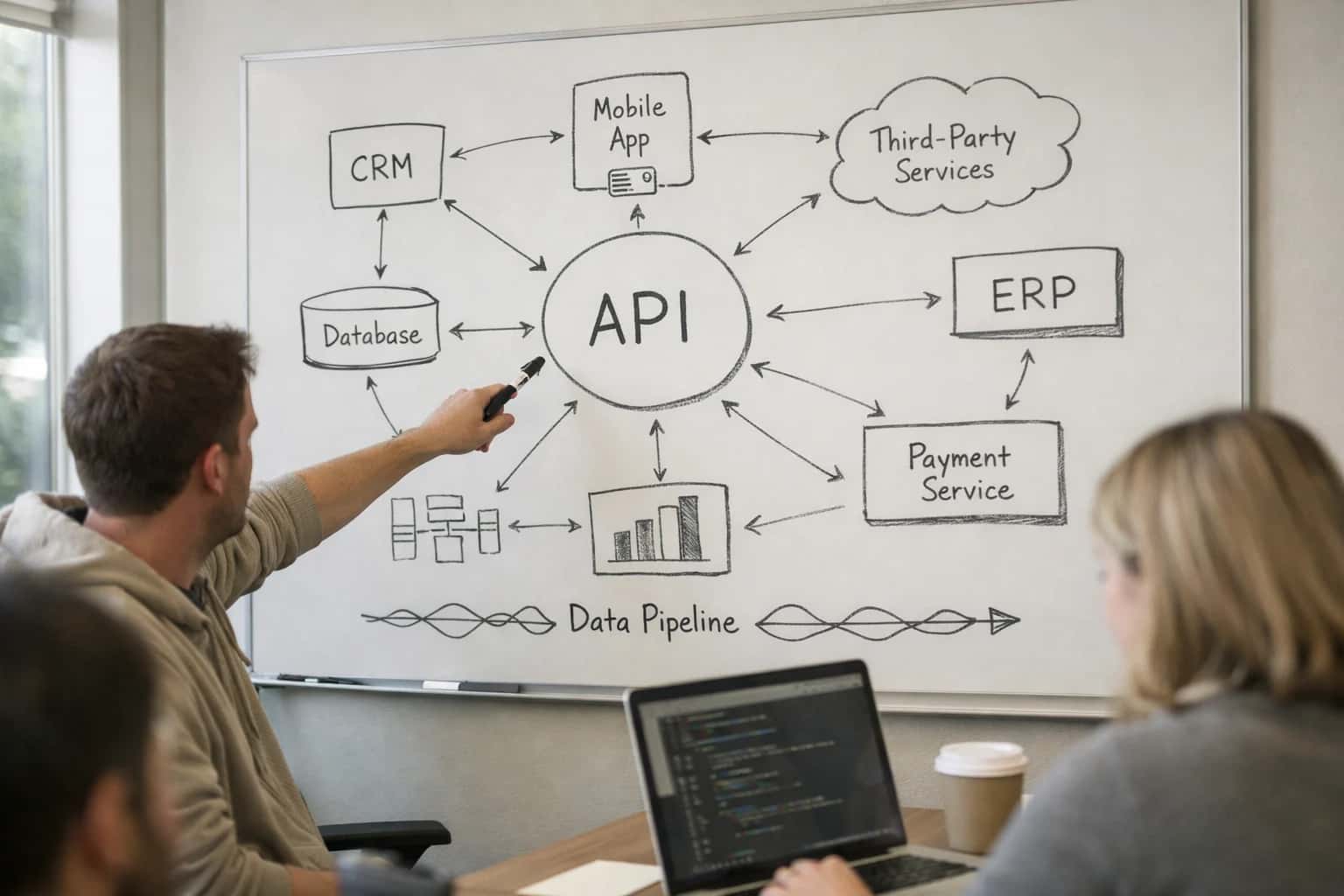
ENTERPRISE COPILOT ARCHITECTURE
Embedding AI Guidance into Sage Intacct's User Experience
A blueprint for deploying contextual AI copilots directly within Sage Intacct's UI to guide users through complex financial tasks.
Implementation requires a lightweight front-end component (often a custom script or widget) that injects the assistant UI and a backend service that orchestrates the AI logic. The backend service connects to Sage Intacct's SuiteScript API or REST API to fetch real-time data context and validate suggestions. For example, when a user is creating a complex intercompany journal, the copilot can call the API to verify the correct intercompany partner and elimination rules before suggesting the entry. All interactions are logged to Sage Intacct's audit trail for compliance, and the system enforces existing role-based permissions—a user only sees guidance for the modules and data they can access.
Rollout should be phased, starting with a pilot group (e.g., corporate accounting) and a single high-value workflow, like month-end accruals. Governance is critical: establish a feedback loop where user interactions train the system, and maintain a human-in-the-loop review for the first 90 days to catch edge cases. The goal is not full automation but augmented accuracy—reducing errors in dimensional coding, speeding up training for new staff, and ensuring policy adherence. For a deeper look at the underlying data architecture that powers these copilots, see our guide on AI Integration for Sage Intacct.
ENTERPRISE FINANCE WORKFLOWS
Where to Embed the Copilot: Key Sage Intacct Surfaces
The Core of Financial Control
The General Ledger is the system of record, making it the most critical surface for an AI copilot. Embed guidance directly into the journal entry interface to assist accountants with complex postings.
Key Integration Points:
- Dynamic Dimension Validation: As users select accounts, the copilot can suggest required dimensions (Department, Location, Project) based on historical postings or company policy, reducing errors.
- Entry Explanation & Compliance: Before posting, the AI can generate a plain-English description of the journal entry's impact and flag potential policy violations (e.g., unusual intercompany transfers).
- Recurring Entry Automation: The copilot can analyze patterns and propose the setup or adjustment of recurring journal entries, automating period-end routines.
This turns the GL from a passive data entry form into an active, guided workspace that enforces consistency and accelerates the close process.
ENTERPRISE-FOCUSED BLUEPRINT
High-Value AI Copilot Use Cases for Sage Intacct
Embedded AI copilots provide contextual, in-workflow guidance for Sage Intacct's complex dimensional accounting, multi-entity structures, and project-based workflows. These use cases target finance teams, controllers, and accountants looking to reduce manual effort and error in high-stakes financial operations.
01
Journal Entry & Allocation Copilot
An AI agent embedded in the journal entry screen analyzes transaction descriptions and amounts to suggest the correct GL accounts, dimensions (Department, Project, Location), and allocation percentages. It validates entries against historical patterns and company policy before posting, reducing rework during the close.
Hours -> Minutes
Entry creation time
02
Multi-Entity Close Orchestrator
An AI copilot manages the period-end close sequence across subsidiaries and legal entities. It monitors task completion status, identifies intercompany mismatches, and suggests consolidation journal entries based on entity-level data. It provides a single dashboard for the corporate controller to track the entire close.
Batch -> Real-time
Close visibility
03
Project Accounting & Billing Assistant
For professional services and project-based firms, this copilot works within Sage Intacct's Project module. It analyzes time and expense postings against project budgets, flags potential overruns, and drafts milestone invoices with proper revenue recognition calculations, ensuring accurate project profitability reporting.
1 sprint
Implementation lead time
04
Vendor Invoice & AP Workflow Agent
Integrates with Sage Intacct's AP module to automate 3-way matching against Purchase Orders and Receipts. The AI agent extracts line-item data from invoices, routes exceptions for review, and suggests approval paths based on vendor history and amount. It learns from approver overrides to improve future routing.
Same day
Invoice processing
05
Financial Report Narrator & Explainer
This copilot connects to Sage Intacct's reporting engine and GL. Users can ask natural language questions like "Why did SG&A increase in Q3?" and the agent queries multi-dimensional data, identifies contributing factors (e.g., department, project), and generates a plain-English narrative summary with links to supporting transactions.
06
AR Collections & Deduction Analyst
An AI agent integrated with the AR and Customer modules segments customers by payment risk, prioritizes collection efforts, and drafts personalized follow-up emails. For payments with deductions, it analyzes reason codes and historical patterns to suggest write-off or dispute actions, updating customer records automatically.
SAGE INTACCT IMPLEMENTATION PATTERNS
Example Copilot-Guided Workflows
These workflows illustrate how an AI copilot can be embedded into Sage Intacct's UI to provide contextual, step-by-step guidance for complex accounting tasks, reducing errors and accelerating user proficiency.
Trigger: User initiates a new journal entry in the General Ledger module.
Copilot Action:
- Context Pull: The copilot reads the entry description and the first line item (e.g., account, amount).
- Guidance Generation: Based on the account selected (e.g.,
Marketing Expense), the copilot surfaces the most commonly used dimensions for that account from historical data (e.g.,Department: Marketing,Project: Q2_Campaign,Location: HQ). - Interactive Suggestions: It provides a dropdown or click-to-apply suggestions for each dimension field, with a note: "85% of past entries for this account used these dimensions."
- Validation: As the user completes the entry, the copilot runs a lightweight validation check against the chart of accounts and active dimension combinations, flagging any invalid pairings before posting.
System Update: User posts a clean, dimensionally accurate journal entry on the first attempt.
Human Review Point: For entries over a configurable monetary threshold, the copilot can automatically route the entry to a senior accountant for approval within Sage Intacct's workflow engine.
ENTERPRISE INTEGRATION PATTERN
Implementation Architecture: Connecting AI to Sage Intacct
A production-ready blueprint for embedding AI agents and copilots into Sage Intacct's core financial workflows.
Connecting AI to Sage Intacct requires a layered architecture that respects its multi-entity, dimensional data model. The integration typically involves: 1) API Gateway & Webhooks using Sage Intacct's SOAP and REST APIs (e.g., JournalEntry, APBill, Customer, Project) to read/write data and subscribe to real-time events like posted transactions. 2) Orchestration & Agent Layer where business logic and AI prompts are executed, often via a workflow engine or agent framework that can call tools, manage state, and handle approvals. 3) Context & Memory Layer using a vector database to index Sage Intacct's GL accounts, dimensions, vendors, and project structures, enabling the AI to provide accurate, context-aware suggestions. 4) User Interface Surfaces where the AI interacts, primarily through custom pages built with Sage Intacct's Custom Objects and Web Services Connector, or via sidecar applications that inject copilot UIs into the existing web interface.
For a copilot guiding a user through a complex journal entry, the workflow is precise: The agent retrieves the relevant transaction context and dimensional chart of accounts from the vector store. It then uses a structured prompt to analyze the source document (e.g., a contract or invoice), suggests the correct GL accounts and dimensions (like Department, Location, Project), and drafts the full journal entry object. The user reviews and approves the suggestion within the Intacct UI, and the agent uses the JournalEntry API to post it, logging the entire interaction for audit. This pattern applies to high-value use cases such as intercompany eliminations, revenue recognition adjustments, and project cost allocations, turning multi-step manual research into a guided, single-screen operation.
Rollout and governance are critical. Start with a pilot module, such as AP Invoice Processing or Month-End Close Checklist, to validate the AI's accuracy and user adoption. Implement strict role-based access control (RBAC) aligned with Sage Intacct's existing permissions, ensuring AI suggestions and actions are scoped to the user's entity and department. All AI-generated proposals should be logged as Custom Object records with a full audit trail, including the source prompt, retrieved context, and user approval. For production resilience, design the orchestration layer to gracefully degrade—defaulting to manual workflows if the AI service is unavailable—and implement continuous evaluation to monitor the quality of suggestions against historical, human-approved entries.
SAGE INTACCT API INTEGRATION PATTERNS
Code and Payload Examples
Validating Dimensional Accuracy
When an AI copilot suggests a journal entry, it must validate against Sage Intacct's dimensional accounting model before posting. This example shows a Python function that calls the Sage Intacct API to check if a proposed GL account and dimension combination is valid, preventing posting errors.
pythonimport requests def validate_dimensions(gl_account, dimensions, session_id): """ Validates a GL account and dimension set via the Sage Intacct API. Returns True if valid, False otherwise. """ url = "https://api.intacct.com/ia/xml/xmlgw.phtml" # Construct XML payload for a 'get_list' query on the GLACCOUNT object payload = f""" <?xml version="1.0" encoding="UTF-8"?> <request> <control> <senderid>your_sender_id</senderid> <password>your_password</password> <controlid>validate-dim-{{control_id}}</controlid> <uniqueid>false</uniqueid> <dtdversion>3.0</dtdversion> </control> <operation transaction="true"> <authentication> <sessionid>{session_id}</sessionid> </authentication> <content> <function controlid="check-gl-account"> <get_list object="GLACCOUNT" maxitems="1"> <filter> <expression> <field>ACCOUNTNO</field> <operator>=</operator> <value>{gl_account}</value> </expression> </filter> <fields>ACCOUNTNO, STATUS</fields> </get_list> </function> </content> </operation> </request> """ response = requests.post(url, data=payload) # Parse response to check if account is active and dimensions are valid # (Full XML parsing omitted for brevity) return is_valid
This validation step is critical for AI-generated entries, ensuring they comply with your chart of accounts and active dimension values before any write operation.
AI COPILOTS FOR SAGE INTACCT
Realistic Time Savings and Operational Impact
How AI copilots embedded in Sage Intacct's UI accelerate complex accounting workflows and reduce manual effort for finance teams.
| Workflow / Task | Before AI | After AI | Implementation Notes |
|---|---|---|---|
Journal Entry Creation & Review | Manual lookup of accounts/dimensions, 15-30 minutes per complex entry | AI suggests accounts/dimensions with context, 5-10 minutes with human validation | Copilot surfaces in Journal Entry UI, uses historical entry patterns and project/GL data |
Multi-Entity Allocations | Manual spreadsheet calculations, cross-referencing, 1-2 hours per allocation run | AI drafts allocation journal based on rules and source data, 20-30 minutes for review | Integrates with Sage Intacct's allocation engine; learns from past approved allocations |
Financial Report Explanation | Manual analysis of variances, drafting narrative for leadership, 2-3 hours per report cycle | AI generates initial variance analysis and narrative summary, 30-45 minutes for refinement | Pulls data from Sage Intacct Reporting API; FP&A team reviews and edits output |
AP Invoice Exception Handling | Manual review of non-PO invoices against policy, 10-15 minutes per exception | AI flags policy deviations and suggests approval path or required documentation, 2-3 minutes review | Works within Sage Intacct's AP workflow; requires initial policy configuration |
Project Costing & Revenue Recognition | Manual reconciliation of time/expenses to projects, checking percent complete, 4-6 hours monthly | AI identifies discrepancies and proposes accruals/deferrals, 1-2 hours for controller sign-off | Leverages Sage Intacct's Project Accounting module; integrates with PSA data |
Month-End Close Task Coordination | Manual checklist tracking, email follow-ups, risk of missed dependencies | AI orchestrates close tasks, sends reminders, and highlights blockers in real-time | Built on Sage Intacct's task management; requires mapping of close process dependencies |
Audit Support & Schedule Preparation | Manual gathering of transaction samples and supporting documents, 8-16 hours per audit | AI retrieves requested samples and generates preliminary supporting documentation packs, 2-4 hours for verification | Queries Sage Intacct's audit trail and document storage; auditor-in-the-loop for final selection |
ENTERPRISE AI IMPLEMENTATION
Governance, Security, and Phased Rollout
A practical framework for deploying AI copilots in Sage Intacct with controlled risk and measurable impact.
A production AI copilot for Sage Intacct must be architected with the platform's multi-entity structure, role-based permissions (RBAC), and audit trail requirements as first-class constraints. This means the AI's access is scoped to specific modules—like the General Ledger, Projects, or Accounts Payable—via Sage Intacct's API using service accounts with least-privilege permissions. All AI-suggested actions, such as a proposed journal entry or a dimensional allocation, are logged as draft recommendations within the system, requiring explicit user review and approval before posting. This creates a clear, immutable audit trail that satisfies internal controls and external audit requirements.
Security is managed through a layered approach: data in transit is encrypted, and sensitive financial data processed by the AI is never persisted in external systems without explicit consent. The integration typically uses Sage Intacct's webhooks and the sdata REST API to listen for events (e.g., a new invoice batch) and post suggestions back into a dedicated AI Recommendations custom object or a work queue. For high-stakes workflows like period-end close, the system can enforce a four-eyes principle, where an AI-generated consolidation journal must be reviewed by both a senior accountant and a controller before finalization.
A successful rollout follows a phased, use-case-driven approach:
- Phase 1 (Pilot): Deploy a single copilot for a non-critical, high-volume task like transaction categorization or expense report audit within one entity. Measure accuracy, user adoption, and time saved.
- Phase 2 (Expand): Roll out to additional entities and introduce more complex workflows, such as intercompany matching or project revenue recognition assistance, leveraging lessons from the pilot.
- Phase 3 (Scale & Automate): Integrate the AI copilot into core financial processes like the month-end close checklist, enabling orchestration where the AI sequences tasks, gathers approvals, and updates statuses in Sage Intacct automatically. Governance is maintained through a regular review of the AI's prompt library, output quality metrics, and user feedback, ensuring the system remains accurate, compliant, and aligned with evolving accounting policies.
Enabling Efficiency, Speed & Accuracy
Intelligent Analysis, Decision & Execution
We build AI systems for teams that need search across company data, workflow automation across tools, or AI features inside products and internal software.
Talk to Us
Search across company data
Give teams answers from docs, tickets, runbooks, and product data with sources and permissions.
Useful when people spend too long searching or get different answers from different systems.
Enterprise searchRAGPermissions
Read more
Automate internal workflows
Use AI to route work, draft outputs, trigger actions, and keep approvals and logs in place.
Useful when repetitive work moves across multiple tools and teams.
AI agentsWorkflow automationGovernance
Read more
Add AI to products and internal tools
Build assistants, guided actions, or decision support into the software your team or customers already use.
Useful when AI needs to be part of the product, not a separate tool.
AI integrationDecision supportModel routing
Read moreIMPLEMENTATION DETAILS
Frequently Asked Questions
Common technical and operational questions about embedding AI copilots into Sage Intacct's user interface and workflows.
The copilot interacts with Sage Intacct through a secure, dedicated integration layer that respects the platform's data model and permissions.
Primary Access Methods:
- Sage Intacct API: For reading GL accounts, dimensions (Departments, Locations, Projects), vendor/customer records, and existing journal entries to provide context.
- Webhooks & Platform Events: To trigger copilot assistance based on user actions, like opening a journal entry screen or saving a transaction.
- User Session Context: The copilot is aware of the user's current screen, selected record, and role-based permissions without storing sensitive data externally.
Data Usage & Security:
- Queries are scoped to the user's permissions; a staff accountant cannot see data they wouldn't normally access.
- No raw financial data is used to train public models. Context is retrieved in real-time and not permanently stored in the AI system.
- All API traffic is encrypted, and credentials are managed via OAuth or key-based authentication with strict IP allow-listing.

About the author
Prasad Kumkar
CEO & MD, Inference Systems
Prasad Kumkar is the CEO & MD of Inference Systems and writes about AI systems architecture, LLM infrastructure, model serving, evaluation, and production deployment. Over 5+ years, he has worked across computer vision models, L5 autonomous vehicle systems, and LLM research, with a focus on taking complex AI ideas into real-world engineering systems.
His work and writing cover AI systems, large language models, AI agents, multimodal systems, autonomous systems, inference optimization, RAG, evaluation, and production AI engineering.
LinkedIn
Limited slotsGet a Free AI Consultation
Partnered with leading AI, data, and software stack.





How We Work
Custom AI workflows for your Business
One-fit-all AI don't work for modern businesses. At Inferensys, we aim to understand your business & custom requirements; which we use to define most efficient agentic workflows, the data, and the tools for your business.
01
Review the use case
We understand the task, the users, and where AI can actually help.
Read more02
Pick the right approach
We define what needs search, automation, or product integration.
Read more03
Build the first useful version
We implement the part that proves the value first.
Read more04
Improve from there
We add the checks and visibility needed to keep it useful.
Read moreThe first call is a practical review of your use case and the right next step.
Talk to Us