An Inference Orchestrator is a software system that automates the deployment, scaling, routing, and lifecycle management of machine learning models across a heterogeneous compute infrastructure (e.g., GPUs, CPUs, NPUs). Its primary function is to dynamically match incoming inference requests with the most appropriate model instance and hardware to meet predefined Service Level Objectives (SLOs) for latency and throughput while minimizing operational costs. This involves intelligent scheduling, load balancing, and resource allocation based on real-time metrics.

Glossary
Inference Orchestrator
An Inference Orchestrator is a software component or service that manages the lifecycle, placement, scaling, and routing of model instances across a heterogeneous compute infrastructure to optimize for cost, latency, and resource utilization.
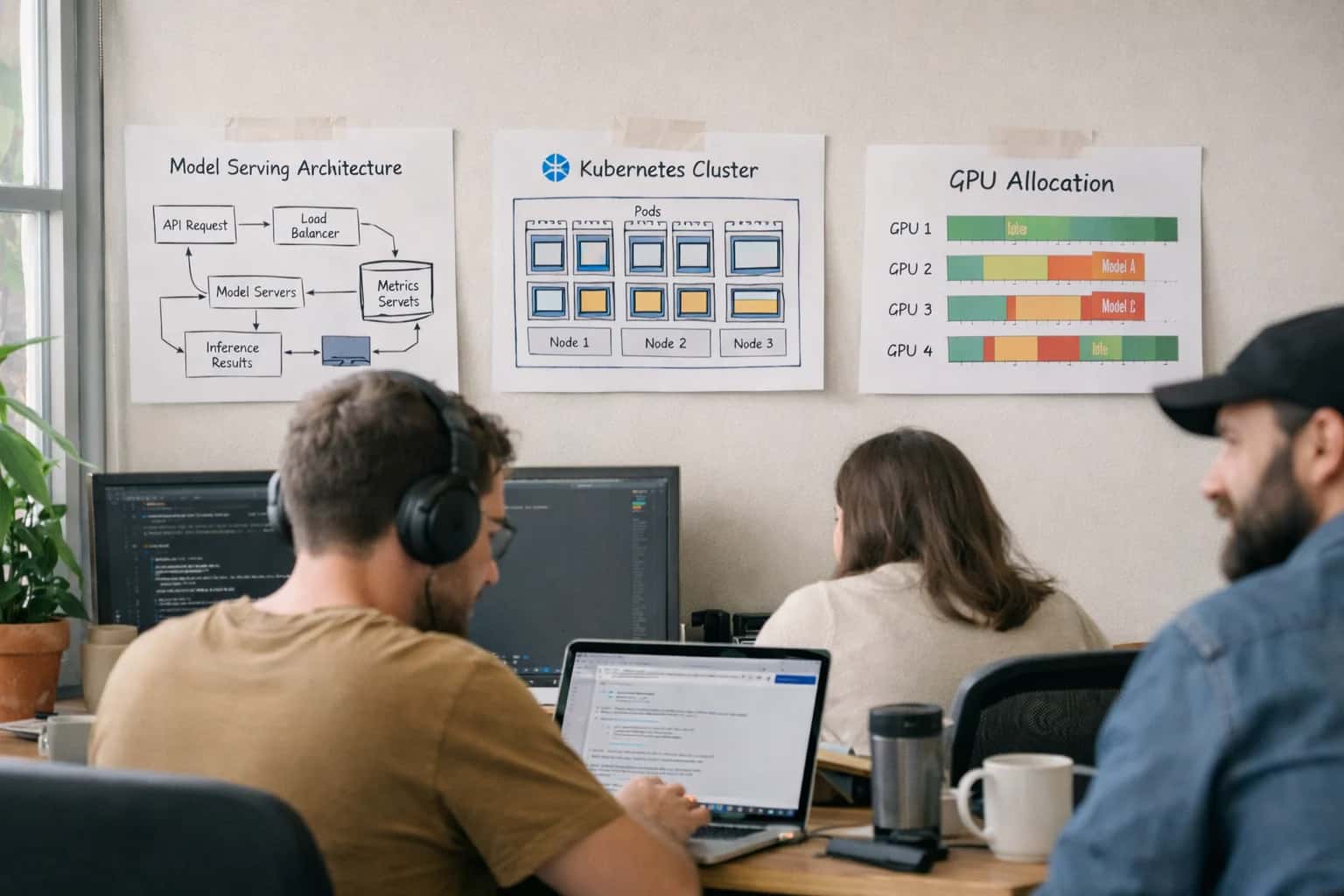
INFRASTRUCTURE MANAGEMENT
What is an Inference Orchestrator?
A core software component for managing model execution across diverse compute environments to optimize cost and performance.
The orchestrator acts as a central decision engine, continuously monitoring system health, request queues, and hardware utilization. It executes policies for autoscaling, instance right-sizing, and multi-cloud routing to handle usage spikes efficiently. By abstracting the underlying infrastructure complexity, it enables consistent, cost-optimized serving, allowing engineering teams to focus on model development rather than operational overhead. Key related concepts include model serving architectures, continuous batching, and inference cost optimization.
INFERENCE COST OPTIMIZATION
Core Functions of an Inference Orchestrator
An Inference Orchestrator is a software component that manages the lifecycle, placement, scaling, and routing of model instances across a heterogeneous compute infrastructure to optimize for cost, latency, and resource utilization.
01
Intelligent Workload Placement
The orchestrator analyzes each inference request and routes it to the most cost-effective hardware instance capable of meeting its Service Level Objective (SLO). This involves evaluating:
- Model requirements (precision, memory footprint)
- Request characteristics (batch size, latency target)
- Infrastructure state (GPU utilization, spot instance availability, regional pricing) By matching workloads to optimal hardware (e.g., routing a quantized model to a cost-efficient CPU instance, or a large model to a high-memory GPU), it minimizes the Total Cost of Ownership (TCO).
02
Predictive & Reactive Autoscaling
To handle usage spikes without over-provisioning, the orchestrator dynamically scales the pool of active model instances. This combines:
- Reactive scaling: Adding/removing instances based on real-time metrics like queue depth and GPU utilization.
- Predictive scaling: Using workload prediction models to provision resources ahead of forecasted demand, reducing cold start latency. The goal is to maintain SLA compliance for high-priority traffic while using strategies like spot instance usage for fault-tolerant workloads to slash costs.
03
Continuous Batching & Scheduling
This core function maximizes hardware utilization—the primary driver of inference cost—by dynamically grouping requests. The orchestrator implements:
- Continuous batching: Incoming requests are grouped into a single batch on-the-fly as the GPU processes previous tokens, keeping the hardware saturated.
- Batch prioritization: Schedules request execution order based on priority, age, or deadline to meet Quality of Service (QoS) guarantees.
- Request queuing: Manages flow during traffic surges, enabling efficient batch formation and preventing system overload.
04
Multi-Model & Multi-Tenant Management
The orchestrator acts as a shared platform, efficiently co-locating multiple models and serving multiple teams or customers (tenants) on the same hardware. Key mechanisms include:
- Resource quotas: Enforcing strict limits on GPU-hours or memory per tenant to control costs and prevent "noisy neighbor" issues.
- Model lifecycle management: Automatically loading, unloading, and version-switching models based on demand to free up memory.
- Cost attribution: Tracking and assigning infrastructure costs to specific business units, projects, or tenants for accountability.
05
Performance-Cost Tradeoff Optimization
The orchestrator provides configurable optimization knobs that allow engineers to explicitly balance cost against performance and accuracy. It manages the performance-cost tradeoff by:
- Dynamically applying techniques like model quantization or weight pruning for specific request types where lower precision is acceptable.
- Implementing load shedding to reject low-priority traffic during overload, protecting system stability for critical requests.
- Providing visibility into the Pareto frontier of optimal configurations, guiding decisions on batch size, hardware selection, and model variants.
06
Multi-Cloud & Heterogeneous Fleet Orchestration
To avoid vendor lock-in and leverage the best pricing across providers, advanced orchestrators manage a hardware heterogeneous fleet spanning multiple clouds and on-premises resources. This involves:
- Multi-cloud inference: Distributing workloads across AWS, Azure, GCP, and others based on real-time cost and availability.
- Unified abstraction: Presenting a single API for inference despite the underlying complexity of different accelerators (GPUs, NPUs, CPUs).
- Cost dashboards: Aggregating spending data across all providers into a single view for financial monitoring and optimizing the Return on Investment (ROI) of the infrastructure.
SYSTEM ARCHITECTURE
How an Inference Orchestrator Works
An Inference Orchestrator is the central intelligence for production model serving, dynamically managing compute resources to balance cost, latency, and throughput.
An Inference Orchestrator is a software system that automates the lifecycle, placement, scaling, and routing of machine learning models across a heterogeneous compute infrastructure. It acts as a cost-aware scheduler, continuously monitoring request traffic and system health to make real-time decisions. Its core function is to optimize resource utilization—such as GPU memory and compute cycles—against defined Service Level Objectives (SLOs) for latency and throughput, directly controlling infrastructure expenditure.
The orchestrator operates through a continuous control loop: it ingests incoming requests into a priority queue, forms dynamic batches for execution, and selects the optimal model instance—considering factors like hardware affinity and current load. It manages autoscaling policies to spin instances up or down and can implement load shedding during traffic spikes. By intelligently routing workloads across different hardware types (e.g., GPUs, CPUs, NPUs) and cloud zones, it minimizes cold starts and leverages cost-efficient resources like spot instances, achieving the target performance-cost tradeoff.
ARCHITECTURAL COMPARISON
Inference Orchestrator vs. Related Concepts
A functional comparison of the Inference Orchestrator with adjacent system components, highlighting its distinct role in cost-aware workload management.
| Primary Function | Inference Orchestrator | Model Serving Framework | Load Balancer | Autoscaling Controller |
|---|---|---|---|---|
Core Optimization Objective | Holistic cost-latency-resource utilization | Request throughput and latency | Even traffic distribution | Matching instance count to demand |
Decision Granularity | Per-request routing & per-model placement | Per-batch execution | Per-connection/request | Per-service aggregate metrics |
Hardware Awareness | Deep heterogeneity (GPU gen, NPU, CPU) | Limited, often GPU-focused | None | Instance type families |
Cost-Aware Scheduling | Direct optimization using cost-per-token & TCO | Indirect via efficiency (e.g., GPU util) | None | Indirect via instance count reduction |
State Management | Global view of model instances, cache states, quotas | Local batch and KV cache state | Session affinity only | Desired vs. actual instance count |
Traffic Prioritization & QoS | Integrated (load shedding, batch prioritization) | Basic request queuing | Limited (weighted routing) | None |
Multi-Cloud/Multi-Region Support | Native, for cost and latency optimization | Typically cluster-bound | Yes, for availability | Yes, per-cloud provider |
Integration with Cost Controls | Direct (resource quotas, chargeback attribution) | Indirect via metrics export | None | Indirect via scaling policies |
INFERENCE ORCHESTRATOR
Frequently Asked Questions
An Inference Orchestrator is the central nervous system for production AI, managing where and how models run to balance cost, speed, and reliability. These questions address its core functions and value for technical leaders.
An Inference Orchestrator is a software component or service that manages the lifecycle, placement, scaling, and routing of machine learning model instances across a heterogeneous compute infrastructure to optimize for cost, latency, and resource utilization. It works by acting as an intelligent traffic controller and resource manager. When an inference request arrives, the orchestrator evaluates factors like the request's priority, the required model, current system load, and the cost-performance profile of available hardware (e.g., GPUs, CPUs, or specialized NPUs). It then decides whether to route the request to an existing, warmed-up model instance, scale up a new instance, or queue it for continuous batching. By dynamically making these placement and scaling decisions, it ensures efficient use of expensive compute resources while meeting Service Level Objectives (SLOs).
Enabling Efficiency, Speed & Accuracy
Intelligent Analysis, Decision & Execution
We build AI systems for teams that need search across company data, workflow automation across tools, or AI features inside products and internal software.
Talk to Us
Search across company data
Give teams answers from docs, tickets, runbooks, and product data with sources and permissions.
Useful when people spend too long searching or get different answers from different systems.
Enterprise searchRAGPermissions
Read more
Automate internal workflows
Use AI to route work, draft outputs, trigger actions, and keep approvals and logs in place.
Useful when repetitive work moves across multiple tools and teams.
AI agentsWorkflow automationGovernance
Read more
Add AI to products and internal tools
Build assistants, guided actions, or decision support into the software your team or customers already use.
Useful when AI needs to be part of the product, not a separate tool.
AI integrationDecision supportModel routing
Read more
About the author
Prasad Kumkar
CEO & MD, Inference Systems
Prasad Kumkar is the CEO & MD of Inference Systems and writes about AI systems architecture, LLM infrastructure, model serving, evaluation, and production deployment. Over 5+ years, he has worked across computer vision models, L5 autonomous vehicle systems, and LLM research, with a focus on taking complex AI ideas into real-world engineering systems.
His work and writing cover AI systems, large language models, AI agents, multimodal systems, autonomous systems, inference optimization, RAG, evaluation, and production AI engineering.
LinkedIn
Limited slotsGet a Free AI Consultation
Partnered with leading AI, data, and software stack.





How We Work
Custom AI workflows for your Business
One-fit-all AI don't work for modern businesses. At Inferensys, we aim to understand your business & custom requirements; which we use to define most efficient agentic workflows, the data, and the tools for your business.
01
Review the use case
We understand the task, the users, and where AI can actually help.
Read more02
Pick the right approach
We define what needs search, automation, or product integration.
Read more03
Build the first useful version
We implement the part that proves the value first.
Read more04
Improve from there
We add the checks and visibility needed to keep it useful.
Read moreThe first call is a practical review of your use case and the right next step.
Talk to Us