A policy-aware AI agent moves beyond simple FAQ retrieval to execute complex, compliant actions like processing refunds or approving loan extensions. Its core capability is grounding agent decisions in structured policy documents, ensuring every action aligns with business logic and regulatory constraints. This requires a design that integrates an LLM's reasoning with a symbolic logic check layer to validate decisions against explicit rules before execution.

Guide
How to Design a Policy-Aware AI Agent for Customer Support
A developer guide to building an AI agent that autonomously interprets and applies business rules, contractual terms, and regulatory policies for customer support resolution.
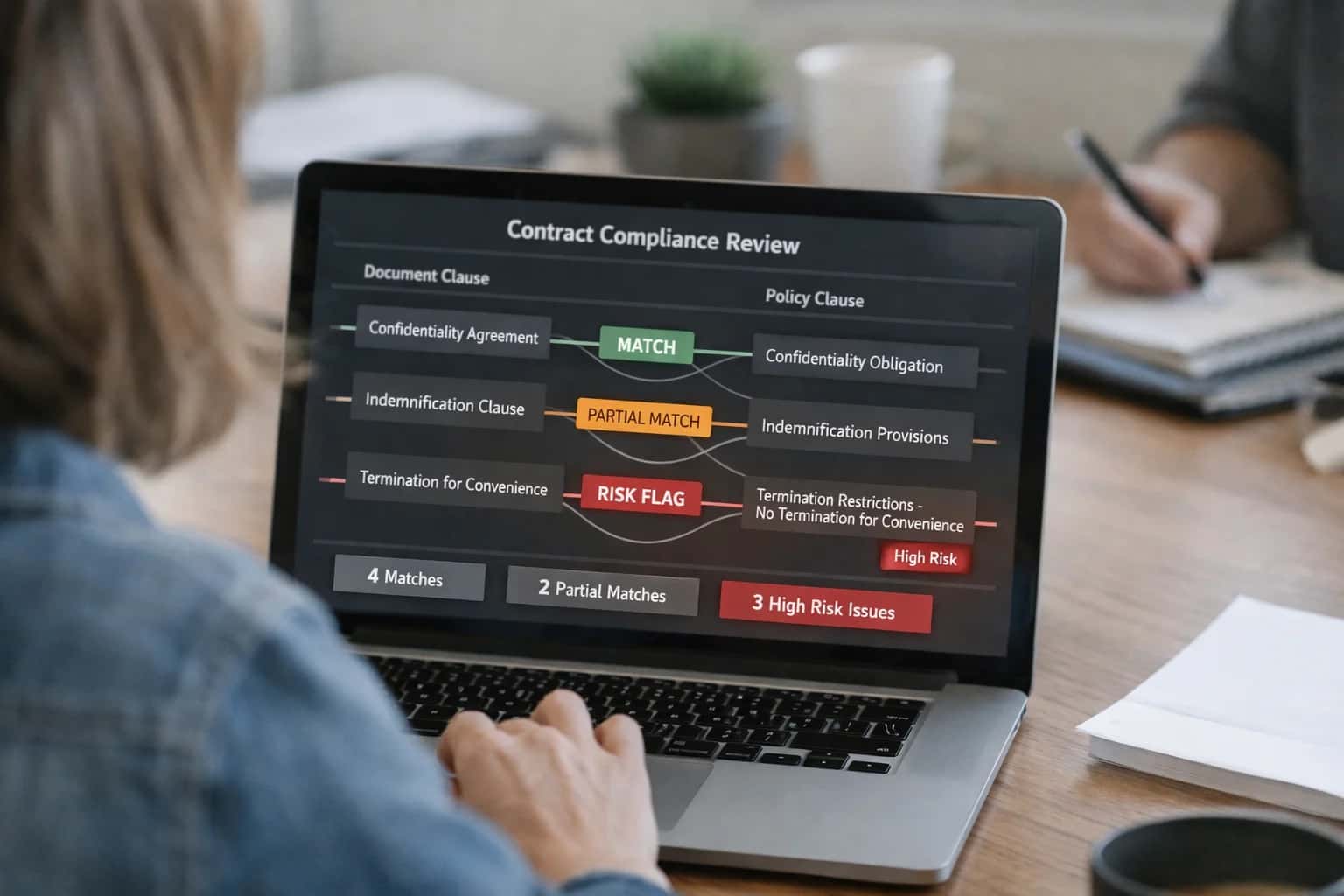
Learn to build an AI support agent that can autonomously interpret and apply business rules, contractual terms, and regulatory policies.
To build this, you architect a verification layer that cross-references the agent's proposed action against a policy knowledge base—often a vector database of parsed contracts or a graph of business rules. This creates a fail-safe, ensuring compliance for actions like those in an autonomous returns system. The final design produces an agent that can handle end-to-end resolution within a governed ACSR architecture.
CORE ARCHITECTURE COMPARISON
Policy Grounding vs. Symbolic Verification
Two complementary techniques for ensuring an AI agent's decisions adhere to business rules and regulations.
| Feature | Policy Grounding | Symbolic Verification |
|---|---|---|
Primary Goal | Inform the agent's initial reasoning with structured policy data | Formally validate the agent's final decision against a rule set |
Execution Timing | Before and during reasoning | After reasoning, before action execution |
Core Mechanism | Retrieval-Augmented Generation (RAG) with policy documents | Logic programming or rule engine (e.g., Prolog, OPA) |
Key Input | Unstructured policy PDFs, knowledge base articles, FAQs | Structured business rules (IF-THEN), regulatory clauses |
Output | Context-aware, policy-informed reasoning trace | Binary pass/fail status with specific rule violations |
Flexibility | High; handles ambiguous or interpretive policies | Low; requires precise, unambiguous rule definition |
Explainability | Moderate; cites source documents but reasoning may be opaque | High; provides clear, step-by-step logical proof |
Best For | Interpreting complex, narrative policies and guidelines | Enforcing non-negotiable compliance and guardrails |
IMPLEMENTATION PATTERNS
Key Use Cases
A policy-aware agent must be grounded in real business logic. These use cases illustrate the core technical patterns for building agents that interpret rules, verify actions, and execute autonomously.
02
Contractual Onboarding & Compliance
Agents interpret lengthy service agreements to guide new users. Implementation requires:
- Agentic RAG over PDF contracts to answer specific eligibility or fee questions.
- A neuro-symbolic layer that extracts key clauses (e.g., SLA terms, termination fees) into a structured fact base.
- Dynamic form generation that adapts required fields based on the user's selected plan and jurisdiction.
- Integration with e-signature platforms to finalize the process without human intervention.
03
Policy-Driven Account Modifications
Handling requests like upgrading a service plan or adding users, where business rules are complex.
- The agent uses a verification layer to confirm the user has authority to make the change.
- It calculates prorated charges by applying pricing rules from a product catalog.
- Before execution, it runs a 'dry-run' simulation to surface the financial impact to the customer for confirmation.
- Updates are made atomically across the CRM and billing system using distributed transaction patterns.
04
Regulatory Disclosure & Data Requests
Automating responses to GDPR 'Right to Access' or financial compliance inquiries.
- The agent must identify the legal basis for the request and verify the requester's identity.
- It orchestrates a data retrieval workflow across multiple siloed systems (CRM, ERP, data lake).
- A redaction module applies policy rules to mask sensitive PII or proprietary information.
- The final report is compiled, watermarked, and delivered through a secure channel, with the action logged for the compliance ledger.
05
Exception Handling & Waiver Processing
Managing edge cases where a customer requests an exception to standard policy.
- The agent assesses the request against a hierarchical rule set to determine if it has the authority to grant a waiver.
- For cases outside its authority, it uses a Human-in-the-Loop (HITL) governance system to escalate with full context.
- If approved, it can generate a one-time policy override, execute the exception, and document the business justification.
- This pattern is critical for balancing autonomy with risk control in complex support environments.
Enabling Efficiency, Speed & Accuracy
Intelligent Analysis, Decision & Execution
We build AI systems for teams that need search across company data, workflow automation across tools, or AI features inside products and internal software.
Talk to Us
Search across company data
Give teams answers from docs, tickets, runbooks, and product data with sources and permissions.
Useful when people spend too long searching or get different answers from different systems.
Enterprise searchRAGPermissions
Read more
Automate internal workflows
Use AI to route work, draft outputs, trigger actions, and keep approvals and logs in place.
Useful when repetitive work moves across multiple tools and teams.
AI agentsWorkflow automationGovernance
Read more
Add AI to products and internal tools
Build assistants, guided actions, or decision support into the software your team or customers already use.
Useful when AI needs to be part of the product, not a separate tool.
AI integrationDecision supportModel routing
Read moreTROUBLESHOOTING
Common Mistakes
Building a policy-aware AI agent is complex. These are the most frequent technical pitfalls developers encounter, from grounding failures to logic errors, and how to fix them.
This is a grounding failure. The agent's LLM is generating responses based on its parametric knowledge, not your specific policy documents.
Fix: Implement a retrieval-augmented generation (RAG) system with strict sourcing. Don't just feed the LLM raw text. Use a vector database to retrieve the most relevant policy snippets for the user's query and instruct the LLM to answer only using the provided context. For critical rules, use symbolic extraction—parse policies into a structured format (JSON, YAML) that the agent can query directly, bypassing LLM interpretation for key facts.
Example Mistake:
python# Weak: LLM answers from memory response = llm(f"User asks: {query}. What's our refund policy?")
Example Fix:
python# Strong: Grounded in retrieved docs relevant_chunks = vector_db.similarity_search(query, filter={"doc_type": "refund_policy"}) context = "\n".join([chunk.page_content for chunk in relevant_chunks]) response = llm(f"Answer based ONLY on this: {context}. Question: {query}")

About the author
Prasad Kumkar
CEO & MD, Inference Systems
Prasad Kumkar is the CEO & MD of Inference Systems and writes about AI systems architecture, LLM infrastructure, model serving, evaluation, and production deployment. Over 5+ years, he has worked across computer vision models, L5 autonomous vehicle systems, and LLM research, with a focus on taking complex AI ideas into real-world engineering systems.
His work and writing cover AI systems, large language models, AI agents, multimodal systems, autonomous systems, inference optimization, RAG, evaluation, and production AI engineering.
LinkedIn
Limited slotsGet a Free AI Consultation
Partnered with leading AI, data, and software stack.





How We Work
Custom AI workflows for your Business
One-fit-all AI don't work for modern businesses. At Inferensys, we aim to understand your business & custom requirements; which we use to define most efficient agentic workflows, the data, and the tools for your business.
01
Review the use case
We understand the task, the users, and where AI can actually help.
Read more02
Pick the right approach
We define what needs search, automation, or product integration.
Read more03
Build the first useful version
We implement the part that proves the value first.
Read more04
Improve from there
We add the checks and visibility needed to keep it useful.
Read moreThe first call is a practical review of your use case and the right next step.
Talk to Us