Model distillation is a knowledge transfer technique where a large, accurate teacher model trains a compact student model to mimic its predictions. The student learns not just from hard labels but from the teacher's softened probability distributions, capturing nuanced relationships. This process, central to creating task-specific small language models (SLMs), dramatically reduces computational and memory footprints while preserving performance, enabling deployment in resource-constrained environments like mobile devices and edge computing grids.

Guide
How to Design a Model Distillation Strategy for Efficiency
A step-by-step guide to distill a large teacher model into a small, fast student model using Hugging Face transformers, temperature scaling, and custom loss functions for edge deployment.
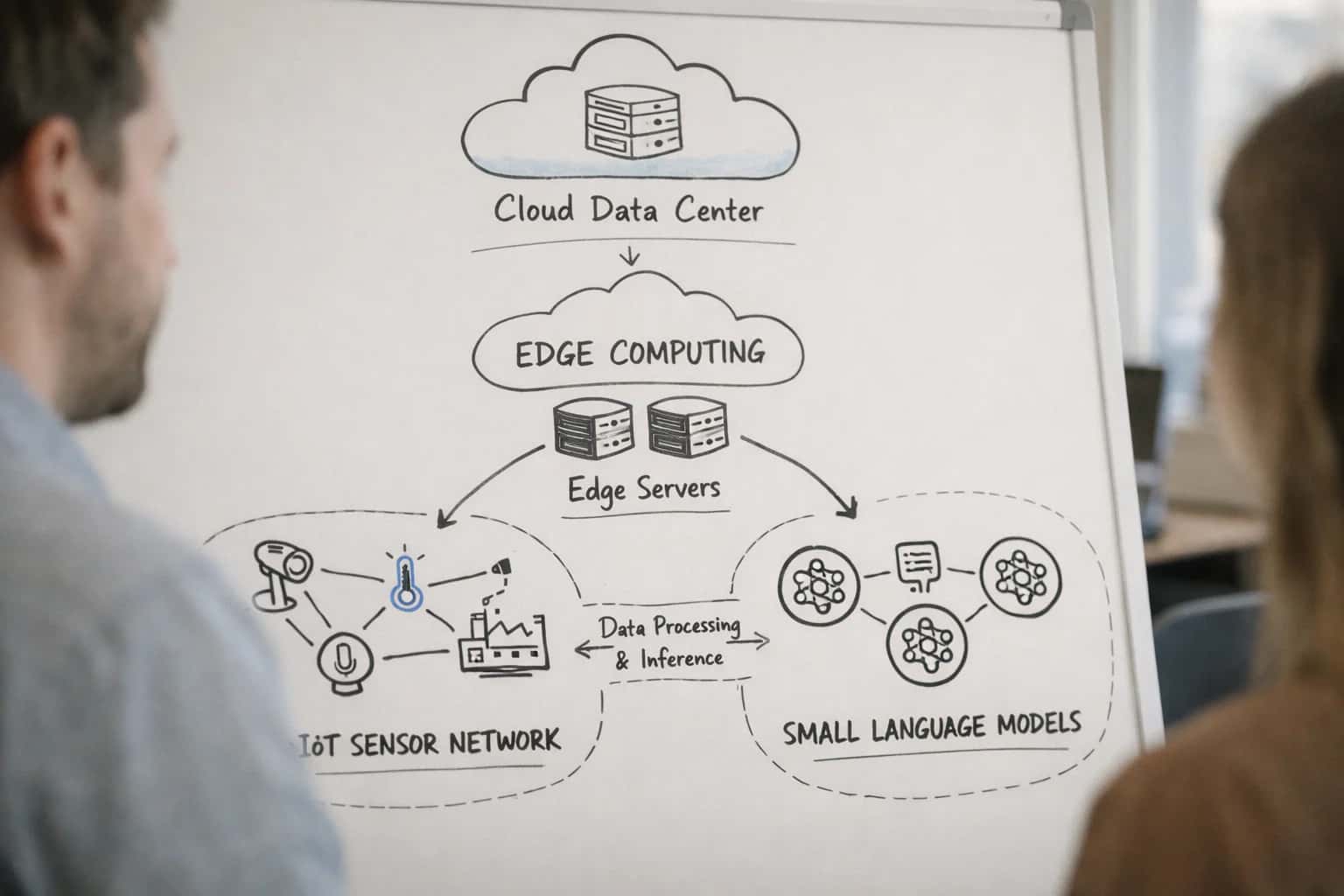
This guide provides a strategic framework for distilling large, capable models into smaller, faster versions suitable for edge deployment, a core technique for building frugal AI systems.
A successful strategy requires selecting an appropriate distillation loss function (like KL Divergence) and applying temperature scaling to smooth the teacher's outputs, making the dark knowledge more accessible. Implement sequential distillation using frameworks like Hugging Face's transformers and leverage libraries such as distilbert for proven architectures. This approach is a practical application of knowledge distillation and model pruning for sustainability, directly reducing the energy required for inference—a key goal of Green AI.
CORE METHODS
Distillation Techniques Comparison
A comparison of the primary strategies for transferring knowledge from a large teacher model to a smaller student model, detailing their mechanisms, resource requirements, and typical use cases.
| Technique | Knowledge Distillation (KD) | Hint-Based Distillation | Attention Transfer |
|---|---|---|---|
Core Mechanism | Mimics teacher's softened output probabilities | Matches intermediate feature maps (hints) | Transfers attention maps from transformer layers |
Primary Loss Function | Kullback–Leibler (KL) Divergence | Mean Squared Error (MSE) or Cosine Similarity | Mean Squared Error (MSE) on attention matrices |
Temperature Scaling Required | |||
Student Architecture Flexibility | High (can differ from teacher) | Low (requires matching layer dimensions) | Medium (requires transformer-based student) |
Typical Compression Ratio | 2x - 10x | 1.5x - 4x | 2x - 6x |
Computational Overhead | Low | Medium | Medium-High |
Best For | General-purpose language/vision models | Computer vision and convolutional networks | Transformer-based models (e.g., BERT, ViT) |
Framework/Tool Example | Hugging Face | Custom layer matching code |
|
Enabling Efficiency, Speed & Accuracy
Intelligent Analysis, Decision & Execution
We build AI systems for teams that need search across company data, workflow automation across tools, or AI features inside products and internal software.
Talk to Us
Search across company data
Give teams answers from docs, tickets, runbooks, and product data with sources and permissions.
Useful when people spend too long searching or get different answers from different systems.
Enterprise searchRAGPermissions
Read more
Automate internal workflows
Use AI to route work, draft outputs, trigger actions, and keep approvals and logs in place.
Useful when repetitive work moves across multiple tools and teams.
AI agentsWorkflow automationGovernance
Read more
Add AI to products and internal tools
Build assistants, guided actions, or decision support into the software your team or customers already use.
Useful when AI needs to be part of the product, not a separate tool.
AI integrationDecision supportModel routing
Read moreMODEL DISTILLATION
Common Mistakes
Avoiding these frequent errors is critical for successfully compressing a large teacher model into a fast, efficient student model without sacrificing too much performance.
Knowledge distillation transfers the generalized knowledge (soft probabilities, hidden states) from a large teacher model to a smaller student. Fine-tuning updates a model's weights directly on a new task's labeled data. The key distinction is the training signal: distillation uses the teacher's output distribution as a 'soft target,' while fine-tuning uses hard, one-hot labels.
- Distillation Loss: Typically a combination of the student's loss against the true labels (hard loss) and its loss against the teacher's softened predictions (soft loss).
- Fine-tuning: Directly minimizes prediction error on the task dataset. You can combine both: first distill a general student from a teacher, then fine-tune it on your specific task data for optimal performance. Learn more about fine-tuning in our guide on How to Implement Few-Shot Learning for Enterprise AI.

About the author
Prasad Kumkar
CEO & MD, Inference Systems
Prasad Kumkar is the CEO & MD of Inference Systems and writes about AI systems architecture, LLM infrastructure, model serving, evaluation, and production deployment. Over 5+ years, he has worked across computer vision models, L5 autonomous vehicle systems, and LLM research, with a focus on taking complex AI ideas into real-world engineering systems.
His work and writing cover AI systems, large language models, AI agents, multimodal systems, autonomous systems, inference optimization, RAG, evaluation, and production AI engineering.
LinkedIn
Limited slotsGet a Free AI Consultation
Partnered with leading AI, data, and software stack.





How We Work
Custom AI workflows for your Business
One-fit-all AI don't work for modern businesses. At Inferensys, we aim to understand your business & custom requirements; which we use to define most efficient agentic workflows, the data, and the tools for your business.
01
Review the use case
We understand the task, the users, and where AI can actually help.
Read more02
Pick the right approach
We define what needs search, automation, or product integration.
Read more03
Build the first useful version
We implement the part that proves the value first.
Read more04
Improve from there
We add the checks and visibility needed to keep it useful.
Read moreThe first call is a practical review of your use case and the right next step.
Talk to Us