
Guides
Task-Specific Small Language Model (SLM) Optimization
Task-Specific Small Language Model (SLM) Optimization
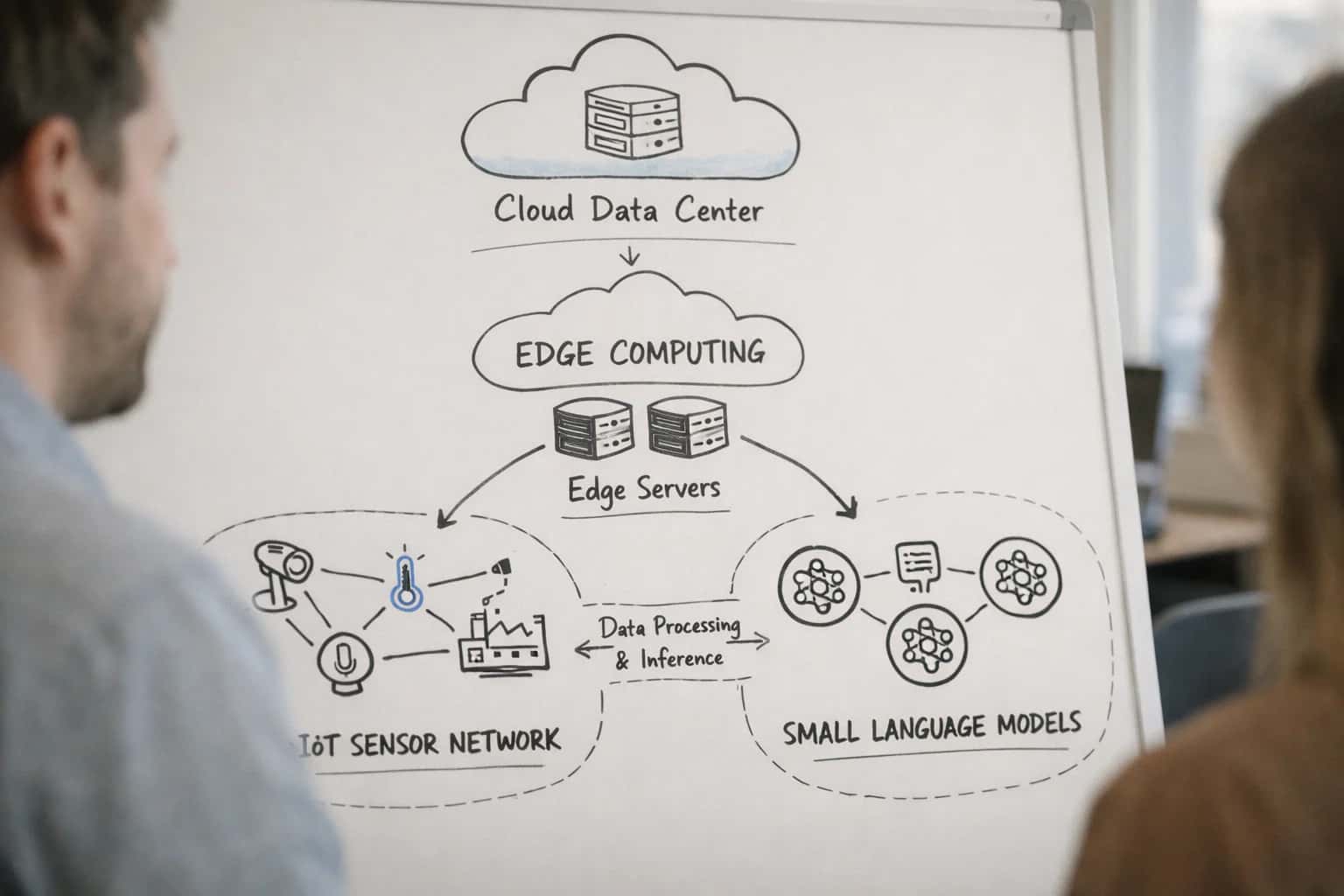
The industry-wide move from 'bigger is better' to 'smarter is better' has made SLM development a core service. This pillar involves the distillation, pruning, and fine-tuning of compact models for specific tasks like coding, medical diagnosis, or legal review. Guides focus on 'How to distill a Llama-4 model for mobile deployment,' 'Optimizing Phi-3 for real-time customer support,' and 'Benchmarking SLMs against GPT-5 for narrow domain tasks.'
How to Architect a Task-Specific SLM Strategy for Your Product
This guide provides a strategic framework for CTOs and product leaders to define the business case, technical scope, and success criteria for a custom Small Language Model. It covers aligning SLM objectives with product KPIs, assessing the build-vs.-buy decision, and creating a phased roadmap from pilot to production. You'll learn to identify high-ROI use cases and avoid common strategic pitfalls in SLM adoption.
How to Select the Right Base Model for Your SLM Project
Choosing between models like Llama, Phi, Gemma, and Mistral is a critical first step. This guide compares open-source and proprietary base models across dimensions of licensing, size, architecture, and task aptitude. You'll learn to evaluate models using benchmarks like MMLU and HELM, and match model capabilities to your specific domain requirements, latency constraints, and deployment environment.
How to Choose Between Fine-Tuning, Pruning, and Distillation
This guide breaks down the core optimization techniques for creating a task-specific SLM. It explains the trade-offs between full fine-tuning, parameter-efficient methods like LoRA, model pruning for size reduction, and knowledge distillation for transferring capabilities. You'll learn a decision framework based on your available data, compute budget, and performance targets to select the most effective technique.
How to Design a Data Strategy for SLM Fine-Tuning
The quality of your training data dictates model performance. This guide covers the end-to-end process of sourcing, cleaning, labeling, and augmenting domain-specific datasets for SLM fine-tuning. You'll learn techniques for synthetic data generation, handling class imbalance, and creating evaluation splits that accurately reflect real-world task distribution, ensuring your model learns the right patterns.
How to Architect an SLM for On-Device Inference
Deploying models on mobile devices, edge servers, or IoT hardware requires specialized optimization. This guide covers techniques like quantization (using GPTQ or AWQ), model compilation with TensorFlow Lite or ONNX Runtime, and memory-aware architecture design. You'll learn to balance model accuracy with strict latency, power, and storage constraints for real-world on-device applications.
Setting Up a Benchmarking Framework for SLM Performance
You cannot improve what you cannot measure. This guide details how to establish a robust evaluation pipeline using tools like Weights & Biases or MLflow. It covers selecting relevant metrics (accuracy, latency, throughput), creating a golden dataset, and automating performance tracking against baselines. You'll learn to set up continuous integration for model testing to catch regressions early.
How to Integrate an SLM into an Existing Product Architecture
Moving from a prototype to a live feature requires careful engineering. This guide provides patterns for integrating an SLM via API endpoints, embedding it within microservices, and managing stateful conversations. It covers critical considerations like authentication, rate limiting, caching strategies, and graceful degradation to ensure reliability and a seamless user experience within your existing tech stack.
Setting Up a Continuous Evaluation Loop for SLM Accuracy
Model performance degrades over time due to data drift and changing user behavior. This guide explains how to implement a production monitoring system that tracks key performance indicators, collects user feedback, and triggers retraining pipelines. You'll learn to use tools like Arize or WhyLabs to detect concept drift and establish automated workflows for model maintenance and improvement.
How to Manage the Lifecycle of a Production SLM
This guide covers the full MLOps lifecycle for a task-specific SLM, from versioning and registry management with tools like Hugging Face Hub or MLflow, to staged rollouts and A/B testing. It details processes for safe deployment, rollback strategies, and decommissioning outdated models. You'll learn to establish governance and audit trails to ensure compliant and reliable model operations.
How to Budget for Task-Specific SLM Development and Deployment
This financial planning guide helps engineering leads forecast the true cost of an SLM initiative. It breaks down expenses across data acquisition, cloud compute for training (e.g., AWS Trainium, Google TPUs), inference hosting, MLOps tooling, and engineering labor. You'll learn to model total cost of ownership (TCO) and build a compelling ROI analysis to secure stakeholder buy-in.
How to Mitigate Bias in a Narrow-Domain SLM
Task-specific models can amplify biases present in their training data. This guide provides a practical methodology for auditing your SLM for fairness issues using libraries like Fairlearn or Aequitas. It covers techniques for bias detection, dataset debiasing, and implementing fairness constraints during training to build more equitable and trustworthy models for sensitive applications.
How to Leverage Open-Source SLMs vs. Building Your Own
This strategic guide helps you decide when to fine-tune an existing open-source model (like Llama or Phi) versus training a model from scratch. It compares the development time, cost, control, and performance trade-offs of each approach. You'll learn to evaluate the ecosystem support, licensing restrictions, and customization depth required for your project to make an informed build-or-leverage decision.
Partnered with leading AI, data, and software stack.





How We Work
Custom AI workflows for your Business
One-fit-all AI don't work for modern businesses. At Inferensys, we aim to understand your business & custom requirements; which we use to define most efficient agentic workflows, the data, and the tools for your business.
01
Review the use case
We understand the task, the users, and where AI can actually help.
Read more02
Pick the right approach
We define what needs search, automation, or product integration.
Read more03
Build the first useful version
We implement the part that proves the value first.
Read more04
Improve from there
We add the checks and visibility needed to keep it useful.
Read moreThe first call is a practical review of your use case and the right next step.
Talk to Us