MLOps transforms machine learning from a research project into a continuous, reliable engineering discipline. For grid AI—where a model failure can mean a blackout—this is non-negotiable. A robust pipeline automates the journey from code commit to production deployment, enforcing version control for data and models, automated testing for performance and safety, and canary deployments to mitigate risk. Tools like MLflow for experiment tracking and Kubeflow for orchestration form the backbone of this system.

Guide
Setting Up MLOps Pipelines for Continuous Grid Model Deployment
A developer guide to building robust MLOps pipelines for deploying and managing high-reliability AI models in smart grid operations. Includes code examples for MLflow, Kubeflow, and automated testing.
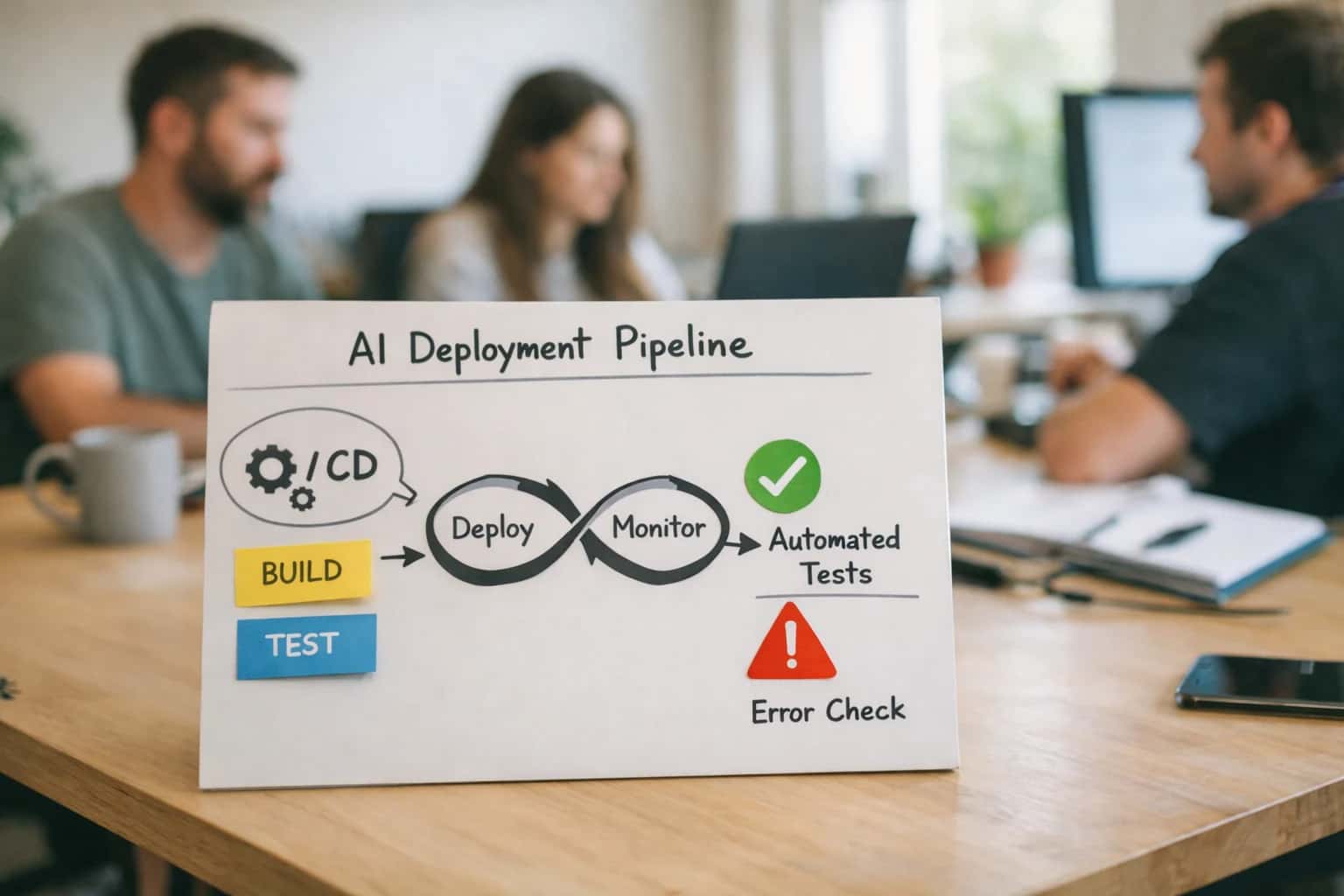
Deploying AI models for grid management requires industrial-grade reliability. This guide introduces the core MLOps principles to achieve it.
The pipeline's ultimate goal is to ensure models remain accurate as grid conditions evolve. This requires continuous monitoring for concept drift—when real-world data patterns shift away from the training set—and performance degradation. Automated rollback strategies must be in place to instantly revert to a stable model version if anomalies are detected. This operational rigor is the foundation for trustworthy autonomous systems, linking directly to our guides on How to Build an Explainable AI Framework for Grid Operator Trust and Cognitive Load Reduction for Human Operators.
PIPELINE ORCHESTRATION
MLOps Tool Comparison for Grid AI
This table compares core MLOps platforms for building continuous deployment pipelines for grid forecasting and optimization models, focusing on features critical for high-reliability energy systems.
| Feature / Capability | MLflow | Kubeflow Pipelines | Azure Machine Learning |
|---|---|---|---|
Native Model Versioning & Registry | |||
Pipeline-as-Code Definition | Python functions | YAML/DSL | Python SDK/YAML |
Automated Retraining Triggers | via API/events | via events | via schedule/data drift |
Canary Deployment Support | Limited (custom) | ||
Integrated Performance Monitoring | Basic metrics | Requires add-ons | Native (Model Monitor) |
Concept Drift Detection | Requires custom code | via add-ons (e.g., Seldon) | Native (Data Drift) |
Rollback Strategy Automation | via pipeline logic | via endpoint management | |
Grid-Specific Data Connectors (e.g., SCADA, PMU) | Custom required | Custom required | Pre-built for Azure IoT |
Enabling Efficiency, Speed & Accuracy
Intelligent Analysis, Decision & Execution
We build AI systems for teams that need search across company data, workflow automation across tools, or AI features inside products and internal software.
Talk to Us
Search across company data
Give teams answers from docs, tickets, runbooks, and product data with sources and permissions.
Useful when people spend too long searching or get different answers from different systems.
Enterprise searchRAGPermissions
Read more
Automate internal workflows
Use AI to route work, draft outputs, trigger actions, and keep approvals and logs in place.
Useful when repetitive work moves across multiple tools and teams.
AI agentsWorkflow automationGovernance
Read more
Add AI to products and internal tools
Build assistants, guided actions, or decision support into the software your team or customers already use.
Useful when AI needs to be part of the product, not a separate tool.
AI integrationDecision supportModel routing
Read moreTROUBLESHOOTING
Common Mistakes
Deploying AI models to manage the electrical grid requires extreme reliability. These are the most frequent technical pitfalls teams encounter when building MLOps pipelines for this critical infrastructure.
Silent failures occur due to environmental drift between training and inference. Your pipeline likely lacks automated integration testing.
Fix: Implement a pre-deployment staging environment that mirrors production. Run a battery of tests:
- Data schema validation: Ensure incoming live data matches the expected feature format.
- Performance regression tests: Compare the new model's predictions on a held-out validation set against the current champion model.
- Inference latency SLA checks: Verify the model meets real-time requirements under load.
Tools like MLflow can package the model, its dependencies, and a scoring script into a container, ensuring consistency. For a robust foundation, see our guide on How to Architect a Data Governance Strategy for Grid AI.

About the author
Prasad Kumkar
CEO & MD, Inference Systems
Prasad Kumkar is the CEO & MD of Inference Systems and writes about AI systems architecture, LLM infrastructure, model serving, evaluation, and production deployment. Over 5+ years, he has worked across computer vision models, L5 autonomous vehicle systems, and LLM research, with a focus on taking complex AI ideas into real-world engineering systems.
His work and writing cover AI systems, large language models, AI agents, multimodal systems, autonomous systems, inference optimization, RAG, evaluation, and production AI engineering.
LinkedIn
Limited slotsGet a Free AI Consultation
Partnered with leading AI, data, and software stack.





How We Work
Custom AI workflows for your Business
One-fit-all AI don't work for modern businesses. At Inferensys, we aim to understand your business & custom requirements; which we use to define most efficient agentic workflows, the data, and the tools for your business.
01
Review the use case
We understand the task, the users, and where AI can actually help.
Read more02
Pick the right approach
We define what needs search, automation, or product integration.
Read more03
Build the first useful version
We implement the part that proves the value first.
Read more04
Improve from there
We add the checks and visibility needed to keep it useful.
Read moreThe first call is a practical review of your use case and the right next step.
Talk to Us