A governance model for autonomous cobots establishes clear rules and oversight for AI-driven decisions, ensuring safety, compliance, and ethical operation. It defines decision boundaries that trigger human-in-the-loop (HITL) intervention, such as handling novel objects or operating near safety thresholds. This framework transforms AI from a black box into a managed, accountable system, which is critical for adoption in regulated sectors like pharmaceuticals or automotive manufacturing where errors have significant consequences.

Guide
Setting Up a Governance Model for AI Decisions in Autonomous Robotic Operations
A technical guide to implementing oversight, accountability, and compliance for AI-driven collaborative robots. Includes code for decision logging, HITL triggers, and review board workflows.
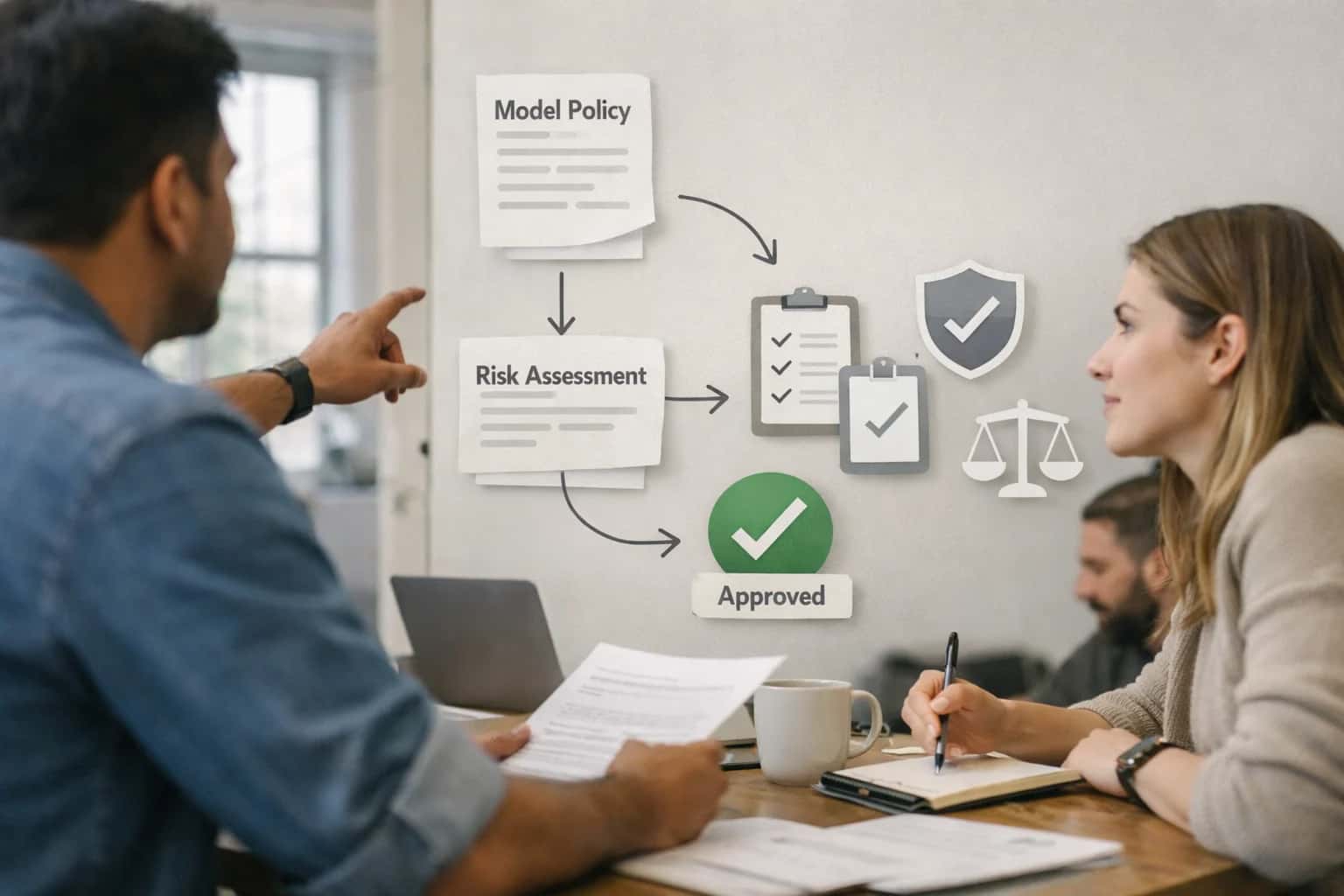
This guide provides a framework for establishing oversight and accountability for AI-driven cobot actions. You will learn to define decision boundaries requiring human-in-the-loop approval, implement auditable logging of all autonomous decisions using tools like MLflow, and create a review board process. This is essential for compliance in regulated industries and for building trust with the workforce.
Implementation requires three core technical components: a policy engine to encode rules, an audit trail using tools like MLflow for logging every decision and sensor context, and a review board process for periodic analysis. This structure not only mitigates risk but also builds operator trust by providing transparency into the cobot's reasoning, a foundational step for successful collaborative robotics integration. For related oversight systems, see our guide on Human-in-the-Loop (HITL) Governance Systems.
IMPLEMENTATION OPTIONS
Governance Tool Comparison
A comparison of core tools for implementing the three pillars of an AI governance model: auditable logging, human-in-the-loop (HITL) integration, and review board workflows.
| Governance Capability | Open-Source Stack (MLflow + Custom) | Enterprise Platform (DataRobot / Domino) | Specialized Cobot OEM Suite |
|---|---|---|---|
Auditable Decision Logging | Partial | ||
Human-in-the-Loop (HITL) Approval Gates | |||
Integrated Risk Scoring | Custom models required | ||
Pre-built Compliance Reports (ISO/TS 15066) | |||
Real-time Intervention Dashboard | Requires custom UI | Limited to OEM ecosystem | |
Model & Policy Version Control | |||
Direct Integration with Cobot Controller APIs | Custom adapter needed | Via partner connectors | |
Annual Operational Cost | < $5k (infrastructure) | $50k - $200k+ | Bundled in service contract |
Enabling Efficiency, Speed & Accuracy
Intelligent Analysis, Decision & Execution
We build AI systems for teams that need search across company data, workflow automation across tools, or AI features inside products and internal software.
Talk to Us
Search across company data
Give teams answers from docs, tickets, runbooks, and product data with sources and permissions.
Useful when people spend too long searching or get different answers from different systems.
Enterprise searchRAGPermissions
Read more
Automate internal workflows
Use AI to route work, draft outputs, trigger actions, and keep approvals and logs in place.
Useful when repetitive work moves across multiple tools and teams.
AI agentsWorkflow automationGovernance
Read more
Add AI to products and internal tools
Build assistants, guided actions, or decision support into the software your team or customers already use.
Useful when AI needs to be part of the product, not a separate tool.
AI integrationDecision supportModel routing
Read moreGOVERNANCE MODEL
Common Mistakes
Establishing oversight for AI-driven cobot decisions is critical for safety and compliance. These are the most frequent technical and procedural errors teams make when building their governance framework.
The most common mistake is implementing governance as a passive logging system, like MLflow, after the AI is deployed. Governance must be designed into the decision loop. This means defining decision boundaries and human-in-the-loop (HITL) triggers at the architecture stage. For example, a cobot's path planner should have a built-in API call to a governance service before executing any motion that enters a dynamic safety zone. Logging is for accountability; integrated governance is for prevention.
Actionable Fix: Model governance as a first-class microservice. Define a GovernanceService class with methods like requires_human_approval(task, confidence_score, risk_level). Integrate this service call into your agent's core decision-making logic before any irreversible action.

About the author
Prasad Kumkar
CEO & MD, Inference Systems
Prasad Kumkar is the CEO & MD of Inference Systems and writes about AI systems architecture, LLM infrastructure, model serving, evaluation, and production deployment. Over 5+ years, he has worked across computer vision models, L5 autonomous vehicle systems, and LLM research, with a focus on taking complex AI ideas into real-world engineering systems.
His work and writing cover AI systems, large language models, AI agents, multimodal systems, autonomous systems, inference optimization, RAG, evaluation, and production AI engineering.
LinkedIn
Limited slotsGet a Free AI Consultation
Partnered with leading AI, data, and software stack.





How We Work
Custom AI workflows for your Business
One-fit-all AI don't work for modern businesses. At Inferensys, we aim to understand your business & custom requirements; which we use to define most efficient agentic workflows, the data, and the tools for your business.
01
Review the use case
We understand the task, the users, and where AI can actually help.
Read more02
Pick the right approach
We define what needs search, automation, or product integration.
Read more03
Build the first useful version
We implement the part that proves the value first.
Read more04
Improve from there
We add the checks and visibility needed to keep it useful.
Read moreThe first call is a practical review of your use case and the right next step.
Talk to Us