A self-repairing telecommunications network autonomously detects, diagnoses, and remediates faults to maintain service continuity. The core architecture integrates real-time monitoring of Key Performance Indicators (KPIs) like latency and packet loss with hardware telemetry. Causal inference models analyze this data stream to pinpoint root causes—such as a failing cell tower radio or a severed fiber optic cable—moving beyond simple anomaly detection to actionable diagnosis. This intelligence is the prerequisite for automated remediation.

Guide
Launching a Self-Repairing Telecommunications Infrastructure
A developer guide to building an AI system that autonomously detects, diagnoses, and repairs cellular and fiber network faults using causal inference, SDN, and autonomous drones.
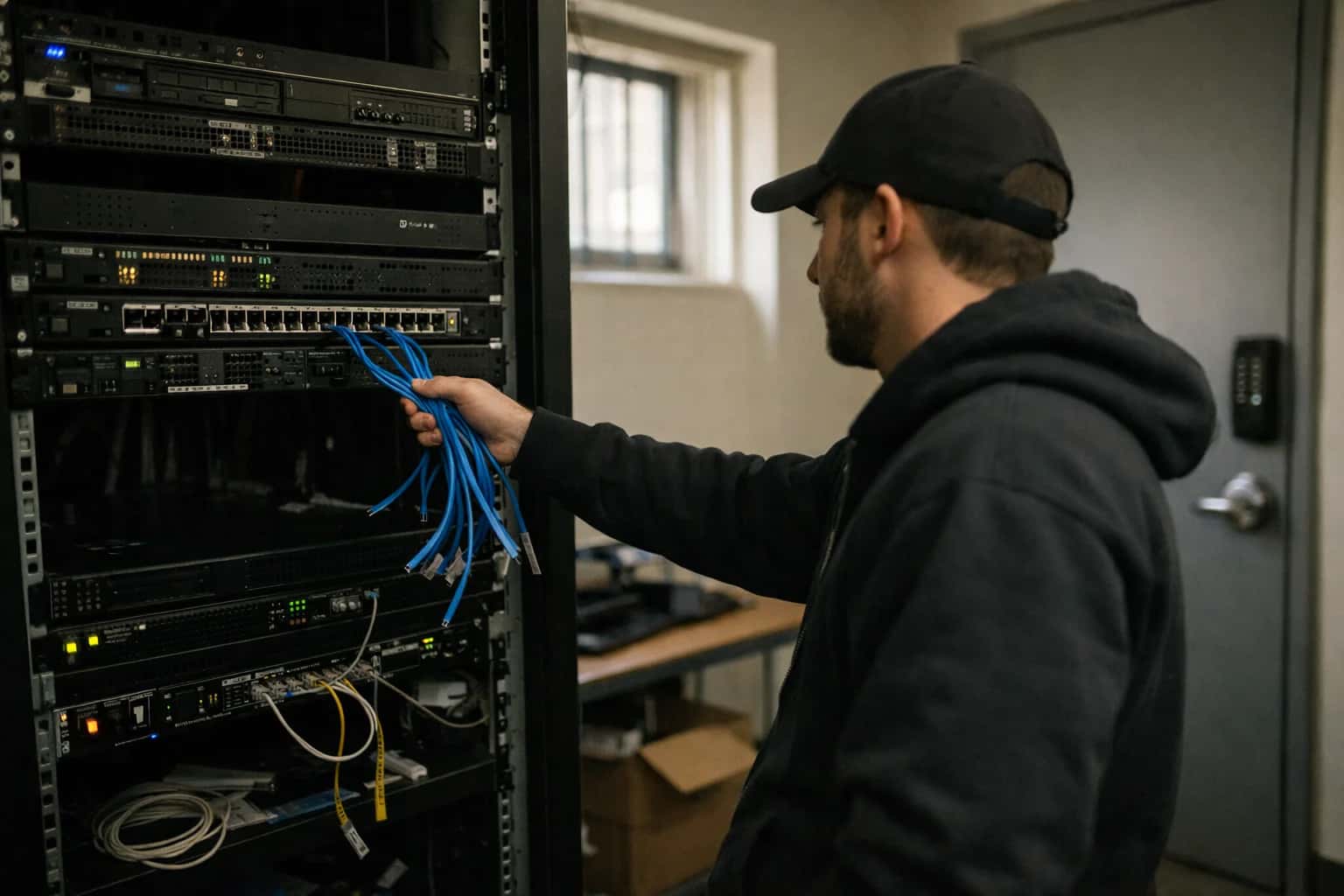
This guide outlines how to build an AI system for cellular or fiber network resilience. It covers monitoring network performance metrics (KPIs) and hardware logs, using causal inference models to pinpoint failing nodes or fiber cuts, and automatically re-routing traffic via Software-Defined Networking (SDN). For physical repairs, the system can dispatch autonomous drones for inspection or guide field technicians with augmented reality overlays, drastically reducing service restoration time.
The system executes repairs through a layered response. First, it triggers Software-Defined Networking (SDN) controllers to re-route traffic around the fault, preserving service. For physical issues, it can dispatch autonomous drones equipped with cameras for visual inspection or initiate augmented reality overlays to guide field technicians. This closed-loop process, from sensor to actuator, drastically reduces Mean Time To Repair (MTTR) and operational costs, transforming network operations from reactive to resilient. For foundational concepts, see our guide on Self-Healing Physical Infrastructure.
CORE INFRASTRUCTURE
Telecom Self-Healing Tool Stack Comparison
A comparison of foundational platforms for building an autonomous, self-repairing network. This table evaluates the core orchestration, inference, and data management layers required to detect, diagnose, and remediate faults.
| Feature / Capability | Kubernetes-Based Orchestration | Specialized Telco Cloud Platform | Proprietary Vendor Stack |
|---|---|---|---|
Unified Orchestration (Compute/Network/Storage) | |||
Native Integration with SDN Controllers (e.g., ONOS) | |||
Real-Time Stream Processing (< 100ms latency) | 50ms | < 100ms | 200ms |
Causal Inference Model Deployment | |||
Autonomous Drone Fleet API Integration | |||
Built-in Digital Twin for Simulation | |||
Hardware-Agnostic Deployment | |||
Open Standards Compliance (TMF, ETSI) | |||
Total Cost of Ownership (5-year estimate) | $2-5M | $5-10M | $10-15M+ |
Enabling Efficiency, Speed & Accuracy
Intelligent Analysis, Decision & Execution
We build AI systems for teams that need search across company data, workflow automation across tools, or AI features inside products and internal software.
Talk to Us
Search across company data
Give teams answers from docs, tickets, runbooks, and product data with sources and permissions.
Useful when people spend too long searching or get different answers from different systems.
Enterprise searchRAGPermissions
Read more
Automate internal workflows
Use AI to route work, draft outputs, trigger actions, and keep approvals and logs in place.
Useful when repetitive work moves across multiple tools and teams.
AI agentsWorkflow automationGovernance
Read more
Add AI to products and internal tools
Build assistants, guided actions, or decision support into the software your team or customers already use.
Useful when AI needs to be part of the product, not a separate tool.
AI integrationDecision supportModel routing
Read moreTROUBLESHOOTING
Common Mistakes
Launching a self-repairing telecom network is a complex integration of AI, networking, and physical systems. These are the most frequent technical pitfalls developers encounter and how to fix them.
This is often caused by using generic models on noisy, domain-specific telemetry. Telecom KPIs and hardware logs have unique seasonal patterns (e.g., daily user traffic cycles) and correlated failures that generic algorithms miss.
Fix: Implement a multi-stage filtering pipeline:
- Baseline with domain rules: First, filter out known, non-critical events using simple thresholds (e.g., scheduled maintenance windows).
- Use causal inference models: Move beyond correlation. Tools like DoWhy or CausalNex help model the causal graph of your network (e.g., a fiber cut causes downstream node failures). This pinpoints root causes instead of flagging all symptoms.
- Incorporate topology: Anomaly severity depends on location. Weight alerts based on the node's criticality in the network graph.
Start with our guide on Setting Up AI-Driven Fault Detection for Critical Infrastructure for a robust pipeline blueprint.

About the author
Prasad Kumkar
CEO & MD, Inference Systems
Prasad Kumkar is the CEO & MD of Inference Systems and writes about AI systems architecture, LLM infrastructure, model serving, evaluation, and production deployment. Over 5+ years, he has worked across computer vision models, L5 autonomous vehicle systems, and LLM research, with a focus on taking complex AI ideas into real-world engineering systems.
His work and writing cover AI systems, large language models, AI agents, multimodal systems, autonomous systems, inference optimization, RAG, evaluation, and production AI engineering.
LinkedIn
Limited slotsGet a Free AI Consultation
Partnered with leading AI, data, and software stack.





How We Work
Custom AI workflows for your Business
One-fit-all AI don't work for modern businesses. At Inferensys, we aim to understand your business & custom requirements; which we use to define most efficient agentic workflows, the data, and the tools for your business.
01
Review the use case
We understand the task, the users, and where AI can actually help.
Read more02
Pick the right approach
We define what needs search, automation, or product integration.
Read more03
Build the first useful version
We implement the part that proves the value first.
Read more04
Improve from there
We add the checks and visibility needed to keep it useful.
Read moreThe first call is a practical review of your use case and the right next step.
Talk to Us