An AI governance framework is a mandatory control system for security models, establishing formal processes for validation, deployment, and continuous monitoring. It ensures models used for threat detection, access control, or vulnerability scoring are reliable, unbiased, and secure against manipulation like data poisoning or prompt injection. This framework creates the necessary audit trails for compliance with regulations like the EU AI Act and internal security policies, linking directly to our guide on Explainability and Traceability for High-Risk AI.

Guide
How to Design an AI Governance Framework for Security Models
This guide provides a technical blueprint for establishing oversight and control of AI systems used in security. You will implement processes for model validation, bias auditing, performance drift monitoring, and secure deployment.
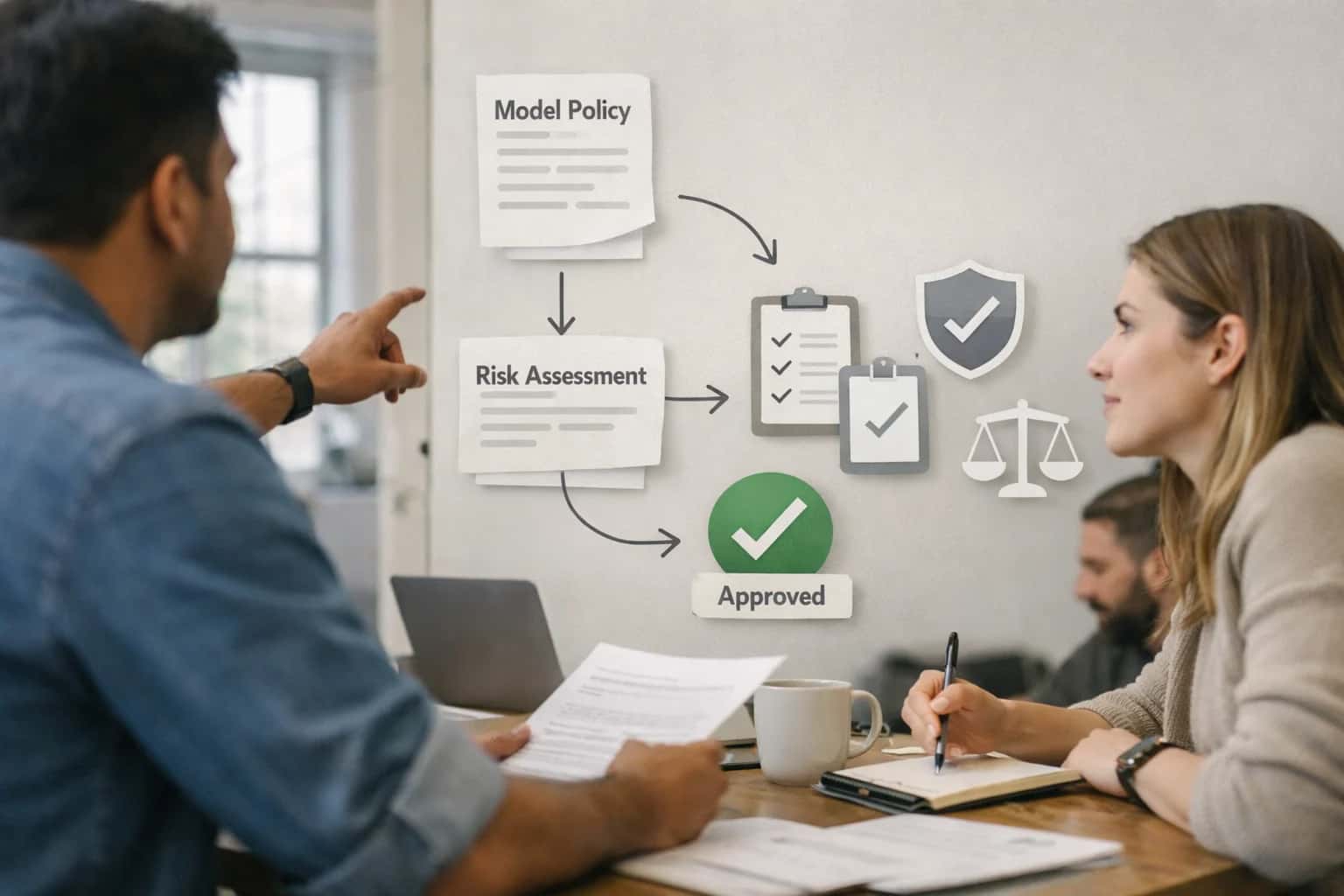
A structured approach to controlling, auditing, and securing AI systems used in cybersecurity operations.
Designing this framework involves four core components: a secure model registry to catalog all assets, automated approval workflows for staging and production, continuous performance and drift monitoring, and a bias auditing pipeline. You must integrate these components into existing MLOps and SecOps toolchains. The outcome is a defensible, repeatable process that mitigates the unique risks of autonomous security AI, preventing model failure from becoming a security incident itself.
FOUNDATIONAL PRINCIPLES
Key Concepts of AI Governance for Security
A robust governance framework is the control plane for secure AI. These core concepts define the processes, tools, and oversight required to manage risk and ensure compliance.
01
Model Validation & Approval Workflows
Before deployment, every security model must pass through a formal validation gate. This involves:
- Performance benchmarking against a hold-out test set representing real-world attack scenarios.
- Bias and fairness auditing to ensure the model does not disproportionately flag activity from specific user groups.
- Adversarial robustness testing to evaluate resilience against data poisoning or evasion attacks. Establish a clear, automated workflow (e.g., using MLflow or Kubeflow) that requires sign-off from security, legal, and model owner stakeholders before promotion to production. This creates an enforceable chain of custody.
02
Secure Model Registry & Artifact Tracking
A secure model registry is the single source of truth for all AI artifacts. It must track:
- Model binaries, training code, and dependencies.
- The exact training data lineage and version used.
- All validation results, audit reports, and approval signatures.
- Deployment history and environment configurations. Implement cryptographic hashing (e.g., SHA-256) for all artifacts to ensure integrity. This registry is critical for incident response, allowing you to quickly roll back a compromised model and trace its origins, a practice aligned with digital provenance principles.
03
Performance Drift & Anomaly Monitoring
Model performance degrades over time due to concept drift (changing attack patterns) or data drift (shifts in input data distribution). Governance requires continuous monitoring of:
- Prediction drift: Statistical tests (e.g., Population Stability Index) on model outputs.
- Data quality metrics: Missing values, data type mismatches, and feature distribution shifts.
- Business KPIs: False positive/negative rates for security alerts. Set automated alerts that trigger a model review and potential retraining when thresholds are breached. This turns governance from a point-in-time audit into a continuous feedback loop.
04
Audit Trails & Explainability for High-Risk Decisions
For any AI-driven security action (e.g., blocking a user, escalating an alert), you must maintain an immutable audit trail. This log should capture:
- The model version and input data that triggered the decision.
- The model's confidence score and the reasoning path (e.g., top contributing features from SHAP or LIME).
- Any Human-in-the-Loop (HITL) review or override. This traceability is not just for internal debugging; it's a regulatory requirement under frameworks like the EU AI Act for high-risk systems. It provides the defensibility needed for legal and compliance reviews, linking directly to our guide on Explainability and Traceability for High-Risk AI.
05
Policy as Code & Automated Compliance
Translate governance policies into executable code. Define rules that automatically enforce standards, such as:
- Data privacy: Automatically redact PII from training datasets.
- Model requirements: Block deployment if a model lacks a required fairness audit report.
- Access control: Enforce role-based permissions for who can train, validate, or deploy models. Use tools like Open Policy Agent (OPA) to codify these rules and integrate them into your CI/CD and MLOps pipelines. This ensures governance is scalable, consistent, and not reliant on manual checklists.
06
Incident Response & Model Decommissioning
Governance must plan for failure. Establish a clear playbook for AI security incidents, such as a model being exploited via adversarial examples or leaking sensitive data. The playbook should define:
- Immediate containment steps (e.g., taking the model offline).
- Forensic analysis using the secure model registry and audit trails.
- Communication protocols for stakeholders and regulators.
- A formal decommissioning process to archive or delete model artifacts and their associated data, ensuring no residual risk remains. This closes the lifecycle loop and is a critical component of preemptive cybersecurity.
FOUNDATION
Step 1: Define Your Governance Policy as Code
The first step in securing AI models is to codify your governance rules, transforming abstract policies into executable, auditable code that integrates directly into your MLOps pipeline.
AI Governance Policy as Code is the practice of expressing security, compliance, and operational rules in machine-readable formats like YAML, JSON, or domain-specific languages. This moves governance from manual checklists and PDFs into the model lifecycle itself. For security models, this includes codifying rules for data privacy (e.g., PII scrubbing), model validation thresholds, approved deployment regions, and mandatory explainability outputs as defined in our guide on Explainability and Traceability for High-Risk AI.
Implement this by creating a policy.yaml file that declares your constraints. Use tools like Open Policy Agent (OPA) or specialized AI policy engines to evaluate these rules during CI/CD. For example, a policy can block a model deployment if its bias audit score exceeds a threshold or if it lacks a required Software Bill of Materials (SBoM). This creates an immutable, version-controlled audit trail and enables automated enforcement, which is critical for compliance with frameworks like the EU AI Act.
PLATFORM ARCHITECTURE
AI Governance Tool Comparison
A comparison of core technical approaches for implementing governance in security AI model lifecycles, from development to deployment and monitoring.
| Governance Capability | Open-Source Framework (e.g., MLflow + OpenLineage) | Commercial AI/ML Platform (e.g., Databricks, Sagemaker) | Specialized AI Governance Suite (e.g., TruEra, Fiddler) |
|---|---|---|---|
Secure Model Registry & Versioning | |||
Automated Bias & Fairness Auditing | Manual script integration | ||
Performance & Drift Monitoring | Basic metrics logging | Advanced automated alerts | Causal analysis & root cause |
Approval Workflows for Deployment | Custom pipeline development | Integrated with CI/CD | Pre-built, policy-driven workflows |
Immutable Audit Trail Generation | With enterprise tier | ||
Integration with Security Tools (SIEM, SOAR) | Custom API development required | Pre-built connectors | Pre-built connectors & dedicated modules |
Compliance Reporting (e.g., EU AI Act) | Manual report assembly | Template-based reports | Automated, regulation-specific reports |
Explainability for High-Risk Decisions | Limited (e.g., SHAP plots) | Integrated libraries | Specialized, actionable traceability |
Enabling Efficiency, Speed & Accuracy
Intelligent Analysis, Decision & Execution
We build AI systems for teams that need search across company data, workflow automation across tools, or AI features inside products and internal software.
Talk to Us
Search across company data
Give teams answers from docs, tickets, runbooks, and product data with sources and permissions.
Useful when people spend too long searching or get different answers from different systems.
Enterprise searchRAGPermissions
Read more
Automate internal workflows
Use AI to route work, draft outputs, trigger actions, and keep approvals and logs in place.
Useful when repetitive work moves across multiple tools and teams.
AI agentsWorkflow automationGovernance
Read more
Add AI to products and internal tools
Build assistants, guided actions, or decision support into the software your team or customers already use.
Useful when AI needs to be part of the product, not a separate tool.
AI integrationDecision supportModel routing
Read moreAI GOVERNANCE
Common Mistakes
Designing an AI governance framework for security models is a critical engineering task. These are the most frequent technical and procedural pitfalls that undermine security, compliance, and operational effectiveness.
A governance framework is not a checklist for a single audit; it's a continuous lifecycle management system. Treating it as a one-time event creates dangerous gaps as models evolve.
- Model Drift: Security models degrade as attacker tactics change. Without continuous monitoring for performance drift, your model becomes a liability.
- Static Policies: Threat landscapes and regulations evolve. A static framework cannot adapt approval workflows or validation criteria.
- Actionable Solution: Implement automated pipelines for continuous validation, bias auditing, and drift detection. Integrate governance checks into your MLOps pipeline for agents, triggering reviews on performance thresholds or code commits.

About the author
Prasad Kumkar
CEO & MD, Inference Systems
Prasad Kumkar is the CEO & MD of Inference Systems and writes about AI systems architecture, LLM infrastructure, model serving, evaluation, and production deployment. Over 5+ years, he has worked across computer vision models, L5 autonomous vehicle systems, and LLM research, with a focus on taking complex AI ideas into real-world engineering systems.
His work and writing cover AI systems, large language models, AI agents, multimodal systems, autonomous systems, inference optimization, RAG, evaluation, and production AI engineering.
LinkedIn
Limited slotsGet a Free AI Consultation
Partnered with leading AI, data, and software stack.





How We Work
Custom AI workflows for your Business
One-fit-all AI don't work for modern businesses. At Inferensys, we aim to understand your business & custom requirements; which we use to define most efficient agentic workflows, the data, and the tools for your business.
01
Review the use case
We understand the task, the users, and where AI can actually help.
Read more02
Pick the right approach
We define what needs search, automation, or product integration.
Read more03
Build the first useful version
We implement the part that proves the value first.
Read more04
Improve from there
We add the checks and visibility needed to keep it useful.
Read moreThe first call is a practical review of your use case and the right next step.
Talk to Us