On-the-fly learning enables autonomous agents to improve their policy in real-time by learning from environmental feedback and their own actions. This is a core capability of Non-Situational AI, allowing systems to adapt to dynamic tasks without full retraining. The foundation involves implementing a reinforcement learning from human feedback (RLHF) loop that operates during execution, coupled with an experience replay buffer to store and learn from past interactions. This creates a system where agents, such as those in video games or robotic process automation, continuously refine their behavior.

Guide
How to Implement On-the-Fly Learning for Autonomous Agents
Build AI agents that learn from their actions and environmental feedback during execution. This guide provides code for implementing real-time RLHF, experience replay buffers, and safe exploration policies.
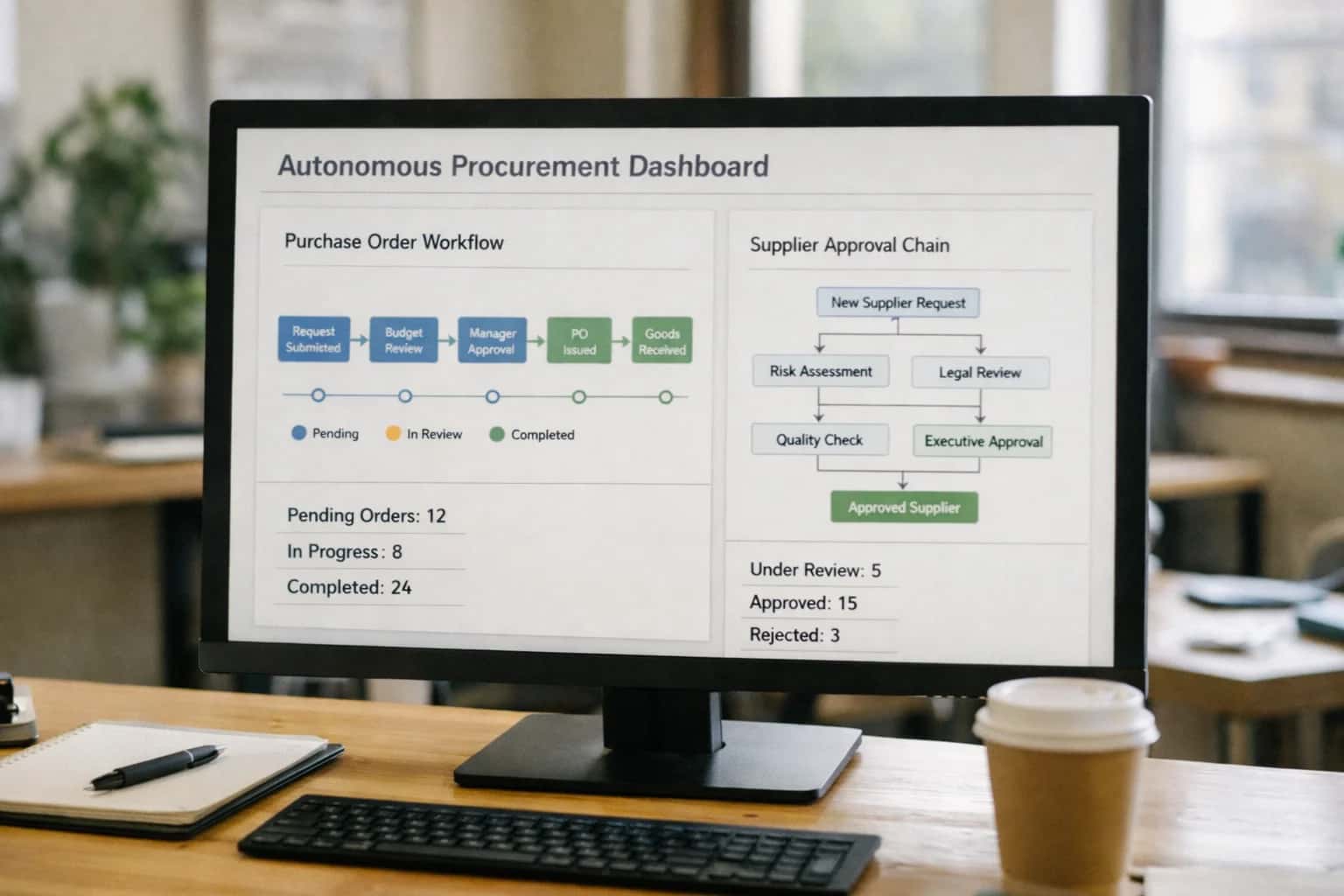
This guide explains how to build autonomous agents that learn from their own actions and environmental feedback during execution, eliminating the need for offline retraining cycles.
You will build a system with three key components: a safe exploration policy to balance trying new actions with reliable performance, a mechanism for reward shaping from environmental signals, and a continuous learning loop that updates the agent's neural network. Practical steps include setting up a simulation environment, integrating a framework like Ray RLlib for distributed training, and designing monitoring for agent drift to ensure learning remains stable and aligned with objectives, as detailed in our guide on MLOps for agentic systems.
CORE ALGORITHMS
On-the-Fly Learning Algorithm Comparison
A comparison of foundational algorithms for enabling autonomous agents to learn from environmental feedback during execution without full retraining.
| Algorithm / Feature | Online Reinforcement Learning | Experience Replay with Prioritization | Contextual Bandits | Meta-Learning (MAML) |
|---|---|---|---|---|
Learning Mechanism | Policy gradient updates from immediate rewards | Stores & replays past transitions for stable training | Selects actions to balance exploration vs. exploitation | Learns an initialization for rapid fine-tuning |
Update Speed | < 1 sec per step | ~10-50 ms per batch | < 100 ms per decision | Minutes for adaptation, seconds per task |
Memory Overhead | Low (policy parameters only) | High (replay buffer storage) | Very Low (context-action weights) | Medium (meta-model + task-specific params) |
Safe Exploration | ||||
Handles Non-Stationary Data | ||||
Sample Efficiency | Low (requires many interactions) | High (reuses experiences) | Very High (optimizes for regret) | Extreme (few-shot capable) |
Best For | Video game agents, robotic control | Autonomous process automation | Dynamic recommendation systems | Agents facing rapidly novel tasks |
Integration Complexity | Medium | High | Low | Very High |
ON-THE-FLY LEARNING
Real-World Use Cases
On-the-fly learning enables autonomous agents to adapt and improve from live experience. These use cases demonstrate the practical implementation and business impact of this capability.
02
Video Game NPCs with Adaptive Behavior
Create non-player characters (NPCs) that learn player tactics in real-time, providing a dynamic and challenging experience. Instead of scripted behavior trees, NPCs use a deep Q-network (DQN) trained on-the-fly with a prioritized experience replay. The agent observes player state-action pairs, predicts strategic patterns, and counter-adapts within the same gaming session. Implementation steps:
- Embed a compact neural network within the game engine for low-latency inference.
- Use reward shaping to balance difficulty (avoiding trivial or impossible opponents).
- Employ federated learning techniques to aggregate learned behaviors across player populations without compromising individual privacy.
05
Real-Time Strategy & Trading Agent
Develop financial trading agents that adapt their strategy to volatile market regimes without offline retraining. The agent continuously ingests market feeds and uses online gradient descent to adjust the parameters of its predictive model. A concept drift detector signals when underlying market dynamics change, triggering a more aggressive exploration phase. Core safeguards include:
- A simulation sandbox where new policies are stress-tested against historical crises before live deployment.
- Explainability layers to trace which signals drove a specific trade decision for auditability.
- Hard risk limits enforced by a separate symbolic rule-checking system, a technique from Neuro-Symbolic AI.
Enabling Efficiency, Speed & Accuracy
Intelligent Analysis, Decision & Execution
We build AI systems for teams that need search across company data, workflow automation across tools, or AI features inside products and internal software.
Talk to Us
Search across company data
Give teams answers from docs, tickets, runbooks, and product data with sources and permissions.
Useful when people spend too long searching or get different answers from different systems.
Enterprise searchRAGPermissions
Read more
Automate internal workflows
Use AI to route work, draft outputs, trigger actions, and keep approvals and logs in place.
Useful when repetitive work moves across multiple tools and teams.
AI agentsWorkflow automationGovernance
Read more
Add AI to products and internal tools
Build assistants, guided actions, or decision support into the software your team or customers already use.
Useful when AI needs to be part of the product, not a separate tool.
AI integrationDecision supportModel routing
Read moreON-THE-FLY LEARNING
Common Mistakes
Implementing on-the-fly learning for autonomous agents is a frontier technical challenge. These are the most frequent architectural and operational pitfalls developers encounter when building systems that learn from live environmental feedback.
This is catastrophic forgetting, where learning new information overwrites previously acquired knowledge. It occurs because standard neural networks have plastic weights that are overwritten during online updates.
Solution: Implement experience replay and stability-plasticity techniques.
- Experience Replay Buffer: Store past state-action-reward tuples in a buffer and periodically sample from it during training to remind the agent of old tasks.
- Elastic Weight Consolidation (EWC): Add a regularization term to the loss function that penalizes changes to weights deemed important for previous tasks. Calculate importance using the Fisher information matrix.
python# Pseudo-code for EWC loss component ewc_loss = 0 for param in model.parameters(): ewc_loss += (fisher_importance * (param - old_param).pow(2)).sum() total_loss = task_loss + ewc_lambda * ewc_loss
Without these mechanisms, your agent will fail at lifelong learning. For a deeper dive on managing model lifecycles, see our guide on MLOps for agentic systems.

About the author
Prasad Kumkar
CEO & MD, Inference Systems
Prasad Kumkar is the CEO & MD of Inference Systems and writes about AI systems architecture, LLM infrastructure, model serving, evaluation, and production deployment. Over 5+ years, he has worked across computer vision models, L5 autonomous vehicle systems, and LLM research, with a focus on taking complex AI ideas into real-world engineering systems.
His work and writing cover AI systems, large language models, AI agents, multimodal systems, autonomous systems, inference optimization, RAG, evaluation, and production AI engineering.
LinkedIn
Limited slotsGet a Free AI Consultation
Partnered with leading AI, data, and software stack.





How We Work
Custom AI workflows for your Business
One-fit-all AI don't work for modern businesses. At Inferensys, we aim to understand your business & custom requirements; which we use to define most efficient agentic workflows, the data, and the tools for your business.
01
Review the use case
We understand the task, the users, and where AI can actually help.
Read more02
Pick the right approach
We define what needs search, automation, or product integration.
Read more03
Build the first useful version
We implement the part that proves the value first.
Read more04
Improve from there
We add the checks and visibility needed to keep it useful.
Read moreThe first call is a practical review of your use case and the right next step.
Talk to Us